
Radio Control: OLD-TIMER
Dee B. Mathews
The History of RC
We have arbitrarily divided the development of RC into four eras. Although many true experts might take exception, for purposes of personal perspective and convenience the four are:
- Ham
- Examination‑Free
- Multi‑Control
- Modern (Proportional)
The Ham Era
The Ham era began with the very earliest pioneering development work of experimenters such as Clinton DeSoto, Leo Weiss, Chet Lanza, the Good brothers, Charles Siegfried, Jim Walker, and several others. In almost every instance these were primarily modelers with strong educational and practical experience in electronics and ham radio — radio enthusiasts who were also model airplane builders.
In an earlier column we pointed out the "tinkerer’s delight" nature of the available equipment. Foxworthy, for example, was for many years a consultant with major electronics manufacturers in the U.S. The Good brothers ended up with PhDs in physics. Jim Walker can be described as the Thomas Edison of model flying, and most of the other pioneers earned their livings in electronics.
This was a time of primary emphasis on developing workable radio control equipment. A secondary interest in model airplanes led to the application of this control to flying models. The models, for the most part, were converted Free Flight designs — a concession to the unreliable nature of the RC equipment. The hope was that the model’s inherent stability would prevent serious crashes in the event of radio system failure.
We owe much to those pioneering efforts: the endless hours of experimenting and testing led to the development of RC as we know it today.
The Examination‑Free Era
The Examination‑Free era opened RC to vastly larger segments of the hobby. By 1950 reliable, commercially available equipment was on the market. A ham license was still required, however, and obtaining one was not a simple matter of sending in a check: a test had to be passed covering electronic theory, law, and — most exasperating of all — the ability to receive and transmit in Morse code.
One of our flying buddies was interested enough in radio to take a correspondence course from the LaSalle Institute in preparation for the licensing exam. We were not.
Primitive but workable equipment was available from Beacon (we could see the design), RCH, Aerotrol, and Bell Labs. All were on the 53–54 MHz bands. The equipment was bulky, heavy, tricky, and expensive, but RC was no longer limited to those who could design and build their own gear.
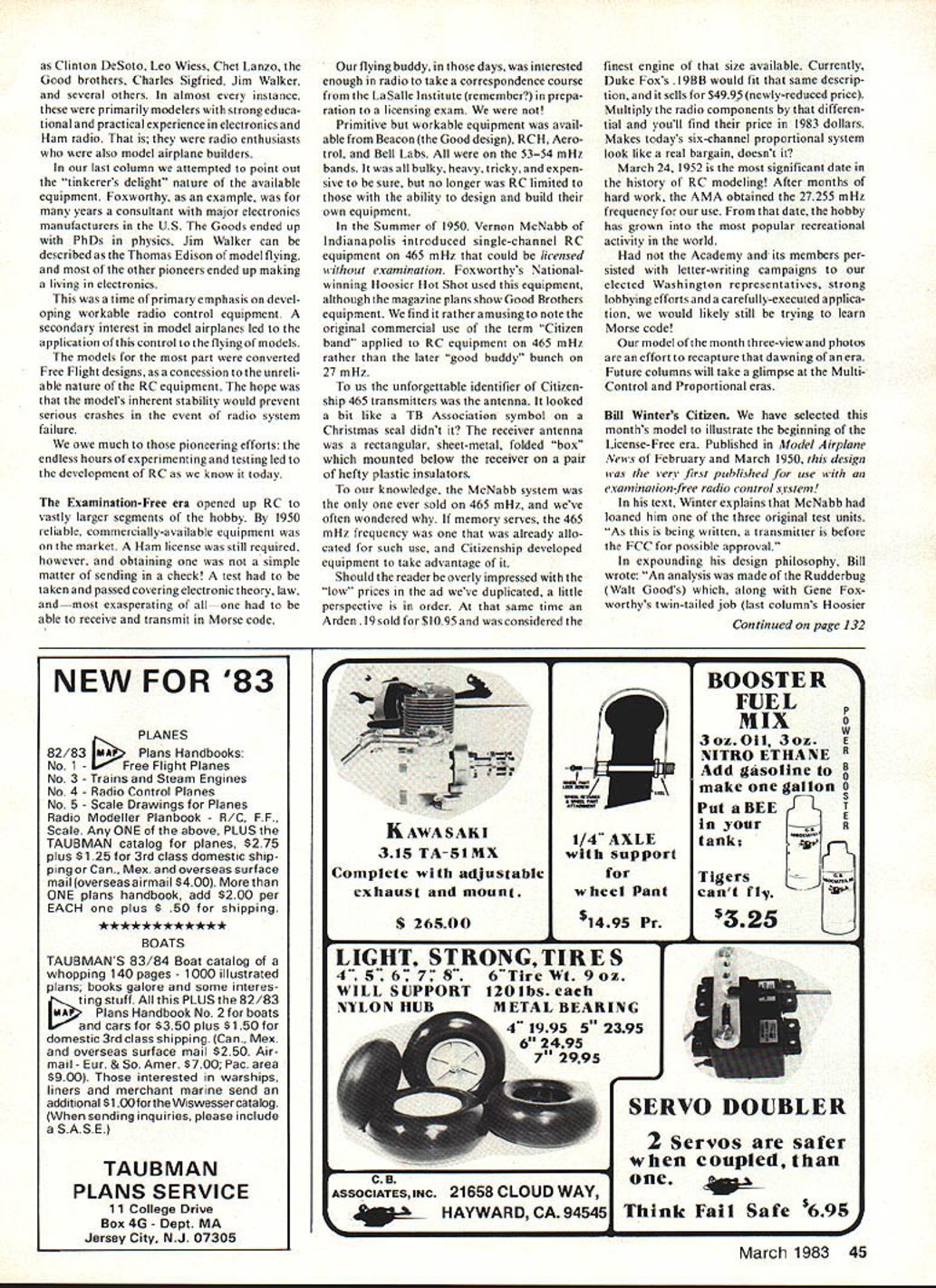
In the summer of 1950 Vernon McNabb of Indianapolis introduced single‑channel RC equipment on 465 MHz that could be licensed without examination. Foxworthy’s National‑winning Hoosier Hot Shot used this equipment, although the magazine plans show Good brothers’ equipment. It is amusing to note the original commercial use of the term "Citizen band" applied to RC equipment on 465 MHz rather than the later "good buddy" bunch on 27 MHz.
The unforgettable identifier of Citizen 465 transmitters was the antenna — it looked a bit like a TB Association symbol on a Christmas seal. The receiver antenna was a rectangular, sheet‑metal, folded "box" that mounted below the receiver on a pair of hefty plastic insulators.
To our knowledge the McNabb system was the only one ever sold on 465 MHz, and we’ve often wondered why. The 465 MHz frequency was apparently already allocated for such use, and Citizenship developed equipment to take advantage of it.
If the reader is overly impressed with the "low" prices in the ad we’ve duplicated, a little perspective is in order. At that same time an Arden .19 sold for $10.95 and was considered the finest engine of that size available. Currently, Duke Fox’s .19 BB would fit that same description and sells for $49.95 (newly reduced price). Multiply the radio components by that differential and you’ll find their price in 1983 dollars. Makes today’s six‑channel proportional system look like a real bargain, doesn’t it?
March 24, 1952 is the most significant date in the history of RC modeling. After months of hard work, the AMA obtained the 27.255 MHz frequency for our use. From that date the hobby has grown into the most popular recreational activity in the world.
Had the Academy and its members not persisted with letter‑writing campaigns to our elected Washington representatives, strong lobbying efforts, and a carefully executed application, we would likely still be trying to learn Morse code.
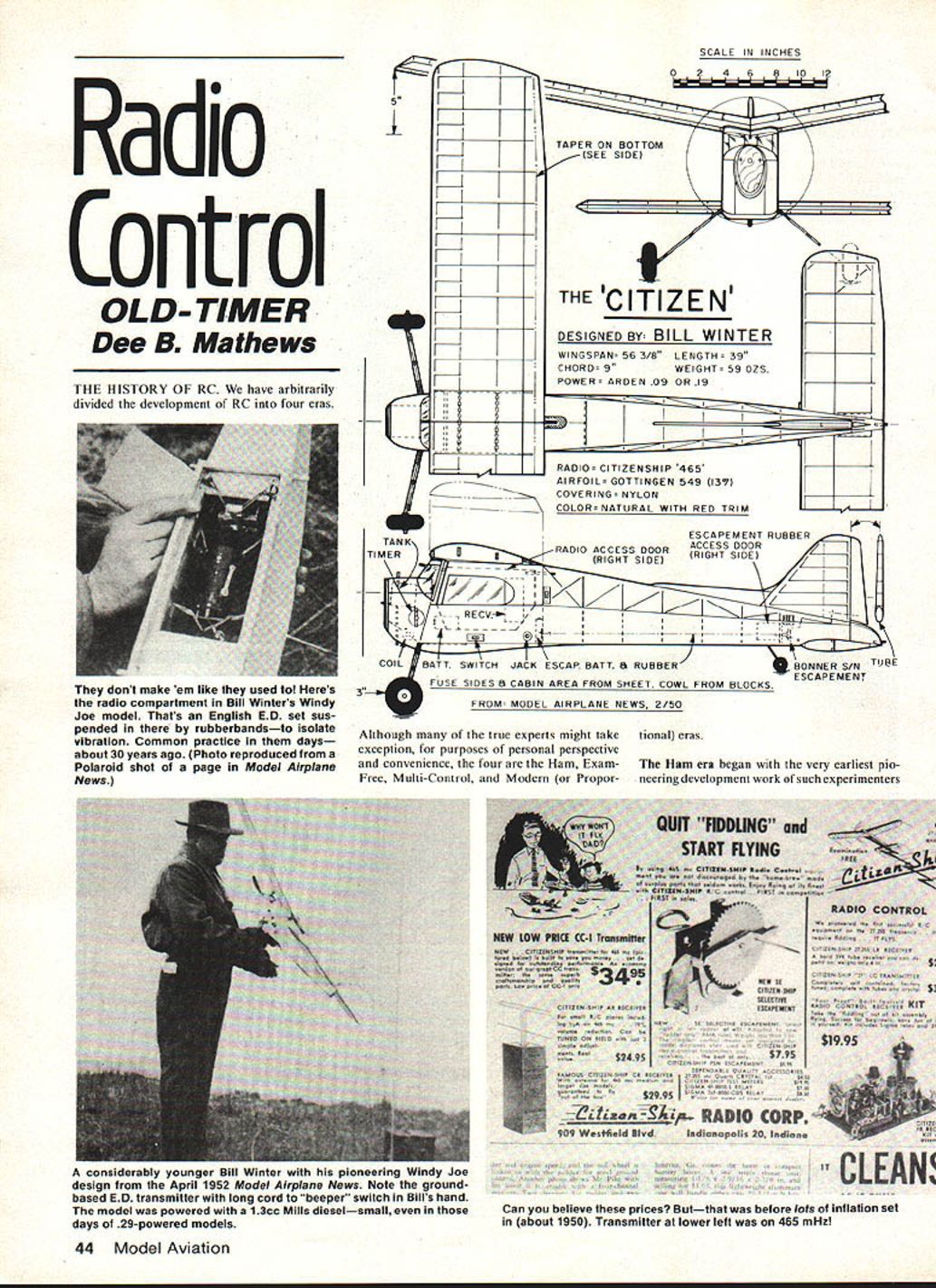
Our model‑of‑the‑month three‑view and photos are an effort to recapture that dawning of an era. Future columns will take a glimpse at the Multi‑Control and Proportional eras.
Bill Winter’s Citizen
We have selected this month’s model to illustrate the beginning of the License‑Free era. Published in Model Airplane News in February and March 1950, Bill Winter’s design was the very first published for use with an examination‑free radio control system.
Winter explains that McNabb had loaned him one of the three original test units. "As this is being written, a transmitter is before the FCC for possible approval."
In expounding his design philosophy, Bill wrote: "An analysis was made of the Rudder Bug (Walt Good’s), which, along with Gene Foxworthy’s twin‑tailed job (last column’s Hoosier Hot Shot), is the best all‑around RC ship in the country today. The 'Bug' has a wing loading of 12.3 ounces per sq. ft. At the Nationals, we observed Rich Gelvin's job spinning in a thermal in a nearly unsuccessful attempt to get it back to mother earth."
Throughout the article Winter detailed his practical experience and the pertinent data obtained from his observations. In typical Bill Winter fashion, the pragmatic approach to complex hypothetical mysteries provided a superb reference for those just entering the field. Nothing fancy or overly complicated by mathematical formulae — just good old "cookbook" information presented in Bill's classic style. As we recall, this article became something of a "Bible" on the subject.
Not only did the Citizen first introduce the license‑free Citizenship equipment, it was also a landmark for its smaller size and weight. While most RC designs of the time were the size of the Hoosier Hot Shot (or larger), the Citizen spanned only 56 inches and was powered with a .19 cu. in. ignition Arden. The magazine caption read: "You Won't Need a Truck to Transport This Compact Radio Control Plane!"
A look at this month's three‑view reveals strong Rudder Bug influence, which Winter readily admitted. Features such as the permanently attached fin and the tip washout in the wing and stabilizer are well explained in the text. They obviously influenced many other modelers. As a matter of fact, this writer can see a very excellent trainer for today's use in Bill's 33‑year‑old design.
Although we chose to build Winter's Windy Joe from Model Airplane News (April 1952) after saving enough dollars to buy an E.D. radio, in retrospect the Citizen would likely have been a better choice.
To illustrate the influence Bill Winter had, not just on me but on all model builders: I chose the English E.D. radio because he used it in Windy Joe. Thirty years later, while chatting with Bill on the phone, he said, "That E.D. stuff wasn't much." I wasn't very disillusioned — I had already figured that out. Couldn't keep the fool thing in tune two flights in a row.
I once took the young lady (who eventually went with me) aloft on my Windy Joe. Powered with an O.K. .14 (it wasn't much, either), the darn thing took off from a hand launch and proceeded to fly at low altitude — with no height gain — until it ran smack into a stone post. It hit directly on the crankshaft. Doesn't that say it all about the degree of available control? The lady still teases me about the first time she went with me to fly.
Tribute
Although we didn't really start all this as a tribute to Bill Winter, it seems to have worked out that way. The greatest thrill this writer will ever have in modeling was having Bill's help and guidance when beginning to write and design for publication. Frankly, it was similar to a youngster developing a personal relationship with a boyhood hero.
From all of us who have read your articles for nearly 50 years, built your designs, and respected the magazines you have edited: thanks for all the enjoyment, Bill!
Dee B. Mathews 506 South Walnut Greensburg, KS 67054
Transcribed from original scans by AI. Minor OCR errors may remain.

