
Radio Control: Old-Timer
Dee B. Mathews
THIS MONTH, we are returning to our traditional format in order to catch up on a number of items more germane to SAM-type Old-Timer activities. Next time around, we have a bunch of interesting things from the Reed Era of RC.
Long before Thimble Drome. It seems ironic, somehow, that the most popular Old-Timer designs of the pre-War era are seldom seen at Old-Timer contests today. Take the Dallaire as an example: I am unable to locate a single advertisement for the kit in my rather extensive magazine collection, yet it is extremely common today. The reason is, of course, obvious—competition success.
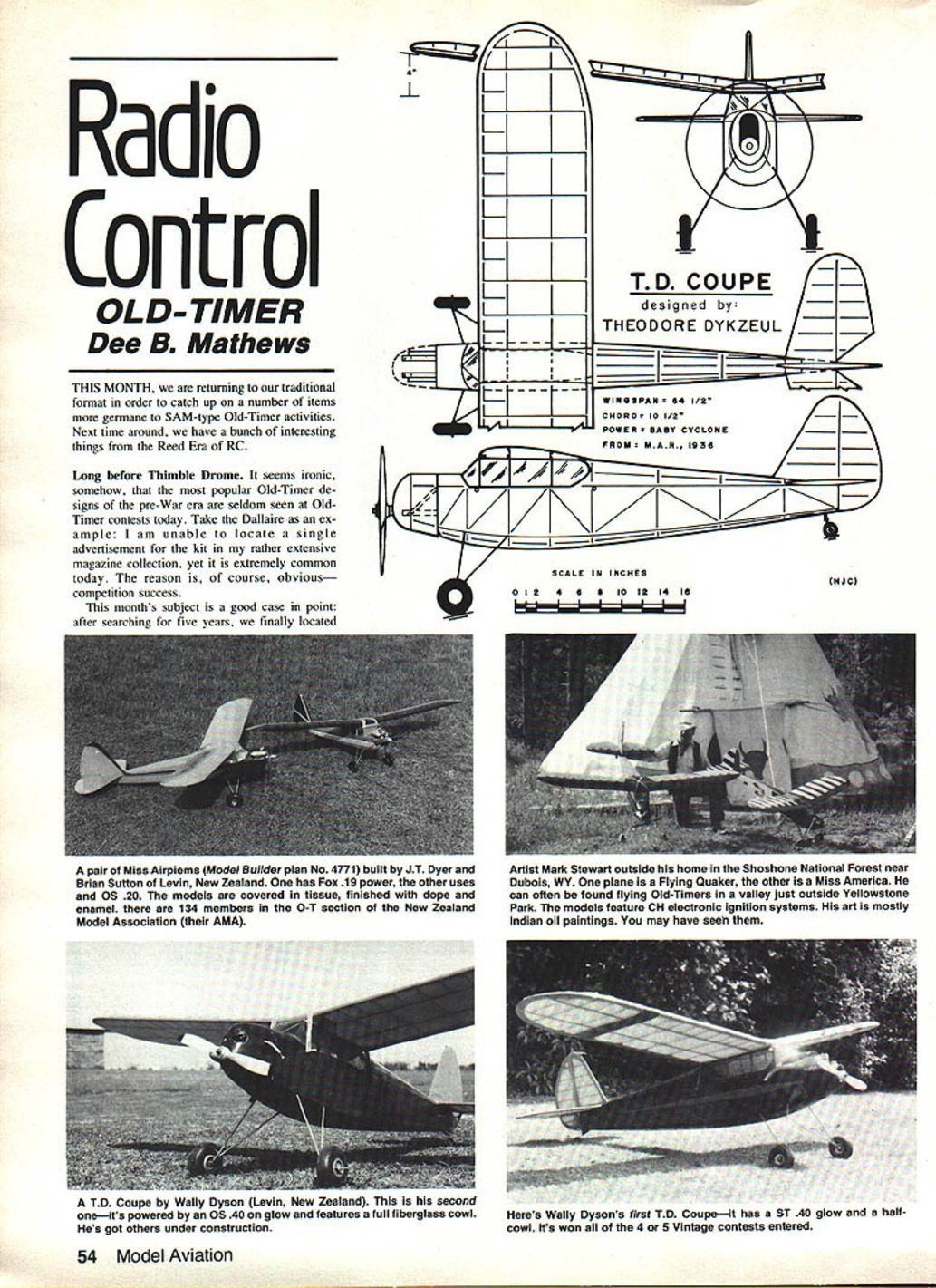
This month's subject is a good case in point: after searching for five years, we finally located some photos of a T. D. Coupe in New Zealand. Examining the photos and the drawings causes one to wonder why such a lovely design should be so rarely seen. We hope that this little feature will introduce the T. D. Coupe to some potential builders who will order plan No. 3D7 from John Pond Plans (P.O. Box 3215, San Jose, CA 95156) and build one.
Designed by Theodore Dykzeul (initials T. D.—get it?) and published in MAN in October 1936, the model was designed around the ubiquitous Baby Cyclone. Quoting from the article: "As for performance, this model flies at a fair rate of speed, climbs at about a 30° angle, and has a glide of about 15 to 1. It is also built easily enough so that an experienced builder of rubber-powered models will have no trouble with the construction. Since airwheels and silk were used, the cost was about $7.00. Using wood wheels and bamboo paper, the price can be cut in half."
"The model has now made 82 flights with absolutely no repairs, outside of a few broken props and patches on the silk. It is practically crash-proof, having hit an office at the airport, a windbreak of trees, a concrete watering trough, and a barbed-wire fence. The pictures of the completed model were taken after the 48th flight."
Construction is totally conventional and well-conceived, with the exception of what we perceive to be a rather weak cabin framework. Some simple re-engineering, carrying the forces down onto the fuselage, would be advisable. The hinge lines for rudder and elevator are nearly ideal as originally designed.
Although the wing area would allow use of a .25 cu. in. power plant under SAM rules, a Fox .19BB would be nearly ideal, we think. The cowl would be developed easily using the lost-foam technique shown in the February 1982 issue of Model Aviation. With such a simple method to develop a cowl, flying a T. D. Coupe without one would be sinful.
While the design would likely have great difficulty competing with the run-of-the-mill Playboys, ad nauseam, it nonetheless would certainly be a delight to build and fly in a sport role. So do it and send us a picture!
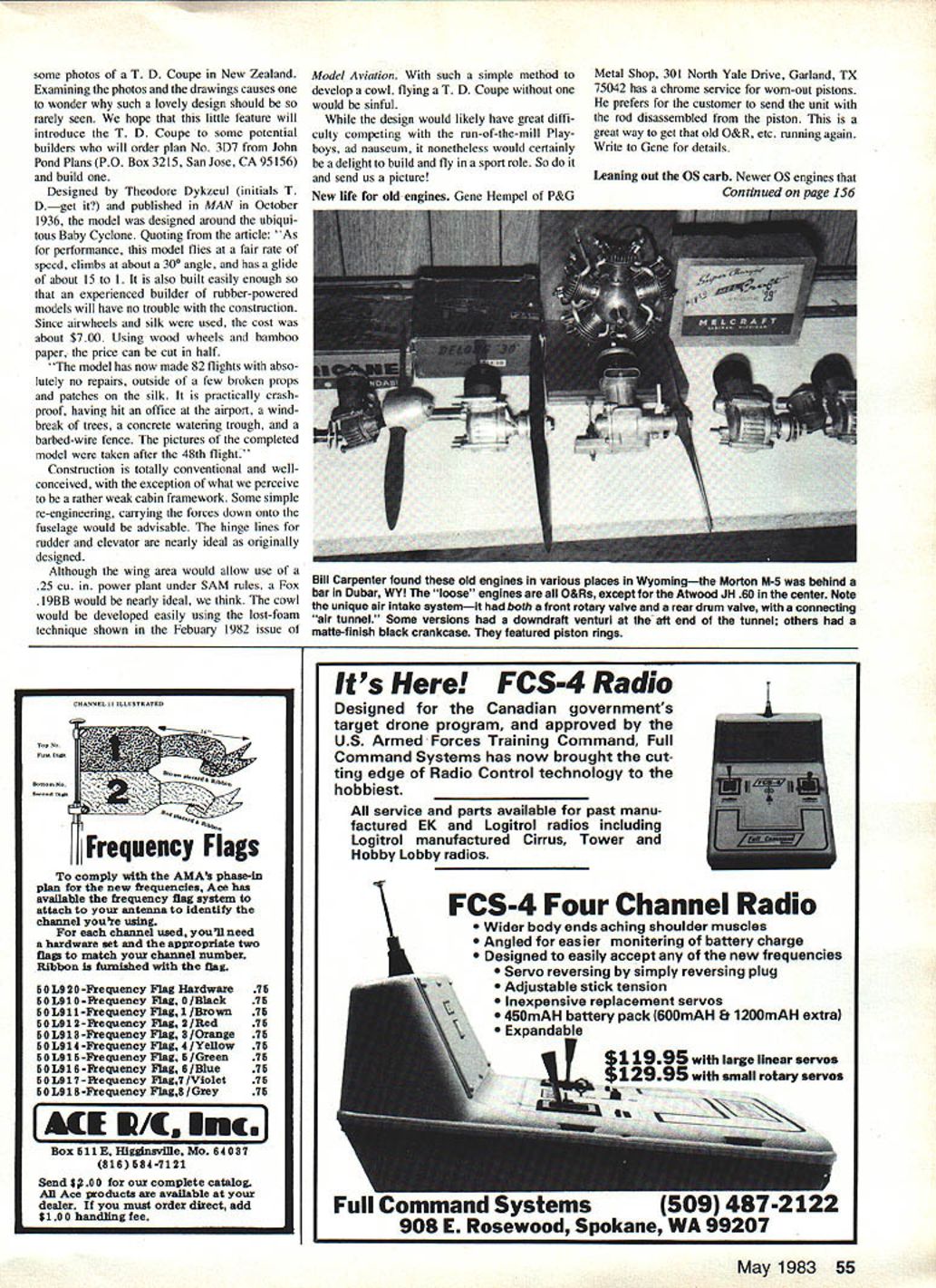
New life for old engines
Gene Hempel of P&G Metal Shop, 301 North Yale Drive, Garland, TX 75042, has a chrome service for worn-out pistons. He prefers the customer to send the unit with the rod disassembled from the piston. This is a great way to get that old O&R, etc., running again. Write to Gene for details.
The offset-cam carb can be modified to lean out the low-throttle setting by using a technique developed by Bill Carpenter of C. H. Electronics. He cuts a small screwdriver slot in the outside end of the low-speed needle with a razor saw. The cam lever's square hole is filed to a round shape with a needle file, then the low speed is adjusted before tightening the cam permanently.
This modification is very helpful when using gas and oil in a spark unit or when running on OS with a Davis Diesel conversion. The markedly reduced volume of fuel needed requires much leaner settings.
Overheating on ignition?
Tightly-cowled installations running on the CH Electronics ignition system can, on occasion, overheat. Doran Hiatt cures this by adding an additional head gasket. We have encountered heating only once, on a 100°F day with too much ground running on an inverted and tightly-cowled engine; however, it's good to know a cure.
The Hot Stuff revolution
Bob and Bill Hunter (both past Nationals Champions) began selling cyanoacrylate glue by mail to the Free Flight fraternity in 1970. At contests, they frequently "wowed" all of us by using the material to repair models for any and all who had damaged theirs. At that time, our personal reaction was the material was only useful in a repair emergency role. We couldn't accept the idea that models could be constructed with it. How wrong we were!
The ensuing 13 years have seen the Hunters (and others) develop techniques that have virtually revolutionized model building. Construction time has been reduced to a fraction of what it once was, and the use of cyanoacrylates has become the norm, rather than the exception.
In our humble opinion, these adhesives are now as fundamental to model construction as razor blades, pins, and waxed paper. In that way CyAs must rank as the biggest improvement in modeling since the introduction of balsa wood.
A picture is worth a thousand words (or more). The Hot Stuff "Video-Tips" tape represents another major breakthrough in our hobby. Not only does this one-hour program provide excellent information on techniques and procedures, it may well be the forerunner of a revolution in disseminating "how-to" knowledge to the hobbyist.
In full-sized aviation, Cessna and other manufacturers use videotapes to conduct ground school training for prospective pilots. The Hot Stuff tape clearly shows the way for use of videotapes to instruct not only new RC pilots, but also to develop building, trimming, installation, flying and other skills. Don't be surprised if, someday, a new RC trainer kit will include a rental coupon for an instructional tape from the manufacturer!
If you've not had an opportunity to view the Hot Stuff "Video-Tips" at a club meeting, or if a bunch of you want to get together to view it, contact Satellite City, P.O. Box 836, Simi, CA 93062 for details. It's one of the most instructive hours you can spend.
Old-Timers and ailerons
Every once in a while, someone will write asking about installing ailerons on their Old-Timer, or to detail the misery they've had when they did. Frankly, the only reason we can imagine for such a modification would be to improve crosswind landing and take-off handling. Surely, no one would want to use an Old-Timer for aerobatics!
In nearly every instance we are aware of, adding ailerons to the highly-dihedral Old-Timer produces severe adverse yaw. While this is not the place to get into a detailed dissertation on adverse yaw, it is a phenomenon in which the model tends to slide outward from the aileron-induced turn. That is, one would swear the rudder servo was glitching to the opposite setting. Adverse yaw can become so severe that the model will actually snap roll in the wrong direction!
The only real cure is to reduce the dihedral a bunch. As an example, we know of a Tabi Powerhouse with dihedral reduced to 1½ in. per tip, and it still tends to yaw. Naturally, this modification also reduces the inherent stability of the model and also produces a rather odd-looking Powerhouse. In our opinion, the whole idea is an exercise in frustration and isn't worth all the bother. Old-Timer RC conversions take off so quickly they can easily be launched and landed on the runway's width. (Using that approach, one ends up with the classic student pilot joke about the runway being awfully short but terrifically wide!)
How it was done
For many years, we've wondered how on earth those rather primitive early models could possibly thermal for hours and still be recovered. Haven't you?
Leafing through a recently-acquired MAN from October 1934, we ran across the following in "Air Ways":
"One of the most important events which took place recently was the remarkable flight made by the Brown-powered Bassett model, Miss Philadelphia, at Camden, N. J., May 28, 1934. It was followed from Camden and landed at Middletown, Del., two hours, 35 minutes later.
"It was followed by a large airplane ... it rose to a height of 8,000 feet. When the motor ceased, the machine reached the ground after a twenty-nine minute glide. Mr. Fritz, who followed the model in the full-sized airplane, remarked that it was the most remarkable descent, it was all they could do to make their own ship dive fast enough to keep it in sight."
Aha! Just as I suspected: to drop from 8,000 feet to touchdown in 20 minutes, the darn thing must have glided like a stone! So how the heck did Bassett get 2 1/2 hours? Read on.
"With superior gliding qualities, the little machine might have stayed up forever, a 13-ounce load of fuel was carried by the model."
Maxwell used the same model to win Texaco that summer, but Joe Kovel's KG was felt to be the superior model. Unfortunately, "... on its first test flight while it was gliding beautifully into a landing, the timers who were following it in an automobile inadvertently ('I'd certainly hope so') ran into it while it was still in the air."
Those were the good old days?
Kits and kits
The Hot Stuff videotape uses a SkyMaster Industries Lazy Ace kit as the subject. In the tape, Bill Hunter comments on the superb quality of the pre-cut parts. Anyone who has built one of P&W's superb Old-Timer kits should understand why. Gene Walloch (P&W) cuts the SkyMaster kits. (See the Hobby Horn ad in this issue for a list of P&W Old-Timer kits. We recommend them highly.)
Also, Campbell's Custom Kits, P.O. Box 5996, Lake Worth, FL 33461, has just announced they will resume production of the Quaker 84, Quaker 54, and Dallaire kits formerly kitted by M&P. While we have not seen these as yet, if they are of quality equal to Campbell's Spacer and P-30 kits, they will be further welcome additions to the Old-Timer kit list.
Oh, well!
Back in 1976, we paraphrased an old saying about fishing into: "God does not deduct the time spent building and flying model aircraft from a man's life span." Since then, we have sent nearly 500 9 x 4-in. cards around the world. Many of you readers have them, I'm sure.
Can you imagine our surprise upon recently seeing an exact duplicate, down to the border design and type style, but with our name removed and the emblem of an RC club substituted? We didn't plan to sell the things or try to make a buck off the idea, but really guys, that's plagiarism!
Thanks, Frank!
Frank Zaic has recently released Model Airplanes and the American Boy, a compendium of articles and construction features from the pages of the monthly American Boy magazine, circa 1927–1934. It is absolute must reading for anyone interested in model airplanes. From the cover illustrated with a line drawing of a young man launching a twin pusher through 158 pages of marvelous reading, the book documents what many consider the golden age of modeling.
Just to tease the prospective purchaser a little... by 1930, the membership of the AMLA (Airplane Model League of America) had over 400,000 members! Truly, America's youth were wild over model airplanes in the post-Lindbergh era!
The National Champions of 1929 were sent to Europe for the Wakefield Cup! The static scale winner was a young man from Vancouver, WA named Lou Proctor! Such interesting articles and photos abound throughout this book. You have just got to get one, read it cover-to-cover, then maybe donate it to a local library. (Frank's address is: Model Aeronautic Publications, Box 135, Northridge, CA 91328.)
Good news!
Nitrate dope was the standard finishing material for Old-Timers and was also used well into the late Forties. The introduction of "hot fuels" forced us to change to HEP, STA, Aero-Gloss, and fuel-proof paints until the butyrate dopes were introduced. Butyrate dope is not without problems, but unless gas and oil were used, we had little choice. In our opinion, nitrate dope is still the preferred material, were it not for the fuel-proof and flammability problems.
Those of us who have been scrounging around for nitrate dope ever since are delighted to learn that Sig Mfg. Co. is now shipping clear nitrate to the hobby shops.
The primary advantage of nitrate dope is its compatibility with Superpoxy, Hobbypoxy, Poly-U, and Perfect paints, as well as with auto enamels. All adhere to an underlayment of nitrate dope base with none of the "stuffing" associated with butyrate dope.
A less obnoxious odor, faster setting, minimal delayed warping, and better weave-filling are added pluses for nitrate. This product is a welcome addition to the modeler's armory of finishing products.
Dee B. Mathews, 506 South Walnut, Greensburg, KS 67054.
Transcribed from original scans by AI. Minor OCR errors may remain.

