
Radio Control GIANT SCALE
Bob Beckman
Building philosophy: three basic categories
When is a plan a PLAN? Over the past three years, I have looked at—and reported on—a lot of Giant Scale plans. In the process, I find that I have reached some conclusions about plans in general, and that those conclusions are finding their way into my reviews. In fairness to both plan users and actual or potential plan producers, I think it's time I tried to pass on those conclusions.
First, I've got to talk a little about my philosophy of building. In my own mind, I identify three basic categories of building:
- Kit-building
- Plan-building
- Scratch-building
Most modelers seem to recognize only two categories, and use the term "scratch-built" to mean anything not built from a kit. For a lot of reasons, I think that catch-all term should be split in two.
One reason is that the person who designs and documents a model so that others can reproduce it from his plans deserves some credit. We talk about models being built from a Nosen kit, or a Balsa U.S.A. kit, but how often is it volunteered that a model was made from someone's plans? Time and time again, I've had people tell me they scratch-built their model, but when you ask a few more questions, you find they used plans produced by someone else.
Now, before you all start hissing and booing, please understand that I'm not saying there is anything wrong with plan-building. I just think the guy who put all the work into designing the original and drawing the plans should get his share of the credit.
There is another reason to distinguish between plan-building and scratch-building. In RC modeling, as in any well-established construction-type hobby, the participant usually follows a well-defined pattern of skill development. He starts with a kit that contains all (or most) of the materials needed and, in some cases, with some parts preformed and/or pre-assembled. Once basic construction is mastered, he usually goes on to more and better assembly and finishing techniques. Some people never build anything but kits, and they produce beautiful and fine-performing aircraft.
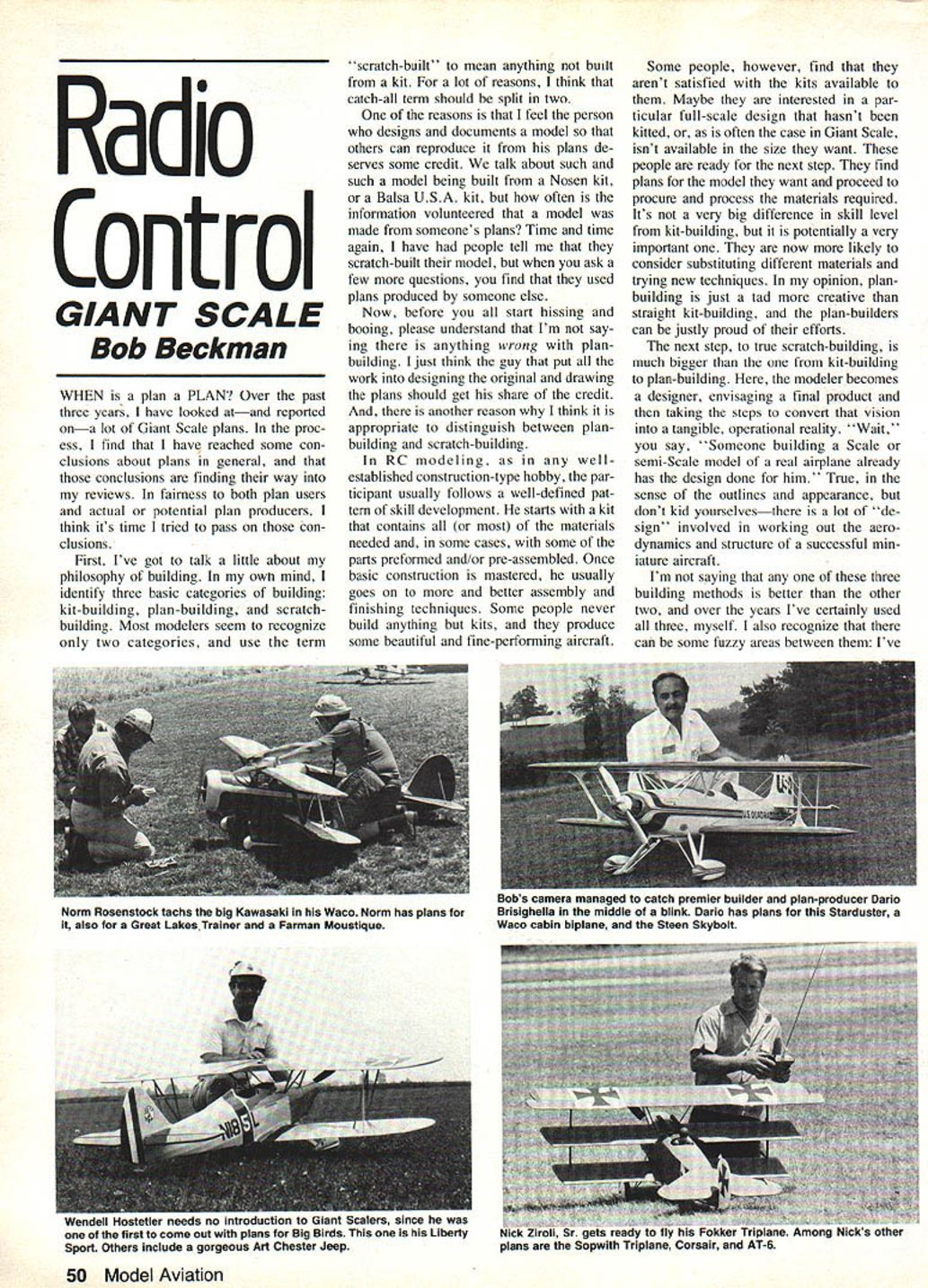
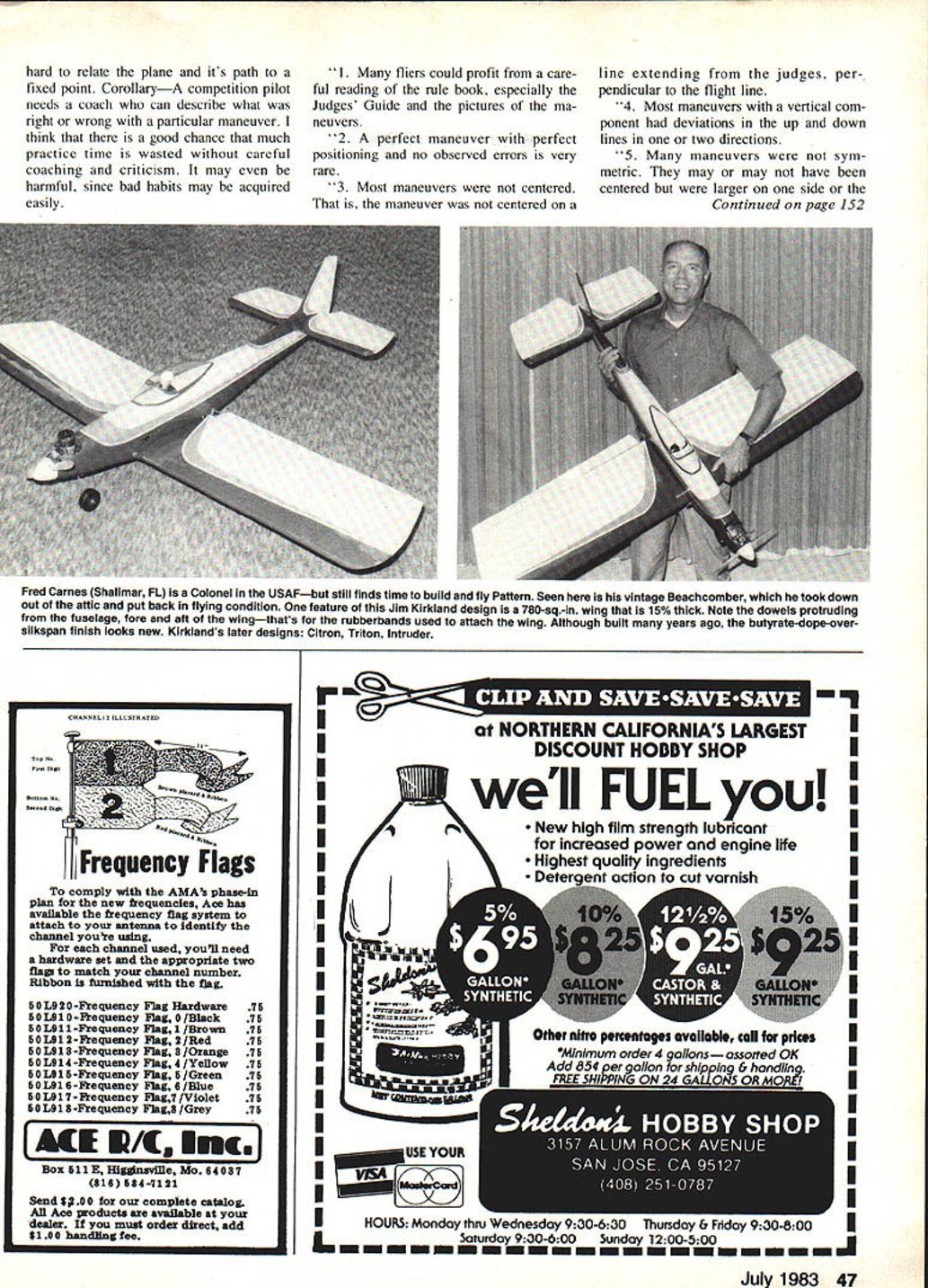
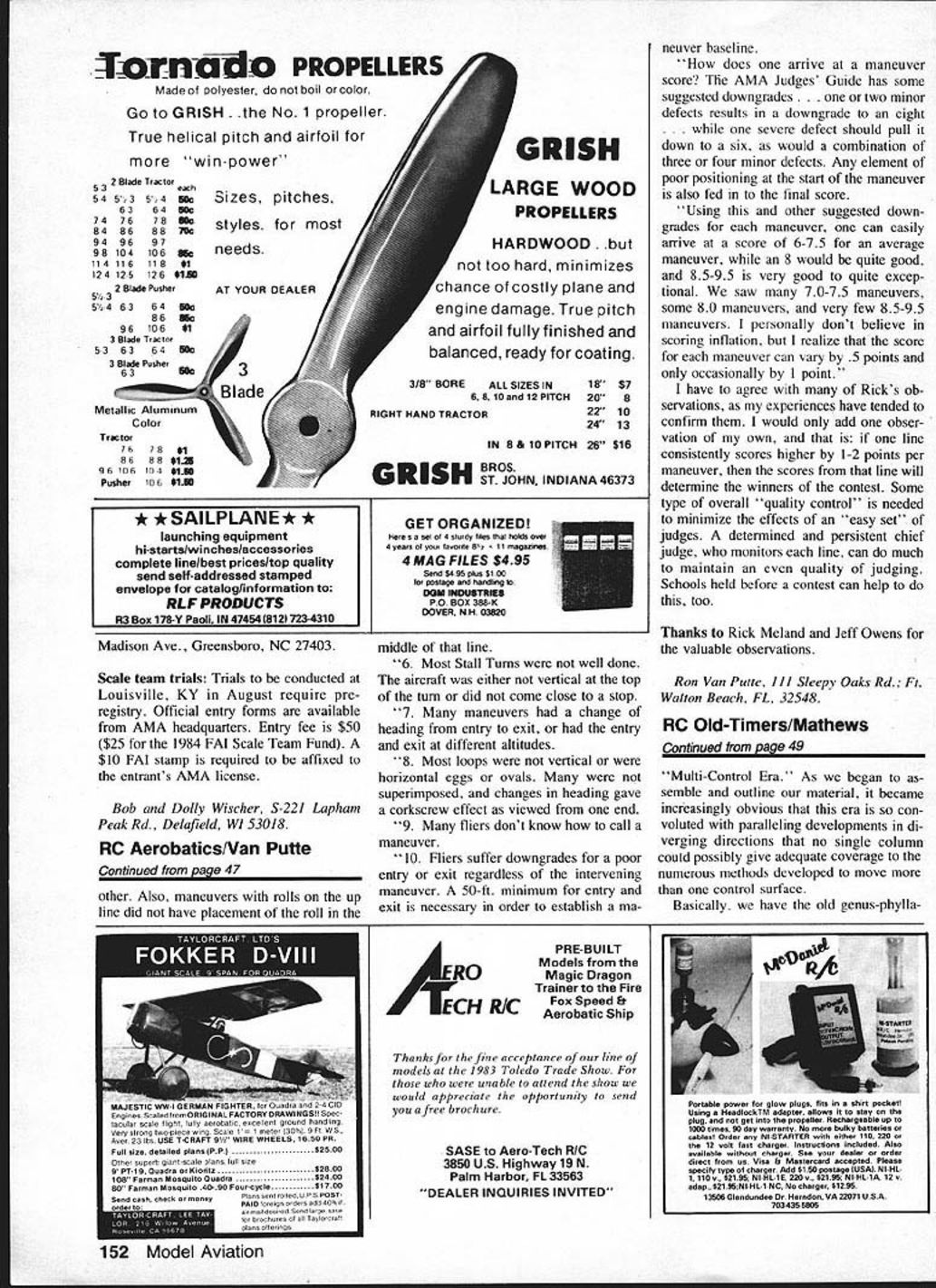
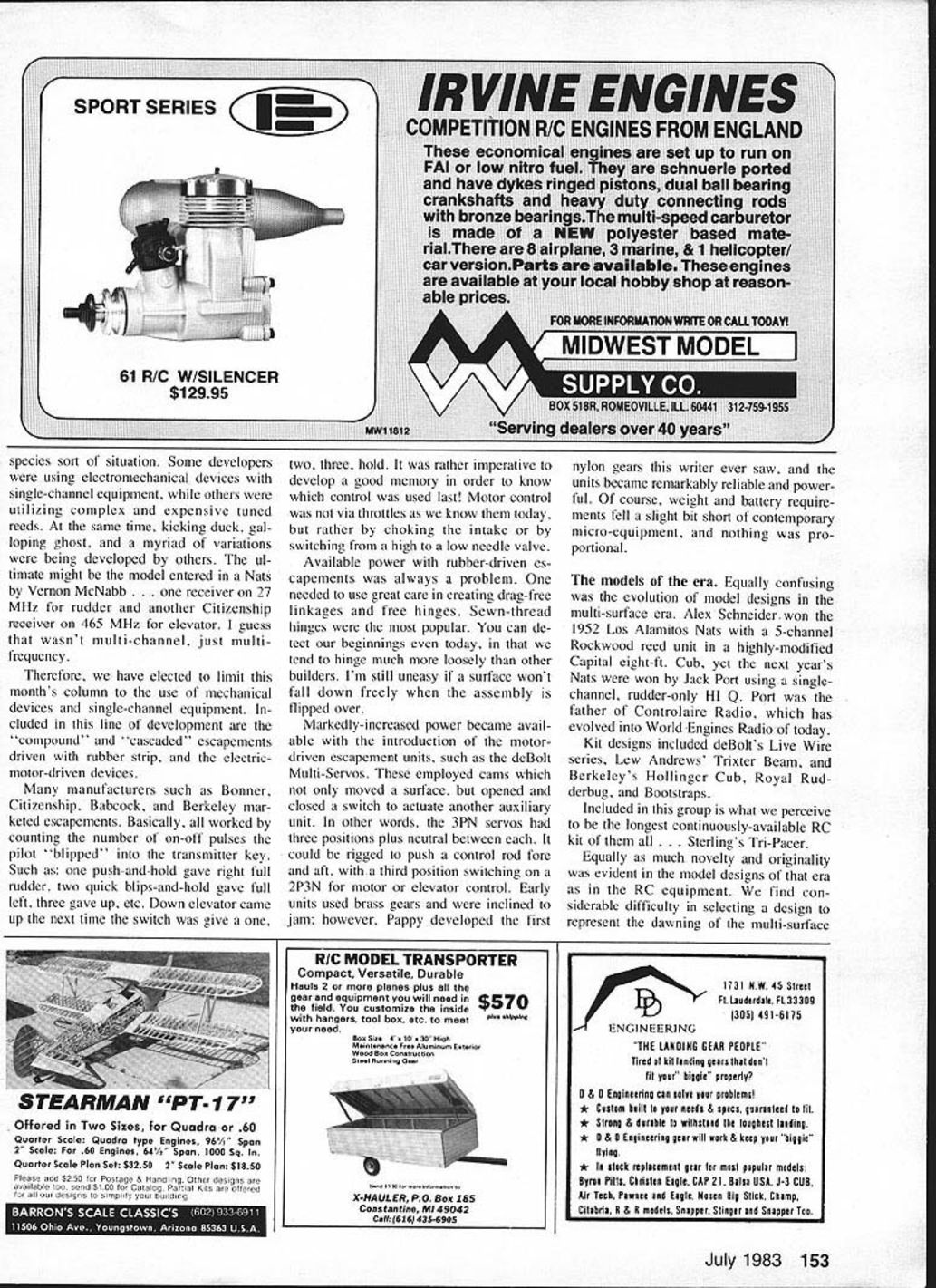
Some people, however, find they aren't satisfied with the kits available to them. Maybe they are interested in a particular full-scale design that hasn't been kitted, or, as is often the case in Giant Scale, isn't available in the size they want. These people are ready for the next step. They find plans for the model they want and proceed to procure and process the materials required. It's not a very big difference in skill level from kit-building, but it is potentially a very important one. They are now more likely to consider substituting different materials and trying new techniques. In my opinion, plan-building is just a tad more creative than straight kit-building, and plan-builders can be justly proud of their efforts.
The next step, true scratch-building, is much bigger than the one from kit-building to plan-building. Here, the modeler becomes a designer, envisaging a final product and then taking the steps to convert that vision into a tangible, operational reality. "Wait," you say. "Someone building a scale or semi-scale model of a real airplane already has the design done for him." True, in the sense of the outlines and appearance, but don't kid yourselves—there is a lot of "design" involved in working out the aerodynamics and structure of a successful miniature aircraft.
I'm not saying that any one of these three building methods is better than the other two, and over the years I've certainly used all three myself. I also recognize that there can be fuzzy areas between them, and overlaps in technique and approach.
---
RC Old-Timers / Mathews
"Multi-Control Era"
As we began to assemble and outline our material, it became increasingly obvious that this era is so convoluted with paralleling developments in diverging directions that no single column could possibly give adequate coverage to the numerous methods developed to move more than one control surface.
Basically, we have the old genus–phyllae–species sort of situation. Some developers were using electromechanical devices with single-channel equipment, while others were utilizing complex and expensive tuned reeds. At the same time, kicking duck, galloping ghost, and a myriad of variations were being developed by others. The ultimate might be the model entered in a Nats by Vernon McNabb — one receiver on 27 MHz for rudder and another Citizenship receiver on 465 MHz for elevator. I guess that wasn't multi-channel, just multi-frequency.
Therefore, we have elected to limit this month's column to the use of mechanical devices and single-channel equipment. Included in this line of development are the "compound" and "cascaded" escapements driven with rubber strip, and the electric-motor-driven devices.
Escapements and motor control
Many manufacturers such as Bonner, Citizenship, Babcock, and Berkeley marketed escapements. Basically, all worked by counting the number of on-off pulses the pilot "blipped" into the transmitter key. One push-and-hold gave right full rudder, two quick blips-and-hold gave full left, three gave up, etc. Down elevator came up the next time the switch was given a one, two, three, hold. It was rather imperative to develop a good memory in order to know which control was used last! Motor control was not via throttles as we know them today, but rather by choking the intake or by switching from a high to a low needle valve.
Available power with rubber-driven escapements was always a problem. One needed to use great care in creating drag-free linkages and free hinges. Sewn-thread hinges were the most popular. You can detect our beginnings even today in that we tend to hinge much more loosely than other builders. I'm still uneasy if a surface won't fall down freely when the assembly is flipped over.
Markedly increased power became available with the introduction of the motor-driven escapement units, such as the deBolt Multi-Servos. These employed cams which not only moved a surface, but opened and closed a switch to actuate another auxiliary unit. In other words, the 3PN servos had three positions plus neutral between each. It could be rigged to push a control rod fore and aft, with a third position switching on a 2P3N for motor or elevator control. Early units used brass gears and were inclined to jam; however, Pappy developed the first nylon gears this writer ever saw, and the units became remarkably reliable and powerful. Of course, weight and battery requirements fell a slight bit short of contemporary micro-equipment, and nothing was proportional.
The models of the era
Equally confusing was the evolution of model designs in the multi-surface era. Alex Schneider won the 1952 Los Alamitos Nats with a 5-channel Rockwood reed unit in a highly modified Capital eight-foot Cub, yet the next year's Nats were won by Jack Port using a single-channel, rudder-only HI Q. Port was the father of Controlaire Radio, which has evolved into World Engines Radio of today.
Kit designs included deBolt's Live Wire series, Lew Andrews' Trixter Beam, and Berkeley's Hollinger Cub, Royal Rudderbug, and Bootstraps. Included in this group is what we perceive to be the longest continuously available RC kit of them all — Stirling's Tri-Pacer.
Equally as much novelty and originality was evident in the model designs of that era as in the RC equipment. We find considerable difficulty in selecting a design to represent the dawning of the multi-surface era. There were many lovely and interesting designs kitted and/or published. After many days of consideration, we have selected Phil Kraft's Bi-Fli from MAN (October 1959). We reasoned that it represents nearly the ultimate development of cascaded compound-escapement.
While the majority of contestant flying was multi-channel reed by 1959, here was a design capable of inside and outside loops, inverted flight, and spins — all on one single-channel receiver!
Not only was the Bi-Fli novel in being a bipe, but it used aerodynamic balances on the control surfaces. Those low-powered, rubber-driven escapements needed all the help they could get!
Kraft had evolved the design through at least three prototypes, ranging from a 37-oz, K&B .09-powered version to a 1,000-sq.-in. monster. One need only look at the construction and the photo of the silk-covered gem to detect Kraft's free-flight background. The first of the Bi-Flis were free-flight designs published by Kraft.
In anticipation of a blizzard of inquiries: no, we do not have the full-size drawings of this model! Should some reader have them, we would gladly borrow them, make copies, and return. We have this awful urge to develop a modern version of this design, should enough interest be expressed.
Errata
Our March 1983 column erred in stating that Citizenship was the only manufacturer of equipment on 465 MHz. As the ad shows, Babcock sold units four years later, in August 1956.
We have reproduced the ad, since this equipment represented the state of the art for that year. The single-channel and two-channel receivers were among the first to use transistors and hermetically sealed relays.
The military-contractor nature of Babcock is clearly evident in the ruggedness of the designs. The BCR-7 two-channel unit with its attached battery weighed 10 oz.!
Unlike the Citizenship equipment on 465, the Babcock units were tone-modulated. That is, the signal (or signals) from the transmitter was tuned to a specific tone (like B flat, or such). At least in theory, the receiver would not respond to any other tone on its frequency. This principle of tone-modulation was to become the key concept used in the multi-channel reed units being developed by Rockwood on the West Coast and Schmidt on the East. More about reeds in our next column.
Lorenz, McEntee, etc.
As the reader has perceived, explosive development in electronics and mechanics was the rule between 1950 and 1960. Our interest was always riveted on monthly columns in MAN by Ed Lorenz and in American Modeler by Howard McEntee. Nearly every issue brought a new wrinkle, some helpful ideas, and reports on activities around the world.
Lorenz's "Radio Control News" in the March 1959 MAN featured schematics and layout drawings for a single-tube (1AG4) relay-tone receiver. Ed described it as "one of the best we have seen; sensitive, nondrifting, and highly selective." He states: "We built one, and operation was perfect the first time it was hooked up." This recommendation from the highly regarded Ed Lorenz, plus excellent reports from the field, made this receiver so popular that Ace Radio made a parts package available to constructors in August 1959.
Now, so far, nothing too unusual applies to this development. Many other units, such as Marcy and Lorenz's own two-tuber, were also available in kit form from Ace. What does make this particular receiver notable is its designer — Phil Kraft! Check the dates: you see that the Kraft name didn't become synonymous with the sport overnight.
Dee B. Mathews 506 South Walnut Greensburg, KS 67054
Transcribed from original scans by AI. Minor OCR errors may remain.

