
Radio Control OLD-TIMER
Dee B. Mathews
REMINDER: SAM membership is due for renewal. If you haven't done it yet or wish to join for the first time, send $10 to Society of Antique Modelers, 4269 Syoko Circle, San Jose, CA 95136.
Plecan Simplex
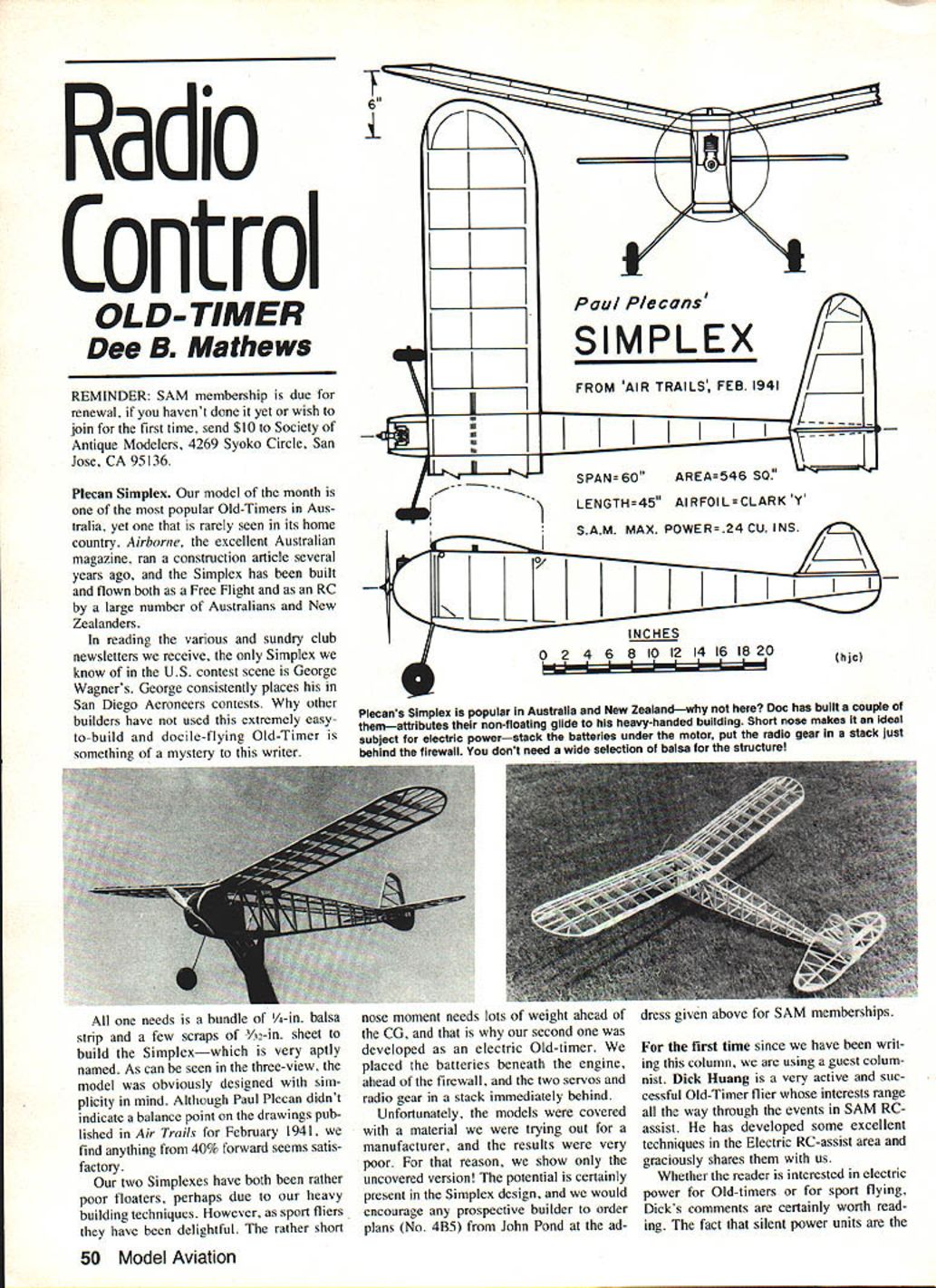
Our Model of the Month is one of the most popular Old-Timers in Australia, yet one that is rarely seen in its home country. Airborne, the excellent Australian magazine, ran a construction article several years ago, and the Simplex has been built and flown both as a free-flight and as an RC model by a large number of Australians and New Zealanders.
In reading the various and sundry club newsletters we receive, the only Simplex we know of in the U.S. contest scene is George Wagner's. George consistently places his in San Diego Aeroneers contests. Why other builders have not used this extremely easy-to-build and docile-flying Old-Timer is something of a mystery to this writer.
All one needs is a bundle of 1/4-in. balsa strip and a few scraps of 3/32-in. sheet to build the Simplex—which is very aptly named. As can be seen in the three-view, the model was obviously designed with simplicity in mind. Although Paul Plecan didn't indicate a balance point on the drawings published in Air Trails for February 1941, we find anything from 40% forward seems satisfactory.
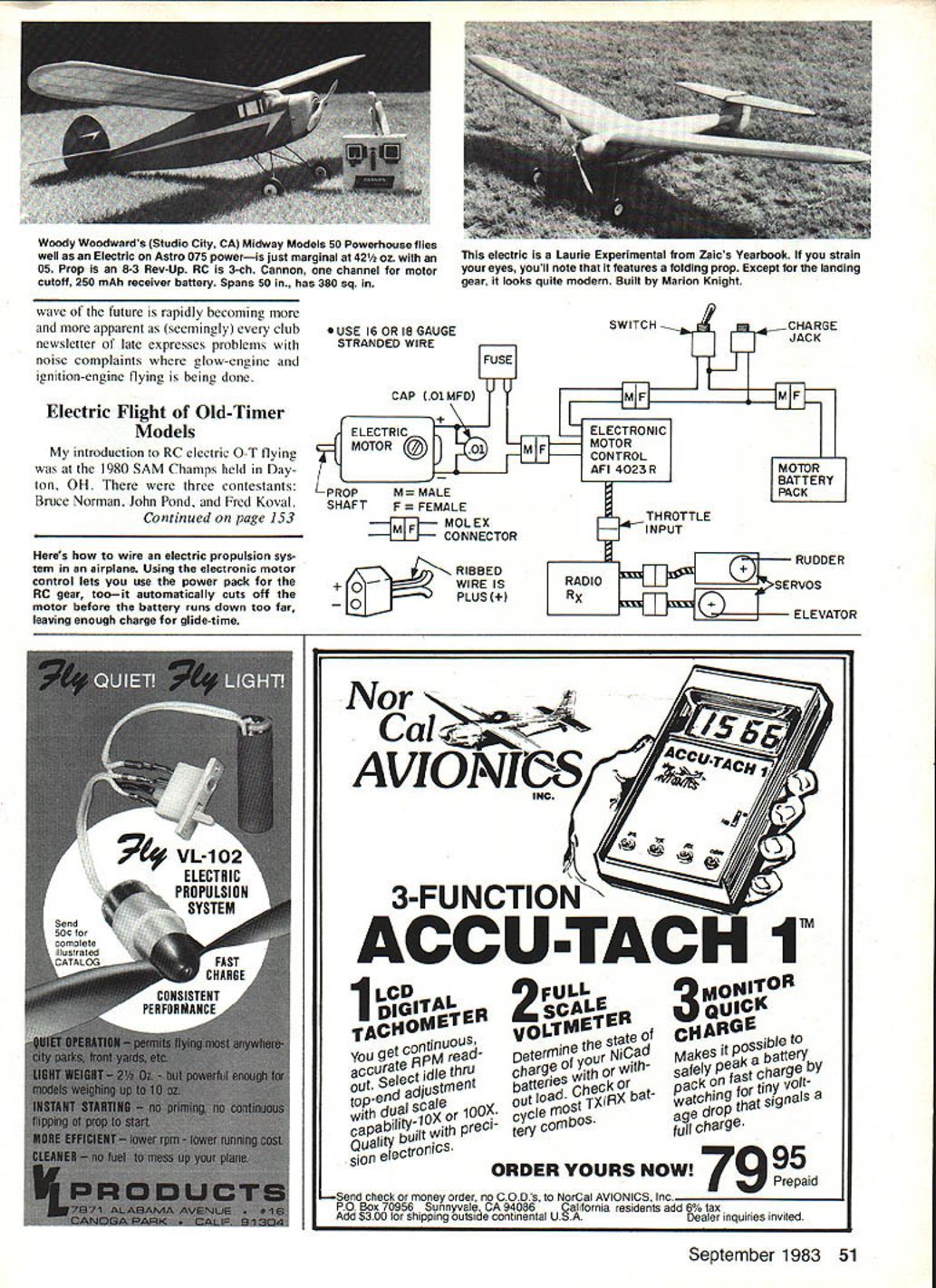
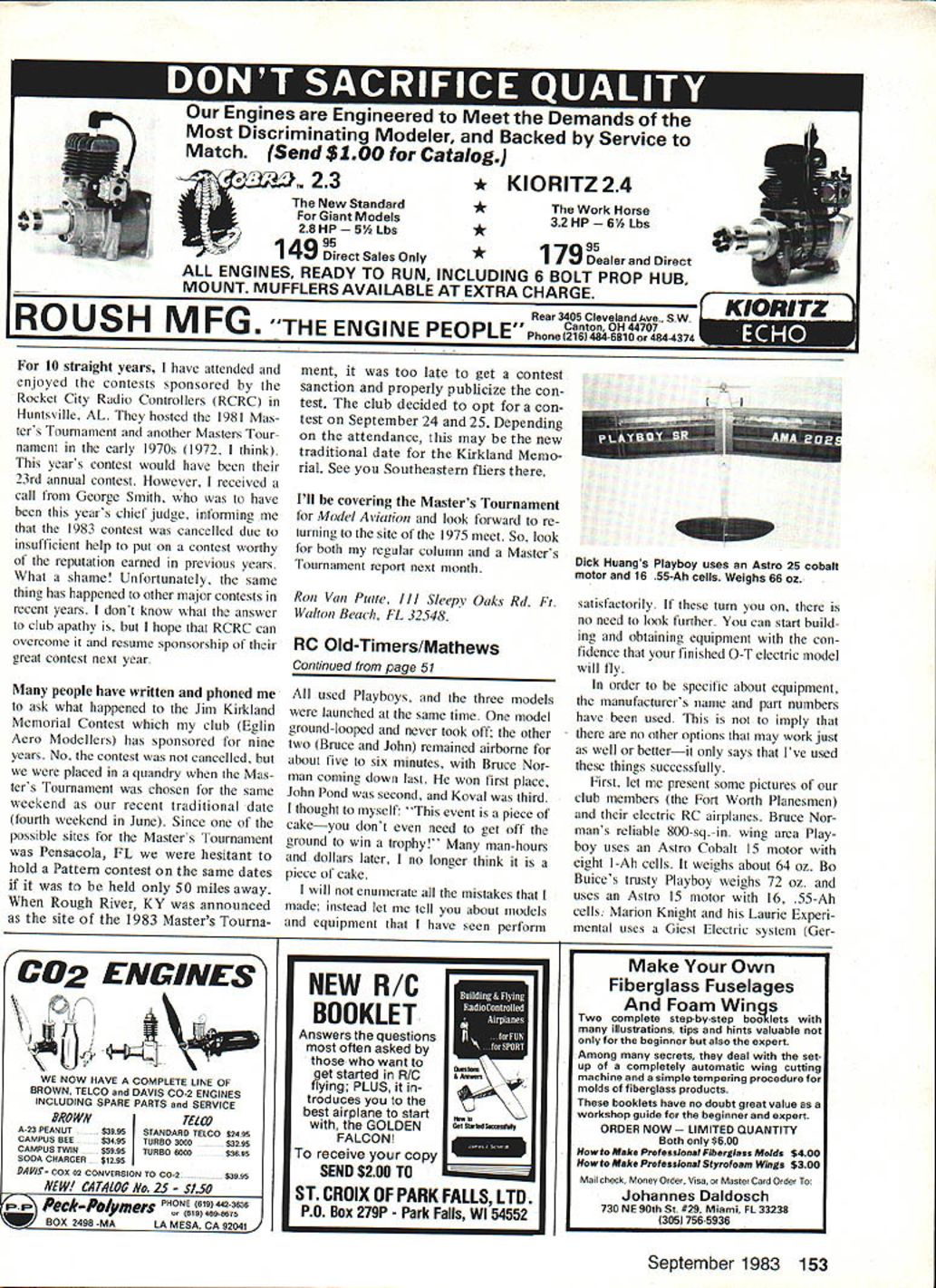
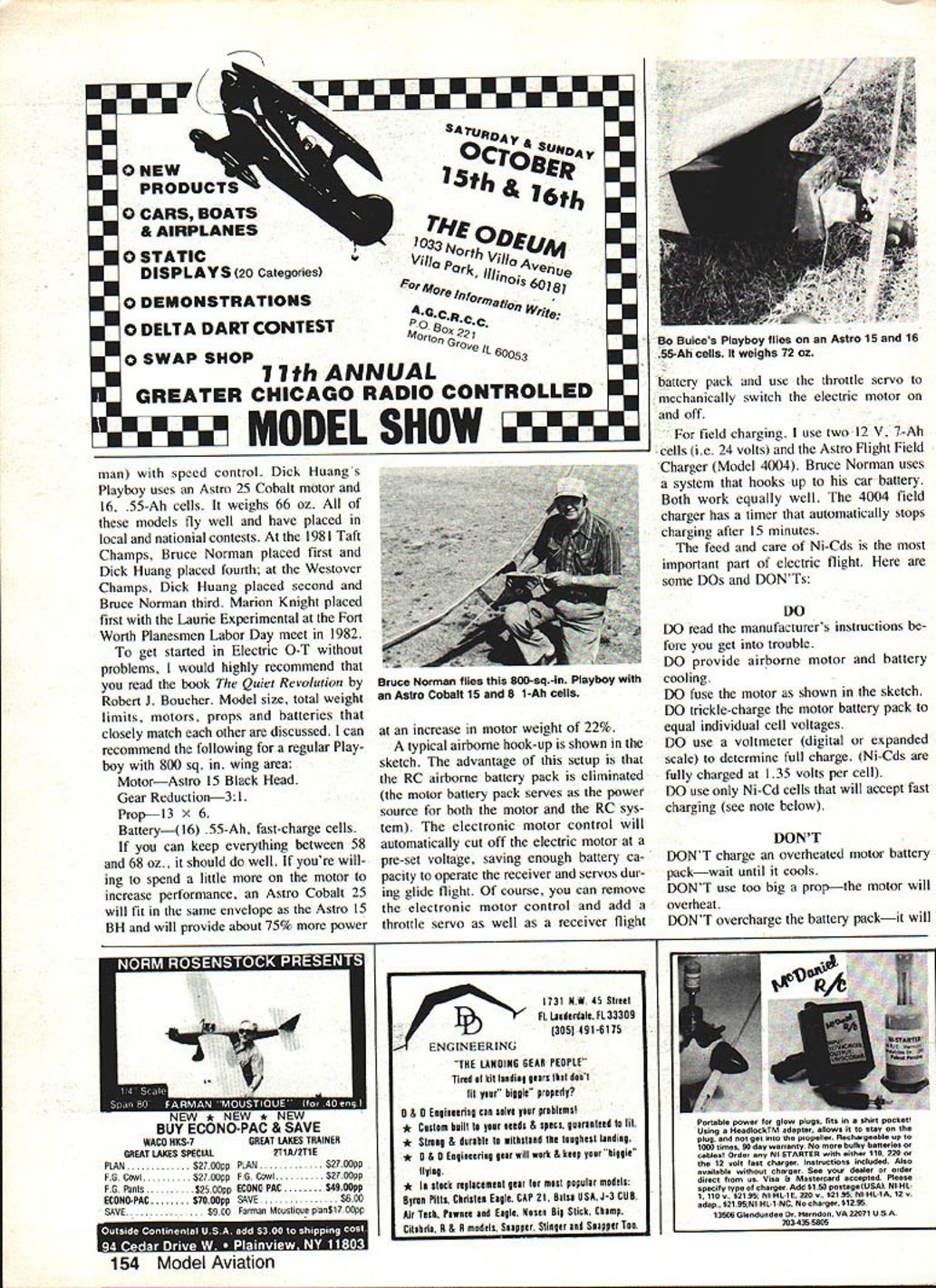
Our two Simplexes have both been rather poor floaters, perhaps due to our heavy building techniques. However, as sport fliers they have been delightful. The rather short nose moment needs lots of weight ahead of the CG, and that is why our second one was developed as an electric Old-Timer. We placed the batteries beneath the engine, ahead of the firewall, and the two servos and radio gear in a stack immediately behind.
Unfortunately, the models were covered with a material we were trying out for a manufacturer, and the results were very poor. For that reason, we show only the uncovered version. The potential is certainly present in the Simplex design, and we would encourage any prospective builder to order plans (No. 4B5) from John Pond at the address given above.
For the first time since we have been writing this column, we are using a guest columnist. Dick Huang is a very active and successful Old-Timer flier whose interests range all the way through the events in SAM RC-assist. He has developed some excellent techniques in the electric RC-assist area and graciously shares them with us. Whether the reader is interested in electric power for Old-Timers or for sport flying, Dick's comments are certainly worth reading. The fact that silent power units are the wave of the future is rapidly becoming more and more apparent as (seemingly) every club newsletter of late expresses problems with noise complaints where glow-engine and ignition-engine flying is being done.
Electric Flight of Old-Timer Models
Guest columnist: Dick Huang
My introduction to RC electric O-T flying was at the 1980 SAM Champs held in Dayton, OH. There were three contestants: Bruce Norman, John Pond, and Fred Koval. All used Playboys, and the three models were launched at the same time. One model ground-looped and never took off; the other two (Bruce and John) remained airborne for about five to six minutes, with Bruce Norman coming down last. From our first place, John Pond was second, and Koval was third. I thought to myself: "This event is a piece of cake — you don't even need to get off the ground to win a trophy!" Many man-hours and dollars later, I no longer think it is a piece of cake.
I will not enumerate all the mistakes that I made; instead let me tell you about models and equipment that I have seen perform satisfactorily. If these turn you on, there is no need to look further. You can start building and obtaining equipment with the confidence that your finished O-T electric model will fly.
In order to be specific about equipment, the manufacturer's name and part numbers have been used. This is not to imply that there are no other options that may work just as well or better — it only says that I've used these things successfully.
First, let me present some notes on club members' electric RC airplanes (Fort Worth Planesmen):
- Bruce Norman: reliable 800-sq.-in. wing-area Playboy using an Astro Cobalt 15 motor with eight 1-Ah cells. It weighs about 64 oz.
- Bo Buice: Playboy weighing 72 oz., uses an Astro 15 motor with 16 0.55-Ah cells.
- Marion Knight: Laurie Experimental uses a Giesl electric system (German) with speed control.
- Dick Huang: Playboy using an Astro Cobalt 25 motor and 16 0.55-Ah cells. It weighs 66 oz.
All of these models fly well and have placed in local and national contests. At the 1981 Taft Champs, Bruce Norman placed first and Dick Huang placed fourth; at the Westover Champs, Dick Huang placed second and Bruce Norman third. Marion Knight placed first with the Laurie Experimental at the Fort Worth Planesmen Labor Day meet in 1982.
Getting started — recommended equipment
To get started in electric O-T without problems, I highly recommend the book The Quiet Revolution by Robert J. Boucher. Model size, total weight limits, motors, props and batteries that closely match each other are discussed. I can recommend the following for a regular Playboy with 800 sq. in. wing area:
- Motor: Astro 15 Black Head.
- Gear reduction: 3:1.
- Prop: 13 x 6.
- Battery: (16) 0.55-Ah fast-charge cells.
If you can keep everything between 58 and 68 oz., it should do well. If you're willing to spend a little more on the motor to increase performance, an Astro Cobalt 25 will fit in the same envelope as the Astro 15 BH and will provide about 75% more power at an increase in motor weight of roughly 22%.
A typical airborne hook-up uses the motor battery pack as the power source for both the motor and the RC system. The electronic motor control will automatically cut off the electric motor at a preset voltage, saving enough battery capacity to operate the receiver and servos during glide flight. Of course, you can remove the electronic motor control and add a throttle servo as well as a receiver flight battery pack and use the throttle servo to mechanically switch the electric motor on and off.
USE 16 OR 18 GAUGE STRANDED WIRE for motor and power connections.
Field charging
For field charging, I use two 12 V, 7-Ah cells (i.e., 24 volts) and the Astro Flight Field Charger (Model 4004). Bruce Norman uses a system that hooks up to his car battery. Both work equally well. The 4004 field charger has a timer that automatically stops charging after 15 minutes.
Ni-Cd feed and care — DOs and DON'Ts
The feed and care of Ni-Cds is the most important part of electric flight. Here are some DOs and DON'Ts:
DO:
- Read the manufacturer's instructions before you get into trouble.
- Provide airborne motor and battery cooling.
- Fuse the motor as shown in the sketch.
- Trickle-charge the motor battery pack to equal individual cell voltages.
- Use a voltmeter (digital or expanded scale) to determine full charge. (Ni-Cads are fully charged at about 1.35 volts per cell.)
- Use only Ni-Cd cells that will accept fast charging (see note below).
DON'T:
- Charge an overheated motor battery pack—wait until it cools.
- Use too big a prop—the motor will overheat.
- Overcharge the battery pack—it will get hot and fail.
- Oil the motor—oil is bad for the brushes.
- Store a battery pack in a totally discharged condition—it may not take a charge later.
- Show off too much with bench runs—things can overheat.
Finally, DO get started in O-T electric flying; you will enjoy the clean and quiet propulsion system that starts with a flip of your throttle lever.
Note on Ni-Cd batteries and charging rates
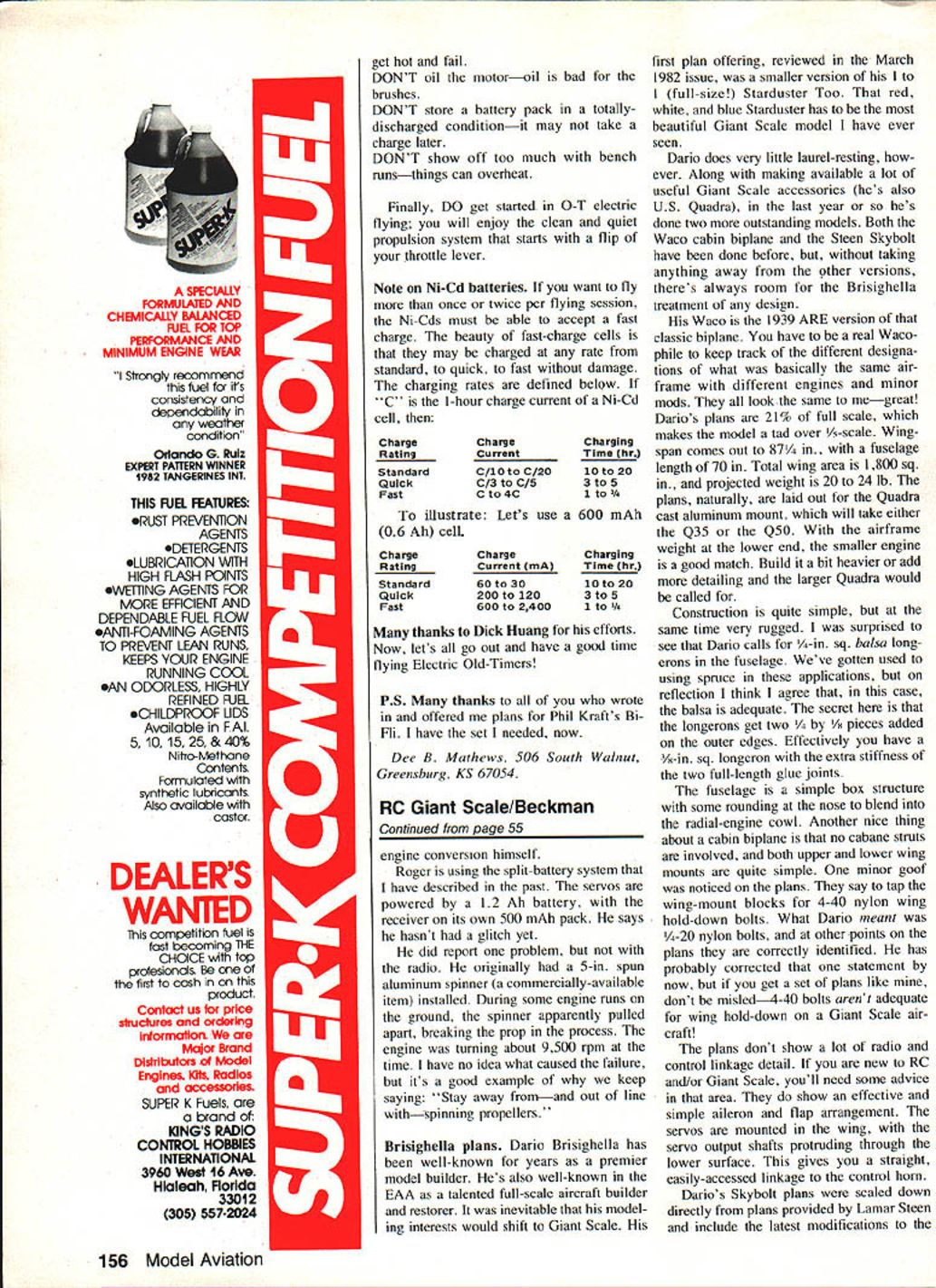
If you want to fly more than once or twice per flying session, the Ni-Cds must be able to accept a fast charge. The beauty of fast-charge cells is that they may be charged at any rate from standard, to quick, to fast without damage. If "C" is the 1-hour charge current of a Ni-Cd cell, then typical charge ratings are:
- Standard: C/10 to C/20 — charging time 10 to 20 hours.
- Quick: C/3 to C/5 — charging time 3 to 5 hours.
- Fast: C to 4C — charging time 1 to 1/4 hour.
Example using a 600 mAh (0.6 Ah) cell:
- Standard: 60 to 30 mA — 10 to 20 hours.
- Quick: 200 to 120 mA — 3 to 5 hours.
- Fast: 600 to 2,400 mA — 1 to 1/4 hour.
Many thanks to Dick Huang for his efforts. Now, let's all go out and have a good time flying Electric Old-Timers!
P.S. Many thanks to all of you who wrote in and offered me plans for Phil Kraft's Bi-Fli. I have the set I needed now.
Dee B. Mathews 506 South Walnut, Greensburg, KS 67054
Transcribed from original scans by AI. Minor OCR errors may remain.

