
Radio Control: Old‑Timer
Dee B. Mathews
History
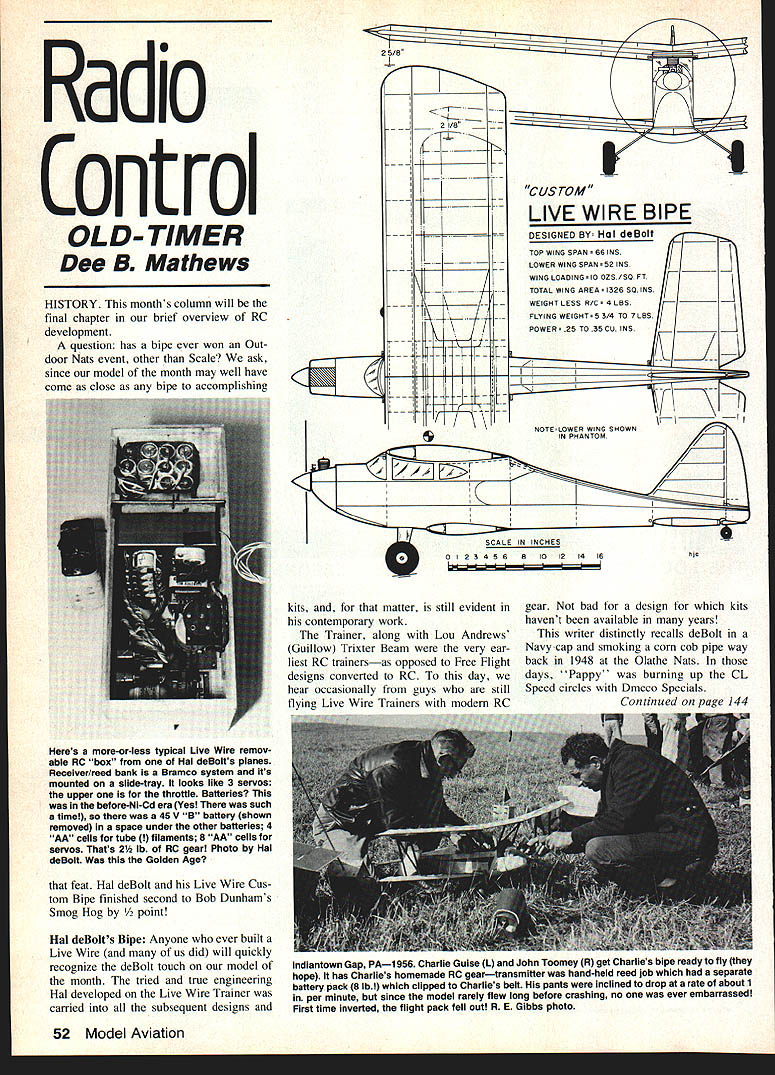
A question: has a biplane (bipe) ever won an Outdoor Nats event, other than Scale? We ask because our model of the month may well have come as close as any bipe to accomplishing that feat. Hal deBolt and his Live Wire Custom Bipe finished second to Bob Dunham's Smog Hog by one-half point.
Hal deBolt's Bipe
Anyone who ever built a Live Wire (and many of us did) will quickly recognize the deBolt touch on our model of the month. The tried-and-true engineering Hal developed on the Live Wire Trainer was carried into all subsequent designs and kits and is still evident in his contemporary work.
The Trainer, along with Lou Andrews' (Guillow) Trixter Beam, were the very earliest RC trainers—as opposed to free-flight designs converted to RC. To this day we occasionally hear from guys who are still flying Live Wire Trainers with modern RC gear. Not bad for a design for which kits haven't been available in many years!
I distinctly recall deBolt in a Navy cap and smoking a corn cob pipe way back in 1948 at the Olathe Nats. In those days "Pappy" was burning up the CL speed circles with Demeco Specials.
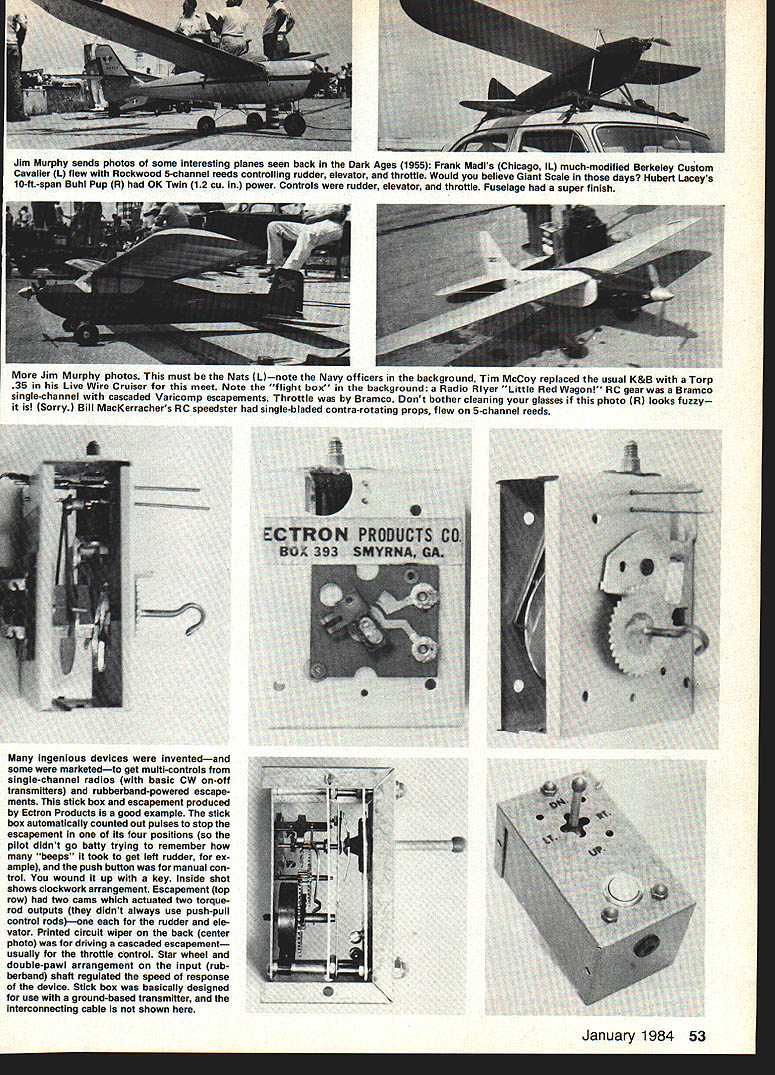
Many ingenious devices were invented—and some were marketed—to get multi-controls from single-channel radios (with basic CW on‑off transmitters) and rubberband-powered escapements. The stick box and escapement produced by Ectron Products is a good example. The stick box automatically counted out pulses to stop the escapement in one of its four positions (so the pilot didn't go batty trying to remember how many "beeps" it took to get left rudder, for example), and the push button was for manual control. You wound it with a key. Inside, a clockwork arrangement regulated the escapement. The escapement had two cams which actuated two torque-rod outputs—one each for rudder and elevator. A printed-circuit wiper was used for driving a cascaded escapement (usually for throttle control). A star-wheel and double-pawl arrangement on the input (rubberband) shaft regulated the speed of response. The stick box was basically designed for use with a ground-based transmitter.
RC Old-Timers/Mathews
Continued from page 52
By 1957, deBolt's kit line had expanded to include RC models ranging from the 1/2 A Kitten to the subject of this column. Also, his Stuntwagon and CL bipes and the free-flight Airfoiler were selling well.
Hal tells us the first experimental bipes were Cruises with Trainer wings added to the bottom. That set the size, and the Custom was of this configuration—only cleaned up. Symmetrical airfoil sections were then incorporated, which required modifying the force arrangements. He says the Custom flew well with a .35, but when the K&B .45 came out, it offered enough additional power for snaps and similar maneuvers.
The Nats second-place model used an eight-channel Bramco (Detroit) reed unit. He later added flaps and a 10-channel unit, although he now wonders why. "I guess we thought we could control landings better."
Standard covering on nearly all his planes was colored silk with clear dope and some colored dope trim, an effort to help hold down weight. When one was forced to use 2 1/2 lb. of RC gear, every ounce saved in the model weight was important.
A novel feature of all the Live Wire series was the removable radio box. As seen in the photos, the entire unit could be disconnected from the pushrods and removed from the fuselage. This feature was very handy when adjusting or repairing the equipment and says much about the complexity and reliability of the systems.
Quoting from a letter from Hal: "The '57 Nats was cute. I was in about fifth place until the last flight. They had some hard‑nosed Marine officers for judges who had a penchant for biased marks for bipes. They encouraged me. I had made some precise trim changes; all worked, and the flight was great. Afterwards, the Marines told my helper (Dick Branstetter) that they hoped they'd do me some good!!"
The three-view was prepared from a set of the original kit drawings we purchased from Fran Pastwicka, 23 Maple Drive, Lavonia, PA 14150. He also has other deBolt kit plans, many with all the patterns required to build. Write him for details.
Radios (1954–1957 era)
To attempt to overview radio equipment in the 1954 through 1957 era is like opening a can of worms. Equipment was still operating on:
- 27 MHz
- 465 MHz
- the amateur (ham) bands
Superhet receivers had become common, tone modulation was used to better reject extraneous signals, and reed units were the penultimate available. The concept of a reed receiver/transmitter was a series of modulated audio tones which vibrated a metal strip, causing it to close onto a switch which, in turn, activated a relay that passed current to a servo. If that sounds complex—it was.
A tone (such as 500 cycles per second) was emitted from the transmitter when the pilot activated one of several switches or buttons and was picked up by the receiver to vibrate a reed. Thus the reed eventually moved a servo in one direction—such as up elevator. To return the surface to neutral, one released the transmitter button or switch. Another switch could then be pushed to generate another tone which would activate the opposite control function, such as down elevator. In other words, a 10-channel unit was capable of moving five surfaces in each of two directions. It was not until 1960 that equipment capable of generating more than one tone at a time became available; that system was referred to as "simul."
For the reader who has never seen reed multi-channel flown, this likely conjures visions of very herky-jerky flying. Such was not the case. Many of the more accomplished fliers became so adept at flicking switches that their flying closely resembled today's proportional equipment. This was, however, a considerable accomplishment.
The very early reed equipment by Rockwood, Schmidt, and others used a control box rather than push buttons; however, this didn't prove popular. Control boxes with scalelike "sticks" were also available for single-channel fliers to simplify flying cascaded and compound escapements. We have included photos of an Ectron controller provided by a reader.
As if things weren't complex enough—with single-channel compound escapements, galloping ghost, kicking duck, reeds, and so forth—we also had Good, Worth, Don Brown, and others flying primitive proportional rigs. Early Quadraplex and Space Control proportional equipment were for sale by 1959, yet multi-reed equipment sold well and was the most commonly used gear well into the mid-1960s. When proportional did catch on, the reed equipment disappeared almost overnight.
SAM Champs '84
Corporal Klinger's hometown—Toledo, OH—will be the scene of SAM Champs '84. A mid-June date has been selected as most likely to produce cooler weather and lighter winds than the traditional July dates. The site is the former Toledo Municipal Airport, on which all full-scale aviation activity will be suspended for the three-day Champs. Concrete runways and well-maintained grass areas should make motorbike retrieval possible for the free flighters. Access is via I-75 and the Ohio Turnpike interchange, an area full of motels. Although the headquarters motel is yet unnamed, it will be the scene of the MECA Collector, the traditional first event—"bean feed"—and the awards banquet.
A SAM Champs is as much a social happening as it is a contest, and this one is shaping up as one of the best ever. Carl Spielmaker will serve as general CD, with Tom McCoy and Buck Zaine in charge of RC. Anyone who knows these rascals is aware of the fun they bring to any activity. The free-flight director had not been named at the time of this writing.
Dee B. Mathews 506 South Walnut, Greensburg, KS 67054.
Transcribed from original scans by AI. Minor OCR errors may remain.

