
Radio Control: Old-Timers
Jack Bolton
ONE HAS to be very careful when answering the telephone. As an example, several weeks ago I was lounging around enjoying my weekend when that direct line to everywhere rang and put an end to such pursuits. Across the miles from D.C. to Pensacola floated the voice of Carl Wheeley asking if I would be interested in providing a column for Model Aviation pertaining to radio-assist old-timer free flight. Being a strong supporter of SAM (Society of Antique Modelers), also a lover of the old flying machines, and specifically a proponent of RC Assist, I had no choice but to reply in the affirmative; particularly since I also believe that one must always be ready to jump in and be part of the solution rather than being part of the problem. It's easy to criticize and complain but not so easy to be constructive or deal with complainers. However, the buck has to stop somewhere.
So since you are stuck with me, please permit a short introduction and a little background information. I am a native of Toronto, OH and developed a love of flying machines at an early age, primarily, through the ministrations of aviation-minded parents. These folk (and I thank them for it), among many excursions, dragged the Bolton kids to all the Cleveland Air Races commencing in '35 through '48, and even to Lakehurst to view the Hindenburg on the trip prior to the ultimate disaster. Around 1939 I started into modeling with those great four-for-a-nickel WWI solids sold at the 5-and-10 stores. My first gassy was a Megow Cardinal that was powered by a Phantom P-30 (an engine with distinct charisma), up through Playboys, Interceptors, Stratostreaks and Rangers to the point of entering the Navy in '49. Out of the Navy in '53 to Kent State and back to Navy flight school after graduation from Kent in '56. Entered into radio in '62 and into old-timer RC Assist in '73. Retired from the Navy in '74 and am presently working as a civilian contract primary helicopter flight instructor for the Army at Fort Rucker, AL and loving every minute of it. But to backtrack a bit, my affiliation with AMA started in 1946 when I became a member of the old Steubenville, OH Sky Hawks MAC, and later I became a member of the Norfolk Aeromodellers, Tidewater R/C, Fort Belvoir Flyers, Northwest Florida R/C, Pensacola Free Flight Team, Old Time Eagles and the Pensacola Vintage Model Air-Crafters.
Now that is over we can settle down to the task of creating this masterpiece, and maybe in the process explain some of the background of RC Assist Old-Timers, including how to get involved, basic aircraft set-up, type and class distinctions, and competition events.
RC Assist Background
When delving into historical background, we run the risk of being inundated with critics taking us to task about dates, sequences, personalities, intentions, etc. So rather than face this potential wrath, let us simply say that RC Assist Old-Timers, in fact, started all over the U.S. and perhaps the world, simultaneously with the advance in radio equipment state of the art. I'm sure that in the 40's and 50's these classic birds carried aloft many tons of usually useless tubes, condensers and batteries that were supposed to work and give a rudder deflection. An identifiable turn was cause for celebration and a distinct thrill. So because of this electronic unreliability, the flying machines themselves had to be basically stable, and what models were more stable than the old gas ships? They were the first RC Assist (hindered) free flights. In the early 60's many of the Old-Timers were converted or even built new as RC trainers. Again, the inherent stability of these ships provided the sought after forgiveness required for neophyte training. The validity of this precept is being proven once again today as several kit manufacturers have recently marketed scaled-down antiques (pre-1939) as basic RC trainers, and if modified back to the original airfoils and construction, as competition entries. In the mid-60's several SAM-affiliated modelers were flying the Old-Timers. Foremost among these was Everett "Woody" Woodman, who, along with his colleagues, petitioned SAM for acceptance of RC Assist as a special event, and formulated and drafted the basic rules for conduct of competition. These rules have stood the test of time and exist today only slightly modified by membership vote. So why do we have Radio Assist Old-Timers? Well, discounting the previously discussed trainer concept, we have modelers that simply love the old flying machines for what they are—models that look like models or what we think models should look like—a chance to build and fly the old classics, and an opportunity to really make the old designs perform using modern engines (if desired) and other materials. You may very well wonder, if that's what we want, why not build and fly straight Old-Timer free flight? That is a valid question for which there is no one simple answer. One reason, of course, is the steadily decreasing availability of adequate free-flight flying sites, particularly in the northeast. Another is the camaraderie found at the old-timer RC gatherings and contests. A very apparent reason also is the inescapable fact that some of our devotees are of an age where trundling over hill and dale on an off-site chase is almost out of the question. Another is the obvious cost of balsa and the man hours invested in the construction of these beauties that is risked to the thermal gods in free flight. But to this writer, who dearly loves the old designs and the participants, it is the unique characteristics of the sport of having a beautifully boxy old structure that can go up like a tiger and be at considerable altitude in 20 seconds, chop the engine, and hopefully soar for the allotted ten minutes, and return to the starting point.
You may notice I have avoided discussion concerning recreation and emulation of actual performance and flights of yesteryear. To some this is the reason and goal of old-timer flying and is certainly a valid one, but very difficult to pursue, particularly in RC Assist because such a thing didn't exist in the golden years. We leave that to the purist free fliers and even they are having trouble due to old engine availability, modern engine power and site availability. But to each his own. That's what a hobby is all about.
RC Old-Timer Events
Most old-timer gatherings are at contests, as are most of the other facets of modeling, so it behooves the devotee or the aspirant to be ready for participation and competition since this is where they gain the most from their endeavors. Old-Timer RC Assist contests have evolved to fairly straight competition events but primarily on a low key. When the originators started RC Assist they were determined that the event priorities be established in the following order: (1) Fun, (2) Much flying, (3) Socializing, (4) Relaxation. These priorities have not changed and old-timer contests are still the most rewarding contests going. But make no mistake! Most of the competitors are just exactly that—competitors! They will be flying the best models and these will be powered by the best engines (ignition or glow) they can find, the planes will be well trimmed out, and the flier will be knowledgeable in picking his air and in thermal hunting and soaring techniques. Where the relaxation comes in is in the administration of the meet. Under the existing rules a flier is permitted six flights or attempts and he chooses the three best for contest scoring. The contestant also selects when he wants to fly subject only to radio frequency conflicts. All of this makes for a very informal atmosphere with much time available for socializing (unless, like me, you try to enter all events).
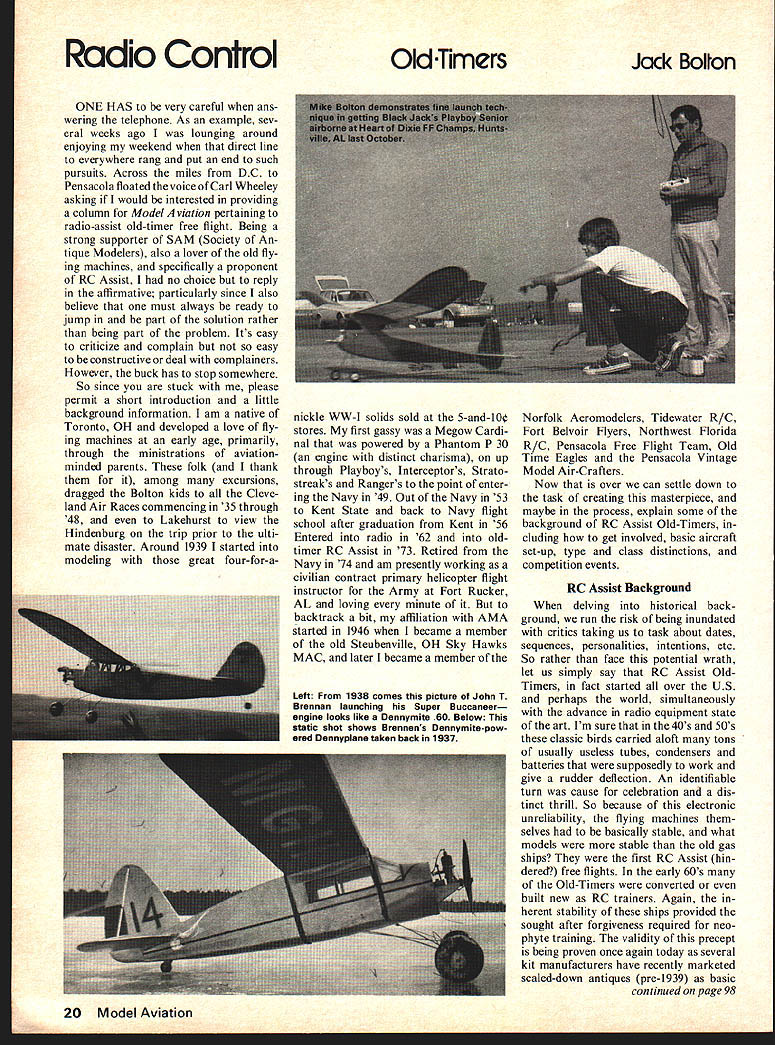
Under SAM rules the models are broken down into two categories: Antique and Old-Timer. These are defined as model aircraft which have been designed, kitted or plans published prior to December 31, 1938 for Antique; and December 31, 1942 for Old-Timer. Models shall be flown in one of the following basic classes: (1) Antique (all classes combined), (2) Old-Timer cabin and pylon, (3) Texaco (all classes combined), a duration event, fuel allotment, (4) .020 Replica. Power runs are: Old-Timer, 20 seconds glow, 25 seconds ignition; Antique, 7 seconds per lb. of aircraft weight to the nearest lb. for glow, 10 seconds for ignition; .020 Replica, 20 seconds. Engine size for Old-Timer classes are: (A) .000-.200, (B) .201-.300, (C) .301-1.20 cu. in. displacement. Old-timer weight requirements are 10 ounces per sq. ft. of wing area for glow, 8 ounces for ignition. In addition, glow-powered old-timers are restricted on engine size by the requirement for 225 sq. in. wing area per .10 cu. in. displacement. As an example, my 800 sq. in. Playboy Senior on glow is restricted to a maximum engine size of .356 CID (800 divided by 225 times .10 = .356). Weight required is 55.55 oz. (800 divided by 144 times 10 ounces = 55.55 oz.) My Playboy weighs 56 ounces and I power it with a Super Tigre ABC .29 for class B, and a Super Tigre .35 in C.
In the next column we will go further into class and category breakdown and event participation. Also we will delve into construction and modification of old-timers for RC Assist, and look at control surface sizing. Engine shut-down will be covered—flood-off, cut-off, throttle. Until then, get started on your bird for the upcoming SAM/Nats affair at Dayton.
Society of Antique Modelers (SAM) annual dues: five dollars. Address: Tim Banaszak, Sec./Treas., 1947 Superior Ave., Whiting, IN 46394. Plans for old-timers available from John Pond Old Timer Plans Service, P.O. Box 3113, San Jose, CA 95156. A reasonably complete list of old-timer suppliers, plans services, engine converters, kit manufacturers and engine restorers was presented in SAM SPEAKS (the bi-monthly publication of SAM) not too long ago. There are plans for up-dating and republishing the list. How do I know this? Well, for one thing, I'm the editor. Like all columnists I am in need of current, or even not so current, material and photos for forthcoming issues. Please forward to John M. Bolton, Cdr. USN (Ret), 9521 Scenic Highway, Pensacola, FL 32504. Ph. (904) 477-2055.
Transcribed from original scans by AI. Minor OCR errors may remain.

