
Old-Timers
Clarence Haught
Bringing 'Em Back Alive
IN THE EARLY days of Free Flight the science of "air picking" was not widely practiced. Thermal flights were often credited to the design of the model and one only need read a few early advertisements telling of 20-minute flights on a 30-second motor run to be convinced that this is the model for you! Contests were won on the strength of one good flight, often with the timer and contestant in hot pursuit by automobile. Of course, many airplanes and engines were lost forever. The life expectancy of a model was short indeed. If the testing didn't get it, a fly away surely would; a fact verified by the skimpy finishes common to the period.
The realization that thermals were responsible for lost models led some pioneer modelers into development of effective dethermalizers. Some early attempts included timer-released drag chutes and an ingenious "spool" system. The spool system called for a length of heavy thread, perhaps 50 to 75 feet, one end attached to a wing tip, the other to a spool. The spool containing the excess thread was secured to the fuselage by a timer-release system. In practice the air-actuated timer dropped the spool, which unwound to the length of the thread, creating a hanging weight on the wing tip. This, in turn, caused a steep spiral turn (dive?) bringing the model down. When the spool contacted the earth, the model, suddenly relieved of the upsetting influence, and still at string altitude, was supposed to recover and land undamaged! Good luck!
Various other systems were developed with varying degrees of success but it was not until a young man named Carl Goldberg (now there is a familiar sounding name) perfected the pop-up stab dethermalizer now in universal use. Carl found that changing stabilizer incidence to 45 degrees negative in flight, would induce a vertical pitching action sufficient to stop forward motion and hold the wing at an angle of attack that would cause the model to parachute down on its own flying surfaces at an acceptable rate of descent. In fact, this rate is somewhat controllable by the stab angle. Too much and the model falls out of the sky. Too little and spinning develops, usually with harmful side effects to the model. So 45 degrees is a good starting point.
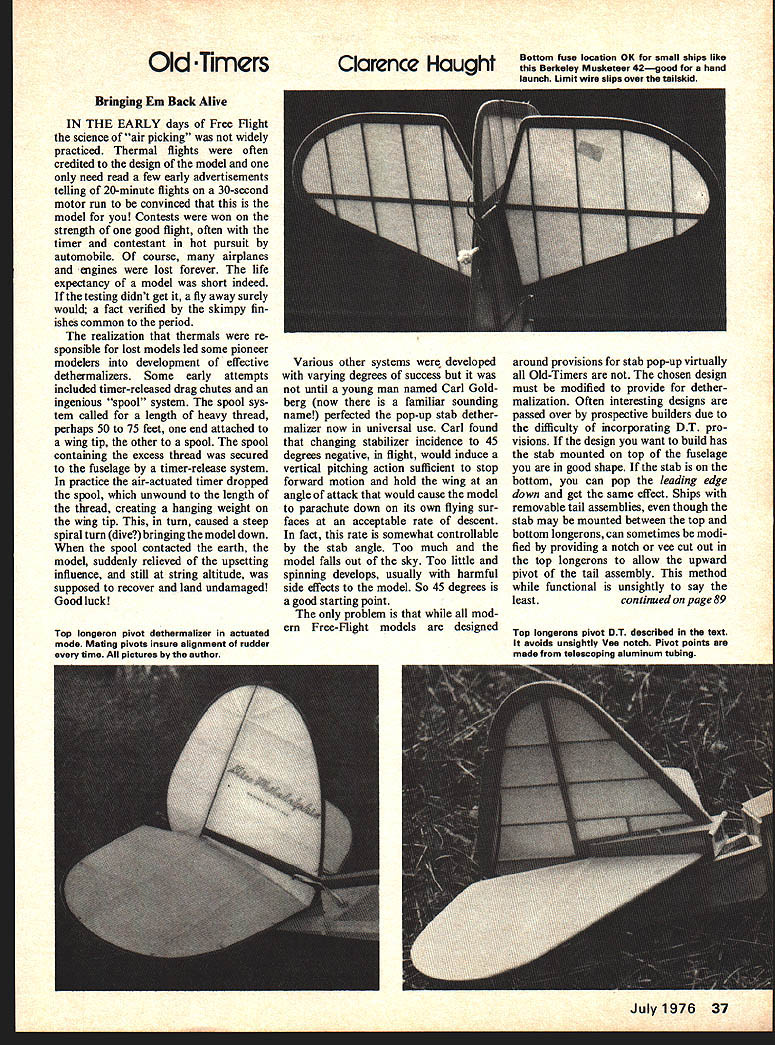
The only problem is that while all modern Free-Flight models are designed around provisions for stab pop-up virtually all Old-Timers are not. The chosen design must be modified to provide for dethermalization. Often interesting designs are passed over by prospective builders due to the difficulty of incorporating D.T. provisions. If the design you want to build has the stab mounted on top of the fuselage you are in good shape. If the stab is on the bottom you can pop the leading edge down and get the same effect. Ships with removable tail assemblies, even though the stab may be mounted between the top and bottom longerons, can sometimes be modified by providing a notch or vee cut out in the top longerons to allow the upward pivot of the tail assembly. This method, while functional, is unsightly to say the least. One approach used locally is to pivot the longerons directly above the stab leading edge rather than at the leading edge. This is accomplished by providing a horizontal pivot tube at the top of the tail assembly longerons and a mating half-tube section on the fuselage longerons as shown in the accompanying photos. This system also provides automatic alignment essential to any system in which the rudder is attached to the stab.
Providing none of the above systems is practical you could resort to popping up the leading edge of the wing! This system has its uses but my experience with it is nil. I have reasoned that this system would bring the ship down in a nose-low attitude which could be bad. Perhaps some of our readers could enlighten us on this one?
Many modelers, after working out an acceptable D.T. arrangement, do not consider any further modifications for, after all, the rules discourage modifications, but they are referring to substitution of sheet for the built-up structures, etc. In actual practice dethermalizing imposes some regular loads to the structure that must be considered if damage is to be avoided. Consider the landing gear. Is the wire size, mounting and gusseting sufficient to stand vertical descent over a conventional glide landing? How about the wing joints, dihedral braces, and sheeting at surface attachment contact points. Give some thought to D.T. actuation. Are you going to use a fuse or a mechanical timer? In either event the location must be accessible at launch time. Some of these ships are quite large and just managing the thing with the engine running can be a real hassle. Method of launch can be a factor — ROG (rise off ground) is the accepted thing. Can you trip your timers and/or light your fuse and launch by yourself? Even the fact that you may be right- or left-handed will influence your decisions. Strive for a layout which will allow you to start your engine alone, move around to your launch position, service your timers, etc., and release your model without putting yourself in an unbalanced or awkward position.
Remember a D.T. system is no good unless you activate it at every flight. Losing your model on its first test may impress some of the troops but it sure sets your building schedule back a ways!
Old-Timer Event of the Month
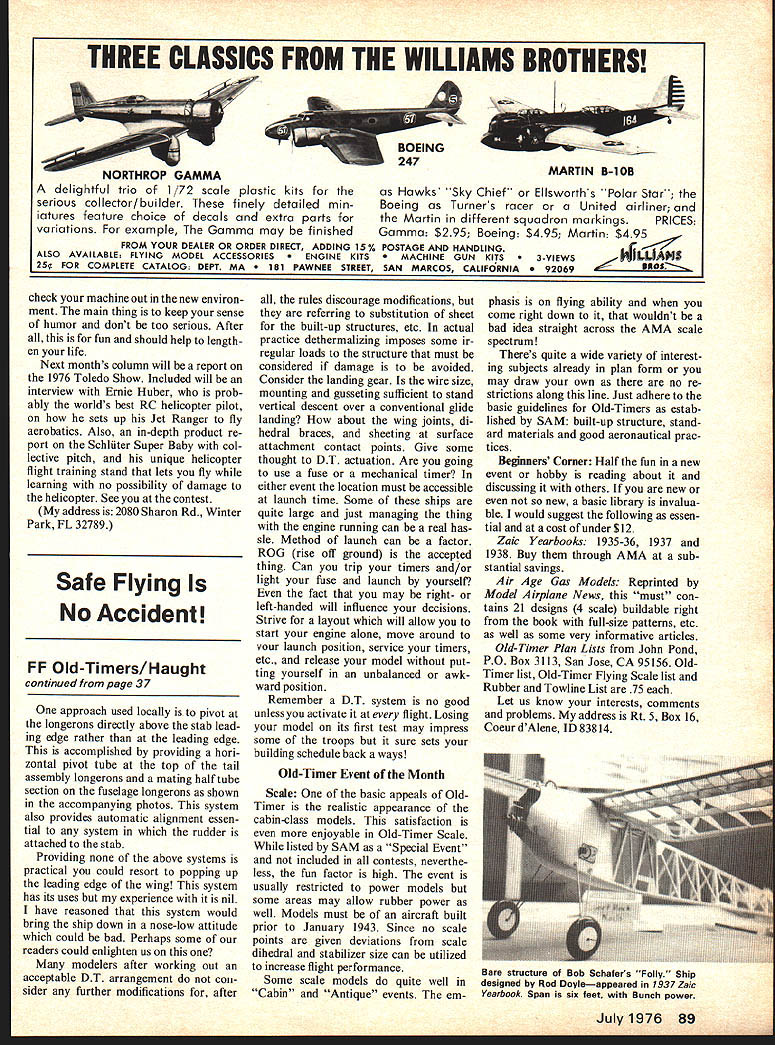
Scale: One of the basic appeals of Old-Timer is the realistic appearance of the cabin-class models. This satisfaction is even more enjoyable in Old-Timer Scale. While listed by SAM as a "Special Event" and not included in all contests, nevertheless the fun factor is high. The event is usually restricted to power models but some areas may allow rubber power as well. Models must be of an aircraft built prior to January 1943. Since no scale points are given deviations from scale dihedral and stabilizer size can be utilized to increase flight performance.
Some scale models do quite well in "Cabin" and "Antique" events. The emphasis is on flying ability and when you come right down to it, that wouldn't be a bad idea straight across the AMA scale spectrum!
There's quite a wide variety of interesting subjects already in plan form or you may draw your own as there are now no restrictions along this line. Just adhere to the basic guidelines for Old-Timers as established by SAM: built-up structure, standard materials and good aeronautical practices.
Beginners' Corner
Half the fun in a new event or hobby is reading about it and discussing it with others. If you are new or even not so new, a basic library is invaluable. I would suggest the following as essential and at a cost of under $12.
Zaic Yearbooks: 1935-36, 1937 and 1938. Buy them through AMA at a substantial savings.
Air Age Gas Models: Reprinted by Model Airplane News, this "must" contains 21 designs (4 scale) buildable right from the book with full-size patterns, etc., as well as some very informative articles.
Old-Timer Plans List from John Pond, P.O. Box 3113, San Jose, CA 95156. Old-Timer list, Old-Timer Flying Scale list and Rubber and Towline list are .75 each.
Let us know your interests, comments and problems. My address is P.O. Box 16, Coeur d'Alene, ID 83814.
Transcribed from original scans by AI. Minor OCR errors may remain.

