
RADIO CONTROL: Old-Timers
Dee B. Mathews
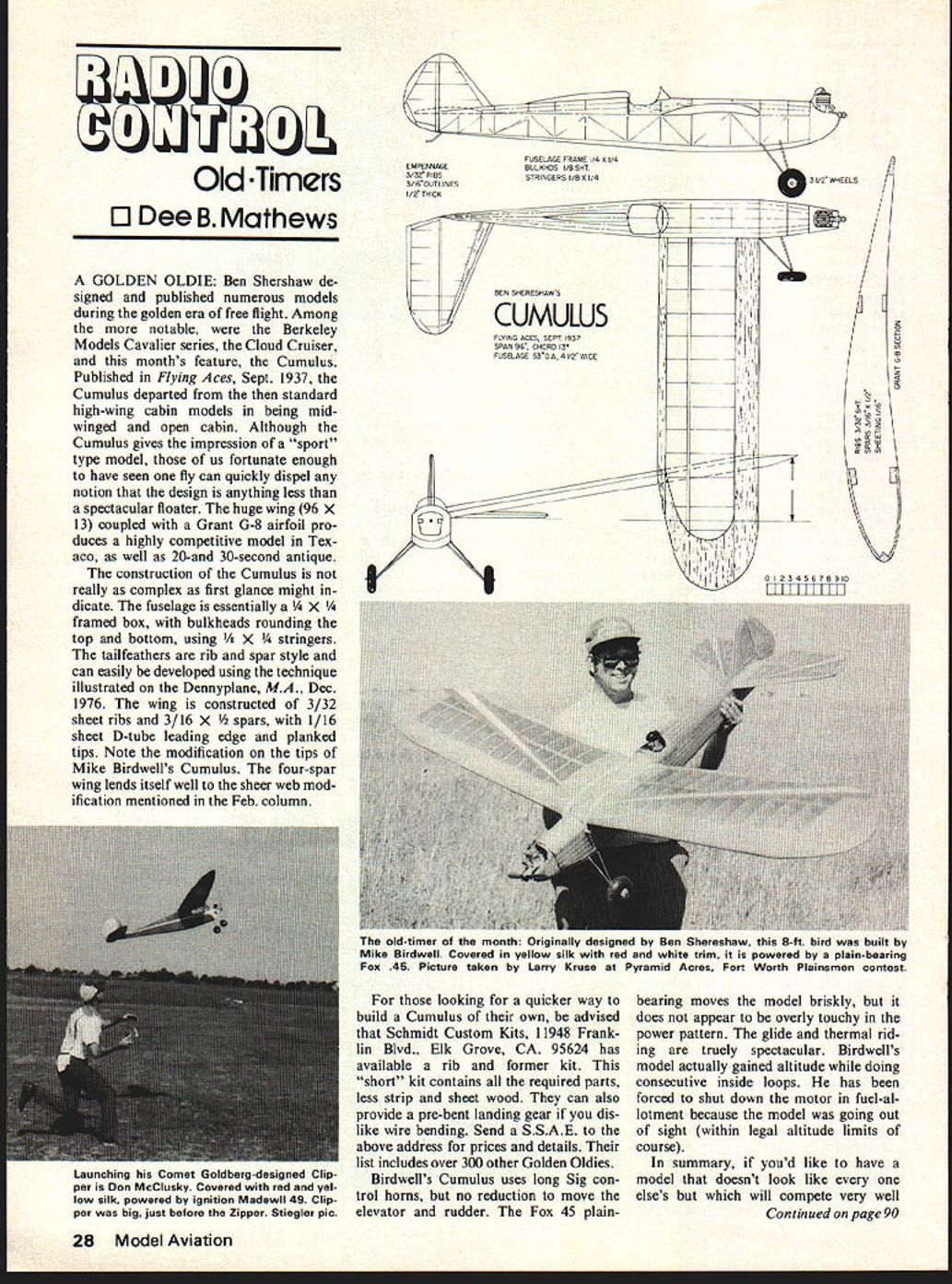
A GOLDEN OLDIE: Ben Shershaw designed and published numerous models during the golden era of free flight. Among the more notable, were the Berkeley Models Cavalier series, the Cloud Cruiser, and this month's feature, the Cumulus. Published in Flying Aces, Sept. 1937, the Cumulus departed from the then standard high-wing cabin models in being mid-winged and open cabin. Although the Cumulus gives the impression of a "sport" type model, those of us fortunate enough to have seen one fly can quickly dispel any notion that the design is anything less than a spectacular floater. The huge wing (96 x 13) coupled with a Grant G-8 airfoil produces a highly competitive model in Texaco, as well as 20-and 30-second antique.
The construction of the Cumulus is not really as complex as first glance might indicate. The fuselage is essentially a 1/4 x 1/4 framed box, with bulkheads rounding the top and bottom, using 1/4 x 1/4 stringers. The tailfeathers are rib and spar style and can easily be developed using the technique illustrated on the Dennyplane, M.A., Dec. 1976. The wing is constructed of 3/32 sheet ribs and 3/16 x 1/2 spars, with 1/16 sheet D-tube leading edge and planked tips. Note the modification on the tips of Mike Birdwell's Cumulus. The four-spar wing lends itself well to the sheer web modification mentioned in the Feb. column.
For those looking for a quicker way to build a Cumulus of their own, be advised that Schmidt Custom Kits, 11948 Franklin Blvd., Elk Grove, CA 95624 has available a rib and former kit. This "short" kit contains all the required parts, less strip and sheet wood. They can also provide a pre-bent landing gear if you dislike wire bending. Send a S.S.A.E. to the above address for prices and details. Their list includes over 300 other Golden Oldies.
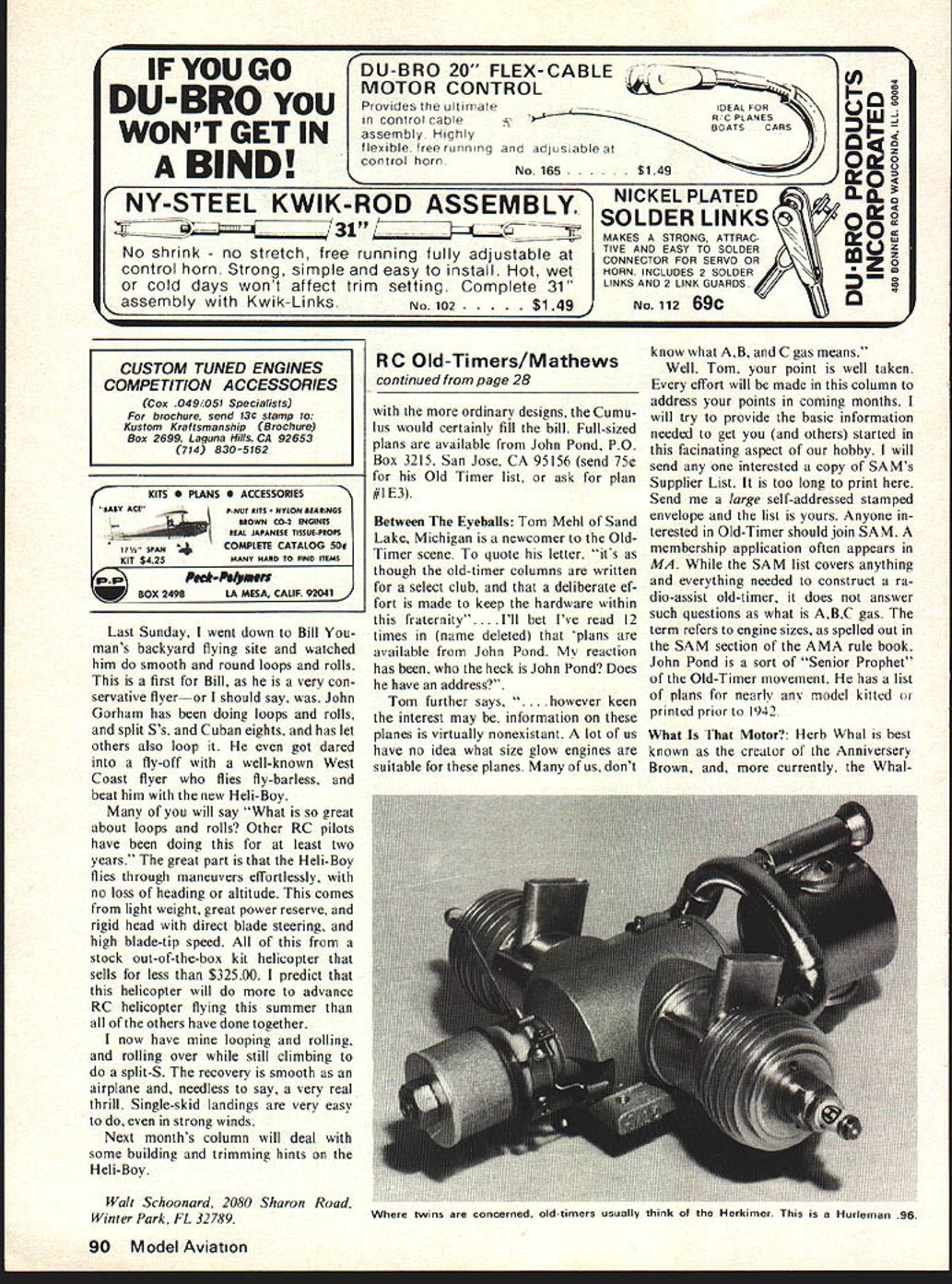
Birdwell's Cumulus uses long Sig control horns, but no reduction to move the elevator and rudder. The Fox 45 plain-bearing moves the model briskly, but it does not appear to be overly touchy in the power pattern. The glide and thermal riding are truly spectacular. Birdwell's model actually gained altitude while doing consecutive inside loops. He has been forced to shut down the motor in fuel allotment because the model was going out of sight (within legal altitude limits of course).
In summary, if you'd like to have a model that doesn't look like every one's but which will compete very well
RC Old-Timers/Mathews
with the more ordinary designs, the Cumulus would certainly fill the bill. Full-sized plans are available from John Pond, P.O. Box 3215, San Jose, CA 95156 (send 75c for his Old Timer list, or ask for plan #1E3).
Between The Eyeballs: Tom Mehl of Sand Lake, Michigan is a newcomer to the Old-Timer scene. To quote his letter, "it's as though the old-timer columns are written for a select club, and that a deliberate effort is made to keep the hardware within this fraternity"... I'll bet I've read 12 times (name deleted) that "plans are available from John Pond." My reaction has been, who the heck is John Pond? Does he have an address?
Tom further says, "... however keen the interest may be, information on these planes is virtually nonexistent. A lot of us have no idea what size glow engines are suitable for these planes. Many of us don't know what A, B, and C gas means."
Well, Tom, your point is well taken. Every effort will be made in this column to address your points in coming months. I will try to provide the basic information needed to get you (and others) started in this fascinating aspect of our hobby. I will send any one interested a copy of SAM's Supplier List. It is too long to print here. Send me a large self-addressed stamped envelope and the list is yours. Anyone interested in Old-Timer should join SAM. A membership application often appears in MA. While the SAM list covers anything and everything needed to construct a radio-assist old-timer, it does not answer such questions as what is A, B, C gas. The term refers to engine sizes, as spelled out in the SAM section of the AMA rule book. John Pond is a sort of "Senior Prophet" of the Old-Timer movement. He has a list of plans for nearly any model kitted or printed prior to 1942.
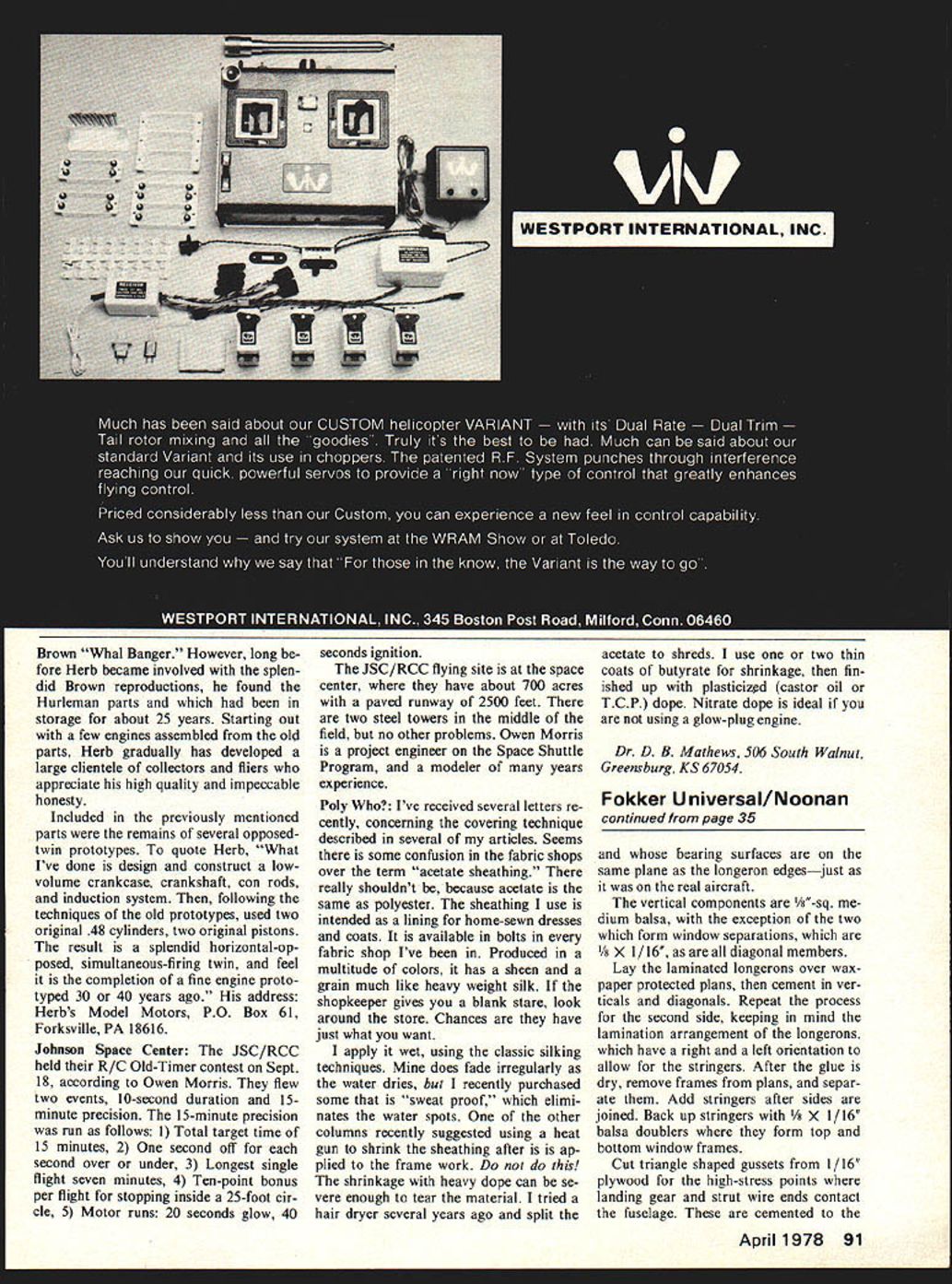
What Is That Motor?: Herb Whal is best known as the creator of the Anniversary Brown, and, more currently, the Whal- Brown "Whal Banger." However, long before Herb became involved with the splendid Brown reproductions, he found the Hurleman parts which had been in storage for about 25 years. Starting out with a few engines assembled from the old parts, Herb gradually has developed a large clientele of collectors and fliers who appreciate his high quality and impeccable honesty.
Included in the previously mentioned parts were the remains of several opposed-twin prototypes. To quote Herb, "What I've done is design and construct a low-volume crankcase, crankshaft, con rods, and induction system. Then, following the techniques of the old prototypes, [I] used two original .48 cylinders, two original pistons. The result is a splendid horizontal-opposed, simultaneous-firing twin, and I feel it is the completion of a fine engine prototyped 30 or 40 years ago." His address: Herb's Model Motors, P.O. Box 61, Forksville, PA 18616.
Johnson Space Center: The JSC/RCC held their R/C Old-Timer contest on Sept. 18, according to Owen Morris. They flew two events, 10-second duration and 15-minute precision. The 15-minute precision was run as follows: 1) Total target time of 15 minutes, 2) One second off for each second over or under, 3) Longest single flight seven minutes, 4) Ten-point bonus per flight for stopping inside a 25-foot circle, 5) Motor runs: 20 seconds glow, 40 seconds ignition.
The JSC/RCC flying site is at the space center, where they have about 700 acres with a paved runway of 2500 feet. There are two steel towers in the middle of the field, but no other problems. Owen Morris is a project engineer on the Space Shuttle Program, and a modeler of many years' experience.
Poly Who?: I've received several letters recently concerning the covering technique described in several of my articles. Seems there is some confusion in the fabric shops over the term "acetate sheathing." There really shouldn't be, because acetate is the same as polyester. The sheathing I use is intended as a lining for home-sewn dresses and coats. It is available in bolts in every fabric shop I've been in. Produced in a multitude of colors, it has a sheen and a grain much like heavy-weight silk. If the shopkeeper gives you a blank stare, look around the store. Chances are they have just what you want.
I apply it wet, using the classic silking techniques. Mine does fade irregularly as the water dries, but I recently purchased one that is "sweat proof," which eliminates the water spots. One of the other columns recently suggested using a heat gun to shrink the sheathing after it is applied to the framework. Do not do this! The shrinkage with heavy dope can be severe enough to tear the material. I tried a hair dryer several years ago and split the acetate to shreds. I use one or two thin coats of butyrate for shrinkage, then finished up with plasticized (castor oil or T.C.P.) dope. Nitrate dope is ideal if you are not using a glow-plug engine.
Dr. D. B. Mathews, 506 South Walnut, Greensburg, KS 67054.
Transcribed from original scans by AI. Minor OCR errors may remain.

