
Radio Control: Old Timers
Dee Mathews
AS MANY of you are aware, several systems have been developed to replace the traditional make-and-break points used on spark-ignition model engines. All of those published so far are complex, requiring electronic skills beyond most of us. For many months I have been following closely the development of a pre-built and commercially available system, hoping that one would become available. Well friends, now it can be announced. I quote from a letter received from Otto Bernhardt's 77 Products.
"The transistorized ignition system allows you to fly any RC model with an ignition engine. It eliminates all of the electrical noises generated by the ignition system, so that radio gear is not affected. (The electrical noise from an unshielded ignition system, such as that used in free flight, can make a radio go crazy!) This unit is intended for the RC modeler who would like to operate his model aircraft engine on gasoline and oil, instead of glow fuel, to take advantage of the economy and reduced fuel costs associated with ignition.
"Our transistorized ignition system is complete, ready to install, and includes the ignition coil assembly, switch assembly, shielded high-tension lead, battery pack and charger, and special thin-wall T-handle socket wrench. The battery charger will be furnished to match battery size of your preference."
Other details are: 250-mah pack will give a 20- to 25-minute motor run; 1.2-ah pack will run the engine for as long as 1-1/2 to 2 hours. Sizes are 1 3/8" dia. x 2 3/8" long for the coil; 1 3/16" x 1 1/16" for the switch-charger jack assembly; and 11/16".
Weights: 9 oz. total (250-mah set-up); 12 oz. (1.2-ah).
Price: $85.00 plus $6.25 optional charger. For further details and delivery date contact 77 Products, 17119 So. Harvard Blvd., Gardena, CA 90247. Otto recently underwent open-heart surgery and anticipates a delivery delay of 6-8 weeks.
Presuming quality workmanship evidenced, Otto's OS Max ignition conversions will also present new TIS. I can hardly wait to see others developing commercial TIS units; please advise us if you might share information with readers. Unbelievable prices — in the future we may well see more gasoline and oil used in phases of modeling. Since gasoline contains much more energy per ounce than methanol, some extra weight in TIS can be made up using a smaller tank.
Coyle What Zone?
The 12th Annual SAM Champs will be held July 25-27, at the National Guard Coyle Drop Zone, New Jersey. Coyle is approximately 4 miles northwest of the intersection of routes 539 and 72, or 20 miles southwest of Lakehurst N.A.S. The site is reported to be an abandoned W.W. II fighter field with gravel runways and ample open area for easy retrieval via motorbike.
Contest manager is Woody Woodman, 389 Floral Lane, Saddle Brook, N.J. 07662. R/C director is Tom Knakal, 7 Seneca Ave., Lake Hiawatha, N.J. 07034. Coyle is only 45 minutes from Atlantic City and its famous boardwalk, so bring the family. Combine a vacation with the SAM Champs.
Old Timer R.O.W.?
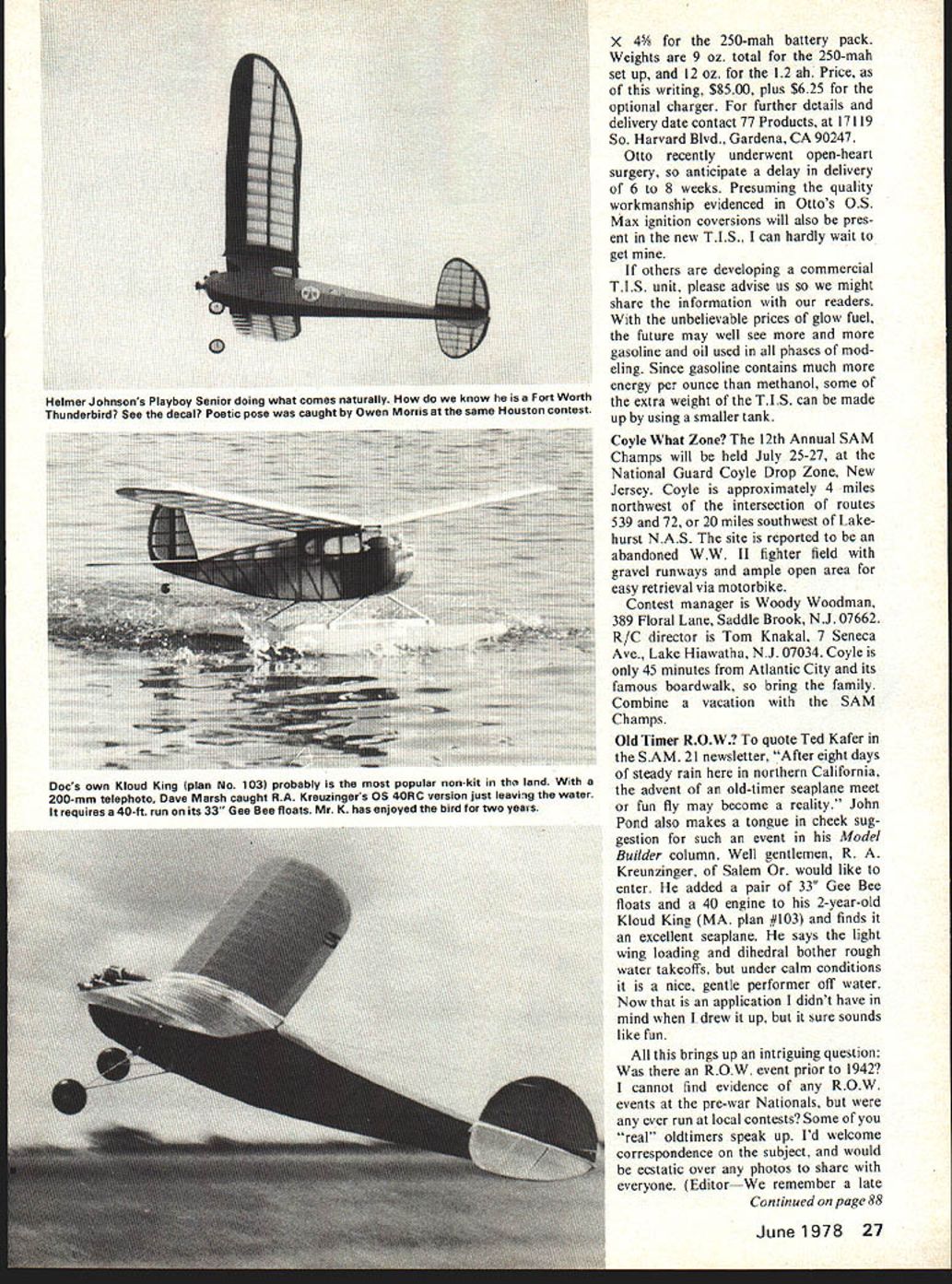
To quote Ted Kafer in the S.A.M. 21 newsletter: "After eight days of steady rain here in northern California, the advent of an old-timer seaplane meet or fun fly may become a reality." John Pond also makes a tongue-in-cheek suggestion for such an event in his Model Builder column. Well gentleman, R. A. Kreunzinger, of Salem, Or. would like to enter. He added a pair of 33" Gee Bee floats and a 40 engine to his 2-year-old Kloud King (MA. plan #103) and finds it an excellent seaplane. He says the light wing loading and dihedral bother rough water takeoffs, but under calm conditions it is a nice, gentle performer off water. Now that is an application I didn't have in mind when I drew it up, but it sure sounds like fun.
All this brings up an intriguing question: Was there an R.O.W. event prior to 1942? I cannot find evidence of any R.O.W. events at the pre-war Nationals, but were any ever run at local contests? Some of you "real" oldtimers speak up. I'd welcome correspondence on the subject, and would be ecstatic over any photos to share with everyone. thirties R.O.W. free flight event at Lake Hopatcong, NJ; published in Air Trails.)
The flying of old-timer models off water certainly has an appeal. Many of us have access to ponds and lakes (sure we have lakes in Kansas). A delightful way to combine a picnic and family outing with our favorite recreation.
Say that again SAM: There still appears to be some confusion over the legality of glow engines in RC Old-Timer events. Glow engines are completely legal in all SAM Radio-Assist events. According to the latest ballot from the SAM membership, the use of glow engines in free flight oldtimers is prohibited. All changes submitted for Section III were rejected by the membership.
To quickly review the vote for the non-SAM reader: The only changes in the rules governing free flight events are: removal of the responsibility of authentication of the design from the builder, and allowing two models per event. The Radio Control Assist changes are: 8 oz. per sq. ft., whether ignition or glow powered; glow and converted-to-ignition engines require 225 sq. in. of wing area for each 10 cu. in. of displacement; and the outlawing of pressure fuel systems, rear-rotor engines, and tuned pipes.
Flight Rule changes for Radio Assist are: Maximum time of flights will be five minutes, all overtime to be deducted. Engine runs changed to 20 seconds for glow and 40 seconds for ignition. Six attempts for three officials (an attempt being any flight under 40 seconds). Timer will stop calling time 10 seconds prior to max.
All other rules remain as printed in the Society of Antique Modelers official rule book for 1978 and the AMA 78-79 rule book. The rules are now finalized, and we can all learn to live with them, regardless of personal preferences. It would appear that few, if any, RC Assist models developed over the last few seasons, or built this winter, will require any major modifications to remain SAM legal. Several of the "performance gaps" between the sparkers and the glows have been closed. Hopefully, the new contest season will see ever increasing numbers of entrants enjoying this delightful aspect of our hobby-sport.
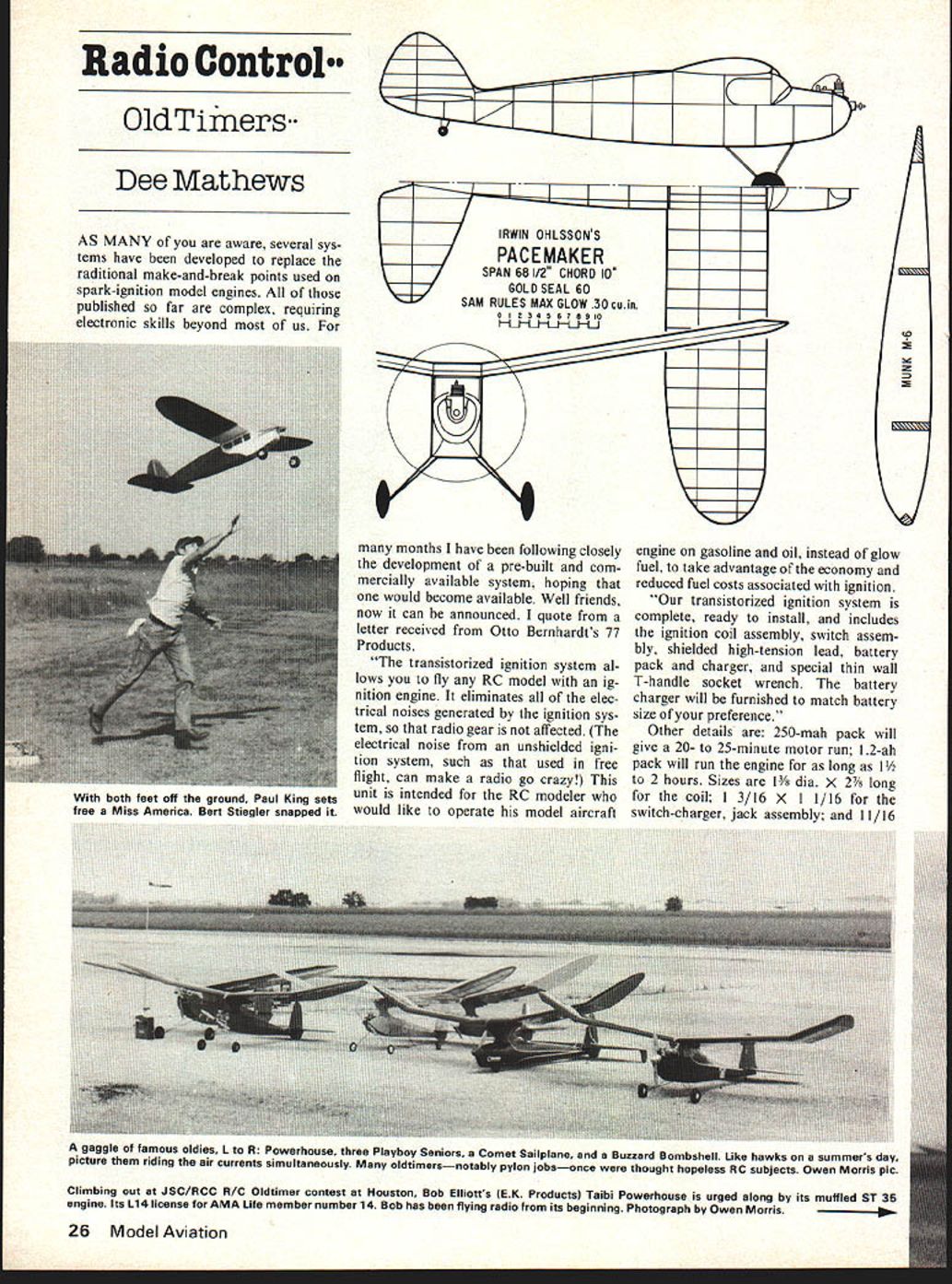
Ohlsson's California "Champion" Pacemaker: The Ohlsson name is familiar to anyone who ever had even a remote interest in powered model aircraft. Irwin and his partner, Harry Rice, produced many tens of thousands of engines in the 1937 to 1955 era. What may not be so well known is that Irwin started in the business with a model kit, the "California Record Holder" first advertised in MAN in July, 1936. It featured a Brown Jr. on the drawings.
Ohlsson decided to enter the engine manufacturing business. In developing the prototype engine he felt a need for testing in all flight conditions. The Pacemaker was the test bed for the new "Miniature" engine. The Feb. 1937 issue of MAN contains a photo of this combination clearly illustrating a radical departure from the then-standard beam engine mounts. The Pacemaker was the first model ever to utilize a radial motor mount.
The Pacemaker kit was immensely successful in California. The unique motor mount and attractive cabin design lent itself to a variety of cowl and paint configurations. Ohlsson won the California State Fair Contest in Sept. 1937, by a large margin and the legend began. Expressly developed for the new 30-second-motor-run rules, the Pacemaker received maximum points when judged for engineering and design. The "Miniature" engine was entered in the aeronautical display at the same fair and received the "gold seal" award, hence the name of this famous engine became "Gold Seal."
The Pacemaker construction is conventional, with the exception of dural wire wing tips and empennage outlines. I would strongly recommend laminated basswood, or sheet, outlines. Spruce fuselage members and wing spars would be an excellent substitution. With these changes, the Pacemaker would be a splendid choice for seaplane events, or could be a delightful sport model. Under S.A.M. rules, the maximum engine size would be 4.0 c.c. (25 cu. in.).
Time-Target Events a Trend? Time-target precision events can be great fun and fine equalizers for beginners and experts. Such events were popularized on the West Coast prior to WW II, often including beauty and craftsmanship points in the formula. I find it amusing to note that, back then, the thermal events were much more popular on the East Coast and in the mid-West, while events more suitable for small fields were more popular on the West Coast. One observes the West Coast origin of such popular thermal designs as the Pacemaker, Mystery Man, Winged Victory, Westerner, Dennyplane, and similar beauties.
Time-target appearance events were also very popular in England prior to WWII. I witness the Bowden Perpetual Trophy. England also produced some designs of strong esthetic appeal during this era. Two outstanding examples being the Vulcan, by D. H. Russel, and Barnard's Premier Lion. Incidentally, if any one has a picture of either of these I'd like to use them as Old-Timer-of-the-Month subjects.
The time-target events are rapidly gaining popularity around the country. A prominent factor is the desire to somehow equalize the disparities in performance between the more ordinary (popular) prototypes, such as Clippers and Playboys, and the equally appealing designs that lack their floating ability. We mentioned in our last column the rules for 15-minute precision used by the Houston group. The approaches with considerable appeal are "Chicken" and "Add 'em Up."
The Chicken events employ a 30-second motor run, the watch starting when the flier hands his transmitter to the timer, and stopping when he takes (grabs?) the thing back. Ten-minute max's with bonus points for landing inside a circle, and a no-time recorded for off-field landings. This event can close much of the performance gap previously mentioned, the superior wind penetration of the flat-bottomed Clark Y airfoils offsetting the floating ability of the more traditional contest machines.
"Add 'em Up" has as its objective a 15-minute three-flight total, with flight time reduced, second for second, for any single flight over 7 minutes. Bonus points are usually awarded for landing inside a designated circle. Here again, the "floaters" are at no particular advantage, unless the contestant chooses to spin out of the boomer and crash inside the circle.
Clarence Haught has mentioned in his column a growing concern over the nearly total domination of the Antique classes by the Clipper MkII. Many of us have distaste for the one-design trend the Playboys are producing in Old Timer events. One need only examine the results from nearly every contest, to see the trend. The early days of the S.A.M. movement saw entries composed of numerous, diverse and interesting designs, so much so that we enjoyed walking around playing the "what is that?" game. This is no longer the case. The current situation almost forces any one interested in winning to choose from a narrow band in the wide spectrum of available choices.
Hopefully, more and more S.A.M. chapters will innovate events that bring back some diversity of design, and introduce a stronger element of luck and fun.
Radio Control: Old Timers
Let's face it folks: AMA free flight and RC glider events can provide all the ferocious competition anyone wants. SAM events are a chance for relaxation, good fellowship, and, most importantly, fun!
Painless Servo Mounts:
A continuously perplexing problem in converting Old Timer models to radio has been mounting the servos to the fuselage frame sides. Invariably, we end up using heavy maple motor-mount stock, epoxied in place on the sides, with cross members to hold down the servo tray. Hardly a neat or light-weight method. I have recently used the "Ser-kit" by Buckeye Balsa, 3330 Youngstown-Kingsville Road, Cortland, Oh. 44410, and find it to be ideal for old-timer use. It consists of two grooved hardwood blocks, 1/4 x 9/16 x 2 3/8, into which two tight-fitting rails are slid, then adjusted fore and aft for an optimum servo location, and glued into the slots and retained with scraps left over from cutting the rails. All in all, a simple solution to a complex problem.
Buckeye Balsa also has an inventory of sheet balsa, and balsa and spruce strip, in 54, 60, 66, and 72" lengths. Wood of these long lengths is often needed in the construction of the really huge old timers, if one is to avoid splicing.
Dee B. Mathews, 506 South Walnut, Greensburg, KS 67054.
Transcribed from original scans by AI. Minor OCR errors may remain.

