
Radio Control - OldTimers - Dee Mathews
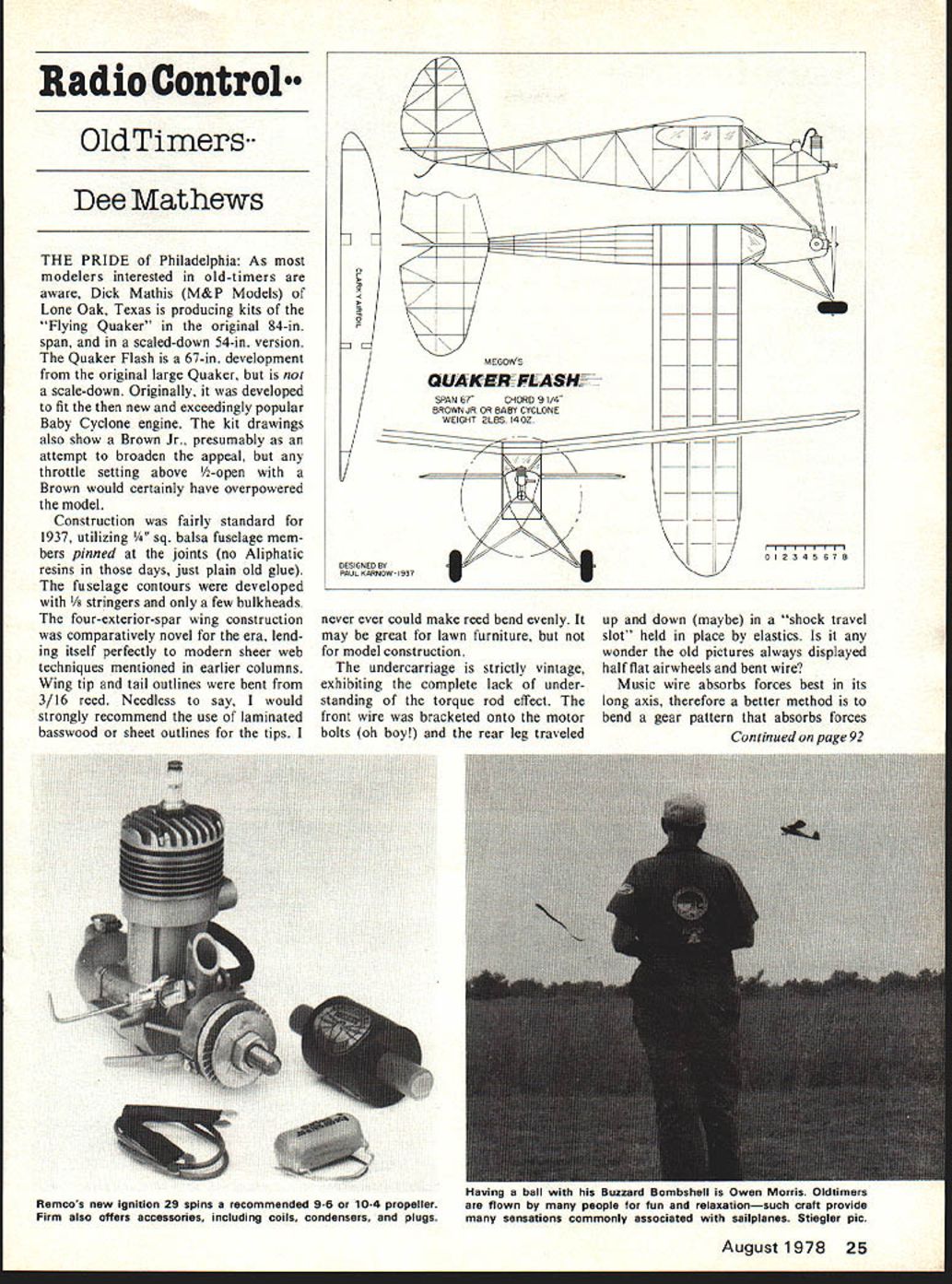
THE PRIDE of Philadelphia: As most modelers interested in old-timers are aware, Dick Mathis (M&P Models) of Lone Oak, Texas is producing kits of the "Flying Quaker" in the original 84-in. span, and in a scaled-down 54-in. version. The Quaker Flash is a 67-in. development from the original large Quaker, but is not a scale-down. Originally, it was developed to fit the then new and exceedingly popular Baby Cyclone engine. The kit drawings also show a Brown Jr., presumably as an attempt to broaden the appeal, but any throttle setting above 1/2-open with a Brown would certainly have overpowered the model.
Construction was fairly standard for 1937, utilizing 1/4" sq. balsa fuselage members pinned at the joints (no Aliphatic resins in those days, just plain old glue). The fuselage contours were developed with 1/8" stringers and only a few bulkheads. The four-exterior-spar wing construction was comparatively novel for the era, lending itself perfectly to modern shear web techniques mentioned in earlier columns. Wing tip and tail outlines were bent from 3/16" reed. Needless to say, I would strongly recommend the use of laminated basswood or sheet outlines for the tips. I never ever could make reed bend evenly. It may be great for lawn furniture, but not for model construction.
The undercarriage is strictly vintage, exhibiting the complete lack of understanding of the torque rod effect. The front wire was bracketed onto the motor bolts (oh boy!) and the rear leg traveled up and down (maybe) in a "shock travel slot" held in place by elastics. Is it any wonder the old pictures always displayed half-flat airwheels and bent wire?
Music wire absorbs forces best in its long axis; therefore a better method is to bend a gear pattern that absorbs forces along its length rather fore-and-aft. Sounds confusing? Consider landing gear in contemporary RC designs: mains don't absorb bending torque; the force simply twists the wire. A model like the Flash needs a dog-leg bend; Top Flite gear used on Old Reliable (see June MA) is attached to a solid-surface fuselage bottom. Actually, this type of torque-rod gear doesn't need a rear leg — one should be used for the sake of authentic appearance.
Quaker Flash would make a delightful subject as a 3-4 cc-sized model. It apparently has excellent moments, a huge rudder, ample dihedral, a cabin large enough for radio installation, and natural hinge lines for rudder and elevator. With the undercarriage modified it should provide ample ground handling. Construction is relatively simple and straightforward; Flash makes a good first old-timer project. An excellent short kit — sheet pieces pre-cut, no strip wood — is also available from Schmidt Custom Kits, 11948 Franklin Blvd., Elk Grove, CA 95624. Plans #5E4: John Pond, Box 3215, San Jose, CA 95156.
Painless Solo Flights:
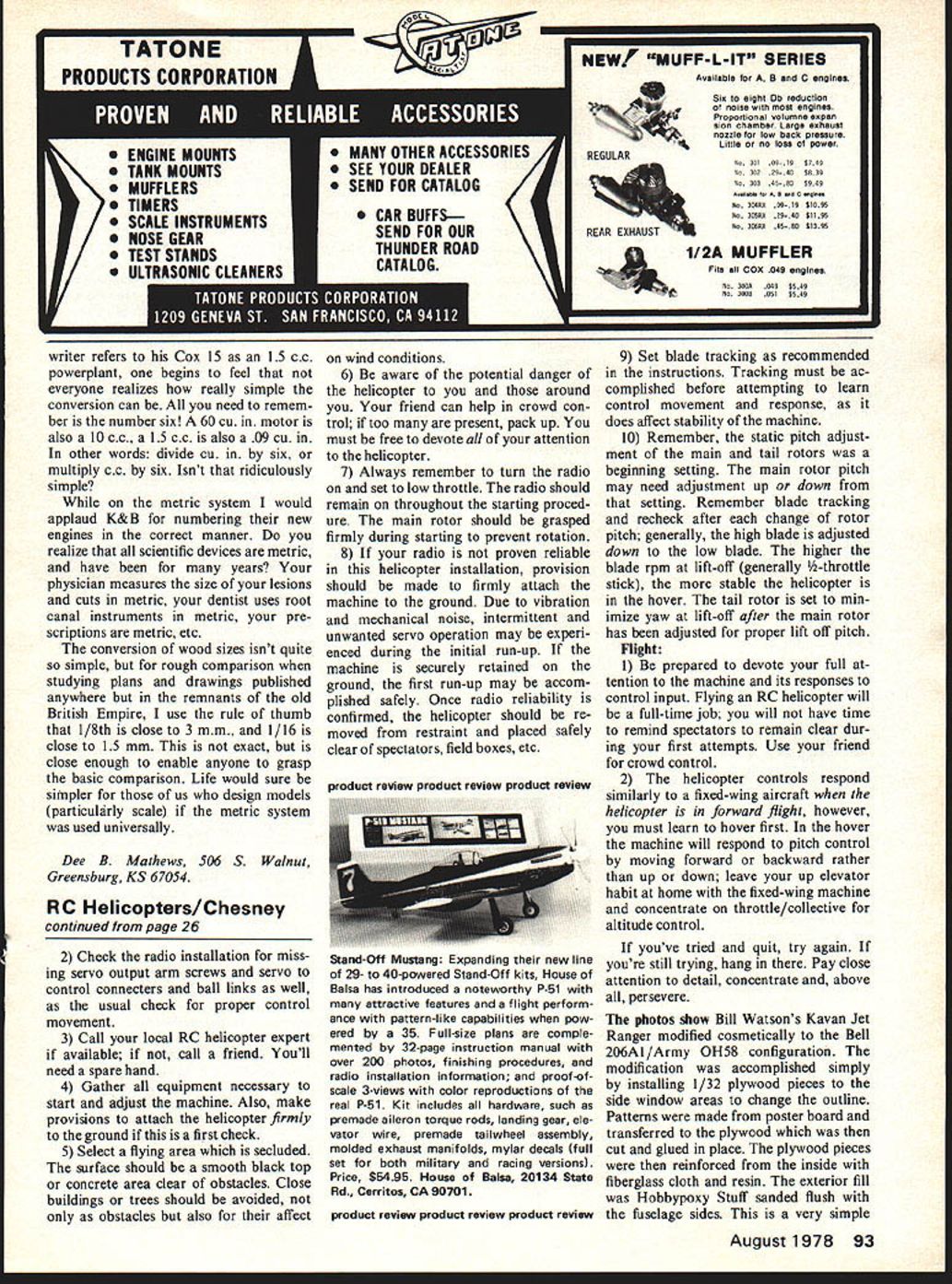
To quote Ed Moorman from Eglin (FL) Aeromodellers, The Beam, "Recently, I let four or five people who had not touched a stick before fly my Buzzard Bombshell. All of them flew it O.K., and I even let two of them land it on their first flights. You might say they soloed the first time out."
I have done this type of thing several times, and never cease to be amazed how well rank beginners can do with a model that moves slowly, and has the ability to correct its flight path if allowed to. Old-timers do make excellent trainers.
Got the picture?:
Writing this column is not really that difficult; the major frustration for me is maintaining a supply of interesting and unusual photos. The pictures with this month's column are about all I have left. I desperately need quality black and white photos or negatives. If enlargement is a problem for you, send me your negatives, and I'll gladly blow them up. Could it be that you photographers aren't aware that Tri-X film is available for 35mm cameras?
Free Sun Helmets?:
In the March/April C.I.A. Informer Harry Murphy reproduces a contest entry form for a Free Flight contest held Sunday June 13, 1948 at Anderson Ind. Several long forgotten features of contests back then jump out of the pictures. The contest was sponsored by an automobile dealer and a local newspaper, hence no entry fees were charged. Sun helmets were given the first 150 entrants. All four events had awards to tenth place, with prizes ranging from an Anderson Spitfire for first place, an Atwood Champion for second, down to ten tubes of glue for tenth place. Similar merchandise was awarded for all events, trophies being only for first place.
All of us who have a trophy case full of useless chrome-plated dust collectors can feel a strong tinge of envy for those long ago winners. I have some trophies I'd willingly swap for ten tubes of glue. With the lack of entry fees and "pith hats" for everyone, no wonder the contest drew 140 entries.
For those readers who weren't modeling in the 1948 era, let's explain the four classes of free flight and U-control as they were set up then. Class A events were for engines of .20 and under. Class B for .20 to .30, Class C .30 to .50, and Class D events were for engines of more than .50. If you've ever wondered why there are Madewell, McCoy, Triumph, etc., .49 engines, you now know. I have a Triumph .49, and a Triumph .51 that were used much as modern free flighters do the Tee Dee .049 and .051 — one plane, two engines, two events.
What Size Engine is Suitable?:
I'd be wise to hedge on this question, but what the heck. For all practical purposes modern glow engines produce twice the power per cu. in. displacement as do the old ignition powerplants. If the original plans show a Brown Jr. .60, use a Sport .29; if a .29 is shown, consider a .15 glow. For pure competition purposes, .35 glow for .60 ignition seems a good conversion, although I've seen glow .40s used with rather terrifying results. The huge old birds (over 6 feet or so) were often underpowered with ignition .60s (the Super Buccaneer and Powerhouse show a Forster 99 on the plans), therefore my suggestion on these is to come towards the top end of the SAM rule of 10 cu. in./225 sq. in.
My experience with glow converted to ignition, such as Otto Burdick and Bruce Chandler have available (the addresses are in the SAM list), seems to indicate less than a ten percent power loss, so that these should be treated as slightly weak glow engines when matching them to model size. As a rule of thumb, use a .50 size factor, glow to ignition, for sport; a 60% factor for competition and converted engines. Of course, for competition, the SAM rules are pretty specific, but can produce some Schneurle-powered hairy monsters on occasion.
The Magic number is six:
The conversion of cubic centimeters to cubic inches, and the reverse, is so simple that I wonder about a recent construction article in another magazine. When a highly regarded writer refers to his Cox 15 as an 1.5 c.c. powerplant, one begins to feel that not everyone realizes how really simple the conversion can be. All you need to remember is the number six! A 60 cu. in. motor is also a 10 c.c., a 1.5 c.c. is also a .09 cu. in. In other words: divide cu. in. by six, or multiply c.c. by six. Isn't that ridiculously simple?
While on the metric system I would applaud K&B for numbering their new engines in the correct manner. Do you realize that all scientific devices are metric, and have been for many years? Your physician measures the size of your lesions and cuts in metric, your dentist uses root canal instruments in metric, your prescriptions are metric, etc.
The conversion of wood sizes isn't quite so simple, but for rough comparison when studying plans and drawings published anywhere but in the remnants of the old British Empire, I use the rule of thumb that 1/8th is close to 3 mm., and 1/16 is close to 1.5 mm. This is not exact, but is close enough to enable anyone to grasp the basic comparison. Life would sure be simpler for those of us who design models (particularly scale) if the metric system was used universally.
Dee B. Mathews, 506 S. Walnut, Greensburg, KS 67054
As modelers interested in old-timers are aware, Dick Mathis of M&P Models, Lone Oak, Texas, is producing kits of the Flying Quaker — the original 84‑in. span — and a scaled‑down 54‑in. version; the Quaker Flash is a 67‑in. development of the original large Quaker scale‑down. Originally developed to fit the new, exceedingly popular Baby Cyclone engine, the kit drawings also show Brown Jr., presumably an attempt to broaden appeal. With the throttle setting above wide‑open, Brown would certainly have overpowered the model.
Construction is fairly standard 1937, utilizing false fuselage members, pinned joints — no aliphatic resins in those days, just plain old glue. Fuselage contours were developed with stringers and few bulkheads. Four‑exterior‑spar wing construction was comparatively novel in that era, lending itself perfectly to the modern shear‑web techniques mentioned in earlier columns. Wing tip and tail outlines were bent from 3/16" reed. Needless to say, I would strongly recommend use of laminated basswood sheet outlines for tips.
MEGOWS QUAKER FLASH — SPAN 67" CHORD 9 1/4" BROWN JR OR BABY CYCLONE WEIGHT 2 LBS. 14 OZ. DESIGNED BY PAUL KARNOW — IBS
I never ever could make reed bend evenly; maybe great for lawn furniture models. The undercarriage is strictly vintage, exhibiting a complete lack of understanding of the torque‑rod effect. Front wire bracketed onto motor bolts — oh boy — rear leg traveled up and down, maybe shock travel slot held in place with elastics. I wonder why old pictures always displayed half‑flat airwheels. Bent wire: music wire absorbs forces best along its long axis; therefore a better method is to bend the gear pattern so it absorbs forces along its length rather than fore and aft. Sounds confusing; consider landing gear in contemporary RC designs — mains don't absorb bending torque force; a straight twist of wire lengthwise on a model like the Flash needs a bent dog‑leg. Top Flite gear used on Old Reliable (see June MA) attached to a solid‑surface fuselage bottom. Actually this type of torque‑rod gear doesn't need a rear leg; the rear leg should be used for the sake of authentic appearance.
The Quaker Flash would make a delightful subject for a 3/4‑size model. It apparently has excellent moments, a huge rudder, ample dihedral and a cabin large enough for radio installation. It has natural hinge lines for rudder and elevator. Undercarriage modified should provide excellent ground handling. Construction is relatively simple and straightforward. Flash makes a good first old‑timer project. An excellent short kit: sheet pieces pre‑cut, no strip wood. Also available from Schmidt Custom Kits, 11948 Franklin Blvd., Elk Grove, CA 95624. Plans: #5E4 John Pond, Box 3215, San Jose, CA 95156.
Transcribed from original scans by AI. Minor OCR errors may remain.

