
Radio Control: Old Timers
Dee Mathews
I have in my collection an old book titled Models for Flying, by L. H. Sparey and C. A. Rippon, of England. This and several other delightful collectors' items were given to me by Mr. Roy Hull, a senior engineer on the Hawker-Siddeley Harrier project. He wished to place his collection with someone who would cherish it as he had for over 40 years. He said, "I fear that upon my demise the wife will put them out for the dustman."
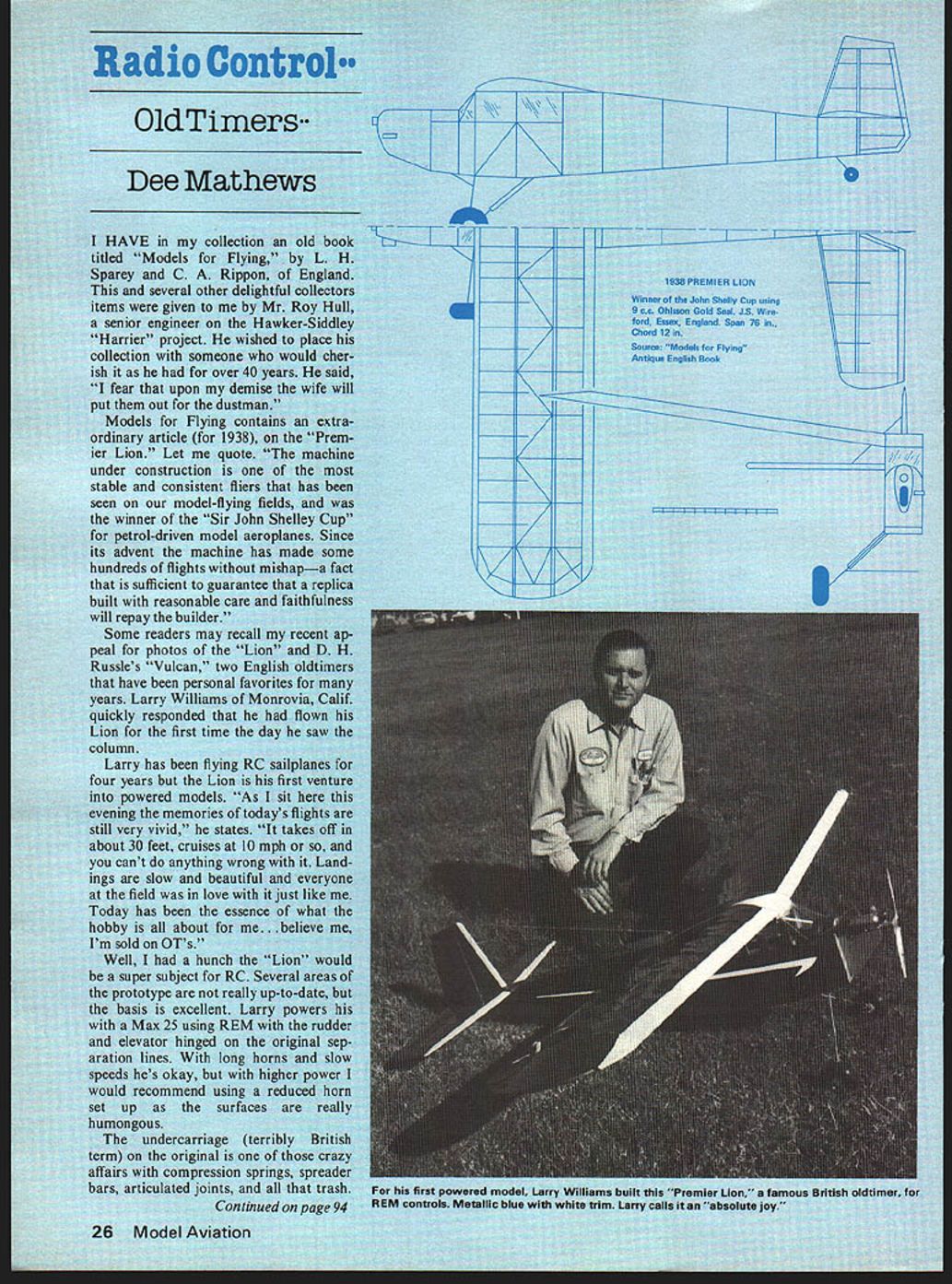
Models for Flying contains an extraordinary article (for 1938) on the "Premier Lion." Let me quote: "The machine under construction is one of the most stable and consistent fliers that has been seen on our model-flying fields, and was the winner of the 'Sir John Shelley Cup' for petrol-driven model aeroplanes. Since its advent the machine has made some hundreds of flights without mishap—a fact that is sufficient to guarantee that a replica built with reasonable care and faithfulness will repay the builder."
Some readers may recall my recent appeal for photos of the Lion and D. H. Russell's Vulcan, two English oldtimers that have been personal favorites for many years. Larry Williams of Monrovia, Calif., quickly responded that he had flown his Lion for the first time the day he saw the column.
Larry has been flying RC sailplanes for four years but the Lion is his first venture into powered models. "As I sit here this evening the memories of today's flights are still very vivid," he states. "It takes off in about 30 feet, cruises at 10 mph or so, and you can't do anything wrong with it. Landings are slow and beautiful and everyone at the field was in love with it just like me. Today has been the essence of what the hobby is all about for me... believe me, I'm sold on OTs."
I had a hunch the Lion would be a super subject for RC. Several areas of the prototype are not really up-to-date, but the basis is excellent. Larry powers his with a Max 25 using REM with the rudder and elevator hinged on the original separation lines. With long horns and slow speeds he's okay, but with higher power I would recommend using a reduced-horn setup as the surfaces are really humongous.
The undercarriage (a terribly British term) on the original is one of those crazy affairs with compression springs, spreader bars, articulated joints, and all that trash.
Modern films are butyrate (look on the edge of a negative strip).
Those of us who were forced to use nitrate dope and cement before the introduction of the fuelproof finishes have horror stories of belching engines and burning models. Interestingly, several recent accounts of incineration in other magazines fail to mention the nitrate dope, only the backfiring engines.
Nitrate dope fumes are also extremely flammable and caution should be exercised when applying it in a confined space, or near an open flame. A furnace or hot water heater in close proximity to the workbench can present a severe hazard. Also don't "flick your BIC" while doping with nitrate, or you may make an "ash" of yourself.
Nitrate dope's low shrinkage, quick setting, and excellent compatibility with epoxy and polyurethane overcoats make it a desirable addition to our finishing techniques, but do follow the precautions printed on the label.
In a recent column in this magazine, George Myers presented some excellent comments on antenna placement and its effect on radio range. Since range is of considerable interest to fliers of radio-assist oldtimers, I'd recommend you read his remarks if you happened to miss them. The skeleton photo of the Powerhouse in my February column illustrates my favorite method of installing the antenna wire: the Nyrod tube running from the cabin into the tail area.
One need only gently push the wire into the tubing, even pulling it out through the covering in shorter fuselages. Too many oldtimers exhibit an obvious failure to consider antenna placement during construction, with the inevitable result being a hunk of wire flying around in the breeze. Most un-oldtimer-looking, unless it's important that everyone know you've got a radio in your model.
I still have corrected copies of the S.A.M. suppliers list available. For those who wonder who, and where, for plans, kits, engines, hardware, etc., send me a large S.S.A.E. for your free list. Get 'em while they last. There's a prize in every box.
Bob Oslan advises he is discontinuing his Cal Aero line of Oldtimer kits. He has a few Series 50 Powerhouse and Air Trails Sportster kits left. Both are for 1.5 cc to 2.5 cc power and two- or three-channel radio. As can be seen in the photo, the Sportster has unmistakable signs of coming off Ben Shereshaw's drawing board. However, Oslan has enlarged the original to a more suitable size. The pre-cut pieces are all band-sawn and sanded, the wood is well graded and of top quality, the plans and instructions should be adequate for the most inexperienced of builders, and only a "fumble thumbs" could build one that didn't fly well.
It is regrettable that Cal Aero has chosen to follow Chuck Gill in withdrawing from the oldtimer kit business. Hopefully, some other kitters will acquire Gill's full-size Powerhouse and Bob Oslan's two designs. For the last of the Cal Aero kits contact Bob Oslan, 7142 Bluesails Drive, Huntington Beach, CA 92647.
Dee B. Mathews 506 South Walnut Greensburg, KS 67054
Transcribed from original scans by AI. Minor OCR errors may remain.

