
Radio Control
Old Timers
Dee Mathews
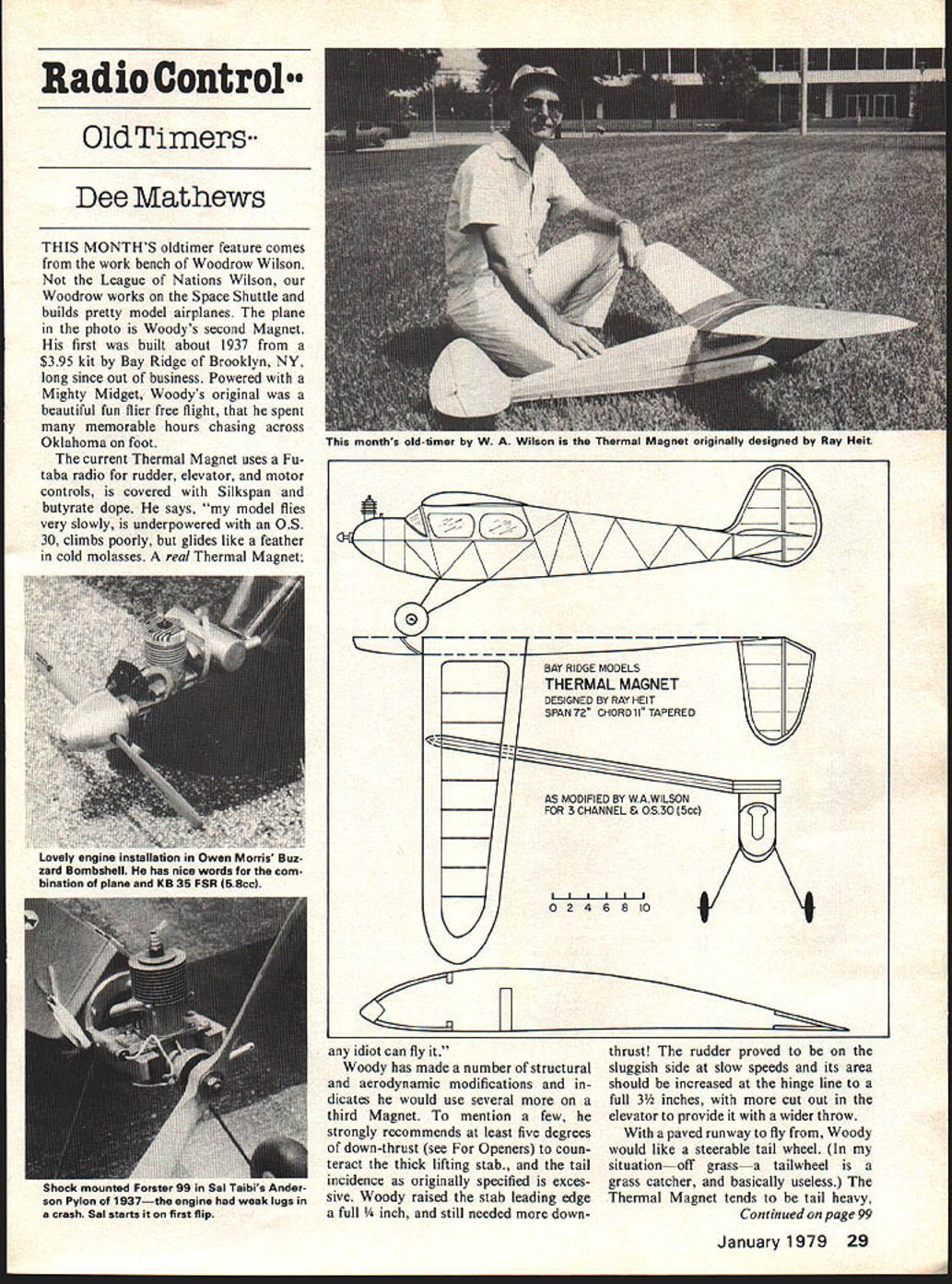
This month's Oldtimer feature comes from the work bench of Woodrow Wilson. Not the League of Nations Wilson — our Woodrow works on the Space Shuttle and builds pretty model airplanes. The plane in the photo is Woody's second Magnet. His first was built about 1937 from a $3.95 kit by Bay Ridge of Brooklyn, N.Y., long since out of business. Powered with a Mighty Midget, Woody's original was a beautiful free flier he spent many memorable hours chasing across Oklahoma on foot.
The current Thermal Magnet uses a Futaba radio for rudder, elevator, and motor controls and is covered with Silkspan and butyrate dope. He says, "My model flies very slowly, is underpowered with an O.S. 30, climbs poorly, but glides like a feather in cold molasses. A real Thermal Magnet; any idiot can fly it."
Woody has made a number of structural and aerodynamic modifications and indicates he would use several more on a third Magnet. To mention a few, he strongly recommends at least five degrees of down-thrust (see For Openers) to counteract the thick lifting stab, because the tail incidence as originally specified is excessive. Woody raised the stab leading edge a full 1/4 inch and still needed more down-thrust. The rudder proved sluggish at slow speeds and its area should be increased at the hinge line to a full 3-1/2 inches, with more cutout in the elevator to provide a wider throw. With a paved runway to fly from, Woody would like a steerable tail wheel. (In my situation — off grass — a tailwheel is a grass catcher and basically useless.) The Thermal Magnet tends to be tail heavy, and Woody cautions any would-be builder to "think light." He cut his elevator and rudder from 1/2" sheet, but recommends built-up surfaces or punching many holes in the sheet. Radio components should be placed well forward. Woody also used some wood size substitutions (but no spruce) to better carry the loads and standardize dimensions. He has done a splendid job of thinking out the conversion of this grand old design to modern use.
Woodrow Wilson, 1423 Basilan Lane, Houston, TX 77058.
Danny Sheelds has compiled a collection of antique ads and photos in booklet form that puts size and shape to all those mysterious names that appear on the oldtimer plans lists. Containing nearly 80 pages of layouts, ads and pictures of "gas jobs" up to Dec. 1942, the booklet costs $6.95.
Danny Sheelds, 3 Cinnamon Circle, Apt. 1C, Randallstown, MD 21133. Danny is also producing kits of the "King Burd" KG (Kovel-Grant), designed by Charlie Grant and published in MAN. He used an extended, cantilever mount that projected into the fuselage.
Perhaps the most interesting activity at Oshkosh is "just looking." The commercial exhibits and the flea markets display an incredible variety of interesting and unusual wares. Among the treasure trove was the Wag-Aero booth, a supplier of several items used in full-scale aircraft construction and maintenance that also are applicable to our modeling uses. They stock and will ship clear nitrate dope, plasticized nitrate dope, and nitrate thinner in gallons (a considerable saving over 8 oz. cans). This is the only source of plasticized nitrate that I know of. If any reader knows of a source of T.C.P. in the small quantities we use, please share the information with us.
Also listed in their free catalog are tools, polyurethane and epoxy finishes, Dacron yard goods and tapes, metals, etc. For those seeking the ultimate in jumbo scale kits, Wag also produces parts packs with all the needed pieces to build a Piper J-3 or Wagabond (Vagabond) in one-foot-to-the-foot scale.
Wag-Aero, P.O. Box 181, Lyons, WI 53148.
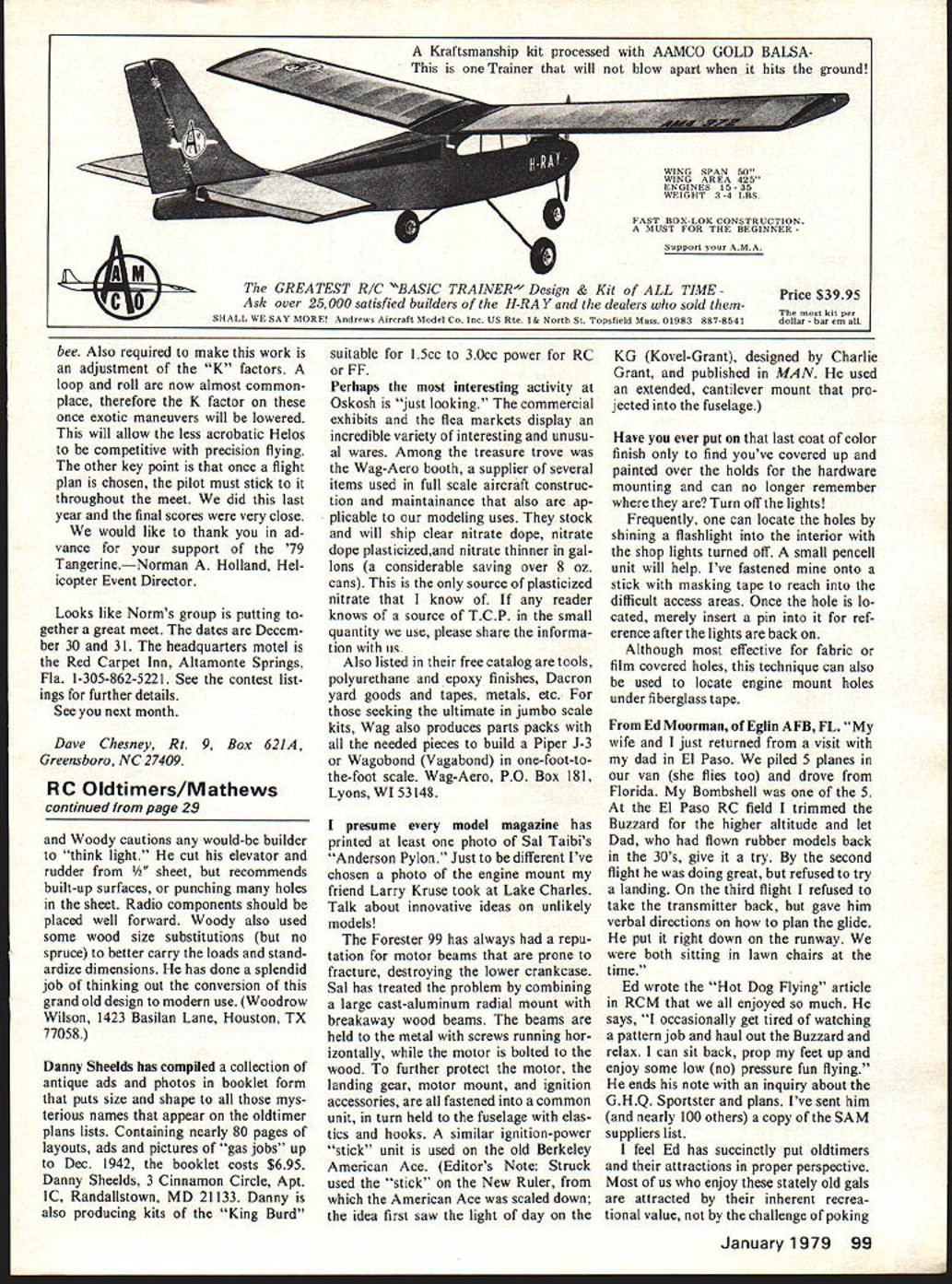
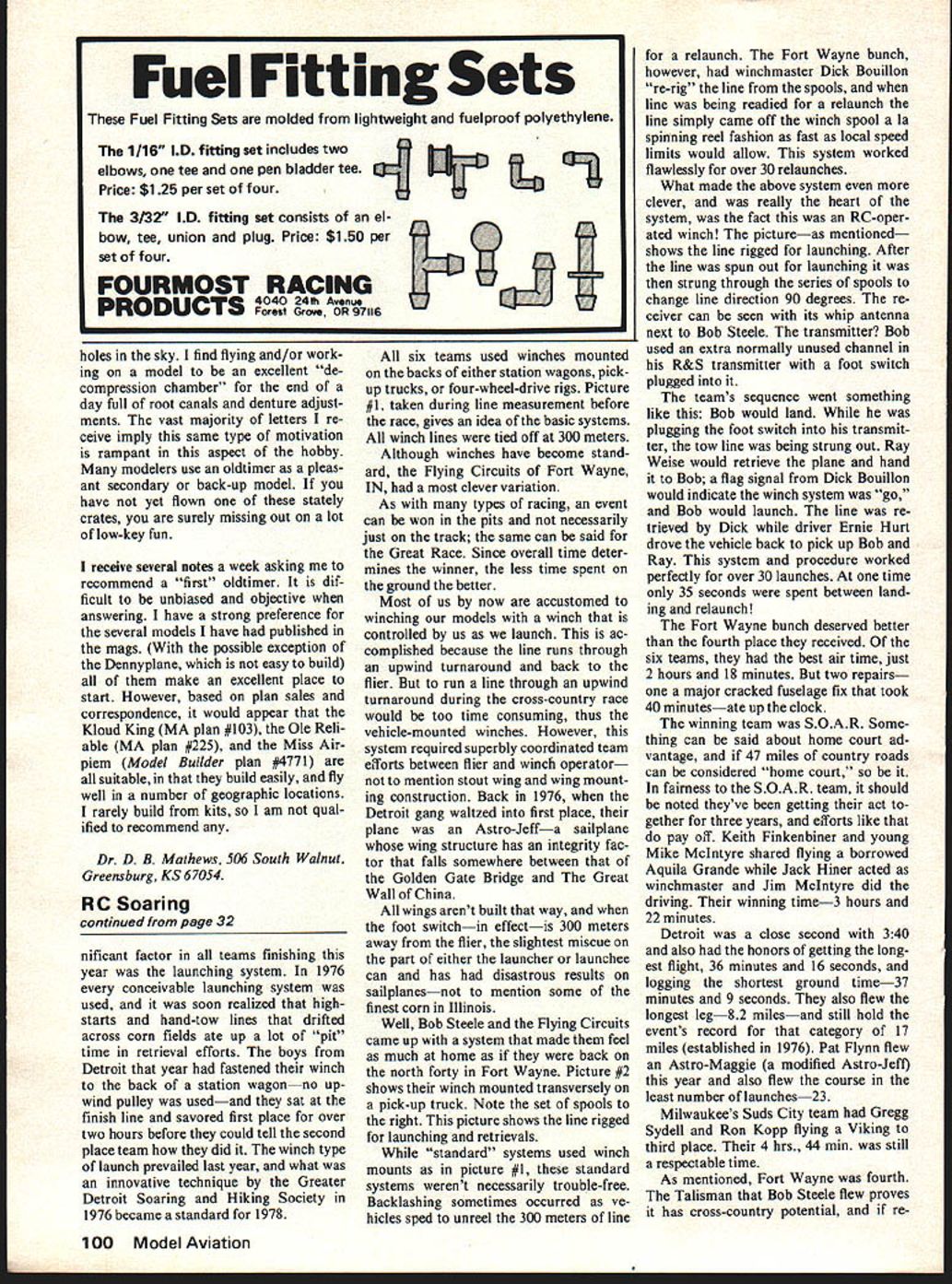
I presume every model magazine has printed at least one photo of Sal Taibi's "Anderson Pylon." Just to be different, I've chosen a photo of the engine mount my friend Larry Kruse took at Lake Charles. Talk about innovative ideas on unlikely models!
The Forester 99 has always had a reputation for motor beams that are prone to fracture, destroying the lower crankcase. Sal has treated the problem by combining a large cast-aluminum radial mount with breakaway wood beams. The beams are held to the metal with screws running horizontally, while the motor is bolted to the wood. To further protect the motor, the landing gear, motor mount and ignition accessories are all fastened into a common unit, in turn held to the fuselage with elastics and hooks. A similar ignition-power "stick" unit is used on the old Berkeley American Ace.
Editor's Note: Struck used the "stick" on the New Ruler, from which the American Ace was scaled down; the idea first saw the light of day on the KG (Kovel-Grant), designed by Charlie Grant and published in MAN. He used an extended, cantilever mount that projected into the fuselage.
Have you ever put on that last coat of color finish only to find you've covered up and painted over the holes for the hardware mounting and can no longer remember where they are? Turn off the shop lights and shine a flashlight into the interior — frequently one can locate the holes this way. A small pencil flashlight will help; I've fastened mine onto a stick with masking tape to reach difficult access areas. Once the hole is located, merely insert a pin into it for reference after the lights are back on. Although most effective for fabric- or film-covered holes, this technique can also be used to locate engine mount holes under fiberglass tape.
From Ed Moorman, Eglin AFB, FL: "My wife and I just returned from a visit with my dad in El Paso. We packed five planes in our van (she flies too) and drove from Florida. My Bombshell was one of the five. At the El Paso RC field I trimmed the Buzzard for the higher altitude and let Dad, who had flown rubber models back in the '30s, give it a try. By the second flight he was doing great, but refused to try a landing. On the third flight I refused to take the transmitter back, but gave him verbal directions on how to plan the glide. He put it right down on the runway. We were both sitting in lawn chairs at the time."
Ed wrote the "Hot Dog Flying" article in RCM that we all enjoyed so much. He says, "I occasionally get tired of watching a pattern job and haul out the Buzzard and relax. I can sit back, prop my feet up and enjoy some low (no) pressure fun flying." He ends his note with an inquiry about the G.H.Q. Sportster and plans. I've sent him (and nearly 100 others) a copy of the SAM suppliers list.
I feel Ed has succinctly put oldtimers and their attraction in proper perspective. Most of us who enjoy these stately old gas jobs are attracted by their inherent recreational value, not by the challenge of poking holes in the sky. I find flying and/or working on a model to be an excellent "decompression chamber" for the end of a day full of root canals and denture adjustments. The vast majority of letters I receive imply this same type of motivation is rampant in this aspect of the hobby. Many modelers use an oldtimer as a pleasant secondary or back-up model. If you have not yet flown one of these stately crates, you are surely missing out on a lot of low-key fun.
I receive several notes a week asking me to recommend a "first" oldtimer. It is difficult to be unbiased and objective when answering. I have a strong preference for the several models I have had published in the mags (with the possible exception of the Dennyplane, which is not easy to build); all of them make an excellent place to start. However, based on plan sales and correspondence, it would appear that the following are suitable — they build easily and fly well in a number of geographic locations:
- Kloud King (MA plan #103)
- Ole Reliable (MA plan #225)
- Miss Airgem (Model Builder plan #477)
I rarely build from kits, so I am not qualified to recommend any.
Dr. D. B. Mathews 506 South Walnut Greensburg, KS 67054
Transcribed from original scans by AI. Minor OCR errors may remain.

