
Radio Control — Old Timers
Dee Mathews
Red Zephyr: Strengthening the Nose
Is it permissible to finish a Red Zephyr in yellow and black? Why select a Red Zephyr as the model of the month when it is so well known?
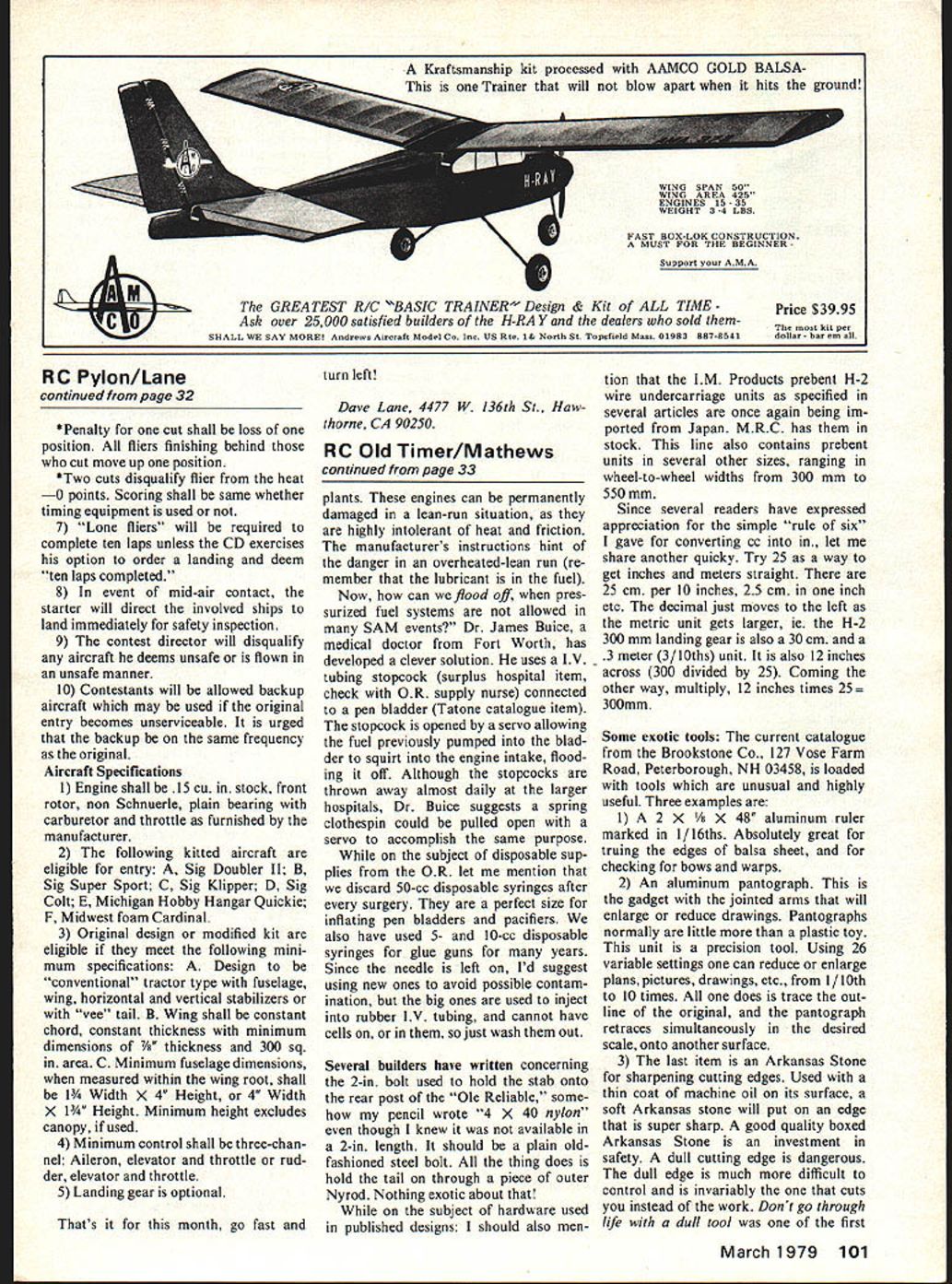
Most anyone who has observed the flight of Herb Greenburg's classic recognizes it as a superb thermal hanger, thanks to its very long tail moment and high-aspect-ratio wing. Yet the Zephyr has an undeserved reputation for a glaring structural weakness. Its construction is light, simple, and economical, but in any contact with something more solid than "tall grass" the nose often separates in front of the wing leading edge. I have observed this mishap at least three times, and John Pond claims it is a 100% probability. A little ingenuity will correct the problem.
Although comparatively unorthodox, using three-ply luan (mahogany) at the base of the nose end, as illustrated in the "Ole Reliable" (MA 6-78), makes the Zephyr as strong as a house. Carry that ply back to the rear cabin bulkhead and form the rear fuselage frame of 3/16" spruce; the ply/open-frame hybrid construction is quite satisfactory. An added benefit is additional weight forward—helpful because the Zephyr tends to be tail-heavy. Anything forward of the CG (about 30–35% of chord) is a dividend.
Wing and Control Surface Changes
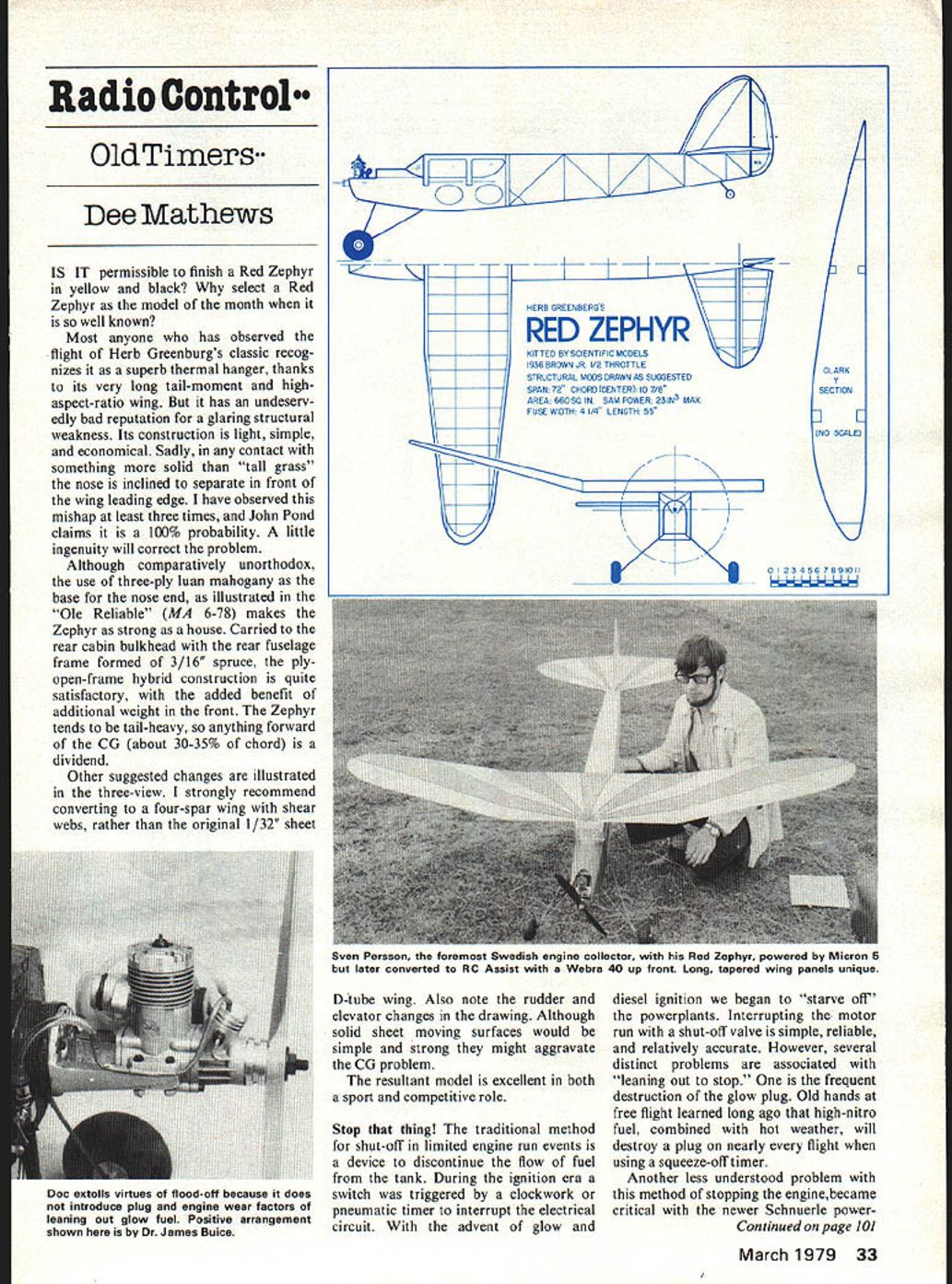
Other suggested changes are illustrated in the three-view. I strongly recommend converting to a four-spar wing with shear webs rather than the original 1/32" sheet D-tube wing. Also note the rudder and elevator changes in the drawing. Although solid-sheet moving surfaces would be simple and strong, they might aggravate the CG problem.
The resultant model is excellent in both sport and competitive roles.
Engine Shut-off Methods
The traditional method for shut-off in limited engine-run events is a device to discontinue the flow of fuel from the tank. During the ignition era, a switch was triggered by a clockwork or pneumatic timer to interrupt the electrical circuit. With the advent of glow and diesel ignition we began to "starve off" the powerplants. Interrupting the motor run with a shut-off valve is simple, reliable, and relatively accurate.
However, several distinct problems are associated with "leaning out to stop." One frequent problem is destruction of the glow plug. Old hands at free flight learned long ago that high-nitro fuel, combined with hot weather, will destroy a plug on nearly every flight when using a squeeze-off timer. Another, less understood problem became critical with the newer Schnuerle powerplants: engines can be permanently damaged in a lean-run situation, as they are highly intolerant of heat and friction. The manufacturer's instructions hint at the danger in an overheated lean run (remember that the lubricant is in the fuel).
Flood-off Solution
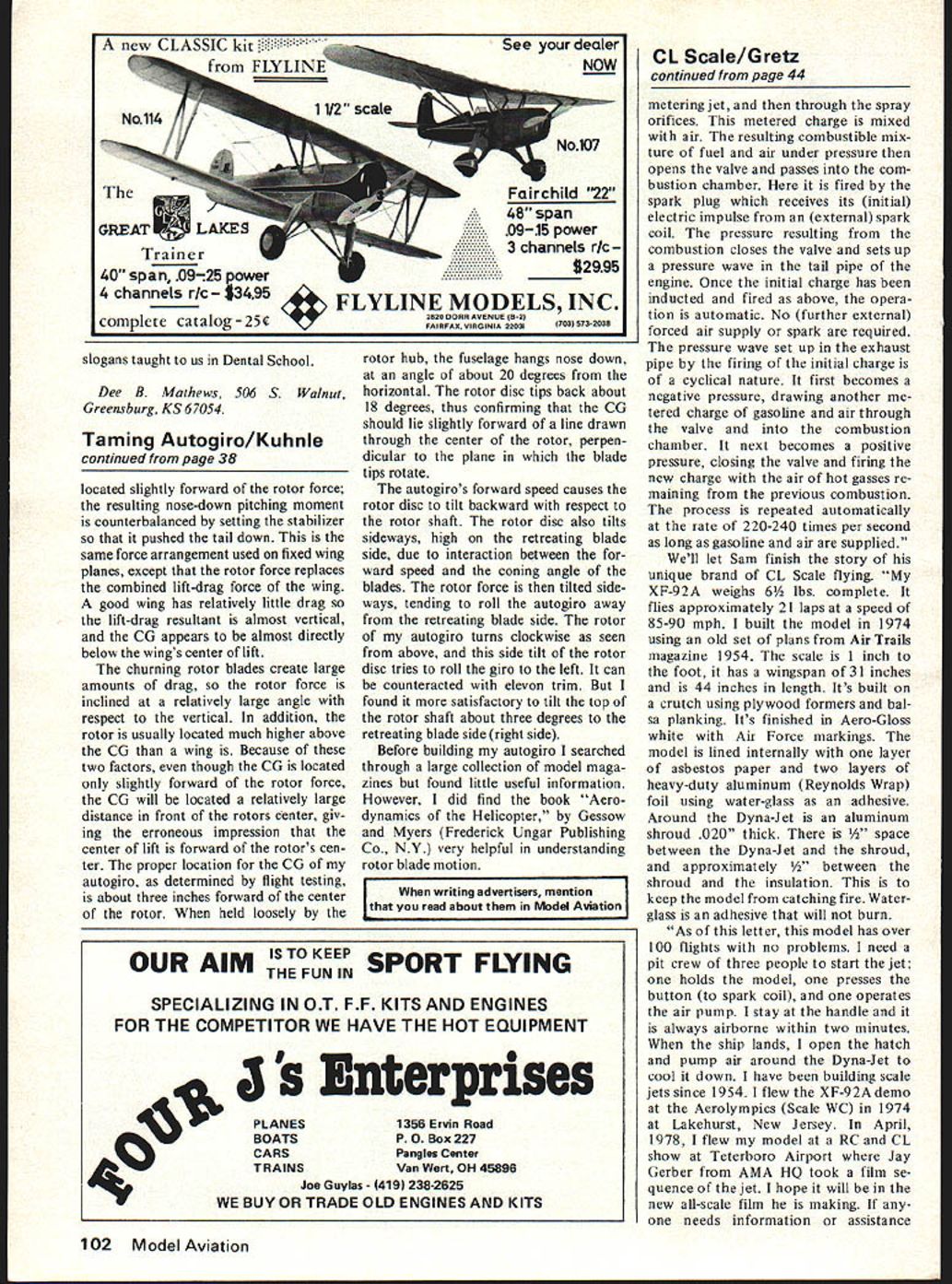
How can we flood off when pressurized fuel systems are not allowed in many SAM events? Dr. James Buice, a medical doctor from Fort Worth, has developed a clever solution. He uses an I.V. tubing stopcock (surplus hospital item—check with an O.R. supply nurse) connected to a pen bladder (Tatone catalog item). The stopcock is opened by a servo, allowing fuel previously pumped into the bladder to squirt into the engine intake, flooding it off. Although stopcocks are thrown away almost daily at larger hospitals, Dr. Buice suggests a spring clothespin could be pulled open with a servo to accomplish the same purpose.
Dr. Buice extols flood-off because it avoids plug wear caused by leaning out glow fuel.
Disposable Supplies from the O.R.
While on the subject of disposable supplies from the O.R., note the following:
- We discard 50-cc disposable syringes after every surgery. They are a perfect size for inflating pen bladders and pacifiers.
- We also use 5- and 10-cc disposable syringes as glue guns. Since the needle is left on, use new ones to avoid possible contamination, but the larger syringes used to inject into rubber I.V. tubing cannot have cells on or in them—just wash them out.
Hardware and Under Carriage Units
Several builders have written concerning the 2-inch bolt used to hold the stab onto the rear post of the "Ole Reliable." My pencil once wrote "4 x 40 nylon" even though I knew it was not available in a 2-inch length. It should be a plain old-fashioned steel bolt. All the thing does is hold the tail on through a piece of outer Nyrod—nothing exotic.
Also, the I.M. Products present H-2 wire undercarriage units specified in several articles are once again being imported from Japan. M.R.C. has them in stock. This line contains units in several sizes, ranging in wheel-to-wheel widths from 300 mm to 550 mm.
Quick Conversion Tip: Rule of 25
Since several readers appreciated the simple "rule of six" I gave for converting ctc into inches, here is another quick tip. Use 25 to get inches and millimeters/meters straight:
- There are 25 cm per 10 inches; 2.5 cm in one inch.
- The decimal just moves to the left as the metric unit gets larger. For example, the H-2 300 mm landing gear is also 30 cm, or 0.3 meters. It is also 12 inches across (300 ÷ 25). Coming the other way, multiply: 12 inches × 25 = 300 mm.
Some Exotic Tools (Brookstone Catalogue)
The current catalogue from the Brookstone Co., 127 Vose Farm Road, Peterborough, NH 03458, is loaded with unusual and highly useful tools. Three examples are:
- A 2 × 1/8 × 48" aluminum ruler marked in 1/16ths. Absolutely great for truing the edges of balsa sheet and for checking bows and warps.
- An aluminum pantograph. This precision tool, with 26 variable settings, will enlarge or reduce drawings from 1/10 to 10 times—far superior to the usual plastic toy versions.
- An Arkansas stone for sharpening cutting edges. Used with a light coat of machine oil, a good Arkansas stone will put on a super-sharp edge. A dull cutting edge is dangerous; a sharp edge is an investment in safety.
Transcribed from original scans by AI. Minor OCR errors may remain.

