
Radio Control: Old Timers
Dee B. Mathews
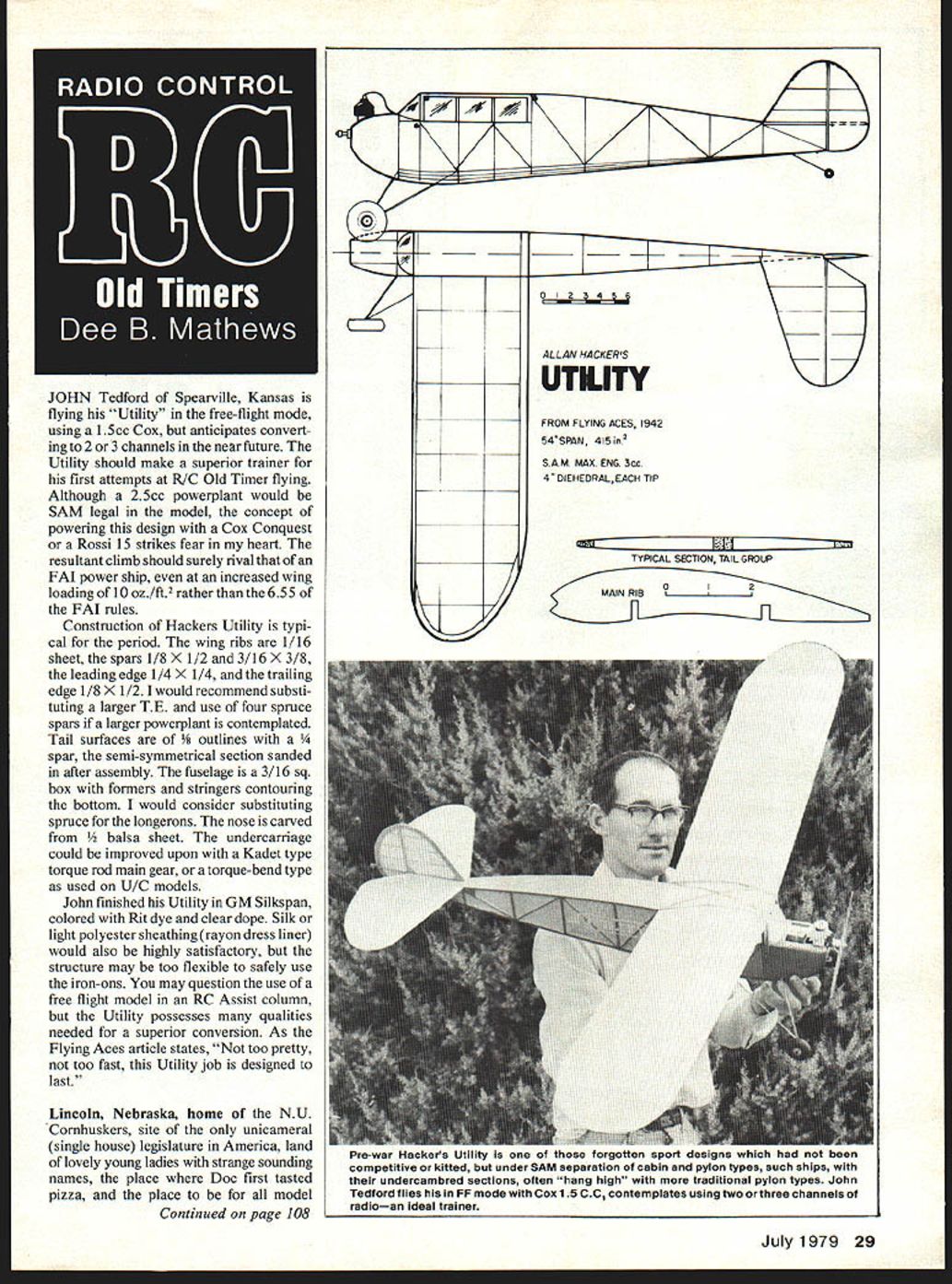
JOHN Tedford of Spearville, Kansas is flying his "Utility" in the free-flight mode, using a 1.5 cc Cox, but anticipates converting to 2- or 3-channel R/C in the near future. The Utility should make a superior trainer for his first attempts at R/C Old Timer flying. Although a 2.5 cc powerplant would be SAM-legal in the model, the concept of powering this design with a Cox Conquest or a Rossi .15 strikes fear in my heart. The resultant climb should surely rival that of an FAI power ship, even at an increased wing loading of 10 oz./ft.2 rather than the 6.55 of the FAI rules.
Construction of Hacker's Utility is typical for the period. The wing ribs are 1/16" sheet, the spars 1/8" x 1/2" and 3/16" x 3/8", the leading edge 1/4" x 1/4", and the trailing edge 1/8" x 1/2". I would recommend substituting a larger trailing edge and use of four spruce spars if a larger powerplant is contemplated. Tail surfaces are of 1/8" outlines with a 1/4" spar, the semi-symmetrical section sanded in after assembly. The fuselage is a 3/16" square box with formers and stringers contouring the bottom. I would consider substituting spruce for the longerons. The nose is carved from 1/8" balsa sheet. The undercarriage could be improved with a Kadet-type torque-rod main gear, or a torque-bend type as used on U/C models.
John finished this Utility in GM Silkspan, colored with Rit dye and clear dope. Silk or light polyester sheathing (rayon dress liner) would also be highly satisfactory, but the structure may be too flexible to safely use the iron-ons. You may question the use of a free-flight model in an R/C Assist column, but the Utility possesses many qualities needed for a superior conversion. As the Flying Aces article states, "Not too pretty, not too fast, this Utility job is designed to last."
Show and Product Notes
- Fab-Tek sport winch: Fab-Tek pointed out this is meant to be a sport winch—one that you take out to fly with to replace your hi-start, not the winch you use for a hundred-plane contest. All-up weight is only 34 pounds; this includes string, foot-switch and battery. However, the battery does not come with the winch and a garden-tractor-type battery is recommended. Using the recommended Sears Deep Cycle Utility Die Hard #96012, about 40 launches can be expected. Write: Fab-Tek, Inc., 17 Sugar Hollow Rd., Danbury, CT 06810.
- Bob Martin R/C Models: Bob Martin showed a line which included plastic molded fuselages. Tough and definitely crash-proof—the three-day demonstration of beating the sports-arena floor showed their durability. Fuselages for the Aquila, Paragon and Coyote are being produced. Write: Bob Martin R/C Models, 3058 N. Marengo Ave., Altadena, CA 91001.
- Hi Flight Model Products (Bill Mueller): Bill Mueller showed his winch—Hi Flight 12. This winch is heavy duty and designed for the hundred-plane contests. Well tested over the past two years, it was selected by the USA FAI Soaring Team for use in Belgium for the World Championships and by the League of Silent Flight for use in the 1979 Tournament. Bill also is now producing the Blane Rawdon-designed Mirage, mentioned in this column from time to time. A fine-quality, low-cost kit, it is already into its second production run. Write: Hi Flight Model Products, 43225 Whittier Ave., Hemet, CA 92343.
- Bob Smith R/C Aircraft: Bob Smith showed his "Sea Breeze," a complete ready-to-fly sailplane for either thermal flying or slope. The fuselage is epoxy molded and finished in white. Wings are two-piece but the polyhedral shape is molded into the foam and epoxy, and the wing is available in red, blue, orange, brown, purple, or yellow. Install your radio and fly. Write: Bob Smith R/C Aircraft, 485 Easy St., Simi Valley, CA 93065.
And that is just a smidgen of what was seen at Toledo. Over 220 booths were used by nearly 200 manufacturers. Most of the models would do most museums an honor to be there—like the Pietenpol with scale fuel filter and spark plugs that nosed out Steve Sauger's Lockheed Orion, a plane which had a finished interior including a desk complete with typewriter. Or the Best-of-Show all-metal P-38 that took one year—full time—to build. 1980's show can't be better—but it will be. The next year's always is.
FAI Update
By the way, the USA is not sending a team to Belgium this year—you are. If you would still care to support the team, send five dollars, or more, to: USA FAI R/C Soaring Team Fund, Box 4319, Irvine, CA 92716. You'll get a patch and decal to show you are part of the team.
Incidentally, your team is taking the job most seriously. All five met on March 10–11 for a full two-day practice session—progress most gratifying. The next session is slated for early May. These sessions are at the individuals' own expense. However, with your support the team hopes to get to Belgium a week early in hopes of getting to know the territory—as they did two years ago in South Africa.
Upcoming SAM Events / Contests
- Thursday, August 2
- Control-line OT: Stunt Open, Glow; Stunt Open, Ignition.
- Friday, August 3
- Free Flight OT: Class A, Gas; Class B, Gas; Class C, Gas; 30-Second Antique; .020 Replica; Rubber; Cabin; Rubber, Stick; Beauty.
John Pond urges everyone to bring a stopwatch. The SAM events are strictly unofficial and therefore will not receive any AMA manpower or financial assistance. Your help is essential to the success of the event.
Contact: Dan Pruss, Rt. 2, Box 490, Plainfield, IL 60544.
Membership and Local Contacts
I believe that any modeler interested in Old Timer flying should belong to the Society of Antique Modelers (SAM). I also believe SAM should provide each member with the address of a contact for each of its chapters. In this way, anyone with a new interest in Old Timers will have a method of contacting a chapter in his area. As things stand, I know only the addresses of the chapters that send me newsletters (three to be exact). When someone writes to inquire of SAM activity in their area, all I can do is refer them to a local club or hobby shop.
That a chapter-by-chapter list is needed is best illustrated by the newsletter of the Model Engine Collectors Association. Its masthead page lists names and addresses for its national officers, its regional officers (13) and even Canada and England.
Old Timer Covering Technique (from Thundervolts Newsletter — George Murphy)
From the Thundervolts Newsletter out of Schenectady, NY, is a new approach to covering Old Timers in silk or polyester. George Murphy writes, "Silk and dope are light, strong, and traditional, but a real pain to work with. The major problem I have always had was using dope as the adhesive and having it soften while doping the silk, causing the whole mess to sag. I had just about given up on ever building a good ship with silk and dope and then I discovered Coverite Quick Stik and the whole situation changed; now I have silk Old Timers."
The following how-to steps are easy to follow. (I have embellished George's description to clarify it, but essentially this is his technique.)
- Sand frame on the outside surfaces.
- Apply one coat of Balsa-Rite to all surfaces that will contact silk.
- Brush on two medium coats of Quick Stik, allowing one hour for drying.
- Cut fabric to size allowing 2 inches of excess around the perimeter.
- Wet fabric and rough-position to outline, working severe wrinkles and folds out by pulling tight along edges.
- Use a heated MonoKote iron to seal fabric onto adhesive surfaces.
- Use the iron to seal and tighten fabric much as is prevalent with Coverite.
- Allow fabric to dry, then shrink to desired tightness with successive coats of Sig Lite Coat and regular butyrate. Beware of latent shrinkage over several days as the butyrate degasses. A preferred technique would be the use of non-tautening nitrate and regular nitrate (see column, February issue for source), finished over with clear epoxy or polyurethane.
Additional tips from George:
- Use a Windex spray bottle to wet the fabric.
- Use a sharp knife to avoid raveling.
- Dope the top, then the bottom, of the same panel in rotation to avoid warping.
- In damp weather, add a plasticizer to dope to prevent "blushing."
Aero Modeller Plans
Long known as a premier source of scale model design plans and superb 3-views of numerous aircraft, Aero Modeller Plan Service (Model and Allied Publications — M.A.P.) is also an excellent source of vintage and veteran plans. M.A.P. lists plans for each and every design ever published in Aero Modeller and Radio Controlled Model Aircraft. Numerous Bowden Trophy-type models are available through this source, as well as construction plans for such pioneering RC aircraft as Dunham's Astro Hog, Good's Rudderbug, and Winter's Pal Joey.
Several firms currently import M.A.P. plans and catalogs into the U.S. One who frequently advertises in this magazine is Hobby Hideaway of Delavan, IL. Owned and operated by Dave Shipman—remembered fondly by many as the man who ran the scale cage at the Nationals for many years—Hobby Hideaway is also an excellent source for diesel engines and fuel.
Although not directly related to Old Timers, the M.A.P. plans catalogs are a mother lode of inspiration for anyone interested in scale modeling. It is purely amazing how frequently U.S. publications feature construction articles that are only vaguely disguised rip-offs from our English cousins.
Dee Mathews, 506 S. Walnut, Greensburg, KS 67054.
Transcribed from original scans by AI. Minor OCR errors may remain.

