

Radio Control: Old Timers
Dee B. Mathews
Many builders of Old-Timer, radio-control-assisted models have successfully scaled designs up or down from the original. For example:
- Powerhouse reduced to 85%
- Ole Reliable reduced to 60%
- Westerner and Scram reduced to 50%
- Viking and Panther enlarged
Such scaling often gives gratifying results, but it does not always preserve the original flight characteristics. This article illustrates a case where scaling produced deleterious results.
History and Design: New Ruler
In 1940 Henry Struck designed a new model to meet that year's rules. Wing-loading requirements had been removed and an 80-oz./cu. in. displacement rule was introduced for competition. Struck named his model the New Ruler. With a .60 engine, the model was required to weigh 48 oz.
The six-foot design was published in Air Trails (April/May 1940). Though the prototype was initially powered with a Brown Jr., Struck substituted a Super Cyclone and the New Ruler established itself as a potent contest machine. Possessed of lovely aesthetics, the model actually looks like a sport airplane while exhibiting an excellent power pattern and a superb glide. Many consider the New Ruler one of Struck's most memorable designs.
During the same period—and for many years thereafter—Struck worked for Bill Effinger's Berkeley Models as a designer and draftsman. Many old Berkeley kit plans bear Henry Struck's name, and he was responsible for numerous models such as Flying Cloud, Bootstraps, and Interstate Cadet.
The American Ace (scale-down)
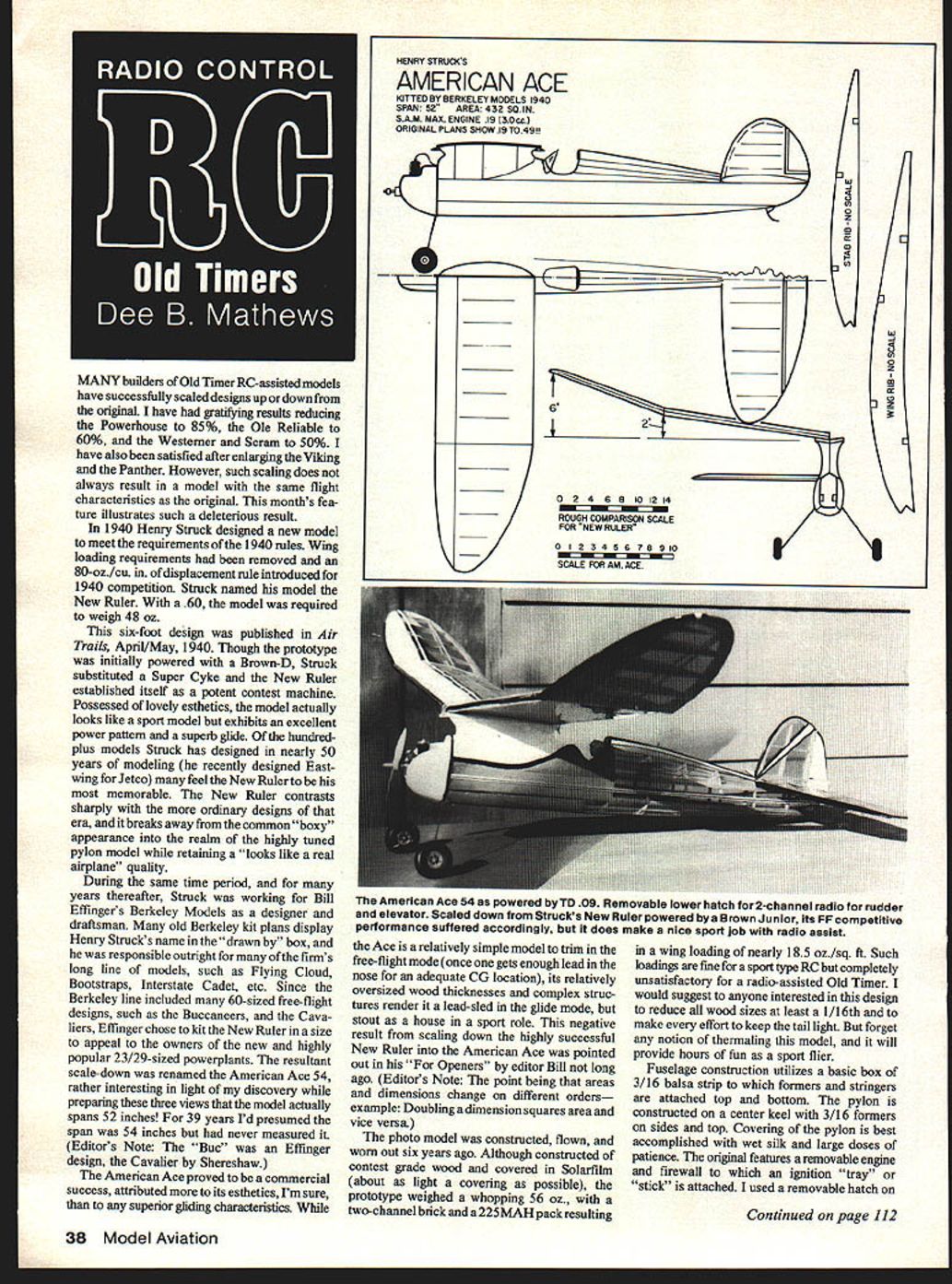
To appeal to owners of the new and popular .23/.29 powerplants, Effinger chose to kit a scaled-down New Ruler. The scale-down was renamed the American Ace .54 (often referred to as the American Ace 54). Interestingly, while preparing three-view drawings, I discovered the model actually spans 52 inches; for 39 years I'd presumed the span was 54 inches but had never measured it.
The American Ace proved a commercial success, largely due to its aesthetics rather than superior gliding characteristics. It is relatively simple to trim in free-flight mode once sufficient nose weight is added for proper CG. However, its relatively oversized wood thicknesses and complex structures make it heavy in the glide mode—stout as a house in a sport role but a "lead-sled" for thermaling and contest free-flight.
Bill Long (editor) long ago pointed out the general problem: areas and dimensions scale on different orders—for example, doubling a linear dimension squares the area—so simple scaling does not preserve all performance characteristics.
The Photo Prototype: Construction and Flight Notes
The pictured model (photo prototype) was constructed, flown, and worn out six years ago. Although built of contest-grade wood and covered with Solarfilm (one of the lightest coverings available), the prototype weighed 56 oz. with a two-channel "brick" receiver and a 225 mAh battery pack. This resulted in a wing loading of nearly 18.5 oz./sq. ft.—acceptable for a sport RC model but completely unsatisfactory for a radio-assisted Old Timer intended to thermal.
Recommendations from that experience:
- Reduce all wood sizes at least 1/16" when building the design for radio-assisted Old-Timer use.
- Make every effort to keep the tail assembly light.
- Forget any notion of thermaling the model with the standard scaling and construction; the design is best used as a sport flier.
I would recommend a throttled 2.5cc powerplant and perhaps adding an inch to the nose for balance. Build one and send a picture!
Construction Details
Fuselage and Pylon
- Fuselage: basic box built from 3/16" balsa strip with formers and stringers attached top and bottom.
- Pylon: constructed on a center keel with 3/16" formers on sides and top. Covering the pylon is best accomplished with wet silk and patience.
- Original features: removable engine and firewall with an ignition "tray" or "stick." In my RC conversion I used a removable hatch on the bottom for access to the radio unit and placed the switch in the cockpit.
Wing and Tail
- Construction: multi-spar wing with a sheet-covered leading edge. The airfoil is undercambered and relatively thin.
- Surfaces: double-elliptical planform constructed with sheet outlines and a bent 3/16" square leading edge.
Undercarriage and Tail Skid
- Undercarriage: semi-torque-rod single-wire unit held to the firewall (originally attached with grooved wooden blocks).
- Tail skid: wire tail skid attached to a balsa block at the tail end.
Note: In 1940, adhesives and hardware options were different; craftsmanship was essential to keep the gear attached. Modern builders should use contemporary adhesives and hardware for reliability.
Kit Availability
Although no kit manufacturer marketed the New Ruler in the 1940s, a semi-kit of the American Ace is available from:
Schmidt Custom Kits 11948 Franklin Blvd. Elk Grove, CA 95624
The semi-kit includes all cut parts such as ribs, formers, and surface outlines. Strip wood pieces and hardware are not included. Wood quality and fabrication are excellent. Write for current prices and availability.
The "Jumbo" Phenomenon and Visibility
These are strange times: as some automobiles become smaller, model aircraft have become larger. The "Jumbo" phenomenon has invaded the Old Timer movement. Examples include:
- Cohen and Longstreet: Quadra-powered 12-foot Powerhouse
- John Pond: 15-foot Folly II
- Tulp and Kiel: 15-foot Dallaire (4,000 sq. in.)
All these giants have plug-in wing panels for portability. The most obvious advantage of such huge models is visibility; a large model can remain in sight while flying far out of radio range.
A dramatic demonstration of visibility occurred recently in north Texas. During a day of high pressure, my wife and I watched a semi-transparent object overhead that remained nearly motionless for hours. It turned out to be a weather balloon released that morning at Palasine, TX, by the National Science Foundation: a 450-foot-diameter polyethylene balloon containing 40 million cu. ft. of helium, floating about 23 miles overhead. The unaided visual identification of an object at approximately 120,000 feet was astonishing, and reflected sunlight produced a pinkish cast that led to many UFO reports.
Conclusion
The American Ace is an attractive, historically interesting design that builds into a highly satisfying sport model—especially when converted to RC. However, be mindful that scaling a successful original (like the New Ruler) down to a smaller size can change flight characteristics drastically. If you build one for radio-assisted Old-Timer flying:
- Reduce wood thicknesses (at least 1/16")
- Keep the tail light
- Use modern hardware and adhesives
- Expect a sport flyer rather than a thermaling contest ship
Enjoy the building and flying project—and send a picture when it's finished!
Transcribed from original scans by AI. Minor OCR errors may remain.

