
Radio Control: Old Timers
Dee B. Mathews
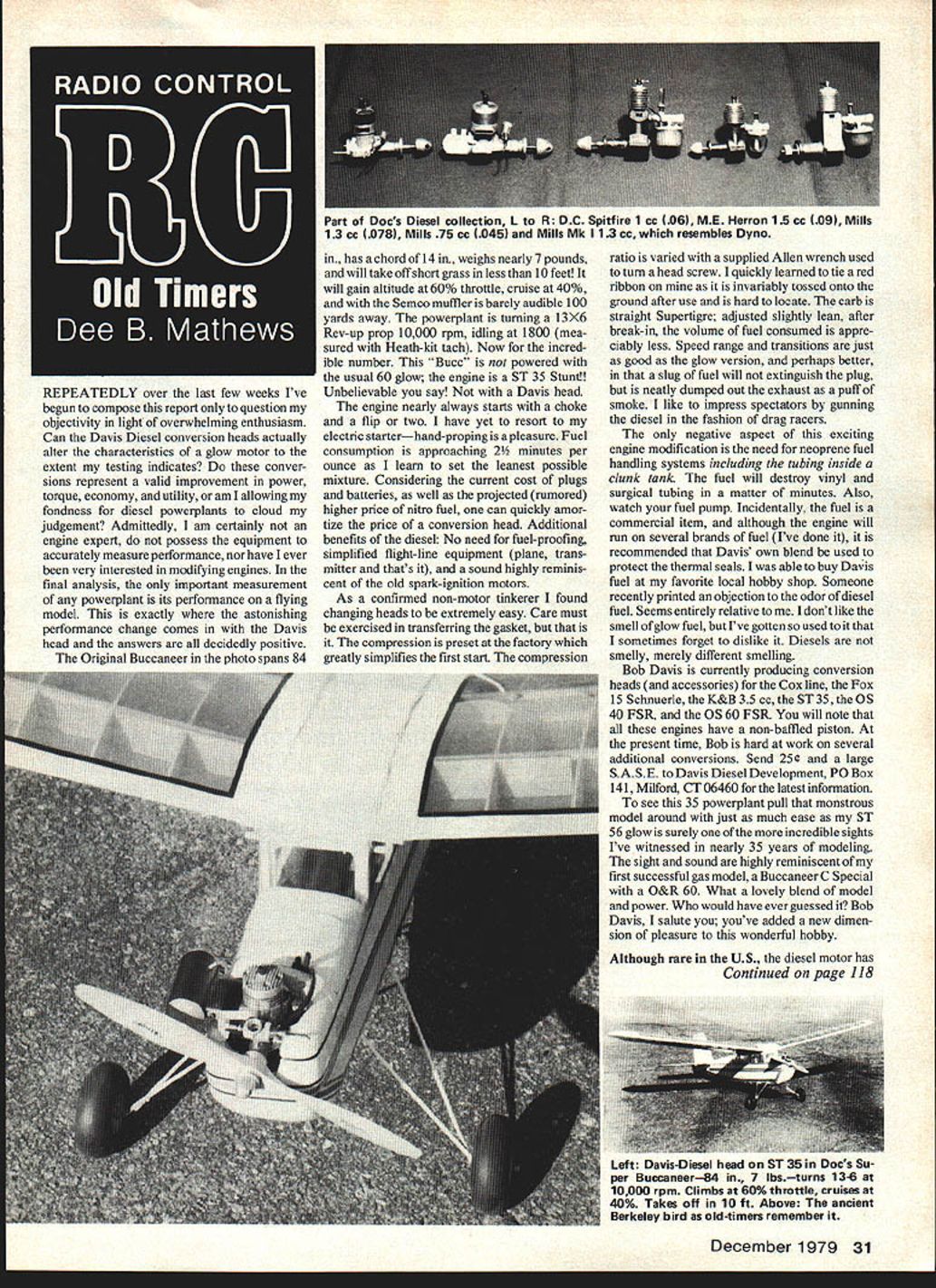
REPEATEDLY over the last few weeks I've begun to compose this report only to question my objectivity in light of overwhelming enthusiasm. Can the Davis Diesel conversion heads actually alter the characteristics of a glow motor to the extent my testing indicates? Do these conversions represent a valid improvement in power, torque, economy, or am I allowing my fondness for diesel powerplants to cloud my judgment? Admittedly, I am certainly not an engine expert, do not possess the equipment to accurately measure performance, nor have I ever been very interested in modifying engines. In the final analysis, the only important measurement of any powerplant is its performance on a flying model. This is exactly where the astonishing performance change comes in with the Davis head and the answers are all decidedly positive.
The original Buccaneer in the photo spans 84 in., has a chord of 14 in., weighs nearly 7 pounds, and will take off from short grass in less than 10 feet! It will gain altitude at 60% throttle, cruise at 40%, and with the Semco muffler is barely audible 100 yards away. The powerplant is turning a 13x6 Rev-Up prop at 10,000 rpm, idling at 1,800 (measured with a Heathkit tach). Now for the incredible number: this "Bucc" is not powered with the usual .60 glow; the engine is an ST 35 Stunt! Unbelievable, you say? Not with a Davis head.
The engine nearly always starts with a choke and a flip or two. I have yet to resort to my electric starter—hand-propping is a pleasure. Fuel consumption is approaching 2.5 minutes per ounce as I learn to set the leanest possible mixture. Considering the current cost of plugs and batteries, as well as the projected (rumored) higher price of nitro fuel, one can quickly amortize the price of a conversion head. Additional benefits of the diesel: no need for fuel-proofing, simplified flight-line equipment (plane, transmitter — and that's it), and a sound highly reminiscent of the old spark-ignition motors.
As a confirmed non-motor tinkerer I found changing heads extremely easy. Care must be exercised in transferring the gasket, but that's all. The compression is preset at the factory, which greatly simplifies the first start. The compression ratio is varied with a supplied Allen wrench used to turn a head screw. I quickly learned to tie a red ribbon on mine, as it is invariably tossed onto the ground after use and is hard to locate. The carb is straight Supertigre; adjusted slightly lean after break-in, the volume of fuel consumed is appreciably less. Speed range and transitions are just as good as the glow version, and perhaps better, in that a slug of fuel will not extinguish the plug but is neatly dumped out the exhaust as a puff of smoke. I like to impress spectators by gunning the diesel in the fashion of drag racers.
The only negative aspect of this exciting engine modification is the need for neoprene fuel handling systems, including the tubing inside a clunk tank. The fuel will destroy vinyl and surgical tubing in a matter of minutes. Also, watch your fuel pump. Incidentally, the fuel is a commercial item, and although the engine will run on several brands of fuel (I've tried it), it is recommended that Davis' own blend be used to protect the thermal seals. I was able to buy Davis fuel at my favorite local hobby shop.
Someone recently printed an objection to the odor of diesel fuel. Seems entirely relative to me. I don't like the smell of glow fuel, but I've gotten so used to it that I sometimes forget to dislike it. Diesels are not smelly, merely differently smelling.
Bob Davis is currently producing conversion heads (and accessories) for:
- Cox .010
- Fox .15 Schnuerle
- K&B 3.5 cc
- ST 35
- OS 40 FSR
- OS 60 FSR
You will note that all these engines have a non-baffled piston. At the present time, Bob is hard at work on several additional conversions. Send 25¢ and a large S.A.S.E. to Davis Diesel Development, P.O. Box 141, Milford, CT 06460 for the latest information.
To see this .35 powerplant pull that monstrous model around with just as much ease as my ST 56 glow is surely one of the more incredible sights I've witnessed in nearly 35 years of modeling. The sight and sound are highly reminiscent of my first successful gas model, a Buccaneer C Special with an O&R .60. What a lovely blend of model and power. Who would have ever guessed it? Bob Davis, I salute you; you've added a new dimension of pleasure to this wonderful hobby.
Although rare in the U.S., the diesel motor has been highly popular in Europe since 1945. The typical European sport model, be it U/C, FF, or RC, is powered with a small diesel of 0.5 cc to 2.5 cc. The reasons for the diesel's continued popularity in Europe are diverse, but most certainly include economy and simplicity. Nitromethane for glow fuel is horrendously expensive in Europe (even illegal in several countries), whereas the paraffin ethers and other components of diesel fuel are relatively inexpensive. The simple starting and long life of the diesel have also contributed to their long-term popularity on the Continent. If there is any truth in the current rumors whirling about concerning the availability and price of nitro and platinum on this side of the Atlantic, diesels may well stage a rapid burst of acceptance here as well.
Interestingly, these small powerplants are not actually diesel engines. To be absolutely accurate they are "compression ignition engines" (C.I.E.). The true diesel compresses air then injects fuel into it with highly complex injection techniques; they are therefore all four-cycle. The miniature C.I.E. engine was first commercially produced by the Klemenz-Schenk group in Switzerland in 1943. The 2.04 cc Dyno I looks much like a Mills 1.3 Mk I. Strangely, the success of this Swiss development came about by borrowing a British patent from the 1920s: the variable compression-ratio head utilizing a contra-piston.
Several U.S. manufacturers joined the diesel market in the immediate post–WW II era, among these O.K. and McCoy, who produced numerous successful engines in the .049 and .09 sizes. Vivell, Edco, and Madewell gave tentative attention to this market segment but did not enter full production. A diesel conversion head was available for the Arden powerplants, and Leon Shulman marketed the .5 cc Drone. The original Drone did not have a variable-compression head, a condition that made hand-starting with a small prop an experience, particularly on a cold humid day.
The Drone was used with great success by several U/C stunt fliers, such as Bob Tucker, who won the Nationals in 1948; Fran McElwee, who powered his Mirror Fair–winning RC with a Drone in 1948; and many others. Later Drones featured variable compression heads and, late in the history of the line, a glow-powered version was introduced. The Drone's demise was related to the gaining popularity of the glow motor and the aforementioned starting problems.
Although numerous manufacturers have produced small-displacement diesels for many years, the Davis-design conversions are the first large-bore diesels produced commercially in a decade or more. English brands, such as Davis-Charlton, P.A.W., Oliver Tiger, Moore Engineering, and E.D. have been imported into the U.S. by Hobby Hideaway and others for many years. Some of the first Webra and Super-Tigre imported motors were diesels. The French Micron and the Hungarian Moki and M.V.V.S. also indicate the worldwide popularity of the C.I.E. powerplant. Even the Japanese Enya Works have included a 1 cc diesel in their line.
The introduction of the Davis conversion heads for the large-size powerplants will likely once again broaden interest in C.I.E. engines, since they are now available from the .32-cc Cox .020 through the .10-cc OS .60. I have not had an opportunity to operate a .10-cc unit as of this writing. I can only speculate as to the raw power that must be available, but my feeling is that such a powerplant–prop combination should likely hold its own with many of the 1.2-cc chainsaw conversions currently in use. Just consider such a thing in a king-sized old-timer like those mentioned in my last column.
Space does not permit a comprehensive outline of hints for operating a C.I.E.; an excellent article on the subject appeared in Flying Models, Dec. 1978, and is recommended. I will give the three cardinal rules:
- Start up with a dry head and a choked throat.
- Never run in an over-compressed state.
- Always use a large prop compared with an equivalent glow engine.
These three rules will prevent difficult starting, excessive wear and breakage, and exploit the strong point of the C.I.E., which is power rather than rpm.
Recommended prop sizes:
- 0.75 cc (0.049) — 8x3
- 1.3 cc — 9x5
- 6 cc — 13x6
Dee B. Mathews 506 S. Walnut Greensburg, KS 67054
Transcribed from original scans by AI. Minor OCR errors may remain.

