
Radio Control: Old-Timers
Jack Bolton
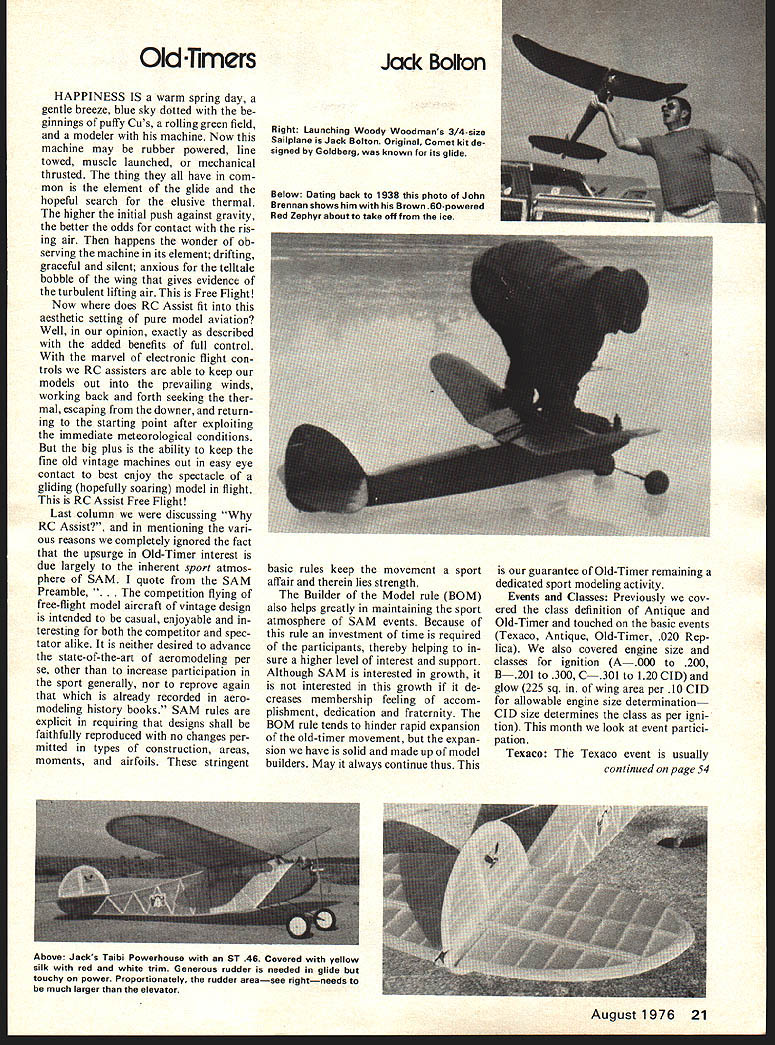
HAPPINESS IS a warm spring day, a gentle breeze, blue sky dotted with the beginnings of puffy Cu's, a rolling green field, and a modeler with his machine. Now this machine may be rubber powered, line towed, muscle launched, or mechanical thrusted. The thing they all have in common is the element of the glide and the hopeful search for the elusive thermal. The higher the initial push against gravity, the better the odds for contact with the rising air. Then happens the wonder of observing the machine in its element; drifting, graceful and silent; anxious for the telltale bobble of the wing that gives evidence of the turbulent lifting air. This is Free Flight!
Now where does RC Assist fit into this aesthetic setting of pure model aviation? Well, in our opinion, exactly as described with the added benefits of full control. With the marvel of electronic flight controls we RC assisters are able to keep our models out into the prevailing winds, working back and forth seeking the thermal, escaping from the downer, and returning to the starting point after exploiting the immediate meteorological conditions. But the big plus is the ability to keep the fine old vintage machines out in easy eye contact to best enjoy the spectacle of a gliding (hopefully soaring) model in flight. This is RC Assist Free Flight!
Last column we were discussing "Why RC Assist?", and in mentioning the various reasons we completely ignored the fact that the upsurge in Old-Timer interest is due largely to the inherent sport atmosphere of SAM. I quote from the SAM Preamble, "... The competition flying of free-flight model aircraft of vintage design is intended to be casual, enjoyable and interesting for both the competitor and spectator alike. It is neither desired to advance the state-of-the-art of aeromodeling per se, other than to increase participation in the sport generally, nor to reprove again that which is already recorded in aeromodeling history books." SAM rules are explicit in requiring that designs shall be faithfully reproduced with no changes permitted in types of construction, areas, moments, and airfoils. These stringent basic rules keep the movement a sport affair and therein lies strength.
The Builder of the Model rule (BOM) also helps greatly in maintaining the sport atmosphere of SAM events. Because of this rule an investment of time is required of the participants, thereby helping to insure a higher level of interest and support. Although SAM is interested in growth, it is not interested in this growth if it decreases membership feeling of accomplishment, dedication and fraternity. The BOM rule tends to hinder rapid expansion of the old-timer movement, but the expansion we have is solid and made up of model builders. May it always continue thus. This is our guarantee of Old-Timer remaining a dedicated sport modeling activity.
Events and Classes: Previously we covered the class definition of Antique and Old-Timer and touched on the basic events (Texaco, Antique, Old-Timer, .020 Replica). We also covered engine size and classes for ignition (A—.000 to .200, B—.201 to .300, C—.301 to 1.20 CID) and glow (225 sq. in. of wing area per .10 CID allowable engine size determination). This month we look at event participation.
Texaco: The Texaco event is usually
Radio Control: Old-Timers
flown very early in the morning prior to strong thermal activity. Event requirements are for a pre-January 1939 design (glow or ignition powered), no timed engine run — fuel is allocated on a 4 oz. per lb. of aircraft weight, a maximum of 1¼ oz. permitted regardless of weight. Timing is from ROG launch to touchdown. Longest of two flights scored.
The key to winning is to have a well trimmed, solidly designed, minimum allowable weight construction, an engine that burns fuel economically, and knowledge of how to run this engine for best endurance. Then you also must be proficient in flying the ship to obtain best performance — no high angles of bank, not too slow on the climb, CG right on, and kept trimmed. A fine event that combines other factors than power and duration.
Antique: RC Assist Antique is a power/duration event with the requirements that the model must be a pre-January 1939 design and the engine run determined by aircraft weight. The engine run formula is seven (7) seconds per lb. of aircraft weight to the nearest lb. (i.e., 4 lbs. is, or would be, 4 lbs.; and 4 lbs. 9 oz. would be 5 lbs. — 28 seconds and 35 seconds respectively for motor runs); ten seconds per pound are allowed for ignition. Flights will be a ten-minute max with overtimes deducted proportionately. Six attempts or flights permitted, the best three to count. This is a great event that gives a decent handicap to the very large, and attendantely heavy, early vintage craft.
Old-Timer: Old-Timer is a power/duration event with the requirement that the model must be a pre-January 1943 (or Dec. 31, 1942 if you will) design and the engine run allocated is twenty (20) seconds for glow and twenty-five (25) seconds for ignition. Flights are of ten-minute max and six attempts or flights are permitted with the best three used for score.
.020 Replica: Replica is basically the same as Old-Timer except the requirement that the model must be no larger than .020 and the model no larger than 36 in. These are scaled-down models of their big brothers and, as such, must retain the original moments, outlines, construction and the basic airfoil.
Event Background: When competition Old-Timer RC Assist got underway the meets were always very interesting because of the proliferation of designs. There were always numerous Scientifics, Mercurys, New Rulers, Red Zephyrs, Quakers, Buccaneers, Sonnys, Dobies, etc. Then there were the Playboys, Zippers, Rangers, Sailplanes, etc., and I'm sure you know what happened. The orders gradually disappeared. Fun or not, low key or not, a true modeler gets tired of traveling some distance to a contest where he knows the machine he has in the back of the car is outclassed before he gets there. RC meets up East are dominated by the Playboys, Sailplanes, etc. The contest organizers and sponsors simply had not acted enough to predict the obvious. They cautiously scheduled the meets around the most popular event (or they made it so by only scheduling the one class, Old-Timer, and all vintage models competed in it or not at all). I was just as guilty as the rest.
So what do we do about this dilemma? A very easy and logical thing to do for those of you programming an Old-Timer meet, and are not expecting large participation, or don't have the funds to warrant a large slate of events, is to simply run the Old-Timer event as usual, but go one step further and allocate the engine run for ignition in accordance with the Antique event (which you are not running). Let them have their seven seconds per lb. of aircraft weight as their motor run criteria. What this means is that, if I show up with my 80" Playboy Senior with glow, I get a 20-second allocated motor run. If I elect to bring my 84" Antique Powerhouse and weigh in at 3 lbs. 4 oz., then I am awarded a 35-second motor run. The Playboy would probably still win, but I stress probably.
Another thing a contest committee plagued by fiscal or time constraints can do to relieve the strain is to split the event — give classes into two groups. Class I .000 to .289, and Class II .290 and up. Not only does this help to reduce event proliferation, but it also puts the hot .29 competition with the larger engines, and that is where they belong. My Playboy, with a ST/ABC .29, can be in head-to-head competition with .23- or .25-powered models on a straight class ABC basis. Now realize I'm speaking of glow-powered models and also remember that engine sizing for glow is dictated by the wing area, so because of the power available, you go to the largest size model your engine can handle. Hence the ST .29/Playboy combo, a tough one to beat even against hot ST .23 or Taipan .21-powered Zippers. Anyway, the Class I and II system precludes a .29-powered anything from flying in Class I, and puts the Playboy Senior where it belongs — up against the Buzzards and the Sailplanes. Now be nice and don't talk about the guy flying a Topper "A" against a Zipper.
Here in Pensacola I run my annual large Old-Timer contest in October and incorporate the following special rules: (1) Class I and II engine split, (2) Antique entries in Old-Timer are allocated engine runs as Antiques, (3) Converted glow to ignition engines are classed as glows for motor run allocation, (4) Cabin Old-Timers are permitted an extra 5-second motor run (New-Ruler/American Ace class as cabin). These are my procedures for improving the lot of the Antiques and Old-Timer cabin models. Others in the country are also devising similar handicapping systems to encourage the building and flying of the classics, and maybe someday we will get a standardized.
By now you should have realized that the only class capable of competing in Texaco, Antique and Old-Timer is Antique. Unfortunately, there is a move afoot to permit Old-Timer models to compete in the Texaco event (in the interest of event participation). A short term gain at best, and, quite possibly a stymie to growth in the long run.
Along similar lines is the waiving of the BOM rule, again in the interest of growth and participation. This, too, possibly might turn into a trap after a dedicated SAM type travels a distance to compete, deals with his creation, and misses a place because of an entry that was purchased or even borrowed so as to enter a particular class. He will not return next year! Keep it straight, Friends!
Contest
We come to the point of arriving at the contest site. The sky is azure, winds nil, air is fresh and you feel like a tiger. You make the rounds visiting all the old friends, go for a cup of coffee, inspect the competition, look over new and interesting models and finally arrive at registration. Here we weigh the models, check for engine and area requirements, pick up the time cards and we are ready to fly.
Since you have multiple entries, and time is limited, you move quickly back to your area and assemble the models and paraphernalia. When ready and the air begins to look reasonably promising, you fuel, get your transmitter at impound and call for a timer. Your strategy is to get three officials in each class entered, sit back, relax, socialize and watch the air and, if obvious thermal activity picks up, then into the air to try and better your score. You will try to bank one or two attempts so to be able to respond should some upstart better your posted flight totals, and herein lies more fun and excitement. Most Old-Timer contests show a last minute flurry of activity as the sandbaggers come out of their dugouts and start trying to recoup their lost cause. Ninety percent of the time they are unsuccessful, but it sure is a lot of fun to watch.
Post Scripts: That's it for this column. My apologies for not getting into the nuts and bolts of Old-Timer building and preparation as promised last column. My good intentions were sidetracked by a self-imposed priority of recruitment and motivation. Hopefully we have been a little successful with both. Next time we will cover construction and sizing of control surfaces, engine shut-down systems and flying tips. If anyone has a specific question or problem, write me and enclose a SASE and I'll try to get you an answer. Keep the info and photos flowing to: John M. Bolton, Cdr., USN (Ret.), 9521 Scenic Highway, Pensacola, FL. Phone (904) 477-2055, weekends only.
Transcribed from original scans by AI. Minor OCR errors may remain.

