
Radio Control: Old Timers
Dee B. Mathews
S.A.M. Rules
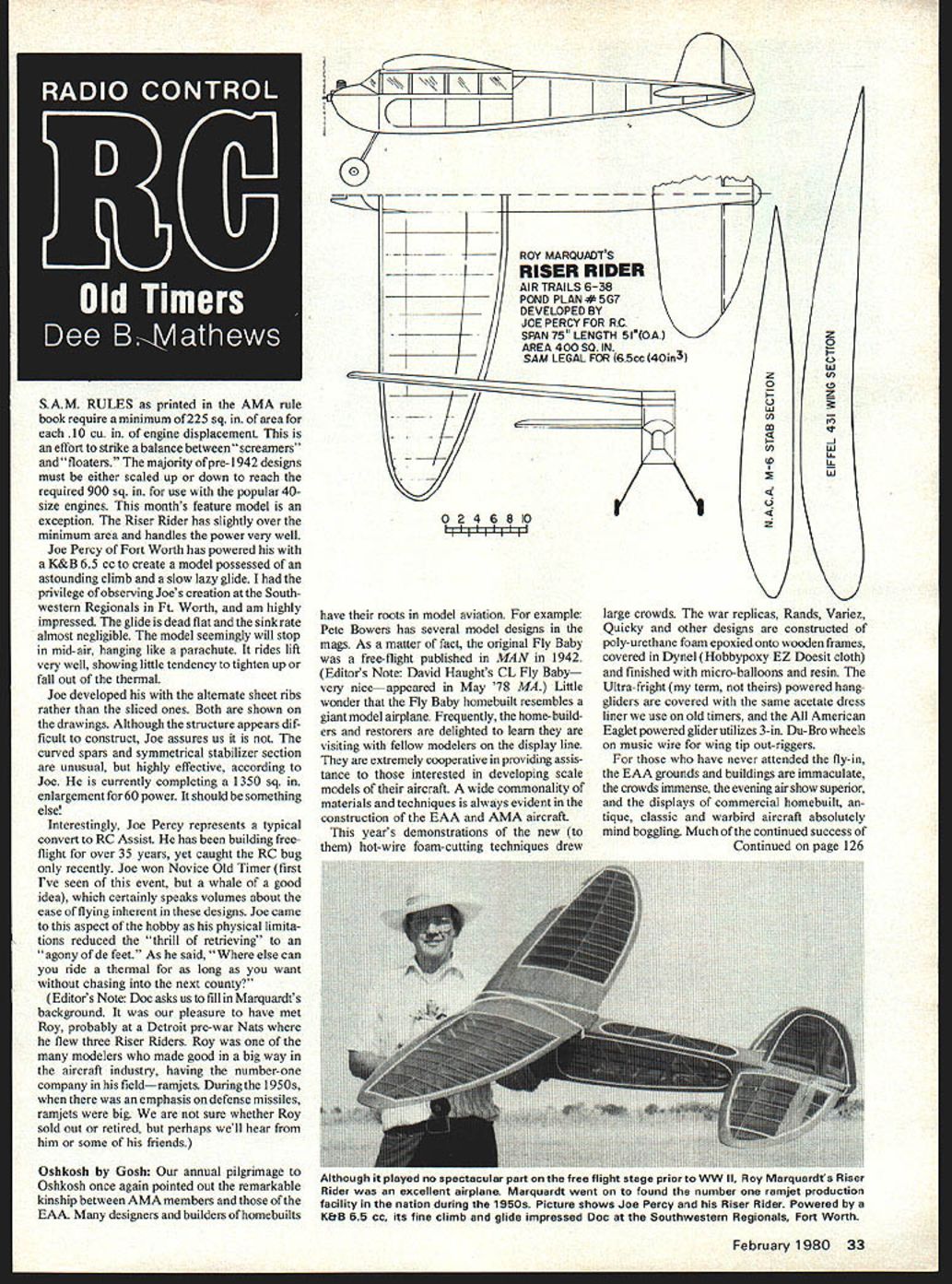
S.A.M. rules as printed in the AMA rule book require a minimum of 225 sq. in. of area for each .10 cu. in. of engine displacement. This is an effort to strike a balance between "screamers" and "floaters." The majority of pre-1942 designs must be either scaled up or down to reach the required 900 sq. in. for use with the popular .40-size engines. This month's feature model is an exception. The Riser Rider has slightly over the minimum area and handles the power very well.
The Riser Rider and Joe Percy
Joe Percy of Fort Worth has powered his with a K&B 6.5 cc to create a model possessed of an astounding climb and a slow, lazy glide. I had the privilege of observing Joe's creation at the Southwestern Regionals in Ft. Worth and was highly impressed. The glide is dead flat and the sink rate almost negligible. The model seemingly will stop in mid-air, hanging like a parachute. It rides lift very well, showing little tendency to tighten up or fall out of the thermal.
Joe developed his with the alternate sheet ribs rather than the sliced ones. Both are shown on the drawings. Although the structure appears difficult to construct, Joe assures us it is not. The curved spars and symmetrical stabilizer section are unusual, but highly effective, according to Joe. He is currently completing a 1350 sq. in. enlargement for .60 power. It should be something else.
Interestingly, Joe Percy represents a typical convert to RC assist. He has been building free-flight for over 35 years, yet caught the RC bug only recently. Joe won Novice Old Timer (first I've seen of this event, but a whale of a good idea), which certainly speaks volumes about the ease of flying inherent in these designs. Joe came to this aspect of the hobby as his physical limitations reduced the "thrill of retrieving" to an "agony of the feet." As he said, "Where else can you ride a thermal for as long as you want without chasing into the next county?"
Editor's Note: Marquardt
Doc asks us to fill in Marquardt's background. It was our pleasure to have met Roy, probably at a Detroit pre-war Nats where he flew three Riser Riders. Roy was one of the many modelers who made good in a big way in the aircraft industry, having the number-one company in his field—ramjets. During the 1950s, when there was an emphasis on defense missiles, ramjet work was big. We are not sure whether Roy sold out or retired, but perhaps we'll hear from him or some of his friends.
Oshkosh by Gosh
Our annual pilgrimage to Oshkosh once again pointed out the remarkable kinship between AMA members and those of the EAA. Many designers and builders of homebuilts have their roots in model aviation. For example, Pete Bowers has several model designs in the mags. As a matter of fact, the original Fly Baby was a free-flight published in MAN in 1942. (Editor’s Note: David Haught's CL Fly Baby—very nice—appeared in May '78 MA.) Little wonder that the Fly Baby homebuilt resembles a giant model airplane. Frequently, the home-builders and restorers are delighted to learn they are visiting with fellow modelers on the display line. They are extremely cooperative in providing assistance to those interested in developing scale models of their aircraft. A wide commonality of materials and techniques is always evident in the construction of the EAA and AMA aircraft.
This year's demonstrations of the new (to them) hot-wire foam-cutting techniques drew large crowds. The war replicas, Rands, Variez, Quicky and other designs are constructed of polyurethane foam epoxied onto wooden frames, covered in Dynel (Hobbypoxy EZ Doesit cloth) and finished with micro-balloons and resin. The "Ultra-fright" (my term, not theirs) powered hang-gliders are covered with the same acetate dress liner we use on old timers, and the All American Eaglet powered glider utilizes 3-in. Du-Bro wheels on music wire for wing-tip outriggers.
For those who have never attended the fly-in, the EAA grounds and buildings are immaculate, the crowds immense, the evening air show superior, and the displays of commercial homebuilt, antique, classic and warbird aircraft absolutely mind-boggling. Much of the continued success of the Oshkosh "happening" stems from a permanent site which has been constantly improved on a long-term lease agreement, and the absolute assurance of knowing what to expect in motel and meal arrangements before one ever arrives. We should perhaps consider the EAA example as we re-evaluate our own annual "convention."
The Omaha Nats
While the rest of the contestants at the '79 Nats flew at either Lincoln or Mead, Nebraska, we RC Old Timers went to the far west edge of Omaha. Our site was in a city park overlooking a lake with neatly mowed grass surrounding it in all directions. Truly a lovely site, with the field placed on the crest of a flattened-off hill, and a panoramic view of the surrounding countryside. Although hardly an ideal way to demonstrate our "thing" to the public or to interested contestants in other events, those who attended were rewarded with a lovely day and a friendly group to mingle with.
Although the entry size was rather disappointing, the caliber of competition was high, with several well-developed models and above-average times recorded. John Pond and this writer demonstrated the brilliant minds required in writing a column: John launched his Dallaire with the receiver off and I locked my keys in the car trunk. Smart! In spite of that, I greatly enjoyed the hospitality extended by the locals, and would gladly fly at their place another time. It was beautiful.
Bill (Berkeley Models) Effinger recently related something worth sharing: "The first gas model I built was a scale Buhl Pup (Editor: it was big, like today's 1/4 scalers), built with removable wings and bracing for easy transportation. I built this model without ever seeing a gas model. Come to think of it, it was likely the first scale gas model. With a six-foot span and a Brown Jr. (#187) it climbed like a rocket, but took 1,000 feet to pull out when the engine quit... must have traveled at 80 mph. Transportation was a problem as I was under 18 and didn't have a driver's license. Taking a model on the subway to the ferry, to the bus, to the trolley, and finally to the airport was an experience."
Mr. Effinger is recalling 1936 in New York City; he lived in Brooklyn. Who says flying site problems are something new? Somehow those who want to fly models always figure a way.
Fast Richard Runs Behind
We hope to include brief overviews of manufacturers' lines of Old Timer-oriented kits, powerplants, and accessories in future columns. You folks in the business are invited to advise me of what you have. We'll start with Dick Mathis Designs Group (formerly M&P), Lone Oak, Texas 75453. "Fast" Richard's kit line includes:
- Flying Quaker 84"
- Quaker 54" (reduced size as opposed to the Quaker Flash — see MA, 8-78)
- Dallaire 108"
- Comet Clipper
He has recently returned to S.M.U. to complete his PhD on a teaching fellowship and is running behind on deliveries of the Clipper. Dick advises anyone who has made a deposit that refunds will be made to those who cannot wait for early 1980 delivery. We'll print a kit review of this Cal Golbert classic cabin job soon. It should be a pure delight.
Dick and his vivacious wife, Mary K., are contemplating adding a 900 sq. in. scaled-down Dallaire to their line. We watched several of them perform at Ft. Worth and suspect the Dallaire Jr., combined with a .40-size engine, will prove highly popular.
You Can Call Me S.A.M.
Bill Rauch, 1730 Gunwood Place, Crofton, MD 21114, is trying to contact all Old Timer fliers in the D.C. area in hopes of forming a S.A.M. chapter. The Prince George's R.C. Club is also considering scheduling an R/C Texaco event next spring. All you "closet" old-timers get in touch with Bill. After all, this is a social event.
Great Bolts of Lightning
We are running a converted-to-ignition engine using an L&L Electronics #301 electronic ignition system. Although primarily intended for use with Quadra and similar chain-saw magneto-ignition engines, the unit fires a fantastic spark and provides improved starting and smoother running when used with a make-and-break ignition system. While the rechargeable sealed lead-acid battery certainly represents an improvement over a pair of D cells in a plastic Megow battery sleeve (remember?), the really significant news is that no radio interference has been encountered when used with our Pro-Line or Cannon equipment.
We are not in a position to evaluate the L&L system using other radio brands, and would greatly appreciate hearing from anyone who is using it with other equipment. The price of the unit is certainly reasonable, and it could well represent a significant breakthrough in the perplexing interference can of worms. (L&L Electronics, P.O. Box 13434, Albuquerque, NM 87112.)
The spectrum of interference from spark ignition is seemingly insane. While one flier can get by with nothing but lead foil on the firewall, another will not be able to fly even with a transistorized ignition. It would be immensely helpful if someone would write an article on this subject in language we non-electronic types can understand. Hint, hint. (Editor: Vernon Macnabb, Cincinnati, in 1948 when we test flew his 465 system on ignition, had us place a resistor (or something) in the high-tension lead. It works but we can't remember value or details.)
Dee B. Mathews 506 S. Walnut Greensburg, KS 67054
Transcribed from original scans by AI. Minor OCR errors may remain.

