
Radio Control: Old Timers
Dee B. Mathews
Editor’s Note: Several "gremlins" crept into the drawing of the Panther II published in the December ’79 issue. Although they will not prevent successful construction and flying of the design, they add some confusion and unnecessary complication. Anyone considering construction of this delightful model is invited to send the author a long, self‑addressed envelope for a correction sheet.
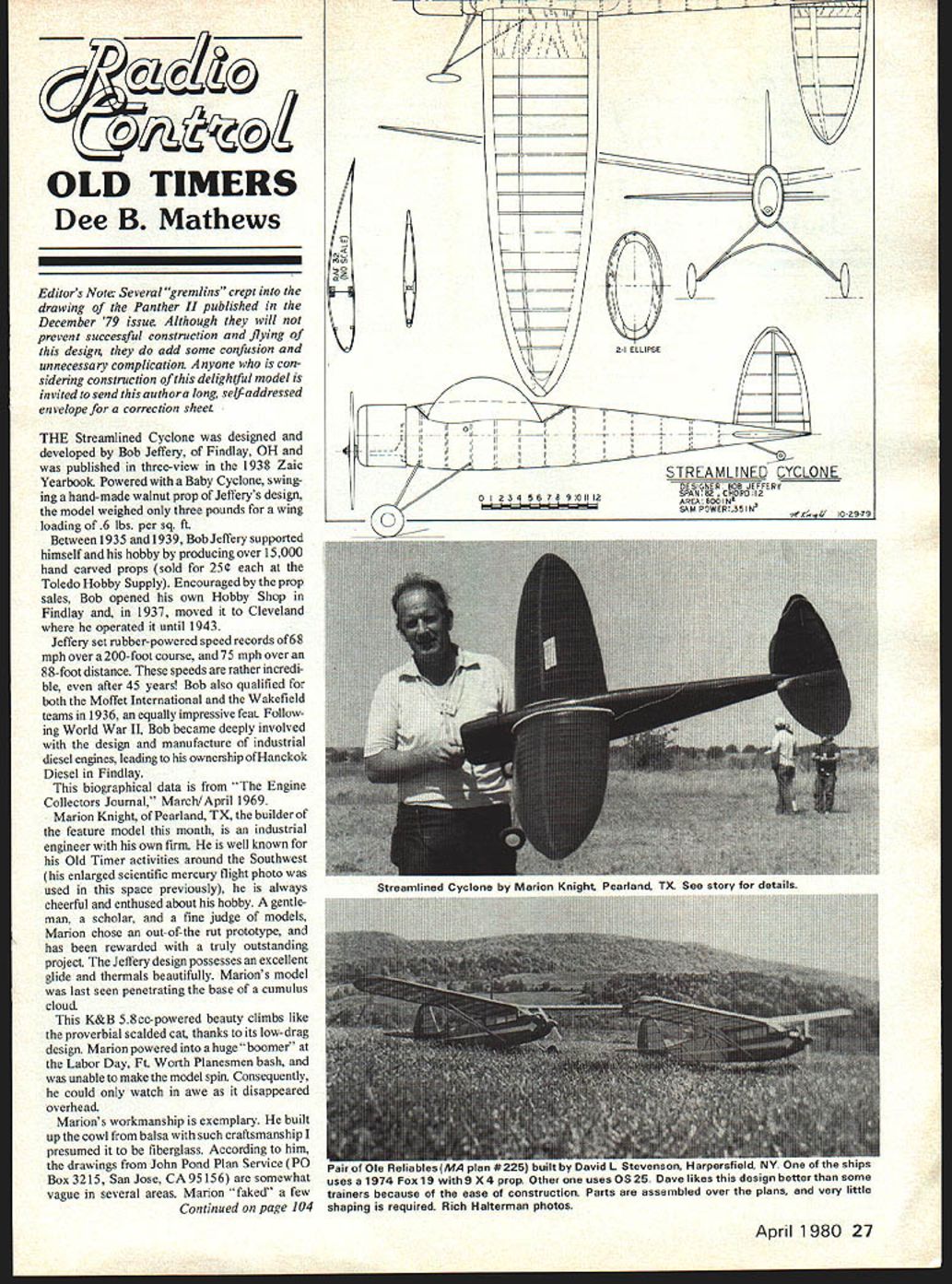
Streamlined Cyclone — Bob Jeffery
The Streamlined Cyclone was designed and developed by Bob Jeffery, of Findlay, OH, and was published as a three‑view in the 1938 Zaic Yearbook. Powered with a Baby Cyclone and swinging a hand‑made walnut prop of Jeffery’s design, the model weighed only three pounds, giving a wing loading of 0.6 lb per sq. ft.
Between 1935 and 1939 Bob Jeffery supported himself and his hobby by producing over 15,000 hand‑carved props (sold for 25¢ each at the Toledo Hobby Supply). Encouraged by prop sales, Bob opened his own hobby shop in Findlay and, in 1937, moved it to Cleveland where he operated it until 1943.
Jeffery set rubber‑powered speed records of 68 mph over a 200‑foot course and 75 mph over an 88‑foot distance — impressive figures even after 45 years. He also qualified for both the Moffett International and the Wakefield teams in 1936. Following World War II, Bob became deeply involved with the design and manufacture of industrial diesel engines, eventually owning Hancock Diesel in Findlay.
(Biographical data from The Engine Collectors Journal, March/April 1969.)
The Feature Model — Marion Knight
Marion Knight, of Pearland, TX, builder of this month’s feature model, is an industrial engineer and proprietor of his own firm. Well known for Old Timer activities around the Southwest, Marion is always cheerful and enthusiastic about his hobby. A gentleman, a scholar, and a fine judge of models, Marion chose an out‑of‑the‑rut prototype and was rewarded with a truly outstanding project.
Jeffery’s design possesses an excellent glide and thermals beautifully — Marion’s model was last seen penetrating the base of a cumulus cloud. Powered by a K&B 5.8 cc engine, the model climbs like the proverbial scalded cat thanks to its low‑drag design. At the Labor Day Ft. Worth Planesmen bash, Marion worked into a huge "boomer" and was unable to make the model spin; he could only watch in awe as it disappeared overhead.
Marion’s workmanship is exemplary. He built up the cowl from balsa with such craftsmanship that it was presumed to be fiberglass. According to him, the drawings from John Pond Plan Service (P.O. Box 3215, San Jose, CA 95156) are somewhat vague in several areas; Marion "faked" a few pieces due to lack of building directions. Anyone constructing the Streamlined Cyclone may contact Marion at Rt. 1, Box 340, Pearland, TX 77581.
Covering Old‑Timers — Polyester Dress Lining (Acetate Sheathing)
No single innovation mentioned in this column has perplexed readers more than the use of polyester dress lining (AKA acetate sheathing) for covering old‑timers. Introduced by John Pond in Model Builder (1974) and described in the Kloud King construction notes (Model Aviation, June 1975), the technique has steadily grown in acceptance. Unfortunately, wide variance in physical properties between mill lots has produced inconsistent results.
SIG Manufacturing has stepped into the confusion with new Koverall. A tested sample batch of this polyester shows excellent quality. It can be applied over a pre‑doped framework using thinned dope, or heat‑sealed to wood previously coated with Coverite’s Quik Stik. Wrinkles can be removed by running a MonoKote iron set at the Coverite temperature over the surface (or presumably with a heat gun).
Although butyrate dopes can be used, their tendency to over‑tighten and their compatibility problems with epoxy and urethane finishes make them a second choice to nitrate dope. Only a few coats of nitrate followed by one or two coats of urethane color produces a passable finish with minimum effort and considerable cost savings compared to silk and the shiny coverings.
Try it — you’ll like it a bunch.
Anecdotes and Notes
- From the Lehigh Valley (PA) R/C Society Newsletter: Jack Thoman recently installed an Eastcraft on‑board starter system in one of his models. After using the electric starter he returned the model to its customary storage spot in his bedroom but neglected to turn off the receiver, allowing the batteries to run down. As current dropped, the servos ran to their limits and, at 2:30 a.m., Jack was awakened by the roar of his engine and the sight of his model racing about his bedroom.
Spark‑Ignition Conversions — Bruce Chandler
Bruce Chandler has been marketing converted glow‑to‑ignition motors based on O.S. Max engines. These spark‑ignition conversions are available in sizes ranging from the Black Knight .15 through a .36 fire‑breather. Features include:
- Increased fin depth for improved cooling
- Open ports for easy cleaning and servicing
- Steel timer cams for long life
- Bench testing of each engine
Although primarily targeted at the vintage modeler, the significant fuel savings of spark‑ignition engines make them attractive to the sport flier. A spark‑ignition engine consumes about one‑third the volume of gasoline‑oil fuel compared to the equivalent glow motor. At typical fuel prices, fuel savings quickly amortize the cost of a quality motor.
Chandler Engineering Co. 7885 Farralone Ave., Canoga Park, CA 91303 They also stock coils, condensers, plugs, clockwork ignition shut‑off timers, and parts. Tell them Model Aviation sent you.
Photos — Please Send Black‑and‑White
Several readers have sent lovely color shots of their old‑timers. These would make delightful "old‑timer‑of‑the‑month" subjects, but the prohibitive cost and poor reproduction of converting them to black‑and‑white precludes their use. The same applies to most Polaroids.
Considering the millions of 35 mm SLR cameras sold over the last few years, surely anyone with an old‑timer model can locate a roll of Plus‑X film and someone with a decent camera. We don’t require professional quality — just follow Monte Grove’s "Get That Picture" (Model Aviation, March 1979). Grab your old‑timer and a camera, and send us some pictures — please.
Fuel Handling — Gasoline and Materials Compatibility
As spark‑ignition powerplants become increasingly popular again, several fuel handling problems are arising:
- Gasoline is incompatible with the diaphragm materials in several brands of fuel pumps. I ruined a pump by running gas‑oil through it. Du‑Bro has made available a special neoprene impeller for their "Quick‑Fill" pump (part number G‑191). They also offer a complete pump unit for gasoline use (number 250).
- Gasoline attacks commonly used silicone and surgical rubber fuel‑line materials, causing them to swell and become gummy. Du‑Bro, SIG, and Davis Diesel are all marketing neoprene tubing suitable for gasoline and diesel blends. Non‑neoprene tubing will rapidly degrade into gelatinous globs when exposed to gasoline or many diesel blends.
Safety note: Gasoline is extremely dangerous when stored in a closed area near any source of flame. Gasoline ignites at a lower temperature than alcohol and is more explosive. Don’t think gasoline is less dangerous than glow fuel — it will ignite with the greatest of ease.
Dee B. Mathews 506 S. Walnut Greensburg, KS 67054
Transcribed from original scans by AI. Minor OCR errors may remain.

