
Radio Control: Old Timers
Dee B. Mathews
Hammer's Flamingo
HAMMER'S Flamingo. We had intended to use the "Flamingo" as our model of the month, completing the three-view one day before learning that R/C Model Builder had used it in the March '80 issue. Rather than use precious space for the drawing, we have elected to present the material and add a second design in three-view as a bonus.
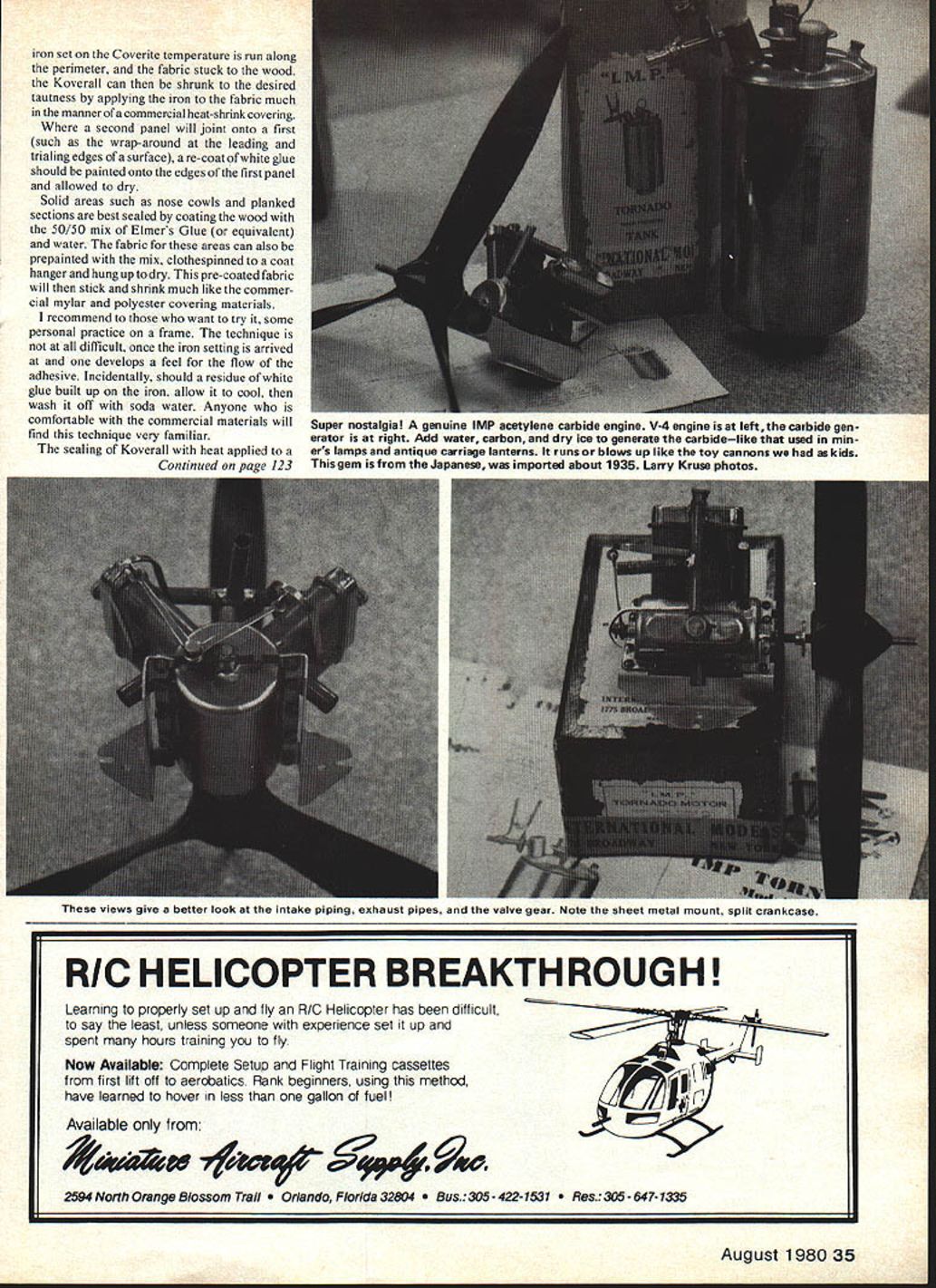
The pictured model was built by Dr. Dan Schneider of Philadelphia, PA. Building from a Schmidt semi-kit, Dan has covered his model in white MonoKote with custom-mixed Perfect urethane "Flamingo Pink" trim. Power is currently a Super Cyclone set up by Mark Fechner, and an Anderson Spitfire .65 will be installed this winter. Dr. Schneider is a periodontist (specialist in diseases of the gums and bone) who finds modeling to be a great escape from the tensions of his work. He is using a transistorized ignition system (TIS) by Otto Burnhardt, and says he has had no interference with his Kraft radio. The surfaces on the Flamingo are hinged at the original spar positions, with internal horns being used. This is one model we would have loved to present in color; it is absolutely beautiful!
A bonus Old-Timer that isn't really
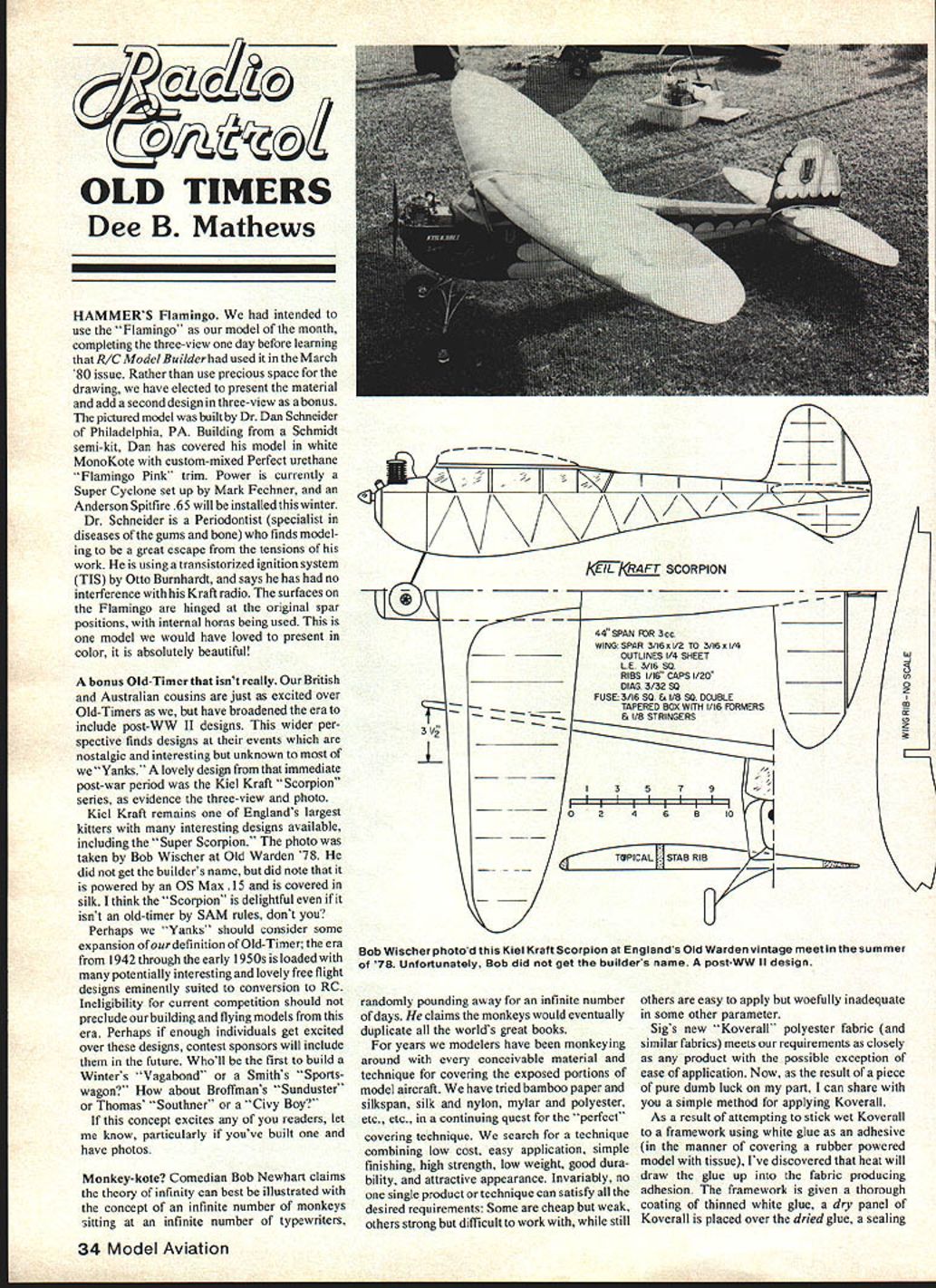
Our British and Australian cousins are just as excited over Old-Timers as we, but have broadened the era to include post‑WWII designs. This wider perspective finds designs at their events which are nostalgic and interesting but unknown to most of we "Yanks." A lovely design from that immediate post‑war period was the Kiel Kraft "Scorpion" series, as evidenced by the three-view and photo.
Kiel Kraft remains one of England's largest kitters with many interesting designs available, including the "Super Scorpion." The photo was taken by Bob Wischer at Old Warden '78. He did not get the builder's name, but did note that it is powered by an OS Max .15 and is covered in silk. I think the "Scorpion" is delightful even if it isn't an old‑timer by SAM rules, don't you?
Perhaps we "Yanks" should consider some expansion of our definition of Old-Timer; the era from 1942 through the early 1950s is loaded with many potentially interesting and lovely free flight designs eminently suited to conversion to RC. Ineligibility for current competition should not preclude our building and flying models from this era. Perhaps if enough individuals get excited over these designs, contest sponsors will include them in the future. Who'll be the first to build a Winter's "Vagabond" or a Smith's "Sportswagon"? How about Broffman's "Sunduster" or Thomas' "Southner" or a "City Boy"?
If this concept excites any of you readers, let me know, particularly if you've built one and have photos.
Monkey-kote?
Comedian Bob Newhart claims the theory of infinity can best be illustrated with the concept of an infinite number of monkeys sitting at an infinite number of typewriters, randomly pounding away for an infinite number of days. He claims the monkeys would eventually duplicate all the world's great books.
For years we modelers have been monkeying around with every conceivable material and technique for covering the exposed portions of model aircraft. We have tried bamboo paper and silkspan, silk and nylon, mylar and polyester, etc., in a continuing quest for the "perfect" covering technique. We search for a technique combining low cost, easy application, simple finishing, high strength, low weight, good durability, and attractive appearance. Invariably, no one single product or technique can satisfy all the desired requirements. Some are cheap but weak; others strong but difficult to work with; still others are easy to apply but woefully inadequate in some other parameter.
Sig's new "Koverall" polyester fabric (and similar fabrics) meets our requirements as closely as any product with the possible exception of ease of application. Now, as the result of a piece of pure dumb luck on my part, I can share with you a simple method for applying Koverall.
During an attempt to stick wet Koverall to a framework using white glue as an adhesive (in the manner of covering a rubber‑powered model with tissue), I discovered that heat will draw the glue up into the fabric producing adhesion. The framework is given a thorough coating of thinned white glue, a dry panel of Koverall is placed over the dried glue, and a sealing iron set to Coverite temperature is run along the perimeter so the fabric sticks to the wood. Koverall can be shrunk to the desired tautness by applying the iron to the fabric much in the manner of commercial heat‑shrink coverings.
To join a second panel—such as for wrap‑around leading or trailing edges—recoat the mating surfaces with white glue. The glue should be painted onto the edges of the first panel and allowed to dry before mating and sealing.
Solid areas such as nose cowls and planked sections are best sealed by coating the wood with a 50/50 mix of Elmer's Glue (or equivalent) and water. Fabric areas can also be prepainted with this mix. Clothespinned to a coat hanger and hung up to dry, pre‑coated fabric will stick and shrink much like commercial coverings.
I recommend that those who want to try it do some personal practice on a frame. The technique is not at all difficult once the iron setting is arrived at and one develops a feel for the flow of the adhesive. Incidentally, should a residue of white glue build up on the iron, allow it to cool, then wash it off with soda water. Anyone who is comfortable with the commercial materials will find this technique very familiar.
The sealing of Koverall with heat works well. If you are not as pleased as I, do not blame me—blame the monkeys.
More on the Flamingo
We contacted Roger Hammer in order to embellish this presentation of his Flamingo, and he graciously sent a highly interesting letter from which we shall quote.
"My modeling background involved all phases, starting with solid scale and progressing through flying scale outdoor, twin pushers, cabin, stick, hand launch and catapult gliders, and speed (I recall about 50 mph at the Junior Birdman Contest of 1936 in Central Park).
"I was also active in indoor micro models, entering most East Coast contests and the Detroit Nationals. In (or about) 1937 I won the Junior Birdman Indoor Championships for the NY area. This entitled me to a free trip to Los Angeles to compete in the JB National Championships; however, I never received the trip. Seems something happened to the funds, or maybe the Hearst Newspapers ran out of money.
"Prior to moving to New York, I was a member of the Philadelphia Model Airplane Assoc. (PMAA), flying in competition with Johnny Stokes, Eddy Manulkin, Irv Leshner and many others. I moved to New York City and later went to work for Frank Zaic at Jasco during which time I organized the NY Aeronauts, which as a group became very active in free flight.
"Several magazines wanted to publish plans for the Flamingo; however, at that time Frank Zaic was contemplating putting it out as a Jasco kit. Circumstances, however, prevented this." —Doc
Answering questions about construction and materials, Roger writes the following: "The original fuselage crutch was made of extra hard 1/4 in. square balsa, about 22 lb. per cu. ft. Since this is not normally available, I would suggest 1/4 in. square hard balsa (or 1/8 in. spruce). The Flamingo was originally designed to be as light as possible, as the Brown Jr. didn't have anywhere near the power of today's engines and had to carry two C batteries, a coil, and condenser. The model was covered with bamboo paper, painted silver with blue details.
"Body construction was unique in that you started with a crutch built over the top view, then added a top strip followed by V sides. A square cabin was built using cut‑to‑contour pads for the wing retainer cradle. Bottom bulkheads were added, followed by stringers placed outside the formers rather than notching. This gave a much nicer and cleaner look. The polyhedral wing was novel at that time on a gas model. It contributed to the extreme stability and fast recovery although the model was flown in very tight right turns.
"The Flamingo was a lot of fun and has stuck in my memory for over 40 years."
Roger moved to the California area following his discharge. He and Frank Zaic developed and marketed a catapult‑launched toy helicopter which had folding blades enabling it to be catapulted to great heights, from which it slowly descended. Marketed on and off for several years under the Aero‑toys label, the expertise developed in producing and selling these toys led Roger into industrial manufacturing of aircraft jacks, and later a job at Roy Marquardt's firm.
Roger Hammer is currently president of Astro Seal, Inc., a manufacturer of hermetic glass and ceramic electrical seals. These are used in high‑environment electrical connectors, explosive devices, medical equipment (I discovered one of his products on the vacuum pump in our operating room), and other electrical feed‑throughs used to get power and signals in and out of sealed units.
Roger is not presently active in our hobby, but interestingly enough has continued to keep his AMA license, number 497.
A whole bunch of ideas
Schmidt Custom Kits, 11948 Franklin Blvd., Elk Grove, CA 95624, specializes in rib and former kits for Old‑Timer designs. Loren's kit list contains over 150 designs ranging from LaTorre's Alert to Goldberg's Zipper. Among designs we have featured in this column, Schmidt cuts kits for American Ace (and New Ruler), Quaker Flash, Cumulus, Ohlsson and Taibi Pacemaker, and Riser Rider. These kits are available with plans and pre‑bent landing gear as options. They do not provide stripwood or flat sheets—just beautifully sawn and sanded parts. After all, why pay for shipping readily attainable strip and sheet back and forth across the country?
Current prices range from $2.00 for Lew Mayhew's Zeek to $45.00 for Don McGovern's Privateer Custom.
Although primarily concentrating on designs prior to 1942, Schmidt also has noted the increasing interest in "vintage" models with such kits as Ehling's Phoenix series and Comet's Interceptor. Send for a list—you'll find enough exciting ideas to stimulate years of building enjoyment. They also are cutting dimensional sizes of redwood and spruce in five‑foot lengths.
Dee B. Mathews 506 S. Walnut Greensburg, KS 67054
Transcribed from original scans by AI. Minor OCR errors may remain.

