
Radio Control: Old Timers
Dee B. Mathews
Joe Weathers and the Tubby
Elbert "Joe" Weathers holds an enviable position in the annals of model aviation. His name is associated with some of the most aesthetically appealing model designs to grace the pages of the modeling press. His designing talents are evidenced in such all-time classics as:
- Westerner
- Mystery Man
- Winged Victory
- Miss San Diego
- Spook
- Pacific Coaster (postwar)
These designs are characterized by sleek lines, graceful proportions, flowing contours, and extraordinary beauty.
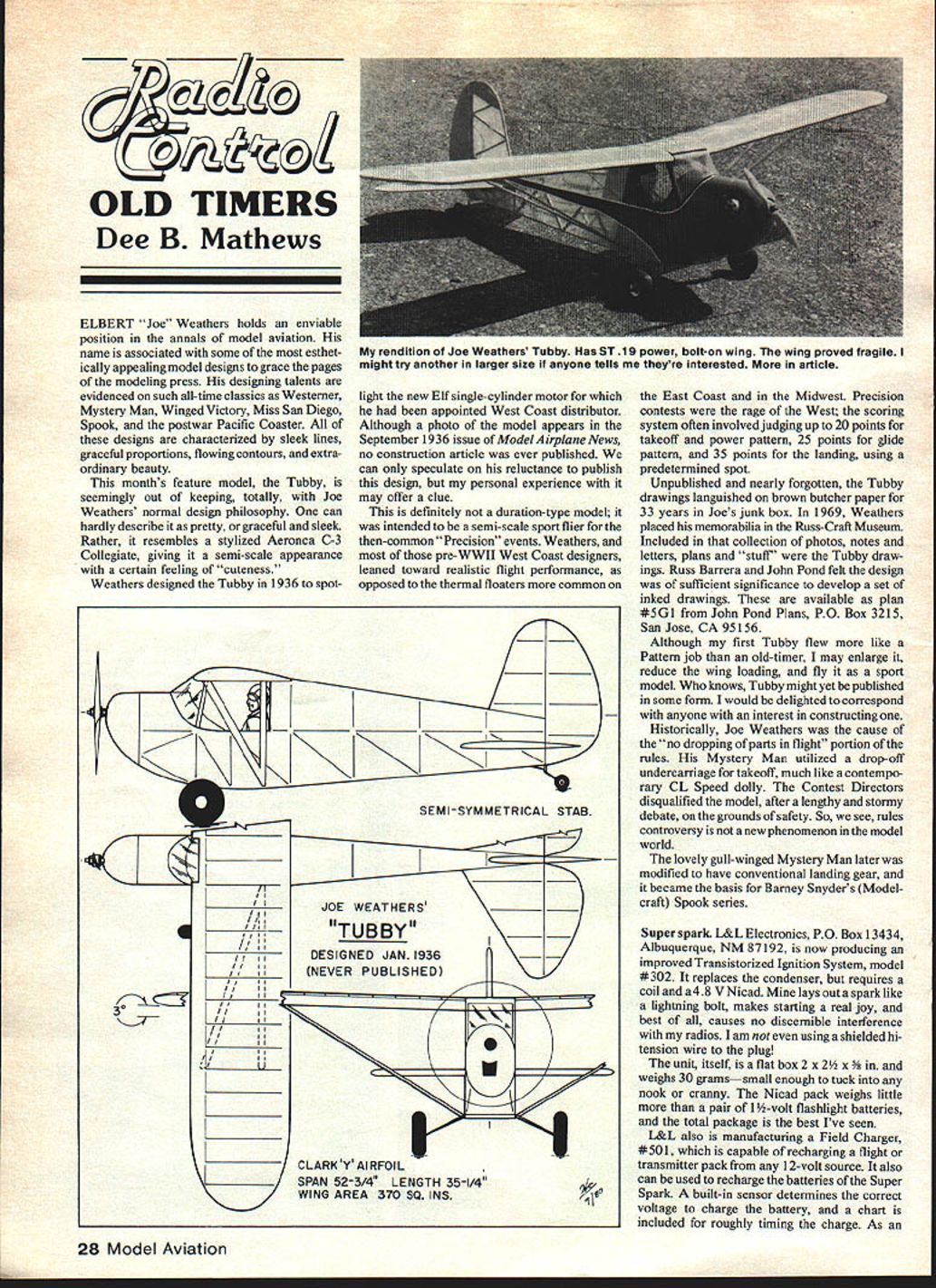
This month's feature model, the Tubby, is seemingly out of keeping with Joe Weathers' normal design philosophy. It is not easily described as pretty, graceful, or sleek; rather, it resembles a stylized Aeronca C-3 Collegiate, giving it a semi-scale appearance with a certain "cuteness."
Weathers designed the Tubby in 1936 to spotlight the new Elf single-cylinder motor for which he had been appointed West Coast distributor. Although a photo of the model appeared in the September 1936 issue of Model Airplane News, no construction article was ever published. We can only speculate on his reluctance to publish this design, but my personal experience with it may offer a clue.
This is definitely not a duration-type model; it was intended as a semi-scale sport flier for the then-common "Precision" events. Weathers, and most pre‑WWII West Coast designers, leaned toward realistic flight performance as opposed to the thermal floaters more common on the East Coast and in the Midwest. Precision contests were the rage on the West Coast; the scoring system often involved judging up to 20 points for takeoff and power pattern, 25 points for glide pattern, and 35 points for the landing, using a predetermined spot.
Unpublished and nearly forgotten, the Tubby drawings languished on brown butcher paper for 33 years in Joe's junk box. In 1969, Weathers placed his memorabilia in the Russ‑Craft Museum. Included in that collection of photos, notes and letters, plans and "stuff" were the Tubby drawings. Russ Barrera and John Pond felt the design was of sufficient significance to develop a set of inked drawings. These are available as plan #5G1 from:
- John Pond Plans, P.O. Box 3215, San Jose, CA 95156
Although my first Tubby flew more like a pattern job than an old-timer, I may enlarge it, reduce the wing loading, and fly it as a sport model. Who knows — Tubby might yet be published in some form. I would be delighted to correspond with anyone interested in constructing one.
Historical notes
Joe Weathers was the cause of the "no dropping of parts in flight" portion of the rules. His Mystery Man utilized a drop-off undercarriage for takeoff much like a contemporary control-line speed dolly. Contest directors disqualified the model, after a lengthy and stormy debate, on the grounds of safety. So, rules controversy is not new in the model world.
The lovely gull-winged Mystery Man was later modified to have conventional landing gear and became the basis for Barney Snyder's (Modelcraft) Spook series.
Products and equipment
#### Super Spark (L & L Electronics model #302) L & L Electronics, P.O. Box 13434, Albuquerque, N.M. 87192, is producing an improved transistorized ignition system, model #302. It replaces the condenser but requires a coil and a 4.8 V NiCd pack. Mine produces a spark like a lightning bolt, makes starting a real joy, and — best of all — causes no discernible interference with my radios. I am not even using a shielded high-tension wire to the plug.
The unit is a flat box about 2 x 2-1/2 x 3/4 in. and weighs 30 grams — small enough to tuck into any nook or cranny. The NiCd pack weighs little more than a pair of 1-1/2 volt flashlight batteries, and the total package is the best I've seen.
#### Field Charger (#501) L & L also manufactures a Field Charger, #501, capable of recharging a flight transmitter pack from any 12-volt source. It can also be used to recharge the batteries of the Super Spark. A built-in sensor determines the correct voltage to charge the battery, and a chart is included for roughly timing the charge.
#### Model 978 (portable ignition system for glow plugs) L & L is also producing Model 978, a portable ignition system for glow plugs. It is a small box with outlets for 15 VDC and 2 VDC plugs, contains a rechargeable battery, and includes a sensor to help with flooded plugs. It is set up to be charged from a standard radio flight-pack charger but also can be charged from a current-limited supply with an output voltage in the range commonly provided by desk-top calculator supplies. These units are of excellent quality and great utility; importantly, prices are reasonable. I recommend them — see your local dealer.
Nitrate dope
I continually receive inquiries about obtaining nitrate dope. The stuff is part of K&B's matched finish system (it is compatible under epoxy or polyurethane paints). Nitrate (clear) dope is also available at some A&E shops at airports. Wag Aero, Lyons, WI, stocks Randolph nitrate dope in regular and low-shrink (dyed blue to avoid confusion) gallons.
I've been challenged on my statement that nitrate does not shrink and warp like butyrate dope. To be scientific about it: most butyrate dopes cure for days, while nitrate sets in a matter of an hour or so. Butyrate has the advantage of being alcohol-resistant and more resistant to abrasion, but it will warp a light structure unless it is pinned flat for several days.
Wahl bangers
Herb Wahl advises that he is contemplating ending production of Brown Jr. replica engines. These beautifully crafted collector items have brought back the qualities that made the original Brown so popular in the 1930s. Anyone considering adding a Brown Jr. to his latest Old-Timer should contact:
- Herb's Model Motors, Box 61, Forksville, PA 18616
Armor All
Armor All, a polymer used on automobile interiors to soften and preserve them, is also an excellent cleaner and preservative for Trexler wheelwells and other rubber and vinyl portions of model aircraft. It is also a very useful lube for rubber motors, as it does not splatter the interior of the fuselage like glycerin-and-green-soap based lubes. Using it, I find I can wind every bit as many turns into Sig contest rubber as with the old-style lubes, while eliminating the mess.
Chicken or Egg?
From the San Diego Aeroneers (SAM 41) newsletter — a reproduction of the inside wrapper on 1/4" x 24 AC spark plugs: "You purchased this miniature AC spark plug as a souvenir at the 'Century of Progress,' but it will interest you to know that this is a real spark plug," etc. The interesting thing is the date — the Chicago World's Fair (the Century of Progress) was held in 1933, a full three years before Bill Brown introduced the Brown Jr.
One must presume these "souvenir" spark plugs were manufactured for use in early prototype Browns and Loutrells, then picked up by some enterprising PR type for use in Chicago.
Dee B. Mathews 506 S. Walnut Greensburg, KS 67054
Transcribed from original scans by AI. Minor OCR errors may remain.

