
Radio Control: Old Timers
Dee B. Mathews
THE ATTRACTION in building and flying miniature replicas of full-scale aircraft is the very essence of our hobby. All of us are stimulated by Scale models, be they Peanut or Monster, or Control Line, Radio Control, or Glider. Some undefinable chemistry flows between modeler and Scale model, catalyzing some to Herculean efforts in creating magnificent reproductions of complex prototypes. Meanwhile, others of us receive equal gratification from creating rather simplistic Scale models which only closely resemble the prototype, but which fly beautifully.
It can be reasonably presumed that nearly every modeler reading these lines selected a Scale model kit as his first purchase, as a youth. Depending upon the reader's age, that kit may have been an Ideal, Megow, Whitman, or, perhaps, a Joe Ott or Comet, or—if much younger—one of the excellent kits available today.
Those lightly-constructed (usually) stick-and-tissue models did not represent ultra-high fidelity to scale, but rather possessed outlines and shapes identifiable as those of a specific prototype. We derived great satisfaction from building and flying these inexpensive models, and could do so again.
Some of the most popular published designs of all time are the near-classic works of Earl Stahl, so much so, in fact, that kits of some of those 35-year-old designs are being produced today by Flyline. It may shock some readers, but many Stahl Free Flight Scale designs (as well as those of such other greats as Struhl, Winter, Lindberg, Struck, and the majority of kits) are not exact scale. Rather, their outlines and dimensions were compromises between flyability, construction ease, and replication. So, who cared? What was, and is, important was that an average builder could create a model that resembled the prototype — and flew well.
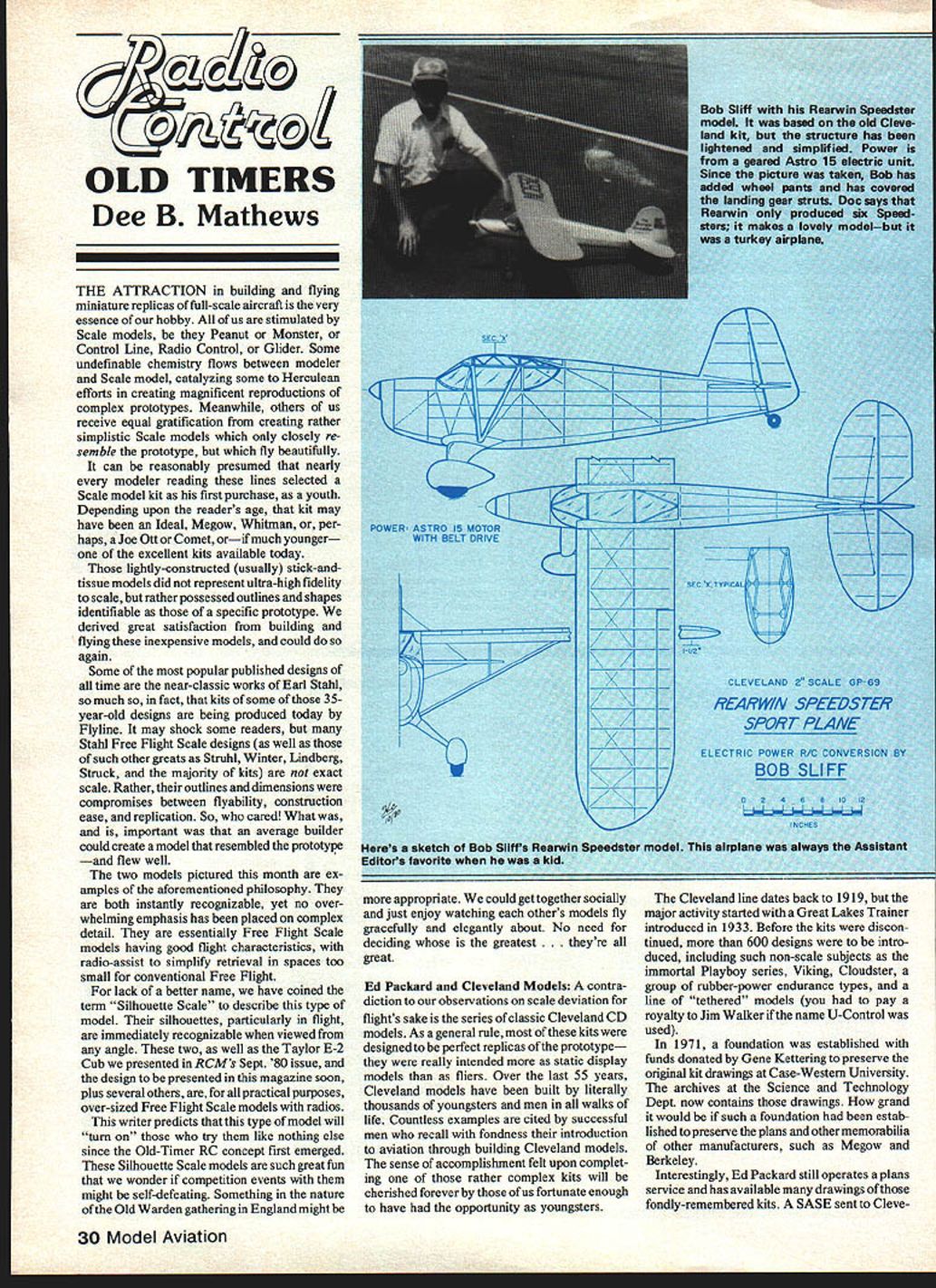
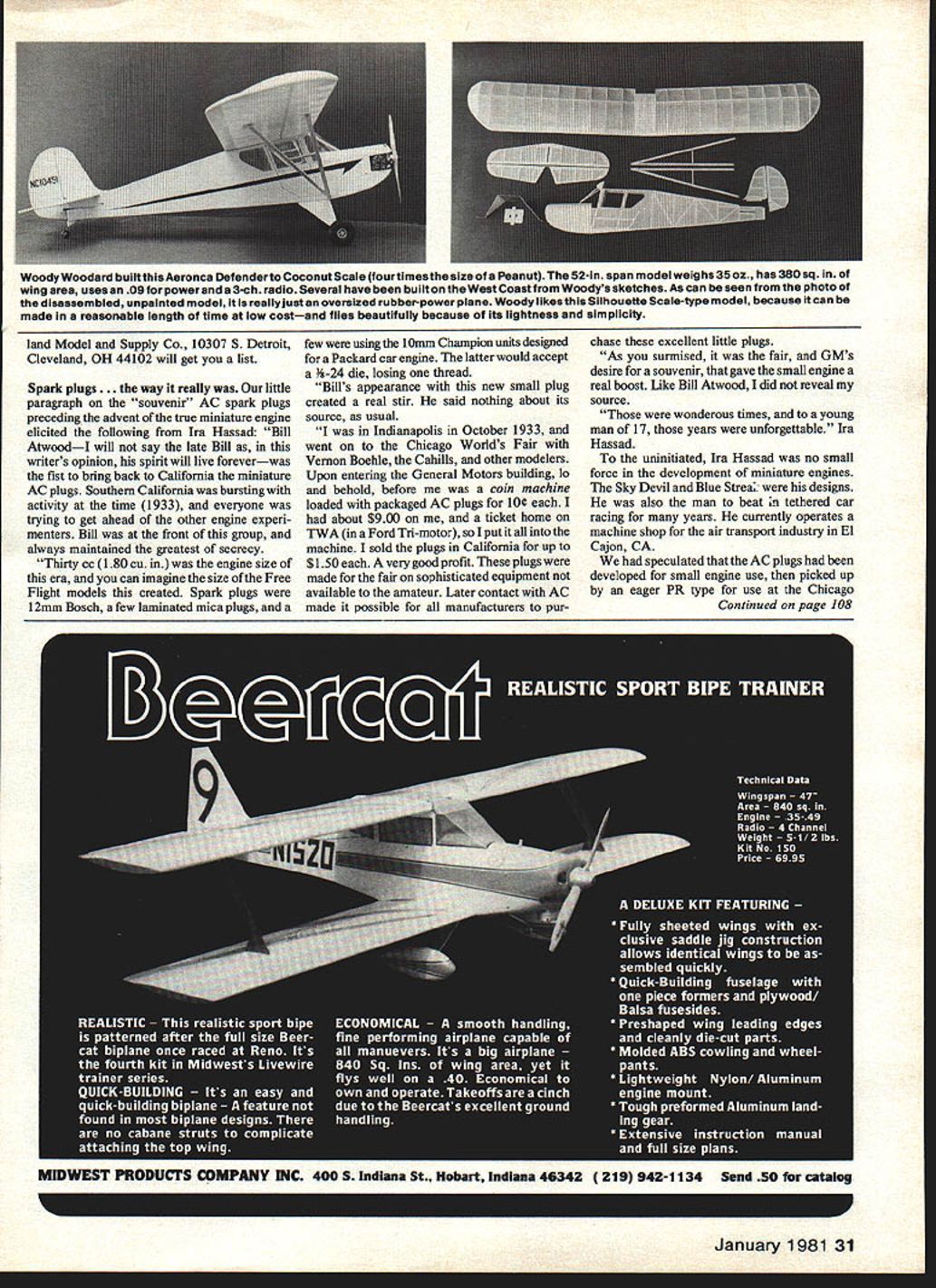
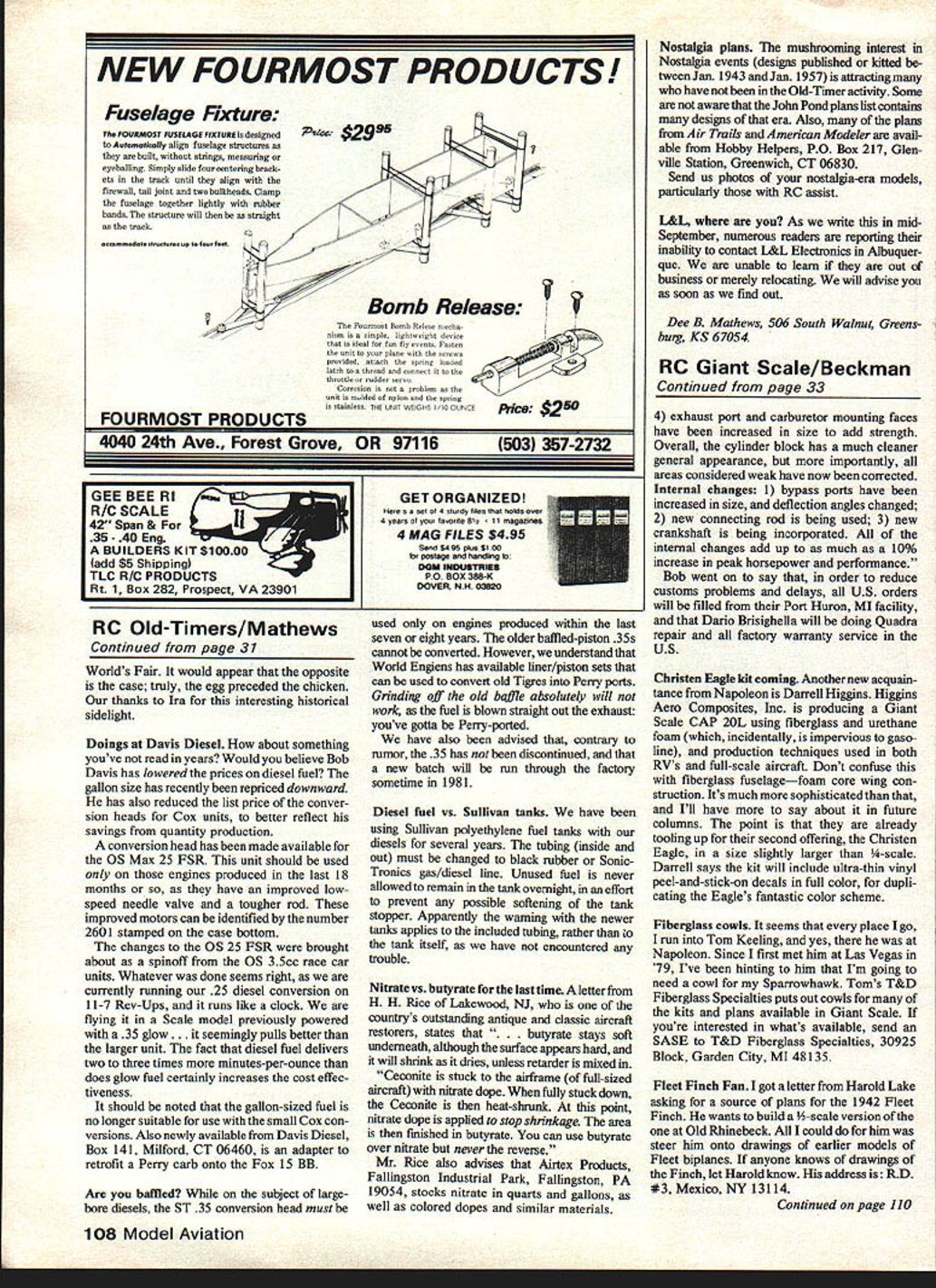
The two models pictured this month are examples of the aforementioned philosophy. They are both instantly recognizable, yet no overwhelming emphasis has been placed on complex detail. They are essentially Free Flight Scale models having good flight characteristics, with radio-assist to simplify retrieval in spaces too small for conventional Free Flight.
Silhouette Scale
For lack of a better name, we have coined the term "Silhouette Scale" to describe this type of model. Their silhouettes, particularly in flight, are immediately recognizable when viewed from any angle. These two, as well as the Taylor E-2 Cub we presented in RCM's Sept. '80 issue, and the design to be presented in this magazine soon, plus several others, are, for all practical purposes, over-sized Free Flight Scale models with radios.
This writer predicts that this type of model will "turn on" those who try them like nothing else since the Old-Timer RC concept first emerged. These Silhouette Scale models are such great fun that we wonder if competition events with them might be self-defeating. Something in the nature of the Old Warden gathering in England might be appropriate. We could get together socially and just enjoy watching each other's models fly gracefully and elegantly about. No need for deciding whose is the greatest . . . they're all great.
Ed Packard and Cleveland Models
A contradiction to our observations on scale deviation for flight's sake is the series of classic Cleveland CD models. As a general rule, most of these kits were designed to be perfect replicas of the prototype — they were really intended more as static display models than as fliers. Over the last 55 years, Cleveland models have been built by literally thousands of youngsters and men in all walks of life. Countless examples are cited by successful men who recall with fondness their introduction to aviation through building Cleveland models. The sense of accomplishment felt upon completing one of those rather complex kits will be cherished forever by those of us fortunate enough to have had the opportunity as youngsters.
The Cleveland line dates back to 1919, but the major activity started with a Great Lakes Trainer introduced in 1933. Before the kits were discontinued, more than 600 designs were introduced, including such non-scale subjects as the immortal Playboy series, Viking, Cloudster, a group of rubber-power endurance types, and a line of "tethered" models (you had to pay a royalty to Jim Walker if the name U-Control was used). In 1971, a foundation was established with funds donated by Gene Kettering to preserve the original kit drawings at Case Western Reserve University. The archives in the Science and Technology Department now contain those drawings. How grand it would be if such a foundation had been established to preserve the plans and other memorabilia of other manufacturers, such as Megow and Berkeley.
Interestingly, Ed Packard still operates a plans service and has available many drawings of those fondly remembered kits. A SASE sent to Cleveland Model Supply Co., 10307 S. Detroit, Cleveland, OH 44102 will get you a list.
Spark plugs — the way it really was
Our little paragraph on the "souvenir" AC spark plugs preceding the advent of the true miniature engine elicited the following from Ira Hassad:
"Bill Atwood — I will not say the late Bill as, in this writer's opinion, his spirit will live forever — was the first to bring back to California the miniature AC plugs. Southern California was bursting with activity at the time (1933), and everyone was trying to get ahead of the other engine experimenters. Bill was at the front of this group, and always maintained the greatest of secrecy.
"Thirty cc (1.80 cu. in.) was the engine size of this era, and you can imagine the size of the Free Flight models this created. Spark plugs were 12mm Bosch, a few laminated mica plugs, and a few were using the 10mm Champion units designed for a Packard car engine. The latter would accept a 1/4-24 die, losing one thread.
"Bill's appearance with this new small plug created a real stir. He said nothing about its source, as usual.
"I was in Indianapolis in October 1933, and went on to the Chicago World's Fair with Vernon Boehle, the Cahills, and other modelers. Upon entering the General Motors building, lo and behold, before me was a coin machine loaded with packaged AC plugs for 10c each. I had about $9.00 on me, and a ticket home on TWA (in a Ford Trimotor), so I put it all into the machine. I sold the plugs in California for up to $1.50 each. A very good profit. These plugs were made for the fair on sophisticated equipment not available to the amateur. Later contact with AC made it possible for all manufacturers to purchase these excellent little plugs.
"As you surmised, it was the fair, and GM's desire for a souvenir, that gave the small engine a real boost. Like Bill Atwood, I did not reveal my source.
"Those were wonderous times, and to a young man of 17, those years were unforgettable." — Ira Hassad
To the uninitiated, Ira Hassad was no small force in the development of miniature engines. The Sky Devil and Blue Streak were his designs. He was also the man to beat in tethered car racing for many years. He currently operates a machine shop for the air transport industry in El Cajon, CA.
We had speculated that the AC plugs had been developed for small engine use, then picked up by an eager PR type for use at the Chicago World's Fair. It would appear that the opposite is the case; truly, the egg preceded the chicken. Our thanks to Ira for this interesting historical sidelight.
Doings at Davis Diesel
How about something you've not read in years? Would you believe Bob Davis has lowered the prices on diesel fuel? The gallon size has recently been repriced downward. He has also reduced the list price of the conversion heads for Cox units, to better reflect savings from quantity production.
A conversion head has been made available for the OS Max 25 FSR. This unit should be used only on those engines produced in the last 18 months or so, as they have an improved low-speed needle valve and a tougher rod. These improved motors can be identified by the number 2601 stamped on the case bottom.
The changes to the OS 25 FSR were brought about as a spinoff from the OS 3.5cc race car units. Whatever was done seems right, as we are currently running our .25 diesel conversion on 11-7 Rev-Ups, and it runs like a clock. We are flying it in a Scale model previously powered with a .35 glow — it seemingly pulls better than the larger unit. The fact that diesel fuel delivers two to three times more minutes-per-ounce than does glow fuel certainly increases the cost effectiveness.
It should be noted that the gallon-sized fuel is no longer suitable for use with the small Cox conversions. Also newly available from Davis Diesel, Box 141, Milford, CT 06460, is an adapter to retrofit a Perry carb onto the Fox 15 BB.
Are you baffled? While on the subject of large-bore diesels, the ST .35 conversion head must be used only on engines produced within the last seven or eight years. The older baffled-piston .35s cannot be converted. However, we understand that World Engines has available liner/piston sets that can be used to convert old Tigers into Perry ports. Grinding off the old baffle absolutely will not work, as the fuel is blown straight out the exhaust; you've gotta be Perry-ported.
We have also been advised that, contrary to rumor, the .35 has not been discontinued, and that a new batch will be run through the factory sometime in 1981.
Diesel fuel vs. Sullivan tanks
We have been using Sullivan polyethylene fuel tanks with our diesels for several years. The tubing (inside and out) must be changed to black rubber or Sonic-Tronics gas/diesel line. Unused fuel is never allowed to remain in the tank overnight, in an effort to prevent any possible softening of the tank stopper. Apparently the warming with the newer tanks applies to the included tubing, rather than to the tank itself, as we have not encountered any trouble.
Nitrate vs. butyrate — for the last time
A letter from H. H. Rice of Lakewood, NJ, who is one of the country's outstanding antique and classic aircraft restorers, states that "Cocoon" is stuck to the airframe (full-sized aircraft) with nitrate dope. When fully stuck down, the Cocoon is then heat-shrunk. At this point, nitrate dope is applied to stop shrinkage. The area is then finished in butyrate. You can use butyrate over nitrate but never the reverse.
Mr. Rice also advises that Airtex Products, Fallington Industrial Park, Fallington, PA 19054, stocks nitrate in quarts and gallons, as well as colored dopes and similar materials.
Nostalgia plans
The mushrooming interest in Nostalgia events (designs published or kitted between Jan. 1943 and Jan. 1957) is attracting many who have not been in the Old-Timer activity. Some are not aware that the John Pond plans list contains many designs of that era. Also, many of the plans from Air Trails and American Modeler are available from Hobby Helpers, P.O. Box 217, Glenville Station, Greenwich, CT 06830.
Send us photos of your nostalgia-era models, particularly those with RC assist.
L&L, where are you?
As we write this in mid-September, numerous readers are reporting their inability to contact L&L Electronics in Albuquerque. We are unable to learn if they are out of business or merely relocating. We will advise you as soon as we find out.
Resources and addresses
- Cleveland Model Supply Co., 10307 S. Detroit, Cleveland, OH 44102 — plans list available via SASE.
- Davis Diesel, Box 141, Milford, CT 06460 — fuel, conversion heads, and adapters.
- Airtex Products, Fallington Industrial Park, Fallington, PA 19054 — nitrate and butyrate dopes.
- Hobby Helpers, P.O. Box 217, Glenville Station, Greenwich, CT 06830 — plans from Air Trails and American Modeler.
Dee B. Mathews 506 South Walnut Greensburg, KS 67054
Transcribed from original scans by AI. Minor OCR errors may remain.

