
Radio Control: Old Timers
Dee B. Mathews
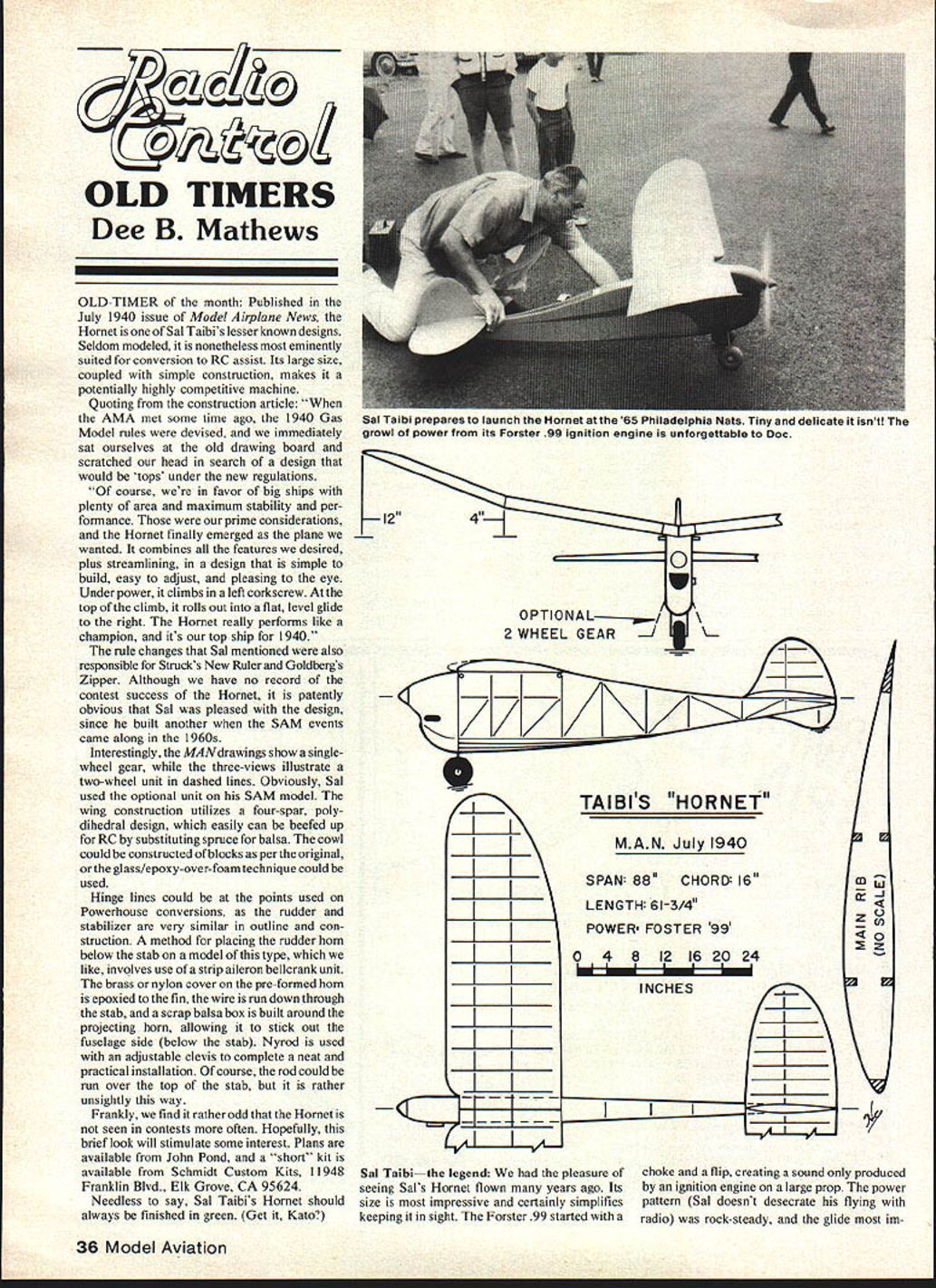
Old-Timer of the Month — Sal Taibi's Hornet
Published in the July 1940 issue of Model Airplane News, the Hornet is one of Sal Taibi's lesser known designs. Seldom modeled, it is nonetheless eminently suited for conversion to RC assist. Its large size, coupled with simple construction, makes it a potentially highly competitive machine.
Quoting from the construction article: "When the AMA met some time ago, the 1940 Gas Model rules were devised, and we immediately sat ourselves at the old drawing board and scratched our heads in search of a design that would be 'tops' under the new regulations.
"Of course, we're in favor of big ships with plenty of area and maximum stability and performance. Those were our prime considerations, and the Hornet finally emerged as the plane we wanted. It combines all the features we desired, plus streamlining, in a design that is simple to build, easy to adjust, and pleasing to the eye. Under power, it climbs in a left corkscrew. At the top of the climb, it rolls out into a flat, level glide to the right. The Hornet really performs like a champion, and it's our top ship for 1940."
The rule changes that Sal mentioned were also responsible for Struck's New Ruler and Goldberg's Zipper. Although we have no record of the contest success of the Hornet, it is obvious Sal was pleased with the design—he built another when the SAM events came along in the 1960s.
The MAN drawings show a single-wheel gear, while the three-views illustrate a two-wheel unit in dashed lines. Obviously, Sal used the optional unit on his SAM model. The wing construction utilizes a four-spar, poly-dihedral design, which can easily be beefed up for RC by substituting spruce for balsa. The cowl could be constructed of blocks as per the original, or the glass/epoxy-over-foam technique could be used.
Hinge lines could be at the points used on Powerhouse conversions, as the rudder and stabilizer are very similar in outline and construction. A method we like for placing the rudder horn below the stab on a model of this type involves the use of a strip aileron bellcrank unit. The brass or nylon cover on the pre-formed horn is epoxied to the fin, the wire is run down through the stab, and a scrap balsa box is built around the projecting horn, allowing it to stick out the fuselage side (below the stab). Nyrod is used with an adjustable clevis to complete a neat and practical installation. Of course, the rod could be run over the top of the stab, but it is rather unsightly that way.
Frankly, we find it odd that the Hornet is not seen in contests more often. Hopefully, this brief look will stimulate some interest. Plans are available from John Pond, and a "short" kit is available from Schmidt Custom Kits, 11948 Franklin Blvd., Elk Grove, CA 95624. Needless to say, Sal Taibi's Hornet should always be finished in green. (Get it, Kato?)
Sal Taibi — a brief tribute
Impressive.
My two sons were with me when Sal was preparing to fly his Hornet. I said, "Boys, this man designed this airplane nearly 30 years ago." Sal looked up with a great big grin and said, "Yes, but I was a mere slip of a boy at that time." That exemplifies Sal Taibi in many ways; he is perpetually young at heart, enjoys modeling to the fullest, and has the reputation of being the winningest Free Flight contestant of all time. The man has been continuously active in this hobby for his whole lifetime. His son, Mike, has followed in his footsteps and was a National Junior Champion. It is safe to say that Sal's Starduster kits have introduced more modelers to Free Flight than any other kit in history. It also must be the winningest design ever. If anyone deserves the title "Mr. Free Flight U.S.A.," it is this man.
SAM Champs '81
At the SAM annual meeting held in Dayton as part of the 1980 Champs, Al Hellman presented a bid for the 1981 Champs from the West Coast chapters. It was accepted, and the tentative dates are during the last weekend of June 1981, at Taft.
While Taft, CA is reputed to be the premier FF site in the U.S.A. and should be an excellent venue for the RC Old-Timer fliers as well, advance motel reservations are strongly advised. Taft is a small oil-and-college town with rather limited motel accommodations. Camping on the site is permitted, and some contestants often merely roll out a sleeping bag, using the star-studded desert sky as a blanket.
Phil Bernhardt, in the Arcing Point of SAM 49, says: "... the whole idea behind the West Coast RC Champs (Memorial Day weekend) was to" have a big once-a-year shindig for those who couldn't travel halfway across the country to attend the regular SAM Champs. Phil, therefore, proposes they not be held in 1981, and that the West Coast SAM chapters put all their efforts into hosting the SAM Champs.
Carrying Phil's logic one step further, perhaps something should be done to assure the Midwest and East Coast SAM types an alternate to traveling "half way across the country." The CIA folks in Indiana-Ohio and the Fort Worth Plainsmen hold large, well-attended annual SAM events. Those unable to go West might wish to check the Contest Calendar.
Enlarging Plans — Project That Three View
Bill Hannan, you're right on. "Project That Three View" in the July '80 issue is must reading for anyone who ever enlarges plans. We are currently using a Brumberger No. 290 "Project-O-Scope," for which I paid $7.95 at a stained-glass shop. While not mentioned in Bill H.'s article, the darn thing works quite well in enlarging airfoils and such. While the optics are not of the quality of the more expensive units, the projected image is perfectly adequate for my requirements.
We hang a piece of paper on the wall, place the projector over the drawing on a wheeled secretary's chair, and move it about to get the desired size. A pencil is used to trace a rough outline, then the roughness is cleaned up on a board with an adjustable French curve (the rubber-covered wire thing from the drafting store) and a ball point. Simple!
More on Monkey Coat (Koverall/white glue/iron-on)
We presume many readers have tried the Koverall/white glue/iron-on technique we described in the August column (which I call "Monkey Coat"). If you haven't, by all means consider using it on your winter project.
As we continue to use this technique, we become increasingly enthusiastic. Some points worth mentioning:
- The white glue adds additional structural strength to the wood.
- The polyester provides increased torsional rigidity.
- We constructed two identical wings, covering one with heat-shrink and the other with "Monkey Coat." The shiny (heat-shrink) wing required one coat to equal the twist resistance of the polyester, which was finished in clear nitrate and polyurethane paints.
- The finished weights were within an ounce or so, with the polyester unit providing added durability and fuel resistance.
Koverall, like all polyester materials, tends to unravel along a cut edge even when a super-sharp blade is used. We have found that a coat of cellulose cement (Ambroid, etc.) rubbed into the edges will harden the ravel, making them much easier to sand smooth. Rubbing the cement in the direction of the "feathers" also helps hold them in place. The cement is also excellent for sticking the polyester onto epoxy/wood and fiberglass surfaces. We are still "monkeying" around with this stuff—let's hear about your efforts and results.
The first "Kraft" radios?
Back in 1948, one of my flying buddies, who had a ham license, constructed an Aerotrol single-channel RC unit from one of Berkeley's kits. Not having access to anything better for a transmitter housing, he used a one-pound wooden Velveeta cheese box. Since the thing had "Kraft" brand cheese labeled all over it, is it possible that Gail Scheuerman of LaCrosse, KS had the first Kraft transmitter?
Aerotrol was designed by Ed Lorenz, who wrote the RC column for MAN for many years. It was originally manufactured by Ben Selbst, whose company also manufactured the Aerotrol spark ignition coils. With the advent of WWII, Ben made tens of thousands of flame throwers which used that same coil as an igniter.
Berkeley acquired the Aerotrol line from Selbst in 1946, and Joe Dale and Bill Elfinger made units available to licensed users for $50.00 complete! When it became apparent that examination-free licenses would become available, Elfinger geared up and had a thousand units made for the announcement.
You will notice the use of the term "examination-free." To my knowledge, it has never been legal to use the airwaves without a license. Prior to the AMA's success in obtaining the 27 MHz and 465 MHz frequencies, the only available radio control bands were the 6-meter ham frequencies and some UHF stuff. To obtain a ham license, one had to have a knowledge of electronics and be able to pass a written examination on the subject. If that weren't obstacle enough, it was also necessary to be able to receive and transmit in Morse code!
Needless to say, the advent of exam-free frequencies was good news indeed! Bill Elfinger's Berkeley Aerotrol, Vernon McNabb's Citizens and others were the earliest efforts available to us.
Bill shared an inside piece with me that is worth telling: "One of the secrets was getting the gas-filled XFG-1 tubes from England to replace the unreliable RK-61 tubes used originally. These were sub-miniature units that performed similar to the RK-61, but we found we could get them to 'ionize' if we put them inside a high-voltage Tesla coil for several hours. This was our secret and the reason our XFG-1's worked while others' wouldn't."
You know, I always wondered why a replacement tube from Berkeley would oscillate, while ordering one from someone else produced "nothing" tubes. Now I know.
Believe me, if you've never spent an afternoon with a meter adjusting the coil slug in a Super Aerotrol receiver for maximum (peak signal on), you have not missed out on a thing!
A whatsit — The Feeney 4-cycle
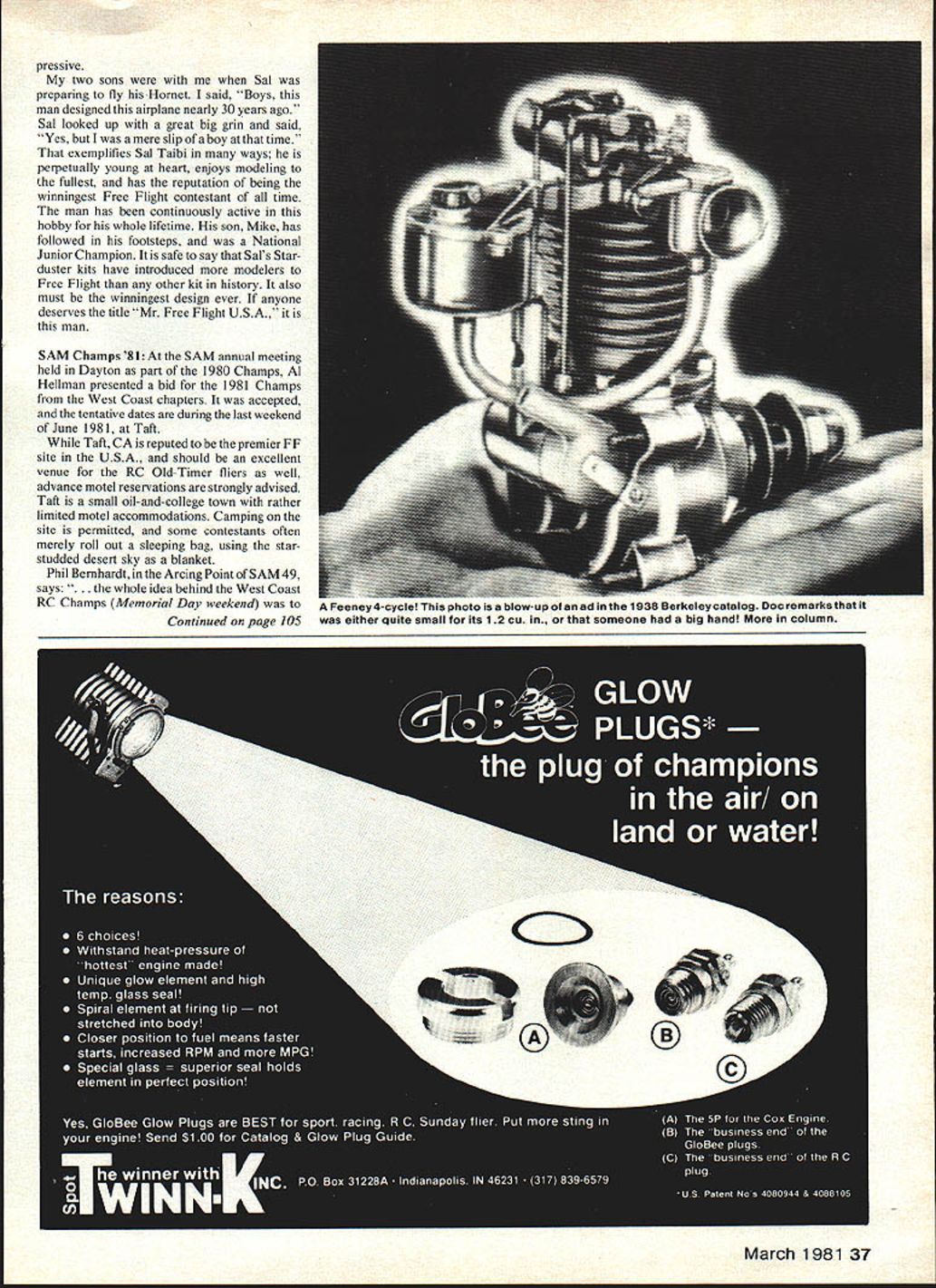
One of our sister magazines runs a "mystery model of the month" feature, and the temptation is strong to run this engine photo in the same manner. However, we find we often have forgotten the model by the time it is identified in the next issue. Therefore, we will resist the temptation and identify the oddball engine in this month's photo.
The Feeney 4-cycle was featured in the 1938 Berkeley catalog. Available in:
- Model A: 20 cc displacement, rated at 1-1/2 hp, weighed 15 oz.
- Model C: 10 cc displacement, weighed 13 oz.
They were true overhead valve four-cycle ignition engines designed for planes, cars and boats. The Model A was rated to produce 1-1/2 hp — the ad copy says: "This Feeney 4-cycle engine gives you more features that assure delivery of championship performance than any other engine of the same size. Full throttle control from idling to top."
The price? An unbelievable $29.50 — in the same era when a Bantam was $16.50 and an O&R was $21.50. No wonder Feeney did not become a household word!
Anyone with knowledge of this truly unusual power plant is invited to share it with our readers.
A Japanese first?
The assistant editor recently sent us a copy of an OS ad from a Japanese model mag. One double page is illustrated with photos of engines produced by the OS company through their history. Interestingly, their Type I (which we presume to be their first commercial engine) was an ignition unit of 1.66 cc! Using our "rule of sixes" to convert metric to cubic inches, 1.66 cc × 0.06 ≈ 0.099 cu. in. In other words, the first OS Max was a .099 cu. in. ignition unit produced and sold in 1936!
Ray Arden's immortal Atom was of this same size, and has, for many years, been considered the first commercial small-bore engine. It was not advertised until several years after 1936. Hmm!!
L&L Electronics
It is rather embarrassing to test and report on equipment from a manufacturer, only to find they have ceased production after the copy is in print. Unfortunately, this is exactly what happened with L&L Electronics. Oh well, we could just ignore little garage-type industries, but then how would anyone know about them?
My home town was populated with second-generation Volga Russians when I was a kid. When they wanted to really emphasize that something was lost, they would say "it's gonner-went." That's what happened to L&L.
Thanks AMA
We will close with another quote from the 1939 Berkeley Catalog: "NOTICE... It is absolutely necessary that the owner of radio equipment have a licensed amateur on hand at all times when flying a radio control model."
Enjoy!
Dee B. Mathews 506 South Walnut Greensburg, KS 67054
Transcribed from original scans by AI. Minor OCR errors may remain.

