
Radio Control: Old-Timers
Dee B. Mathews
Although the entire series of Berkeley Cavaliers are usually thought of as Ben Shereshaw designs, such is not the case. Some letter-writing and magazine research has revealed that only the 1936 Cavalier was the product of Ben's genius. The subsequent Custom, Custom Twin-Tail, Standard, and 60 were all team designs by Bill Effinger and his staff at Berkeley.
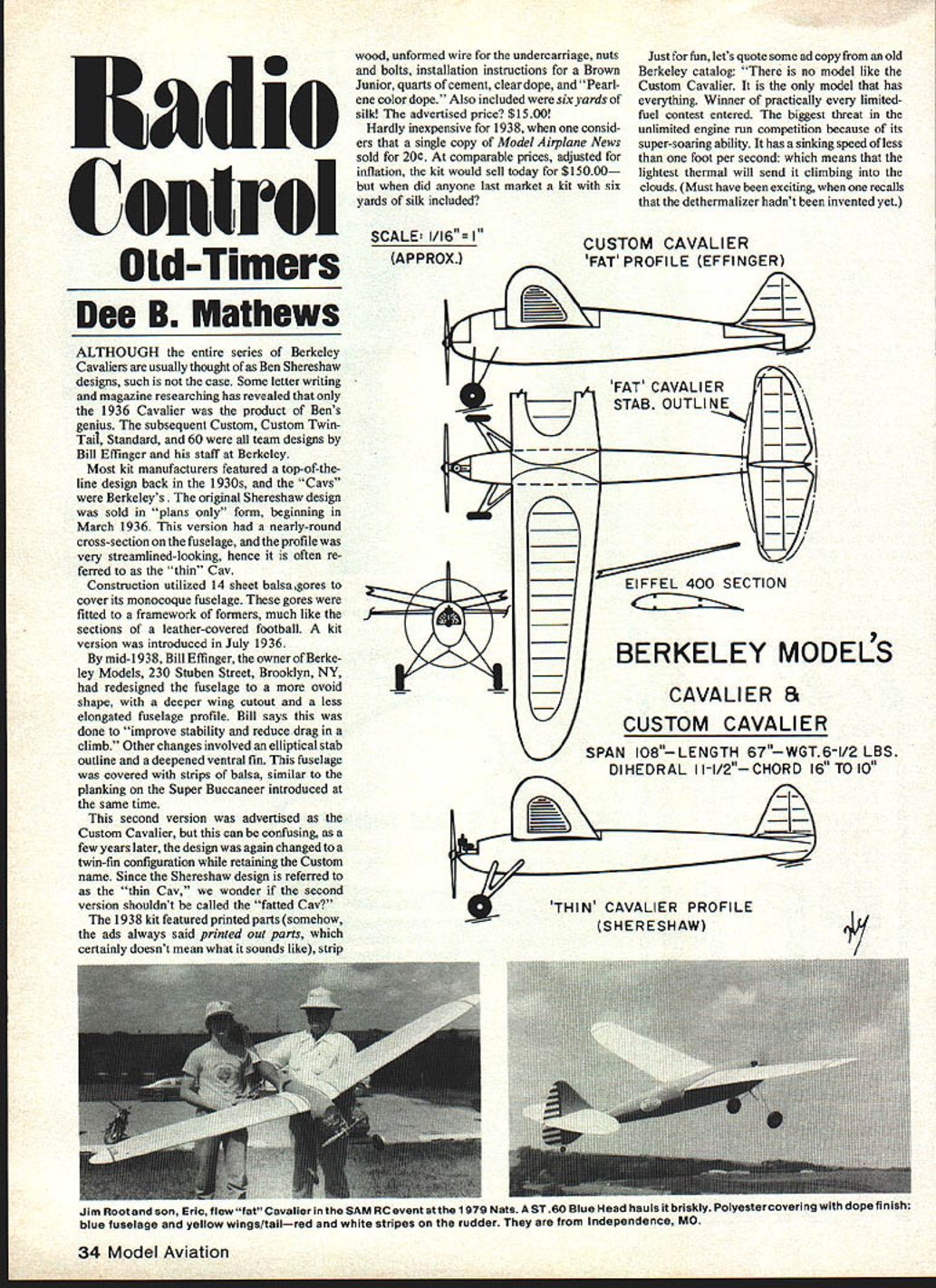
Most kit manufacturers featured a top-of-the-line design back in the 1930s, and the "Cavs" were Berkeley's. The original Shereshaw design was sold in "plans only" form, beginning in March 1936. This version had a nearly round cross-section on the fuselage, and the profile was very streamlined-looking; hence it is often referred to as the "thin" Cav.
Construction utilized 1/4-sheet balsa gores to cover its monocoque fuselage. The gores were fitted to a framework of formers, much like the sections of a leather-covered football. A kit version was introduced in July 1936.
By mid-1938, Bill Effinger, the owner of Berkeley Models, 230 Stuben Street, Brooklyn, NY, had redesigned the fuselage to a more ovoid shape, with a deeper wing cutout and a less elongated fuselage profile. Bill says this was done to "improve stability and reduce drag in a climb." Other changes involved an elliptical stab outline and a deepened ventral fin. This fuselage was covered with strips of balsa, similar to the planking on the Super Buccaneer introduced at the same time.
This second version was advertised as the Custom Cavalier, but this can be confusing, as a few years later the design was again changed to a twin-fin configuration while retaining the Custom name. Since the Shereshaw design is referred to as the "thin Cav," the second version might reasonably be called the "fatted Cav."
The 1938 kit featured printed parts (ads usually said "printed out parts," which doesn't mean what it sounds like), strip wood, unformed wire for the undercarriage, nuts and bolts, installation instructions for a Brown Junior, quarts of cement, clear dope, and "Pearlene" color dope. Also included were six yards of silk. The advertised price? $15.00!
Hardly inexpensive for 1938, especially when a single copy of Model Airplane News sold for 20¢. At comparable prices, adjusted for inflation, the kit would sell today for about $150.00—but when did anyone last market a kit with six yards of silk included?
Just for fun, here is some ad copy from an old Berkeley catalog: "There is no model like the Custom Cavalier. It is the only model that has everything. Winner of practically every limited-fuel contest entered. The biggest threat in the unlimited engine run competition because of its super-soaring ability. It has a sinking speed of less than one foot per second; which means that the lightest thermal will send it climbing into the clouds. (Must have been exciting, when one recalls that the dethermalizer hadn't been invented yet.)"
Continuing the ad copy hyperbole: "Custom Cavalier has been adopted by over 15 colleges and universities for experimental radio control work. Its rugged construction, husky landing gear and smooth glide make it possible to carry a 4-pound payload. Those who have built Custom Cavalier have tops among their model airplanes; owning one is a source of real satisfaction to the model builder. Truly the Rolls-Royce of model airplanes."
Such enthusiastic verbiage in old catalogs may seem amusing; the fact remains that reading copy in 1939 must have seeded daydreams in the minds of youngsters who remember Berkeley catalogs and also recall the difficulty of gathering $15.00 for a model kit. Most modelers contented themselves with $1.45 kits (Megow Comet) and dreamed of something like the Custom Cavalier.
The writer sees R/C Old-Timers as multi-faceted reward machines: constructing and flying model aircraft of bygone years fulfills varied enjoyment objectives. Depending on one's age, they can answer unfulfilled dreams, provide trips down nostalgia trails, challenge one's skills, and—best of all—be just plain fun.
Frankly, I must avoid getting too philosophic about the hobby lest I lose sight of the important aspect—enjoying oneself.
Roots
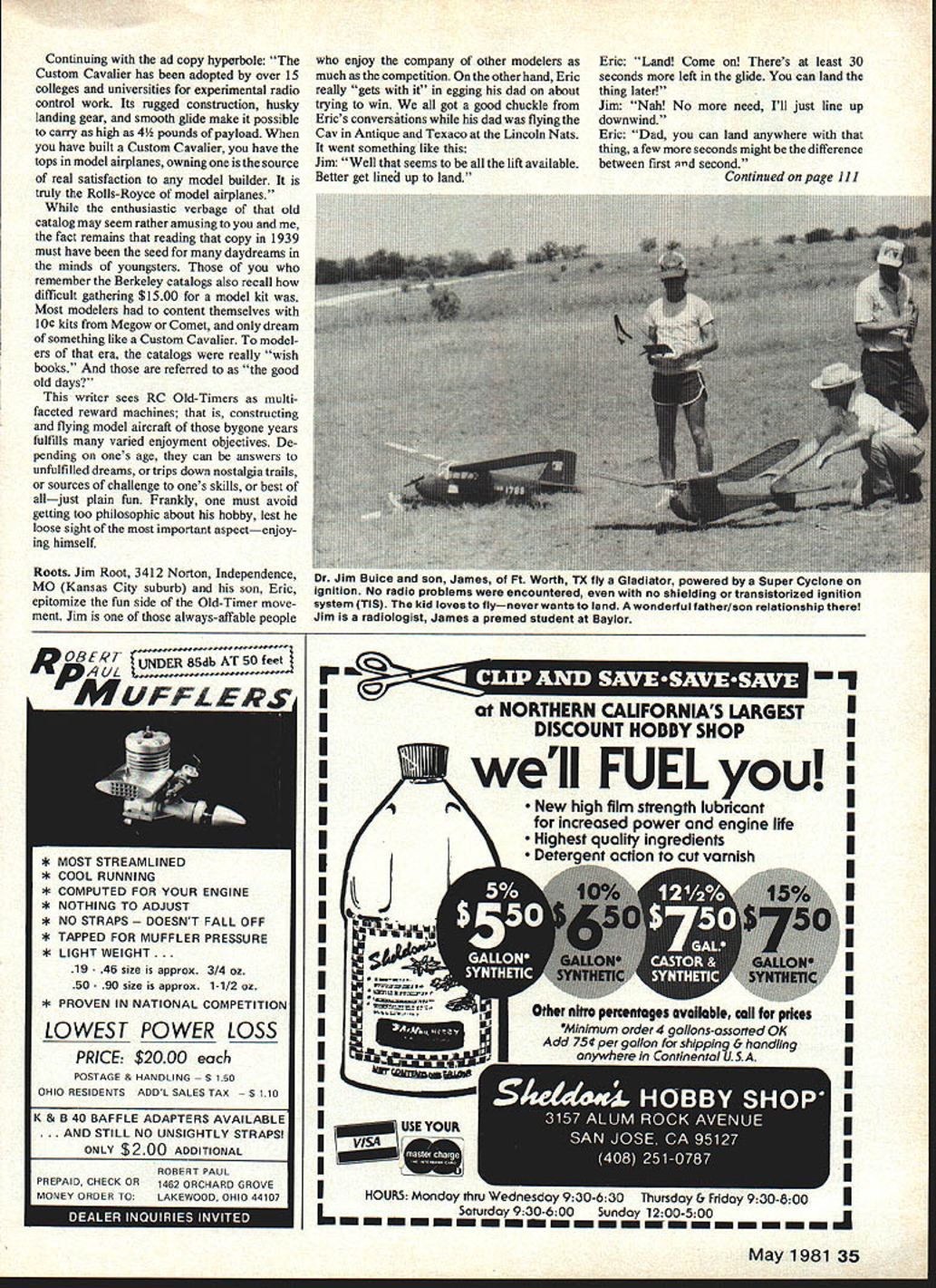
Jim Root, 3412 Norton, Independence, MO (Kansas City suburb), and his son, Eric, epitomize the fun side of the Old-Timer movement. Jim is one of those always-affable people who enjoy the company of other modelers as much as the competition.
On the other hand, Eric really "gets with it" in egging his dad on about trying to win. We all got a good chuckle from Eric's conversations while his dad was flying the Cav in Antique and Texaco at the Lincoln Nats. It went something like this:
Jim: "Well, that seems to be all the lift available. Better get lined up to land."
Eric: "Land! Come on! There's at least 30 seconds more left in the glide. You can land the thing later!"
Jim: "Nah! No more need, I'll just line up downwind."
Eric: "Dad, you can land anywhere with that thing, a few more seconds might be the difference between first and second."
These interplays between fathers and sons are one of the most enjoyable facets of our hobby. Those of us whose sons have grown and moved away might consider "adopting" some young man in the neighborhood, or at work, who could benefit from our building while we benefit from his enthusiasm and sharp eyesight. Believe me, the relationships can be priceless!
Building a Cav
For those interested in building a "fatted" Cavalier, Schmidt Custom Kits, 11948 Franklin Blvd., Elk Grove, CA 95624, has a semi-kit (formers and ribs, no strip wood) available. The plans are available from John Pond Plans, P.O. Box 3215, San Jose, CA 95156.
I suggest considering planking that fuselage with Sig's round-edge planking strips. I've used them on similar projects and find they work well when combined with cyanoacrylate adhesives (Jet, Hot Stuff, etc.).
Planking such a large area would certainly be a challenge, but it is not beyond the skill level of an average builder.
SAM Champs
Taft, CA, the Free Flight capital of the world, will be the scene of the SAM Champs in 1981. The dates are June 30 and July 1 and 2: Tuesday, Wednesday, and Thursday, which are traditional SAM Champs dates. This permits driving to the contest from nearly anywhere in the contiguous 48, if a Friday evening start is used. An extra day will be available for the return home, since the following Monday is a holiday.
Accommodations will be available in one of the dorms at Taft Junior College. On-field camping is permitted, and a list of motels will be published in SAM Speaks by the time you read this. John Targos will be the RC Contest Director.
RC Old Timer at the Alamo Nats
At this writing (early January), we have not been able to definitely pin down a location or details, but RC SAM events will be flown at the AMA Nats this year. Plan to bring along your ships and smiling faces. We'll all get together and have a good time. Ya'll come now, hear?
Dee B. Mathews 506 South Walnut Greensburg, KS 67054
Transcribed from original scans by AI. Minor OCR errors may remain.

