
Radio Control: Old-Timers
Dee B. Mathews
Cavalier Twin
In our May column, we traced the evolution of the Cavalier series from Ben Shereshaw's original 1936 design (kitted by Berkeley) through the "fatted" version introduced in 1938. As we pointed out in that short history, the only Cavalier designed by the legendary Ben Shereshaw was the original. All subsequent development was by Bill Effinger and his group.
Effinger began Berkeley Models as a small living-room operation in Brooklyn. By carefully reinvesting his profits, and by kitting the designs of the leaders in the hobby, he saw his business grow into one of the world's largest by the 1950s. The entire operation was sold to Duke Fox in the late 1950s and moved to Fort Smith, AR. Fox subsequently disposed of those assets to Sig Manufacturing in Montezuma, IA and the Berkeley line became the basis for that firm's early kits.
The Piper Cub J-3 that has been so popular for Sig was originally a Chuck Hollinger design, first published in the January 1951 issue of Air Trails and kitted by Berkeley in 1952. Several redesigns have taken place over the years, to be sure, but the basic design dates back to that old kit. The same is true for several of Sig's smaller gas and rubber Free Flight kits. As an example, Sig's Stinson L-5 was originally designed by Hank Struck and kitted by Berkeley. The Berkeley Sinbad (the Sailor!) design dates back to 1941. Point is . . . you can't keep a good kit down.
One of the trademarks of Effinger and his staff was scaling up or down successful sellers into various other kits. The Cavalier series eventually ranged from a 36-inch rubber-power model to the 108-inch Custom series for radio-control experiments. Other steps in the evolution were the Cavalier 60 for use with the then-new O&R .23, and a Cavalier 72, which Bill tells me wasn't much.
Comparing this month's photo with those used in the May issue quickly reveals marked and radical changes in the Cavalier. The single fin was replaced with a "modern" twin tail mounted on a dihedraled stabilizer. Equally revolutionary was the use of a tricycle gear. Nothing, however, could match the sensation created by the announcement of the twin. To our limited knowledge, this was the first twin-engined Free Flight kit ever marketed, although the 1938 Zaic Yearbook shows a twin by Frank Ehling, indicating others were playing with the concept.
The Cavalier Twin also featured a plug-in wing. The center section was permanently affixed to the fuselage, while the outer panels were removable outboard of the engine nacelles. Power was a pair of O&R .60s, fitted with patented "exhaust thrust augmenters." Effinger says, "The idea was to get a little more thrust from the exhaust and better scavenging." Those exhaust augmenters were a very early tuned-pipe concept. Bill also responded to my query about some form of motor shutoff with: "I don't know what would happen if one engine quit." We can pretty well guess!
A large removable hatch was designed into the nose area for "experiments." The ad copy lists a payload of 5½ lb. Also detailed are such gems as "used for valuable experiments by our Armed Forces in Aerial Targetry, Aerial Torpedoing, and Sound Camouflage." Obviously, these designs (a single-engine version was also available) were vastly more sophisticated than their contemporaries and were directed primarily at the early radio-control experimenters.
As an example, Norm Rosenstock was using a highly modified Cavalier for radio control as late as the early 1960s. Conversely, a four-year search has yet to locate a photo of a Cavalier Twin. The one we have used is from an old Berkeley catalog. Who'll be the first to build one for RC and send us a picture?
Annotation to a legend
We have been aware of Bob Larsh's preparation of his "Goldberg Zipper" article for several years and were anxiously awaiting its publication. Bob's superbly researched and documented history, as printed in the February and March 1981 issues of Model Airplane News, certainly met our expectations. This article is a must read for anyone with an interest in the roots of our hobby.
In that account, Larsh recreates the nearly legendary fly-away of Carl Goldberg's Valkyrie at the 1937 Detroit Nationals. Powered with a Brown Jr. borrowed from Vernon Boehle of Indianapolis, the Valkyrie thermalled out over the Detroit River and was last seen settling onto a deserted island on the Canadian side of the border. It was never recovered.
In a letter dated October 8, 1980, Ira Hassad points out that he had loaned that same Brown Jr. to his friend Vernon Boehle! How about that? Carl Goldberg's Valkyrie flies away with an engine borrowed from Vernon but actually belonging to Ira Hassad. Do you suppose Carl knew whose engine was in his model? We wonder who owed what to whom.
S.A.M. visits the Alamo
Word is just in from John Pond concerning Old-Timer schedules at the 1981 Nats. Old-Timer RC events will be Limited Engine Run, Antique, and Texaco — to be run off on Wednesday, August 5, at a site to be announced later. Thursday, the 6th, will see Old-Timer CL Stunt, and Friday will feature Free Flight. A Victory Banquet will be held on Friday night with trophy awards, movies from the early days, and perhaps some speakers. Sounds like great fun for all. See you there?
An effort will be made to display a map with the location of the events for those who wish to enter or spectate. If space is available for a SAM booth, check there. If not, look on the bulletin board.
How's the weather?
From the newsletter of the Fort Worth Planesmen: some meteorological data gathered by Russ Snyder for early August in the San Antonio area:
- Average high temperature: 95°F (extreme max. 100°F)
- Minimum: 73°F
- Wind/humidity: 5–7 knots and 83% at 7 a.m.; 5–8 knots and 62% at 10 a.m.; 9–10 knots and 43% by 4 p.m.
- Prevailing wind direction: southeasterly
The runway at Seguin is 10,000 ft long, running northwest to southeast. A pair of taxiways run north-south and east-west and are 5,000 ft of pavement. Surely, this set-up will provide excellent facilities for everyone.
That funny Feeney four-cycle
In our March column, we ran a little piece on the Feeney engine, adding what little we could to the photo, and asking for further information. Joe Wagner, the first president of the Model Engine Collectors Association (MECA), responded with a batch of information. Our English cousins call it "gem."
Joe's remarks (edited):
"The most important feature of the Feeney was crudity. Not even the Thor was built so poorly! The engine I had was complete, but was so frighteningly shoddy-looking that I never dared to try to run it. The other Feeney I helped restore was apparently sold in kit form, because several of the parts were not fully machined.
"The engine I had looked somewhat like the picture you ran, but that picture was a heavily airbrushed photo of a hand-built prototype, made by a man named Casimir Leja. Its displacement is nowhere near 1.2 in.^3. My old data book says .687 in.^3.
"My engine was a 'Model B' made in 1940, and displacement of .914 in.^3. Its serial number was 335. The major difference in appearance between this engine and the ad picture was the inclusion of beam mounts. But was it ever cheap-looking! The casings on a Rogers or Buzz are masterpieces compared to the Feeney castings.
"The Leja designs seemed quite competent. But it had to be produced in order to make a mark in aeromodelling history, and that's where the project seems to have met its doom!
"I had been looking avidly for one for years when I was an active engine collector. It was just about 'tops' on my want list. When I finally got one, what a letdown."
Our only comment is that perhaps if this pioneering four-stroke design had been well manufactured, we would not have waited nearly forty years for the advent of four-cycle mass-produced model aircraft engines. Oh yes, I thought that was a terribly large hand in the ad picture!
One mystery solved, another opened
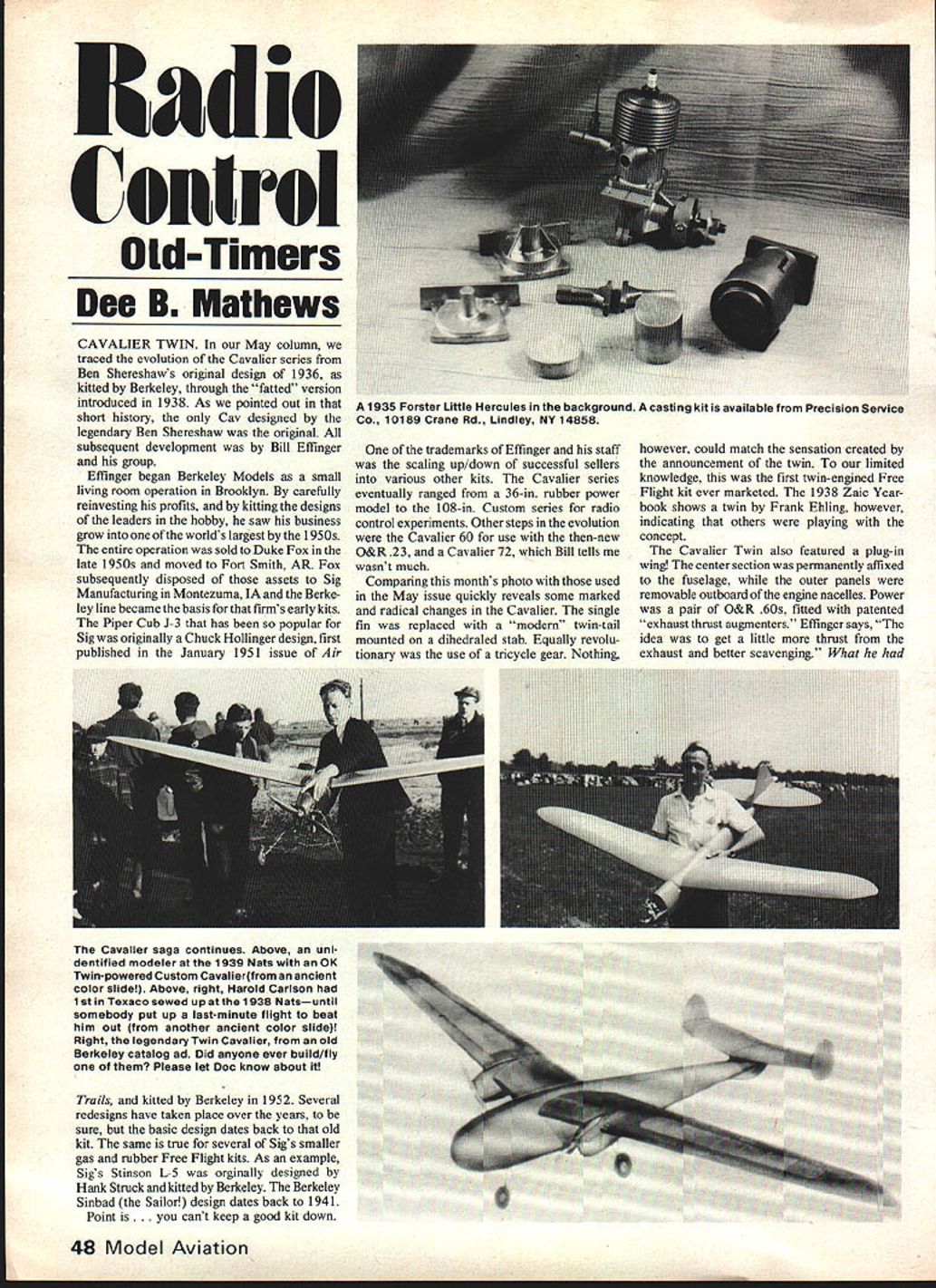
The photo of the 1935 Forster Little Hercules and the casting kits available from Precision Service Co., 10189 Crane Road, Lindley, NY 14858, opens up another mystery. Art DeKalb tells us that the engine is a debored and destroked version of the earlier Apex, but seemingly no one quite knows how the Apex engines relate to the later Forster 99. If anyone can fill in the blanks on that story, we would like to share it with the readers.
Sandbagging in 1938
Bill Effinger says that Harold Carlson had the 1938 Nationals won until very late in the day, when someone came along and beat his time. Who says sandbagging 'til the last possible moment is a SAM phenomenon?
And some folks think I'm prolific?
Ben Shereshaw must surely rank as one of the most prolific model designers of the Old-Timer era. A quick check through a John Pond catalog will find over a dozen Shereshaw designs that were published and/or kitted between 1936 and 1939. Such familiar names as Air Trails Sportster, Cadet, Cloud Cruiser, Cumulus, Eaglet, Miss Exchange Club, Nimbus, Scientific Mercury, and the Commodore (as featured in the Feb. 1981 issue of this magazine), and many others, all are products of the fertile mind of Ben Shereshaw.
We have always marveled at one man designing and publishing such a profusion of large models. The answer is self-evident now that we have learned that Ben taught high-school Industrial Arts at the time, as well as being a paid instructor for a Kresge Model Club. In those days, many department stores promoted their hobby departments by sponsoring clubs.
Ben obviously designed the models, then used the available volunteer manpower around him as a construction crew. In this way, those youngsters could benefit from his expertise, and he was, in turn, able to bang out all those great, big Free Flights.
Although Shereshaw's compensation from the magazine and manufacturers was minimal in dollars, one must always relate them to what they would buy. As an example, we recently have been corresponding with Bill Durand in Omaha, who tells us he placed a Boeing 247 model with Model Airplane News in 1934. He received $55.00 for the text, drawings, and photos—enough to buy most of a semester's tuition at Omaha U! We have not been able to pay even a fraction of a semester's tuition for any one of our three college kids with one construction article, even though the payment is well in excess of $55.00. As we say: it's all relative, really.
Shereshaw designs are all marked by beautiful flowing lines and surfaces. He rarely used a square surface or a flat section. A close study of his work reveals a harmony of line rarely matched in the designs of his contemporaries. They are all truly works of art. The Shereshaw designs are so outstanding they are immediately identifiable as his.
Odds and ends
Here are several sources of supply for items relevant to Old-Timer activities that might prove helpful:
- Trexler air-inflated balloon wheels are in the Sig catalog and are available from Hobby-Horn. We find a large 50 cc plastic syringe from a veterinary supply to be great for inflating these, but Trexler also has a bulb-type unit.
- Y&O (that was Yates & Orwick) wooden props are available from Hobby Horn and Schmidt Custom Kits. Some say they are the finest props ever made for use with ignition motors.
- Black neoprene tubing is available in the Du-Bro line. This is a must for any fuel system through which diesel or gasoline fuel will be run. The more commonly available surgical and vinyl tubing will be ruined by the proportionate amounts of kerosene when used with fossil fuels. (Diesel fuel contains kerosene, hence is a fossil fuel.)
- Baker's AA castor oil, Klotz, and Lubricin N-1 synthetic lubes are all available in pints, quarts, and gallons from Sig.
- Amyl nitrate substitute (Diesel Ignition Improver) is available in small quantities from Henry Nelson, 729 Valemont Dr., Verona, PA 15147.
Dee B. Mathews 506 South Walnut Greensburg, KS 67054
When writing advertisers, mention that you read about them in MA.
Transcribed from original scans by AI. Minor OCR errors may remain.

