
Radio Control: Old-Timers
Dee B. Mathews
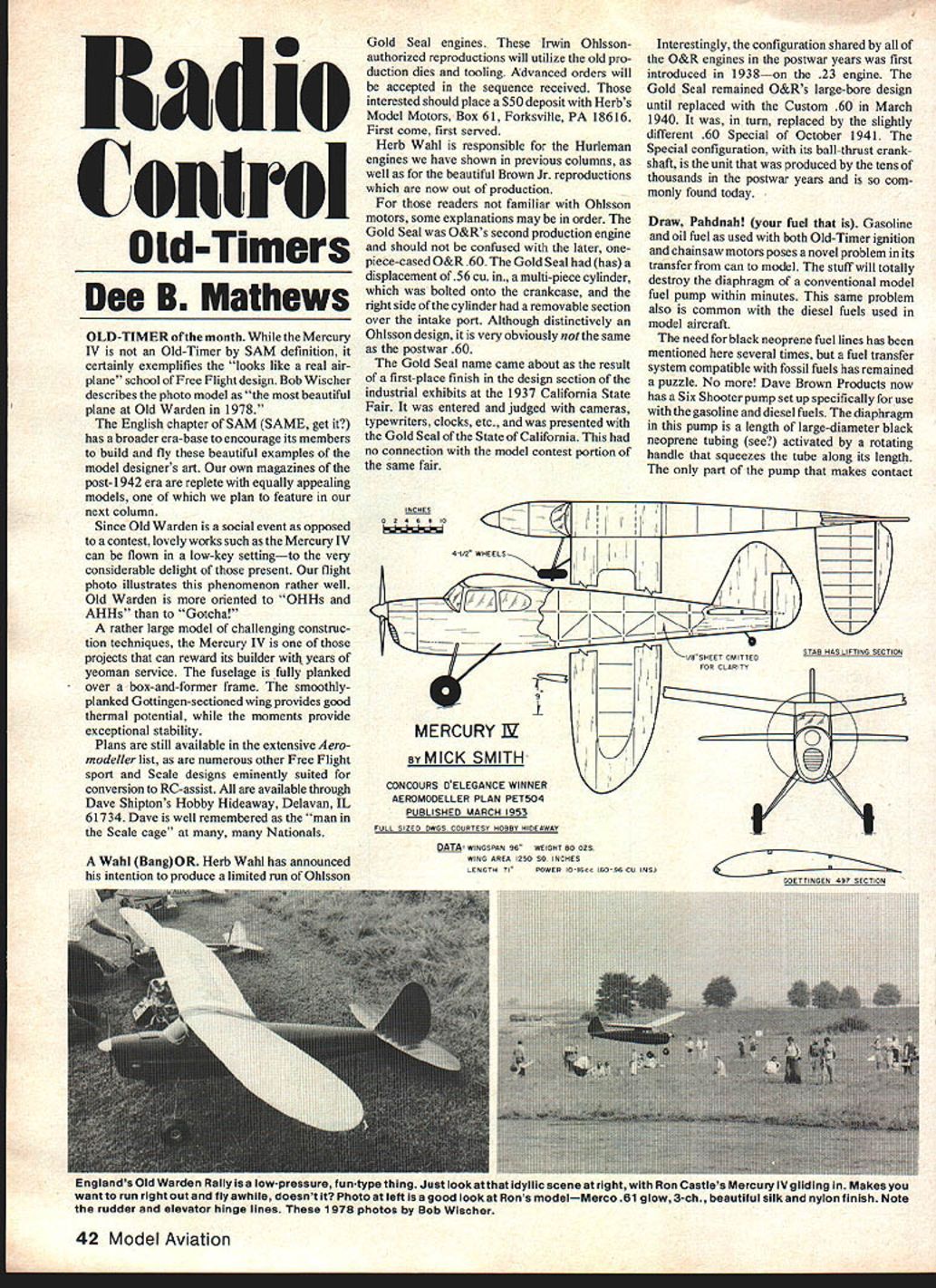
Old-Timer of the Month: Mercury IV
While the Mercury IV is not an Old-Timer by SAM definition, it certainly exemplifies the "looks like a real airplane" school of Free Flight design. Bob Wischer described the photo model as "the most beautiful plane at Old Warden in 1978."
The English chapter of SAM has a broader era-base to encourage its members to build and fly these beautiful examples of the model designer's art. Our own magazines of the post-1942 era are replete with equally appealing models, one of which we plan to feature in a future column.
Since Old Warden is a social event rather than a contest, lovely works such as the Mercury IV can be flown in a low-key setting—to the very considerable delight of those present. Our flight photo illustrates this phenomenon rather well. Old Warden is more oriented to "oohs and aahs" than to "gotcha."
A rather large model of challenging construction, the Mercury IV is one of those projects that can reward its builder with years of faithful service. The fuselage is fully planked over a box-and-former frame. The smoothly planked Göttingen-section wing provides good thermal potential, while the moments provide exceptional stability.
Plans are still available in the extensive Aeromodeller list, as are numerous other Free Flight sport and scale designs eminently suited for conversion to RC-assist. All are available through Dave Shipton's Hobby Hideaway, Delavan, IL 61734. Dave is well remembered as the "man in the Scale cage" at many Nationals.
Herb Wahl: Ohlsson Gold Seal Reproductions
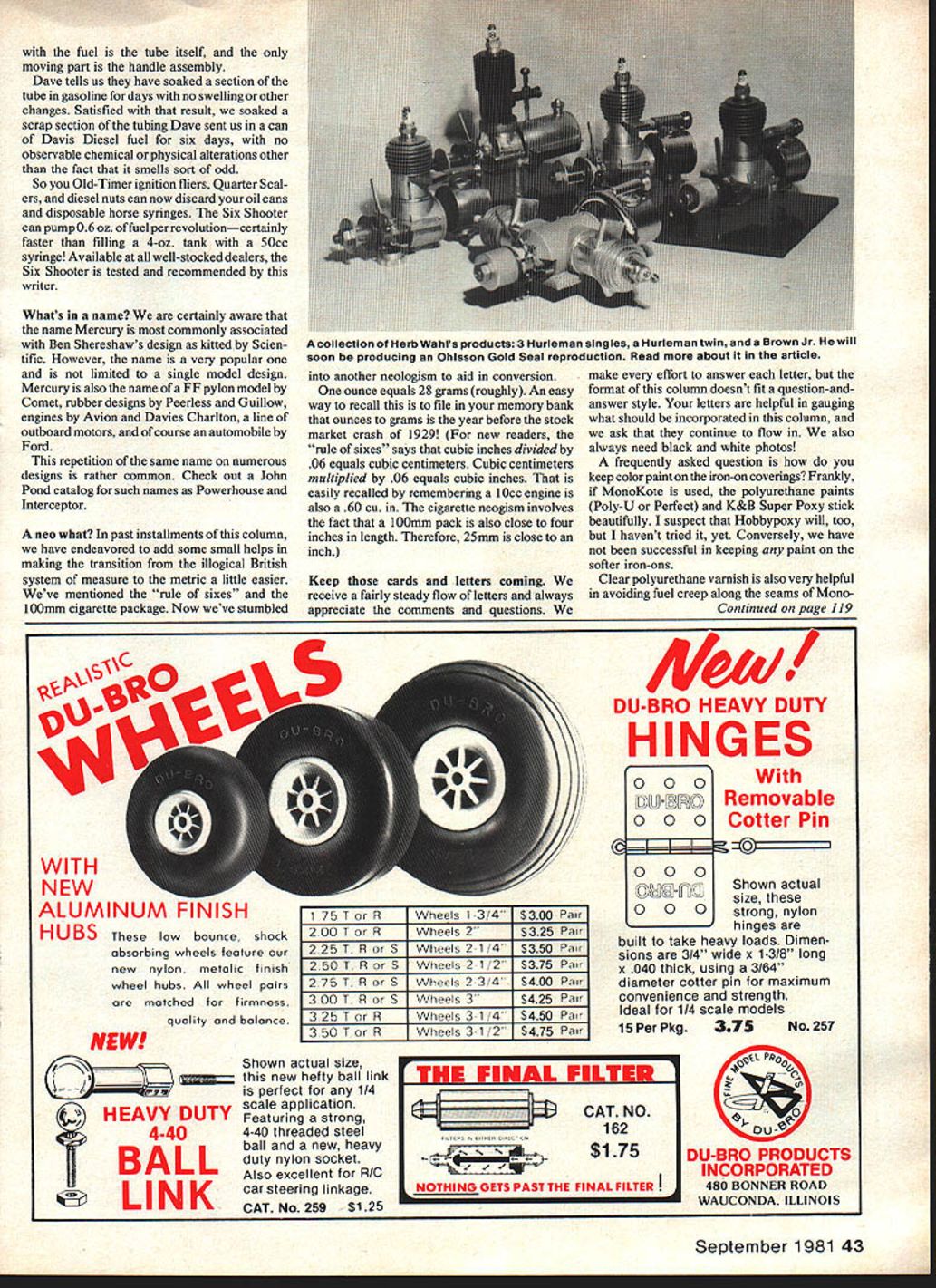
Herb Wahl has announced his intention to produce a limited run of Ohlsson Gold Seal engines. These Irwin Ohlsson–authorized reproductions will utilize the original production dies and tooling. Advanced orders will be accepted in the sequence received. Those interested should place a $50 deposit with Herb's Model Motors, Box 61, Forksville, PA 18616. First come, first served.
Herb Wahl is also responsible for the Hurleman engines we have shown in previous columns, as well as for the beautiful Brown Jr. reproductions which are now out of production.
Ohlsson Engine Background
For those readers not familiar with Ohlsson motors, some explanation is in order. The Gold Seal was O&R's second production engine and should not be confused with the later, one-piece-cased O&R .60. The Gold Seal had (and has) a displacement of .56 cu. in., a multi-piece cylinder bolted onto the crankcase, and the right side of the cylinder had a removable section over the intake port. Although distinctively an Ohlsson design, it is clearly different from the postwar .60.
The Gold Seal name came about as the result of a first-place finish in the design section of the industrial exhibits at the 1937 California State Fair. It was entered and judged alongside cameras, typewriters, clocks, etc., and was presented with the Gold Seal of the State of California. This had no connection with the model contest portion of the same fair.
Interestingly, the configuration shared by all of the O&R engines in the postwar years was first introduced in 1938 on the .23 engine. The Gold Seal remained O&R's large-bore design until replaced with the Custom .60 in March 1940. It was, in turn, replaced by the slightly different .60 Special of October 1941. The Special configuration, with its ball-thrust crankshaft, is the unit that was produced by the tens of thousands in the postwar years and is commonly found today.
Fuel Transfer — "Draw, Pahdnah!" (your fuel that is)
Gasoline-and-oil fuels used with both Old-Timer ignition and chainsaw motors pose a novel problem in transferring fuel from can to model. The stuff will totally destroy the diaphragm of a conventional model fuel pump within minutes. This same problem is common with the diesel fuels used in model aircraft.
The need for black neoprene fuel lines has been mentioned here several times, but a fuel transfer system compatible with fossil fuels has remained a puzzle—until now. Dave Brown Products now offers a Six Shooter pump set up specifically for use with gasoline and diesel fuels. The diaphragm in this pump is a length of large-diameter black neoprene tubing activated by a rotating handle that squeezes the tube along its length. The only part of the pump that makes contact with the fuel is the fuel tube itself; no other moving parts are exposed to the fluid.
Dave tells us he has soaked a section of tube in gasoline for days with no swelling or other changes. Satisfied with that result, we soaked a scrap section of the tubing Dave sent us in a can of Davis Diesel fuel for six days, with no observable chemical or physical alterations other than an odd smell.
So Old-Timer ignition fliers, Quarter Scalers, and diesel nuts can now discard your oil cans and disposable horse syringes. The Six Shooter can pump 0.6 oz. of fuel per revolution—certainly faster than filling a 4-oz. tank with a 50 cc syringe! Available at well-stocked dealers, the Six Shooter is tested and recommended by this writer.
What's in a Name?
We are aware that the name Mercury is most commonly associated with Ben Shereshaw's design as kitted by Scientific. However, the name is very popular and is not limited to a single model design. Mercury is also the name of:
- a Free Flight pylon model by Comet
- rubber designs by Peerless and Guillows
- engines by Avion and Davies-Charlton
- a line of outboard motors
- an automobile by Ford
This repetition of the same name on numerous designs is common. Check out a John Pond catalog for such names as Powerhouse and Interceptor.
A Neo What? — Metric Conversion Aids
In past installments we've tried to help with making the transition from the British/imperial system to the metric a little easier. We've mentioned the "rule of sixes" and the 100 mm cigarette package. Now there's another mnemonic for conversion:
- One ounce ≈ 28 grams. An easy way to recall this is to remember the year before the stock market crash of 1929 (i.e., 28).
- Rule of sixes: cubic inches ÷ 0.06 = cubic centimeters; cubic centimeters × 0.06 = cubic inches. Recall that a 10 cc engine is also a .60 cu. in.
- Cigarette pack: a 100 mm pack is close to four inches, so 25 mm is close to an inch.
Reader Mail, Paint, and Wheel Tracking
Keep those cards and letters coming. We receive a steady flow of correspondence and always appreciate the comments and questions. We make every effort to answer each letter, but the format of this column doesn't fit a Q&A style. Your letters help gauge what should be included here, and please continue to send black-and-white photos.
A frequently asked question is how to keep paint on iron-on coverings. If MonoKote is used, polyurethane paints (Poly-U or Perfect) and K&B Super Poxy stick beautifully. I suspect Hobbypoxy will too, though I haven't tried it yet. Conversely, we have not been successful in keeping any paint on the softer iron-ons.
Clear polyurethane varnish is also very helpful in avoiding fuel creep along the seams of MonoKote. This varnish does not need to be a hobby item; building-supply and paint-store products will suffice.
Another frequent query involves wheel tracking on Old-Timers. The relatively large dihedral of the average Old-Timer can contribute to a tendency to dig a wingtip when landing, particularly in a crosswind. The solution is to set the wheels with some toe-in—that is, the front edges of the wheels should point toward the midline of the model.
Set this way, the model tends to move toward the high wingtip when just one wheel touches terra firma. It may take a moment to visualize or look at your models, but it does work.
SAM Supplier List and Membership
Jim Adams, editor of SAM Speaks (the newsletter of the Society of Antique Modelers), is compiling an updated list of suppliers of hardware, kits, engines, plans, etc., relevant to our hobby. It will be supplied to all SAM members soon. If you are in the business, advise him of your products ASAP: 2538 Spurgeon St., Santa Ana, CA 92706.
If you are not a member of SAM, let the advent of this new list motivate you to join. Send one of the application blanks that appear from time to time in Model Airplane to Tim Banaszak, 1947 Superior Ave., Whiting, IN 46394.
Corrections, Memories, and Historical Notes
Whoops! A delightful elderly patient recently remarked, "As I get older the only part of me that works better and better is my forgetter." You know, she's right!
Our July copy implied the Cavalier Twin was highly novel for 1941. We had forgotten Frank Ehling's twin as illustrated in the 1938 Zaic Yearbook, and Petrides' Dolfin.
Frank Ehling, AMA's technical director, designed as many Free Flight models as any author yet. Among them was a twin E11-powered model featuring plug-in outboard wing panels, twin fins, and a plug-in tail section. Those interested can look it up in the Zaic Yearbook. Incidentally, all sorts of great reading are available in the various Yearbooks, including the newly reproduced 1934 issue. For anyone interested in the history of this hobby, Frank Zaic's Yearbooks should be at the top of the reference list.
More obscure, but certainly not beyond recall, is the Super Dolfin (note the odd spelling) by Tracy Petrides. Although many Petrides designs were published—such as his Privateer, PB-1, and the Dolfin—the Super Dolfin was sold only as a plan from his R.C. Specialist operation with a New York University address.
This model resembles the fat, round-fuselaged Dolphin, with twin engines placed on either side of the nose on winglets. The span was 102 inches and the fuselage 6 ft long! A photo and ad for the Super Dolfin are found on page 60 of Model Airplane News, May 1941.
Dee B. Mathews 506 South Walnut Greensburg, KS 67054
Transcribed from original scans by AI. Minor OCR errors may remain.

