
Radio Control: Old-Timers
Building the Old-Timer
The vast majority of the Old-Timers and Antiques employ the tried and true—build two identical sides and tie them together with cross members. Little may be said about this except to:
- Be sure to make square cuts and use a small mitre box (X-acto has a serviceable one) on sticks over 1/8th square.
- Be sure your longeron splices are cut on a diagonal and are located under an upright member's gluing area.
- On radio models, fill with balsa sheet—from the aft wing hold-down dowel forward—the areas between the fuselage uprights. (Don't overdo it—3/32 sheet is fine for the largest models, and remember this is a possible competition machine so keep it light. It is easier to add than remove weight.)
- Use firm balsa for your main fuselage longerons because they take most of the abuse and also will be prone to pull in under the stress of an ever-tightening doped covering. (You don't want your model to look like a starved horse!)
- Consider making a 3/32 ply wood forward auxiliary firewall plug (balsa would work too) that is exactly square. (This bulkhead is used to true up the fuselage and is used in conjunction with the farthest forward cross members, uprights and longerons.)
- Please do not worry about the celluloid covered cabin area being weak because it's not.
Wing: In building the wing you must have decided what you intend the model to do and build accordingly. If you plan on sport flying the ship and subjecting it to heavy G-loading, then beef it up with larger spars, planking, capstrips, etc. On the other hand, if it is meant for competition or standard free-flight sport soaring with little planned high-G maneuvering, then build it reasonably stock and light. In any case, some strengthening is in order to compensate for the more powerful engines used and for the extra weight carried in the form of radio gear. The following are suggested beef-ups for the competition model or soaring sport model: On multi-spar wings such as used on the Playboy (if built stock) a major modification needed is to use larger trailing edge stock. The Playboy is a notorious wing-flutter bird if allowed to pick up speed under power and a more sturdy trailing edge can eliminate this problem. The Tyro Models' Playboy has a considerably beefed-up wing and there's no need for the heavier trailing edge on that version. The P&W rib kit incorporates larger stringers and spars and this should be sufficient to cure flutter but I must state that my model is a P&W and I did enlarge the TE, but perhaps this was overkill. Each model must be judged on its own design and construction as to a decision on beefing up. As an example, the Goldberg Sailplane, Zipper and Interceptor are sufficiently strong as originally designed; as is the Ranger and the Buzzard Bombshell. For many of the others use good judgment and be sure to consider aspect ratio, thickness, etc.
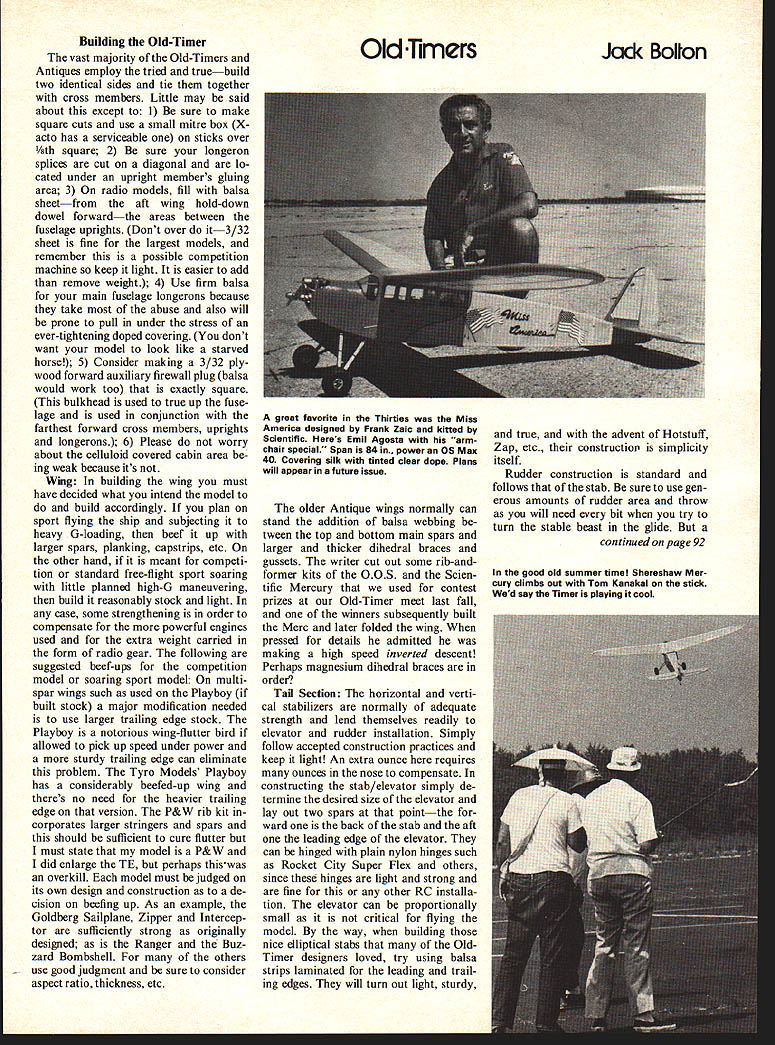
The older Antique wings normally can stand the addition of balsa webbing between the top and bottom main spars and larger and thicker dihedral braces and gussets. The writer cut out some rib-and-former kits of the C.O.S. and the Scientific Mercury that we used for contest prizes at our Old-Timer meet last fall, and one of the winners subsequently built the Merc and later folded the wing. When pressed for details he admitted he was making a high speed inverted descent! Perhaps magnesium dihedral braces are in order?
Tail Section
The horizontal and vertical stabilizers are normally of adequate strength and lend themselves readily to elevator and rudder installation. Simply follow accepted construction practices and keep it light! An extra ounce here requires many ounces in the nose to compensate. In constructing the stab/elevator simply determine the desired size of the elevator and lay out two spars at the point—the forward one is the back of the stab and the aft one the leading edge of the elevator. They can be hinged with plain nylon hinges such as Rocket City Super Flex and others, since these hinges are light and strong and are fine for this or any other RC installation. The elevator can be proportionally small as it is not critical for flying the model. By the way, when building those nice elliptical stabs that many of the Old-Timer designers loved, try using balsa strips laminated for the leading and trailing edges. They will turn out light, sturdy, and true, and with the advent of Hotstuff, Zap, etc., their construction is simplicity itself.
Rudder construction is standard and follows that of the stab. Be sure to use generous amounts of rudder area and throw as you will need every bit when you try to turn the stable beast in the glide.
RC Old-Timers/Bolton continued from page 23
A word of caution! Be careful on the power climb as the speed of the machine and the propwash now make the rudder super sensitive, so small, steady-rate control inputs are the name of the game.
Control Installation:
All controls are installed in a standard fashion. We prefer the old hard-balsa square push/pullrods over the other types. They seem to have less flex, are temperature stable, and are lightweight. Keep the radio gear and other weight as far forward as possible.
For engine shutdown we use the floodoff system because it is instantaneous, reliable and causes less wear and tear on the engine. A fuel shutoff system causes the engine to lean to a cutoff. Our floodoff system is simplicity itself. You run the engine on pressure (usually the fitting replaces the upper left back-plate screw). Make a "Y" fitting for the middle of the fuel line and attach a line from one of the Y's to the needle/valve fitting, and the other to the open throat of the engine venturi. Use the small size surgical tubing for this line so it can be pinched off easily by a servo-activated rod that has a 90-degree bend on the end closest to the engine.
You run the surgical tubing on the outside of the firewall in close proximity to the protruding rod with the 90-degree bend and open your throttle control, pulling back on the rod, and squeezing the tubing shut between the rod and the firewall. This permits the fuel to flow only to the needle valve. The rod can be adjusted at the servo arm by use of a clevis so as to eliminate battery-draining servo stall. But even though some servo stall exists, it's not too critical since the condition is short lived because the normal time of engine run usually will not exceed some 30 seconds from time of start to engine floodoff. Anyway, when the throttle control is closed on the transmitter the rod moves forward, thereby releasing the surgical tubing and permitting unrestricted flow of the fuel to the venturi mouth, and an instantaneous floodoff of the engine effected. It works every time and the weight differential is not that much over the mechanical timers, and you have the choice of when to shut down. This can save aircraft in many cases.
That's it for a very cursory look at building an Old-Timer RC Assist flying machine. Next column we'll take a look at flying the bird.
Contest Reports
Received word from Joe Beshar (SAM Prexy) on the outcome of his "Beshar Rules" Old-Timer RC return free-flight contest. It seems the entire eastern seaboard was socked in with rain and low ceilings except for the Lakehurst area. Even so, 13 contestants participated and apparently enjoyed the activities. This was basically an experimental affair that stipulated that no RC control could be used except rudder and engine shutoff during the climb, and nothing further until such time as the model either landed or the contestants declared the flight over, so as to return the model to the field. Additionally, it was stipulated that for the flight to be official, the model had to land in a large pre-designated area. Winners were: Class A — Woody Woodman, Class B — D. Meyers, Class C — Al Schwankart.
Down here in Pensacola the Fiesta of Five Flags Contest came off in fine fashion with two days of beautiful flying weather — cloudless skies with light and variable winds. Some 59 contestants entered the 19 events for a total of over 300 entries. In Old-Timer the events were split into Cabin and Pylon (ABC), .020 Replica, OT Rubber, and one class RC Assist. Unfortunately, we had a conflict with a major Pattern contest set up by the Fort Walton R/Cers that occurred the same weekend. Because of this, several of the RC Assist people from that area couldn't make the Fiesta. So the RC Assist entries were limited to three: Ed and Paul Smith from Fort Lauderdale, and Lee Webster from Tennessee. Your writer stayed out of it due to being the meet Contest Director. Anyway, Ed's Scientific Mercury beat out Lee's Tyro Playboy by virtue of Ed's two 10-minute max's and a third flight of over six minutes. Apparently, the imposed handicapping system of permitting Antique entries a minute corresponding to seven seconds per pound of aircraft weight, versus the straight 20 seconds for glow-powered Old-Timers, is reasonable as the outcome was decided by the choice of air.
Notes
With regret we report the passing of Mr. John Brennan from Gerrish Island, Kittery Point, ME. Readers may recall the nice pictures of Mr. Brennan's real old-timers which were printed in this column over the years. His models are hung in the cellar of our home, and this is where I shall keep them, as reminders of the patience and love he had in building them. We offer our sincere sympathy.
In our first column we pointed out the risks involved in trying to document the development of the RC Assist events. Well, apparently we should have included a Mr. Richard Tanis of the North Jersey RC Club as one of the developers. No slight was intended and we hope this sets the record straight.
Veterans Day weekend in Pensacola will be observed, among other things, by the scheduling of the Gordon "Scotty" Murray Memorial Old-Timers' Meet. It is meant to honor and fittingly remember this gallant and talented model designer and flier. Scotty was a member of the Brooklyn SkyScrapers, a designer of note (Topper and others), a fine contest flier and one of the first to go to war in WWII where he gave his life. A perpetual award is being established, named the "Topper Award," to be given to the high-point contestant to retain for the year until the next meeting. Additionally, an event called "Scotty's Event" is established and will be restricted to those gas models designed by Scotty, and a special trophy will be set up. The meet will have some Old-Timer events (six FF and three RC) and four AMA FF that will not count toward High Point and will have special awards. A top junior award is scheduled for each event except for the AMAs. The meet is being organized by your writer and Bell Tom McLaughlin.
People, we are in dire need of news inputs, photos, writeups, sketches, and any other thing directed toward RC Assist. If there are any questions you need answered, drop us a line with a SASE enclosed and we will try to get you an answer. Take care and keep your head on a swivel.
Jack Bolton, 9521 Scenic Highway, Pensacola, FL 32504; Ph: (904) 477-2055.
Transcribed from original scans by AI. Minor OCR errors may remain.

