
Radio Control: Old-Timers
Dee B. Mathews
I Love a Mystery
I love a mystery. Our July '81 column featured a three-view and photos of Harold Carlson's Berkeley Cavalier. Bill Effinger had mentioned in a letter that Carlson had "won" Texaco at the 1938 Nationals, only to end up second to a last-minute "mystery" flight. To quote Effinger's letter of June 4, 1980: "...at the last minute after everyone had left the field, a mystery plane beat him out. No witnesses, no idea of what the plane looked like, but Carlson had to be satisfied with second place."
Those comments set us off on a search to try to determine who that winner was, and what he had flown. We wrote many of the still-living participants in that Nationals of 43 years ago, checked through our magazine collection, inquired if anything was in the AMA Archives (what archives?), and pursued several promising leads, all to no avail. All efforts to solve the mystery were fruitless.
Reconciling ourselves to never learning the solution to this intriguing mystery, we referred to it as a case of "sandbagging" in our write-up. This produced a response from Jack Schwartz of Punta Gorda, FL which has developed into this fabulous story we now relate.
Motown as Mecca
Motown once was Mecca for modelers. The 1938 National Model Airplane Championships was held in Detroit. Sponsored by the National Exchange Club, the "Nats" was the culmination of a nationwide series of local contests, with winners often sponsored to the Nats by their local Exchange Clubs. The area clubs combined in greater Detroit to provide year-round planning for the Nats, taking care of all advance planning and arrangements. A full-time staff member was assigned responsibility. Is it any wonder that Detroit was the scene of seven of the first 12 Nationals?
Were that not enough, the City of Detroit provided 75 employees from the Department of Recreation to set up the facilities, control traffic, etc. The local Army Air Corps unit at Selfridge Field assigned another 75 men to serve as timers, and the Navy Reserve Base provided men to work at the indoor events held in their balloon hangar.
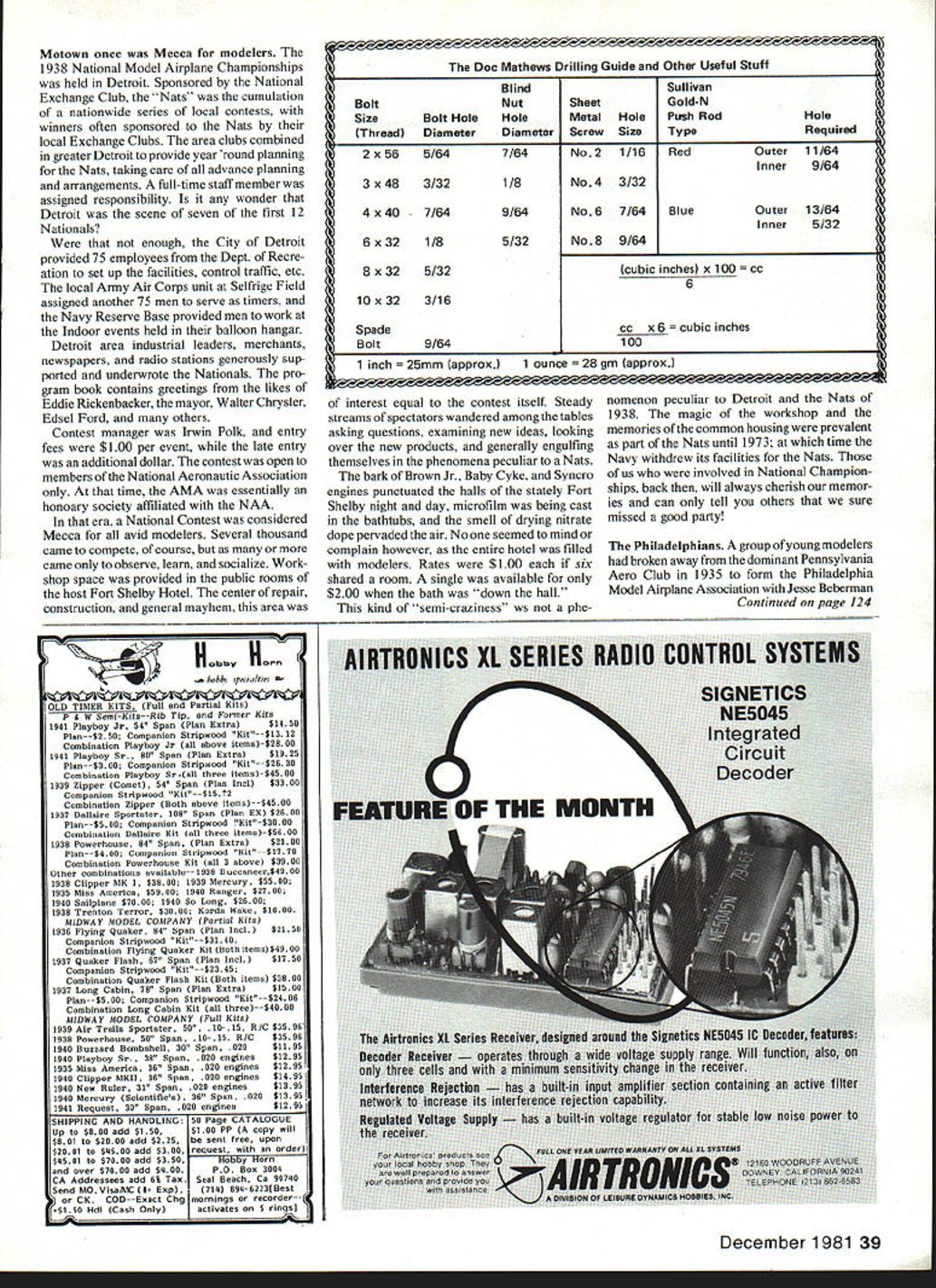
Detroit area industrial leaders, merchants, newspapers, and radio stations generously supported and underwrote the Nationals. The program book contains greetings from the likes of Eddie Rickenbacker, the mayor, Walter Chrysler, Edsel Ford, and many others.
Contest manager was Irwin Polk, and entry fees were $1.00 per event, while the late entry was an additional dollar. The contest was open to members of the National Aeronautic Association only. At that time, the AMA was essentially an honorary society affiliated with the NAA.
In that era, a National Contest was considered Mecca for all avid modelers. Several thousand came to compete, of course, but as many or more came only to observe, learn, and socialize. Workshop space was provided in the public rooms of the host Fort Shelby Hotel. The center of repair, construction, and general mayhem, this area was of interest equal to the contest itself. Steady streams of spectators wandered among the tables asking questions, examining new ideas, looking over the new products, and generally engulfing themselves in the phenomena peculiar to a Nats.
The bark of Brown Jr., Baby Cyke, and Syncro engines punctuated the halls of the stately Fort Shelby night and day. Microfilm was being cast in the bathtubs, and the smell of drying nitrate dope pervaded the air. No one seemed to mind or complain, however, as the entire hotel was filled with modelers. Rates were $1.00 each if six shared a room. A single was available for only $2.00 when the bath was "down the hall."
This kind of "semi-craziness" was not a phenomenon peculiar to Detroit and the Nats of 1938. The magic of the workshop and the memories of the common housing were prevalent as part of the Nats until 1973, at which time the Navy withdrew its facilities for the Nats. Those of us who were involved in National Championships back then will always cherish our memories and can only tell you others that we sure missed a good party!
The Philadelphians
A group of young modelers had broken away from the dominant Pennsylvania Aero Club in 1935 to form the Philadelphia Model Airplane Association with Jesse Beberman as their leader. Beberman later became one of the earliest pioneers in RC. Among the members of the PMAA were Milt Kahn, Eddie Manulkin, and Jack Schwartz, our storyteller. Then, as now, a certain "elitism" existed among the established commercial interests in the hobby, frequently arousing resentment and hostility among the "outsiders." Our young modelers were free thinkers and unwilling to accept the design concepts of Charles H. Grant and his disciples, such as Kovel and Basset. As Jack Schwartz says: "We believed we could design our own. We just had trouble getting the motors to run."
To the everlasting credit of our hobby, there has always been ample opportunity for and appreciation of the "non-followers" who prefer to innovate, develop, and approach problems in their own solutions. Our three young Philadelphians certainly fell into that mode.
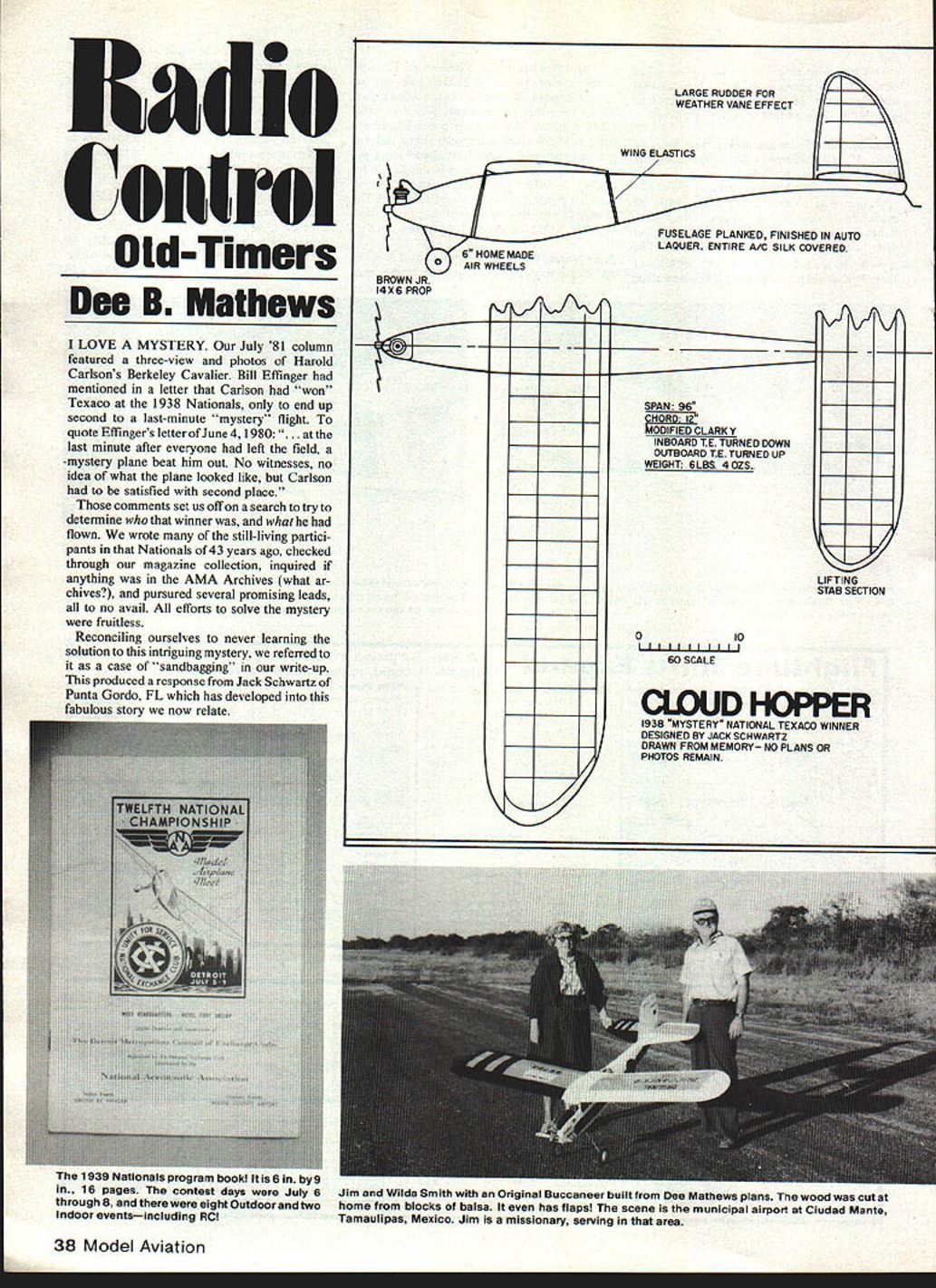
While Grant's airfoils and aerodynamic concepts were universally accepted and were used successfully by the vast majority of gas-power builders, Schwartz and Manulkin chose a different route. At that time, the newest Boeing and Curtiss pursuits were using a new and unusual airfoil called the Clark Y. Certainly a common airfoil today, but much out of the rut in 1938, particularly for large Texaco models. Charles Marcy, Frank Efling, and others were using the Clark Y at about the same time, but our Philadelphians went a step further by drooping the trailing edge slightly. Equally odd was the application of a new idea from Cornell's Engineering Dept. called washout. Somehow, this writer had the feeling that the use of tip washout to cure tip stalls had been around since the Wright brothers. Jack tells us that Cornell's concept was considered revolutionary in 1936 or so.
Schwartz developed a design he called the Cloudhopper through trial and error. Milt Kahn was sufficiently impressed that he built one from Jack's drawings. Eddie Manulkin, who later founded Sterling Models, used the airfoil and tip washout, but on a smaller and lighter model. Schwartz preferred large and relatively heavy models in order to get those extra 4 ounces of fuel per pound. As we will see, the extra fuel allotted was to become only ballast.
Detroit or Bust
Our three intrepid modelers loaded planes and equipment into a single-wheeled trailer that doubled as a workspace when set on end. Sharing fuel and oil costs, they arrived in Detroit after nearly losing everything in a thunderstorm in Ohio. Hot, dirty, hungry and tired, they forgot all their woes as they arrived at Wayne Co. Airport and were engulfed by the excitement.
Their models created only mild interest from the spectators. After all, how could three unheralded youngsters possibly hope to compete with the nationally known experts? The disregard shown them seemed justified when Eddie crashed and destroyed his model the first day. Milt severely damaged his model on its second official flight on Friday. Jack used up his three attempts without a good flight.
This left the three stars of our story with one repairable model for one more official flight. Undaunted, they decided to repair Milt's badly mangled Cloudhopper and went to work at about 8:00 p.m. Friday evening. It was a sorry mess, but liberal applications of Ambroid cement, tongue depressors, paper napkins from the dining room, and magazine pages from the lobby mixed in with lots of sweat and effort produced a flyable model by 4:00 a.m. Saturday morning.
At Wayne Co. that final day, the Brown in Milt's model grew cantankerous and difficult to keep running at wide-open throttle. A day of tinkering and bug hunting produced only two short test hops and minor crashes. Eddie finally gave up about 1:00 p.m., and Milt followed shortly thereafter. Jack, being a "never say die" type, kept plugging away until about 4:00 p.m., when the engine problems finally were corrected. He set out to find Milt, who consented to try his luck for a final flight.
Figuring everything had already happened, our intrepid three got in line for a timer. With time running out, there were two entrants ahead of them. Will there be a chance to even get into the air before the 5:00 p.m. shut-off? The other two in line quickly crashed their planes, and it was "now or never" time.
As the Cloudhopper of Milt Kahn was placed on the runway for a final, desperate try, three young men felt their hearts in their throats, as all the dreams of the year and the frustrations and disappointments were warming up again.
The Mystery Flight
It was 4:35 p.m.; only a few moments of the 1938 Nationals remained on this August Saturday. Jack Schwartz, Milt Kahn, Eddie Manulkin, and a nameless Army Air Corps timer were about to witness what should have become one of the most glorious moments in Nationals competition! But until now, it has never been chronicled.
Jack hooked up the booster battery and began to flip the Brown over one last time. It came to life with a start — for it was a roar. Milt placed the Cloudhopper on the runway and watched it slowly lumber into the air. Climbing majestically, the plane reached 75 feet or so, and the engine stopped! "Snake pit again! Ain't there no justice? My gosh, and it was going up so well. Oh well, wait until next year."
But wait! As the Cloudhopper glided slowly down to within the last few feet, the wings rocked a bit, and the nose started to point up. Could it possibly be in lift? "Come on you rascal! Go! Go! Go!" In a huge thermal, the model climbed higher and higher. "How much time do we need? There's still plenty of daylight left. Do you suppose something will go wrong again?"
Since the timer was restricted to a 50-ft. radius and unaided vision, some concern was expressed about the model staying in sight for a sufficient time. Drifting slowly to the southeast while gaining immense height, the Cloudhopper was large enough to remain visible at great distances. Our unnamed timer settled in for a long, long period of peering at a model airplane.
It became apparent that a long flight would eventually drift across the river into Canada, so Milt was left to provide company and encouragement to the timer, since virtually no one else was left on the airport. Eddie and Jack fired up the car and pursued the Cloudhopper across the Windsor Bridge into Canada. Even with the delightful help of the Northwest Mounties, they were unable to locate the model. They returned to learn that the timer recorded a flight of over three hours!
For the uninitiated, the rule in Free Flight used to say that the model is timed for its full flight if the flight commenced before "quitting time." This rule produced a rather amazing problem... everyone was gone, and the timer still had the card! Since the Victory Banquet was scheduled for 7:00 p.m., everyone had returned the 15 miles or so to the hotel to get cleaned up for the banquet.
Loading the timer into the car, our nearly ecstatic threesome arrived at the banquet among the city's dignitaries and notables while still dressed in their, by now, thoroughly grubby clothes. After a brief discussion, the timer's card was accepted and recorded. This, of course, altered the order of the Texaco finish and caused a reshuffling of the already-presented trophies.
In the words of Jack Schwartz: "It's been 43 years, and the details have grown a little vague, but you can never ever forget when the Gods smile on you, and they sure smiled on us that day."
Many of us who are fortunate enough to have flown Free Flight in competition have shared Jack Schwartz's ecstasy at one time or another, but we dare say few if any of us have ever topped this time! As a matter of fact, that would be an exceptional time even today in RC-assist Texaco!
Postscript
Although Milt Kahn received the trophy and prizes, it is patently obvious that only the hard work and perseverance of Jack Schwartz made it come true. Isn't it remarkable in this hobby how often someone receives more joy from the success of a friend than his own recognition would bring? To all the uncredited "winners" in this great hobby, we dedicate this story. We all also owe a deep debt of gratitude to Jack for sharing this experience before it was lost forever.
Should any reader have similar memories of the great moments in this hobby, please share them with us.
Whoops!
Contrary to the information we previously printed, Herb Wahl's new production run of Ohlsson Gold Seal reproductions will not utilize the original tools, dies, and fixtures from long ago. Herb is developing all new production equipment with the approval of Irwin Ohlsson.
Dee B. Mathews 506 South Walnut Greensburg, KS 67054
Transcribed from original scans by AI. Minor OCR errors may remain.

