
Radio Control: Old-Timers
Dee B. Mathews
A Baltimore Oriole?
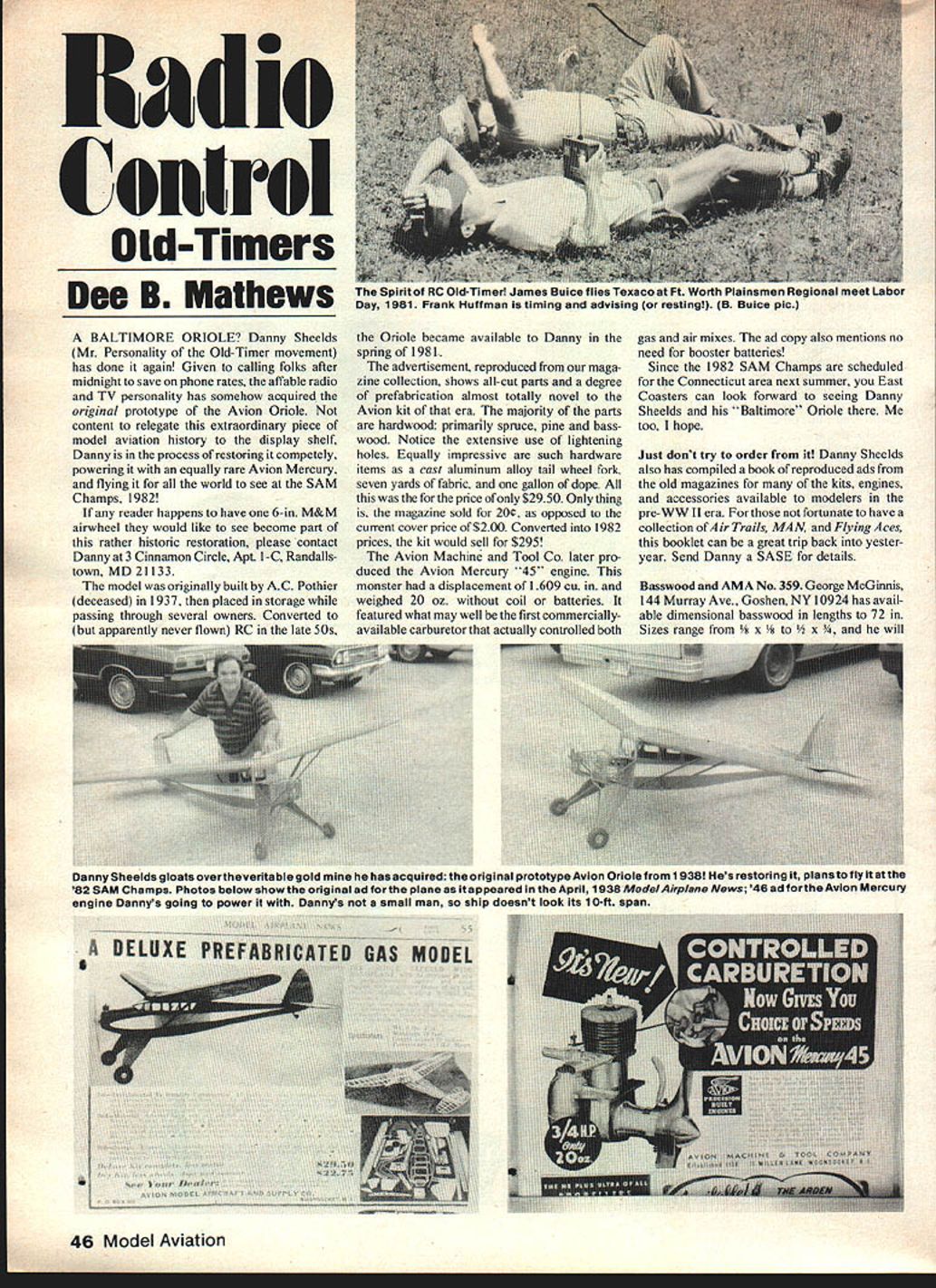
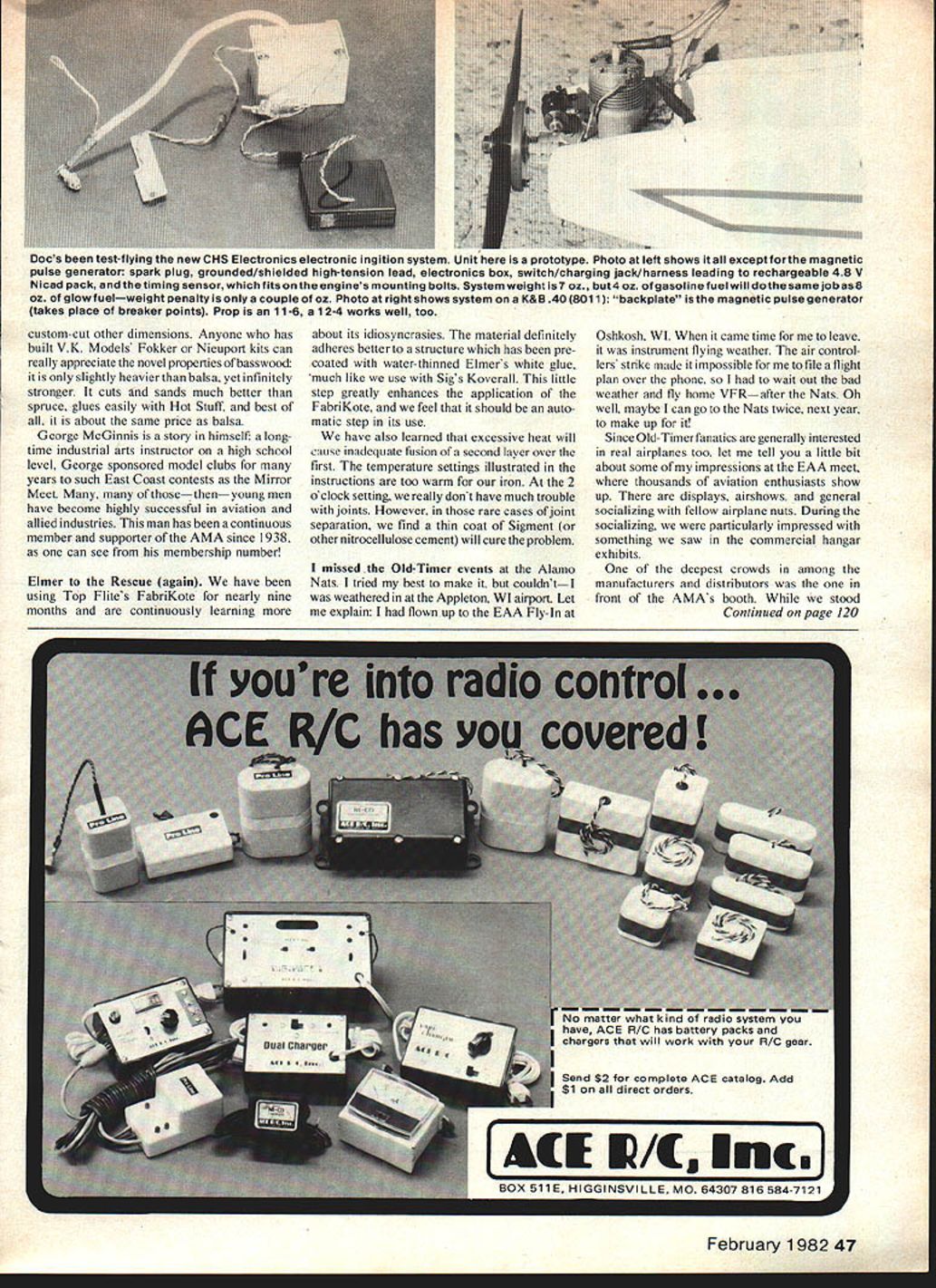
Danny Sheelds (Mr. Personality of the Old-Timer movement) has done it again! Given to calling folks after midnight to save on phone rates, the affable radio and TV personality has somehow acquired the original prototype of the Avion Oriole. Not content to relegate this extraordinary piece of model aviation history to the display shelf, Danny is in the process of restoring it completely, powering it with an equally rare Avion Mercury, and flying it for all the world to see at the SAM Champs, 1982!
If any reader happens to have one 6-in. M&M airwheel they would like to see become part of this rather historic restoration, please contact Danny at 3 Cinnamon Circle, Apt. 1-C, Randallstown, MD 21133.
The model was originally built by A. C. Pothier (deceased) in 1937, then placed in storage while passing through several owners. Converted to (but apparently never flown) RC in the late ’50s, the Oriole became available to Danny in the spring of 1981.
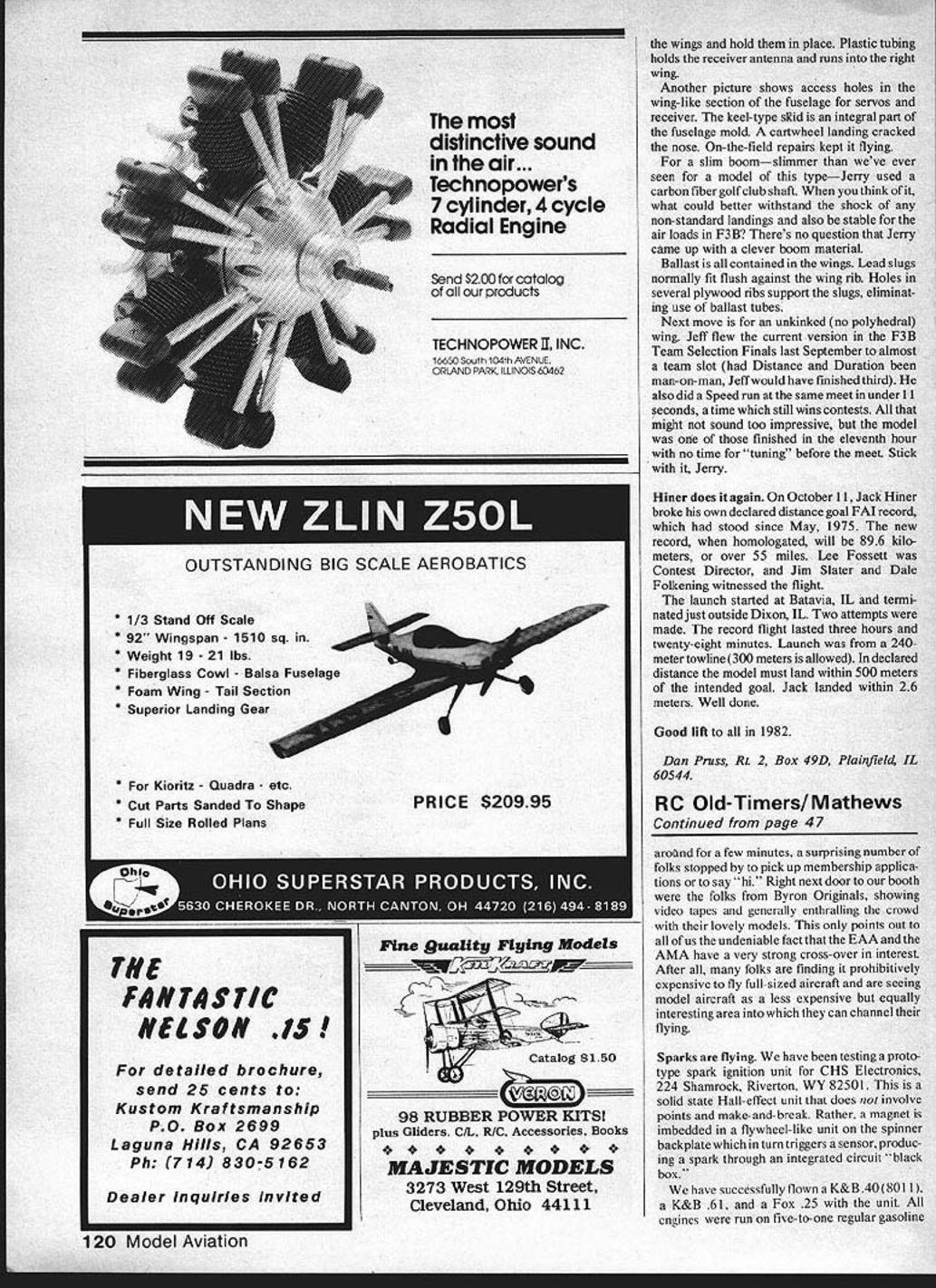
The advertisement, reproduced from our magazine collection, shows all-cut parts and a degree of prefabrication almost totally novel to the Avion kit of that era. The majority of the parts are hardwood: primarily spruce, pine, and basswood. Notice the extensive use of lightening holes. Equally impressive are such hardware items as a cast aluminum alloy tail wheel fork, seven yards of fabric, and one gallon of dope. All this was for the price of only $29.50. The magazine sold for 20¢ then, as opposed to the current cover price of $2.00. Converted into 1982 prices, the kit would sell for $295!
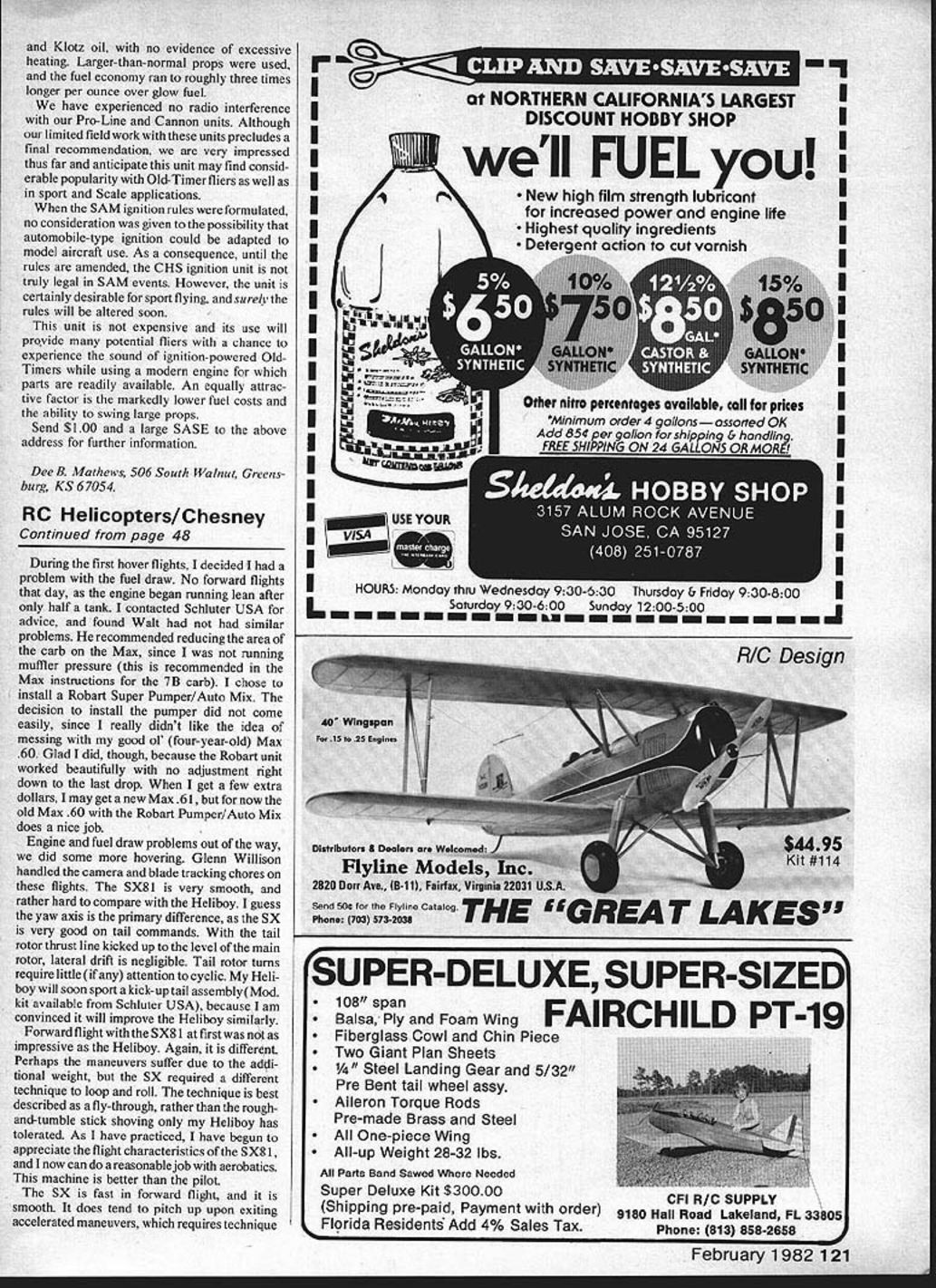
The Avion Machine and Tool Co. later produced the Avion Mercury "45" engine. This monster had a displacement of 1.609 cu. in. and weighed 20 oz. without coil or batteries. It featured what may well be the first commercially available carburetor that actually controlled both gas and air mixtures. The ad copy also mentions no need for booster batteries!
Since the 1982 SAM Champs are scheduled for the Connecticut area next summer, you East Coasters can look forward to seeing Danny Sheelds and his "Baltimore" Oriole there. Me too, I hope.
Just don't try to order from it! Danny Sheelds also has compiled a book of reproduced ads from the old magazines for many of the kits, engines, and accessories available to modelers in the pre‑WWII era. For those not fortunate to have a collection of Air Trails, MAN, and Flying Aces, this booklet can be a great trip back into yesteryear. Send Danny a SASE for details.
Basswood
AMA No. 359 George McGinnis, 144 Murray Ave., Goshen, NY 10924, has available dimensional basswood lengths up to 72 inches and a variety of sizes.
Anyone who has built V.K. Models' Fokker or Nieuport kits can really appreciate the novel properties of basswood: it is only slightly heavier than balsa, yet infinitely stronger. It cuts and sands much better than spruce, glues easily with Hot Stuff, and best of all, it is about the same price as balsa.
George McGinnis is a story in himself: a long-time industrial arts instructor at the high school level, George sponsored model clubs for many years and supported East Coast contests such as the Mirror Meet. Many of those then-young men have become highly successful in aviation and allied industries. This man has been a continuous member and supporter of the AMA since 1938, as one can see from his membership number.
Elmer to the Rescue (again)
We have been using Top Flite's FabriKote for nearly nine months and are continuously learning more about its idiosyncrasies. The material definitely adheres better to a structure which has been precoated with water‑thinned Elmer's white glue, much like the way we use Sig's Koverall. This little step greatly enhances the application of the FabriKote, and we feel that it should be an automatic step in its use.
We have also learned that excessive heat will cause inadequate fusion of a second layer over the first. The temperature settings illustrated in the instructions are too warm for our iron. At the 2 o'clock setting we really don't have much trouble with joints. However, in those rare cases of joint separation, we find a thin coat of Sigment (or other nitrocellulose cement) will cure the problem.
I missed the Old‑Timer events at the Alamo Nats. I tried my best to make it, but couldn't — I was weathered in at the Appleton, WI, airport. Let me explain: I had flown up to the EAA Fly‑In at Oshkosh, WI. When it came time for me to leave, it was instrument‑flying weather. The air controllers' strike made it impossible for me to file a flight plan over the phone, so I had to wait out the bad weather and fly home VFR — after the Nats. Oh well, maybe I can go to the Nats twice next year to make up for it!
Since Old‑Timer fanatics are generally interested in real airplanes too, let me tell you a little bit about some of my impressions at the EAA meet, where thousands of aviation enthusiasts show up. There are displays, airshows, and general socializing with fellow airplane nuts. During the socializing, we were particularly impressed with something we saw in the commercial hangar exhibits.
One of the deepest crowds among the manufacturers and distributors was the one in front of the AMA's booth. While we stood around for a few minutes, a surprising number of folks stopped by to pick up membership applications or to say "hi." Right next door to our booth were the folks from Byron Originals, showing videotapes and generally enthralling the crowd with their lovely models. This only points out the undeniable fact that the EAA and the AMA have a very strong crossover in interest. After all, many folks are finding it prohibitively expensive to fly full‑sized aircraft and are seeing model aircraft as a less expensive but equally interesting area into which they can channel their flying.
Sparks are flying. We have been testing a prototype spark ignition unit for CHS Electronics, 224 Shamrock, Riverton, WY 82501. This is a solid‑state Hall‑effect unit that does not involve points and make‑and‑break. Rather, a magnet is embedded in a flywheel‑like unit on the spinner backplate which in turn triggers a sensor, producing a spark through an integrated‑circuit "black box."
We have successfully flown:
- K&B .40
- K&B .61
- Fox .25
All engines were run on five‑to‑one regular gasoline and Klotz oil, with no evidence of excessive heating. Larger‑than‑normal props were used, and the fuel economy ran to roughly three times longer per ounce versus glow fuel.
We have experienced no radio interference with our Pro‑Line and Cannon units. Although our limited field work with these units precludes a final recommendation, we are very impressed thus far and anticipate this unit may find considerable popularity with Old‑Timer fliers as well as in sport and Scale applications.
When the SAM ignition rules were formulated, no consideration was given to the possibility that automobile‑type ignition could be adapted to model aircraft use. As a consequence, until the rules are amended, the CHS ignition unit is not truly legal in SAM events. However, the unit is certainly desirable for sport flying, and surely the rules will be altered soon.
This unit is not expensive and its use will provide many potential fliers with a chance to experience the sound of ignition‑powered Old‑Timers while using a modern engine for which parts are readily available. An equally attractive factor is the markedly lower fuel costs and the ability to swing large props. Send $1.00 and a large SASE to the above address for further information.
Dee B. Mathews 506 South Walnut, Greensburg, KS 67054
Transcribed from original scans by AI. Minor OCR errors may remain.

