
Radio Control: Old-Timers
Dr. D.B. Mathews
SON of a gun! Our March 1984 column asked: "Who will be the first to send us a photo of a Peerless Blackhawk?" Since we had never seen one or even heard it mentioned in other columns, we presumed the best we could hope for would be to stimulate someone to build the Blackhawk.
Several modelers responded with fond memories of the design and a desire to build one. But Albert Counsellor of Turnersville, NJ is actually flying one. This is Albert's second Blackhawk: the first was built from a kit he bought in 1939 at the Aviation Building of the New York World's Fair.
The original model was constructed just before WWII, covered with silk and dope, and powered with an O&R .60. Flown in local contests such as those held by the Brooklyn Skyscrapers, the model was eventually lost overhead with a stuck engine-run timer. Albert was a member of the old Long Island Gas Monkeys and flew from a deserted airport in Valley Stream, Long Island called Curtiss Field.
After his discharge from the Navy, Albert worked for several years for Nate and Irwin Polk at what was, at that time, the world's largest hobby shop. It was there that he saw his first glow plug. A salesman (presumably from Ray Arden's Microbuilt, Inc., out of Danbury, CT) asked if they had an engine he could put his funny-looking plug in. An O&R .23 was set up in the motor test room and their reaction to seeing that engine run without the coil-condenser-battery was much like this writer's at the 1948 Olathe Nats... Wow!
The Blackhawk
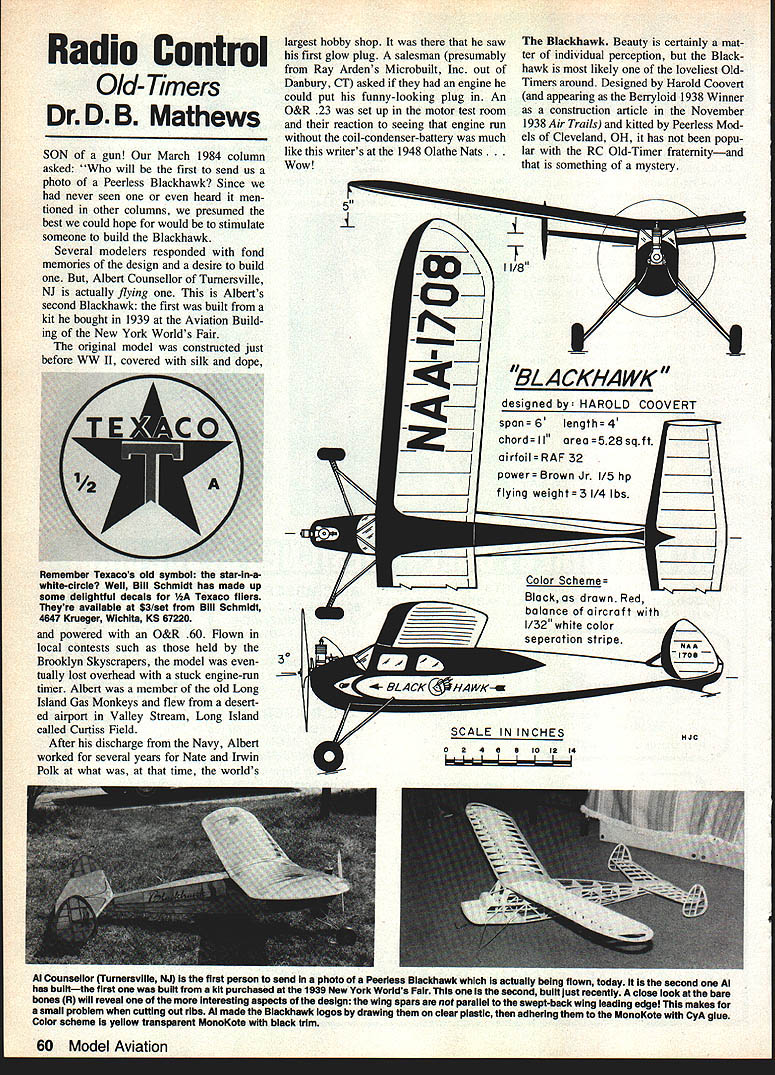
Beauty is certainly a matter of individual perception, but the Blackhawk is most likely one of the loveliest Old-Timers around. Designed by Harold Covert (appearing as the Ben-yloid 1938 Winner as a construction article in the November 1938 Air Trails) and kitted by Peerless Models of Cleveland, OH, it has not been popular with the RC Old-Timer fraternity—and that is something of a mystery.
BLACKHAWK (specifications)
- Designed by: Harold Covert
- Span: 6'
- Length: 4'
- Chord: 11"
- Area: 5.28 sq. ft.
- Airfoil: RAF 32
- Power: Brown Jr., 1/5 hp
- Flying weight: 3 1/4 lbs.
Color Scheme
- Black, as drawn.
- Red, balance of aircraft with 1/32" white color separation stripe.
Albert Counsellor advises beefing up the structure for the rigors of RC conversion and also points out that, with the wing spars parallel to the swept-back wing leading edge, the ribs have the spar at different locations — not an easy approach but certainly worth the effort. Albert substituted spruce 1/4" x 1/4" spars and used balsa elsewhere. Ribs are exceptionally deep, 1/2" with slight undercamber. He says climb is either an ST 35 or an OS 40 four-stroker — spectacular; glide really great. Cutaway part of elevator provides clearance for twin rudders. Articulated bellcrank, double horns. Also rear landing gear brace is set up to move into a fuselage slot; obviously this would tear the area up on a hard landing.
Model finished in yellow transparent MonoKote with black trim. Blackhawk logos on sides and wingtips were drawn on clear plastic, then adhered to the MonoKote with CyA glue. Albert is a commercial artist, and it certainly shows. Unfortunately, we can't show Albert Counsellor's Blackhawk in color, but use your imagination and get to building on your own. The plan is 7G1 from Pond Plans, P.O. Box 3215, San Jose, CA 95156.
Plans and requests
Speaking of plans, we occasionally receive requests for sources of plans not in Pond's catalog. As a matter of fact, we have one of our own that we've been searching for over many years. After the incredible response to our request for Bi-Fil drawings produced, it occurs to us that some reader just might have drawings for Joe Ott's Skylark. If you do, please advise and we'll work out a way they can be duplicated without sending the originals through the mail.
Unless it gets out of hand, if others have need of rare plans not in the normal supply line, we will try to help you find them. Write us and we'll try to serve as a clearinghouse.
From the workbench
We've stumbled onto several helpful things lately and want to share them:
- A small jar of kerosene is great for keeping the spray nozzle open on "Spray-Mate" (spray cement).
- Acetone will clean up MonoKote smudges very well and will also dissolve the color-adhesive side to create windows with no seams. Just rub the inside of the window area free of color after applying the covering. It is also great for cleaning off masking tape residue.
- A Dixon Visu-aid (and other similar products) is a grease pen that will mark trim designs, etc., onto MonoKote. Lay out the pattern, mask the outlines, and remove pencil marks with acetone.
- Claude McCullough, in the instructions with the new Sig King Kobra, suggests using a drill bit having the inside diameter of the fuel tank's brass tubing to form the curves. Push the bit all the way in and slowly bend the tubing as it is withdrawn. This makes for remarkably smooth bends, with no collapse of the tube.
- A Top Flite heat gun is the slickest way to shrink heat-shrink covering you'll ever find.
- Polyurethanes and epoxies will adhere to MonoKote better if the surface is first rubbed with 400–600 steel wool, washed off thoroughly with acetone, and not touched with the fingers before spraying.
- Bob Hunt of Flying Models talked us out of using a tack rag to "dust" our structures prior to painting, and our "fish-eye" problems disappeared. He also pointed out that silicon carbide sandpaper, used wet, leaves some of the silicon on the surface, and you sure can't get anything to stick to it.
- Servo tape is fine for 1/2A Texaco models to hold the raw balsa where the tape is to be applied, if the area is given a coat of CyA before sticking it down. The reason servo tape pulls loose is that the wood grain lets go. Ever notice it always sticks to the side of the servo but pulls off the wood? So, harden the wood with it!
Just what is SAM-legal?
The Society of Antique Modelers (SAM) rule book is rather specific about not altering moments, airfoils, landing gear, etc., but some vague changes are permissible. As an example: Bob Oslan's magnificent Cloud Cruiser (MAN, November 1983) substitutes tubular spars for the original wing's sheeted leading edge. That's certainly well within the intent of the SAM rules. My 1/2A Mini-America omits the original wing sheeting entirely; it would have taken 1/8" balsa to be scale.
On the other hand, I've published several modernized Old-Timers on which the airfoil or nose contours or profiles have been changed in the name of simplicity. I don't apologize for changing the original designs, and since these updated designs have proved to be very popular and have introduced many prospective modelers to the world of Old-Timers, the SAM rules are not intended for all design applications. The exception was the Kloud King XL, which appeared in Flying Models, August 1980. In that instance, something was lost between my penciled drawing and the draftsman's ink. The significance of this is that the design and the currently available kits based on it are not SAM-legal!
In my part of the country, a great deal of activity is being generated around the 1/2A Texaco event, with many fellows now flying RC Old-Timers for the first time. In order to keep things simple for them, the promoters of contests are allowing the use of "tabs" for elevator control. I have no quarrel with this and feel that it is a wise move, since elevators are sometimes difficult to develop on some designs; however, it should be clearly understood that such a change is for local use only and is totally illegal for competition on a national level. This is much in keeping with the non-SAM-legal published designs for my Panther II and Kloud King XL.
The other MECA
Moslems bow toward one (Mecca), and Old-Timer nuts to another (MECA). The one we are talking about here is the Model Engine Collectors Association. With nearly 1,800 members, MECA is bound by a common interest in old-time spark engines from the Forties and Thirties, with some additional interest in glow and diesel power plants.
Collectors are held regionally to provide members an opportunity to display their engines and to buy, sell, and trade. Obviously, much discussion and socializing goes on at these events, as well. A "Grand National Collecto" is held in conjunction with the SAM Champs.
MECA has two publications: the Swap Sheet, which is issued on a bi-monthly basis, and the Bulletin, which deals with engine history and information. Both are included with the annual dues of $10.
To join, contact secretary/treasurer Bob McClelland, 3007 Travis, Westlake, LA 70669 for an application.
Some chuckles
One of the benefits associated with corresponding with many SAM-types around the world is the collection of wild and crazy things modelers say and do:
- Jean Gibbs (York, PA) advised husband Dick that while he was out mowing the lawn some guys had called to ask if he'd like to come watch them fly their quarter pounders.
- Ed Zartmann (also of York), when asked why he'd opened the needle valve four turns instead of the requested one turn, replied: "Oh, I was using metric turns."
- The Rev. Bob Lowe (Muldersdrift, South Africa), upon discovering that the T.D. had fallen off his Strato Streak in the glide: "Well I thought it was a little tail-shy."
- George Wandell tells of his Sunduster with a Cosmic Ray fuselage at a contest near St. Louis during the summer of 1949. "I had two so-so flights and was trying to get the last one in, but had ignition trouble with the Super Cyclone. About 15 minutes before the contest closed, I hand-launched. The model circled and descended to about 30 feet, where it locked into a thermal. It was officially timed for 25 minutes, 26 seconds. I chased it through water up to my waist and mud up to my knees across fields and such for 45 minutes until a buddy caught up in a car. We were stopped by the Mississippi River with the plane a dot in the sky, obviously over the river.
"I gave up and went back to pick up the first-place trophy and returned home. A couple of days later, a postcard from a farmer's wife arrived saying the plane had landed in their yard in Golden Eagle, IL, about 7:30 p.m. I still have the plane."
What is remarkable about all this is that George received his trophy while the model was still in the air!
- And finally, the wildest "lost plane story" of all time: Nino Campana D.C. (Sault Ste. Marie, Ontario) tells of a modeler launching an FF model there in 1940 that went out of sight (OOS) and wasn't found until a hunter came across the badly weathered remains some forty miles away. The owner's name was still legible, so the model was returned to him. Only thing is: a boy lost it and a mature man had it returned — 20 years had passed!
Lost and found
Any of us who have a Free Flight background are critically aware of the need for identification tags on models. Unfortunately, those who fly RC-Assist don't seem to be. For that matter, the AMA rules clearly state that all models must display the owner's name and AMA number.
My sons always used a rubber stamp on the wood of their Free Flight models before covering and also adhered a tag somewhere on the fuselage. The labels gave name, address, phone number, and the advice "call collect ... reward." As a result, they had models returned from Wisconsin to Louisiana and California to Ohio.
The AMA has just simplified things for us. Now available are pre-printed labels on mylar-covered, sticky-backed forms. One need only write (or type) his license number, name, address and phone number on a tab and seal the unit onto the model.
Just to add some wallop, the bottom of the plate reads: "Unauthorized possession of this model can lead to prosecution under the law."
These are really clever little gadgets and are available from AMA Supply and Service at a cost of 10 for a dollar. It has now become simple for everyone to make their models legal.
SAM in Reno
For many years, John Pond has been organizing SAM RC and Free Flight events on an unofficial basis at the various Nationals. It is our understanding that such will be the case at the 1984 Nats. Check the AMA bulletin board for locations and times. By all means, bring along your Old-Timers and join in the fun, or come out and spectate. You're bound to enjoy!
Contact
Dee B. Mathews 506 South Walnut Greensburg, KS 67054
Transcribed from original scans by AI. Minor OCR errors may remain.

