
Radio Control: Old-Timers
Dr. D. B. Mathews
CORRECTION
The January 1984 column gave a source for plans of the DeBolt Live Wire kits. Unfortunately I gave the wrong address and several modelers have had letters returned. The correct source is Fran Ptaszkiewicz, 23 Marlee Drive, Tonawanda, NY 14150.
Cleveland Cloudster Mk I and Mk II
One of the more popular kits in the old Cleveland line was the Cloudster. Its graceful, scale-like lines and excellent aerodynamics made it very attractive to kit buyers — it always seemed to fly well.
The touch of Joe Elgin is apparent in the design, although he is not credited on the plans or in the advertisements. The wing and empennage planforms are very much like the Playboy, and the airfoil is similar. The 50 in. span design was intended for Class B Free Flight; the original plans show an O&R .23 mounted inverted.
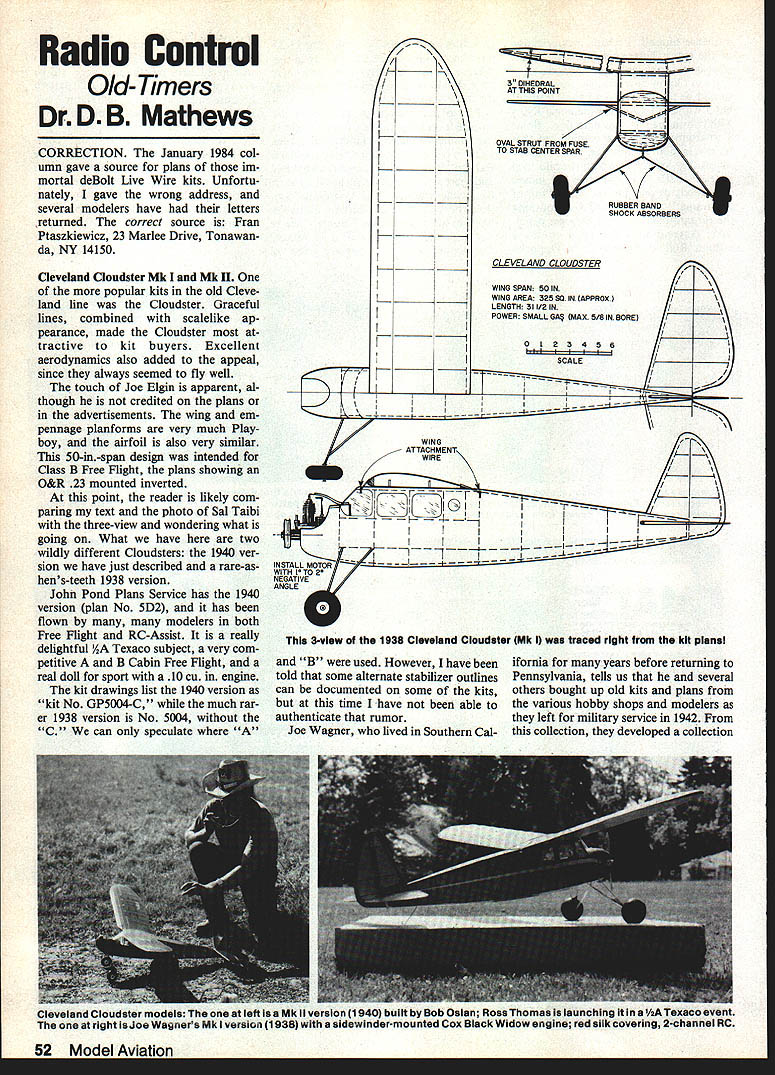
What we actually have are two quite different Cloudsters: a 1940 version and a much rarer 1938 version.
- The 1940 version (often seen) is the one many modelers know. John Pond Plans Service has the 1940 version as plan No. 5D2; the kit drawings list it as Kit No. GP5004-C. It has been flown successfully in Free Flight and RC-assist, is a delightful 1/2A Texaco subject, competitive in A and B Cabin Free Flight, and a great sport model with a .10 cu. in. engine.
- The 1938 version is rare. The kit plan is listed as No. 5004 (without the "C") and differs markedly from the 1940 Cloudster: the airfoil is flat-bottomed, the stabilizer is flat and inset into a much wider fuselage, there is a multiple-piece undercarriage, and it lacks the leading-edge notch characteristic of the Mk II (1940) version.
Because of these differences, one must be careful when identifying Cloudsters. I have arbitrarily used the Mk I and Mk II designations for the 1938 and 1940 versions, much as others have distinguished two versions of the Comet Clipper.
John Pond and the preservation of plans Joe Wagner and several others bought up old kits and plans from hobby shops and departing modelers when they left for military service in 1942. Plans were not originally saved with any thought of a future SAM (Society of Antique Modelers) movement, but when interest grew some of Joe's friends donated their plan collections to John Pond so the designs could be made available. John, a Naval draftsman, and several other draftsmen refurbished drawings in their spare time and began making copies. For a while Russ Barrera's museum was a source for plans; as Russ became ill and John retired from the Navy he went into the Old-Timer plans business full time.
Obtaining the 1938 Cloudster plans Joe Wagner did not donate the 1938 Cloudster kit plans. Recently Joe built an RC version of the 1938 design and displayed it at La Junta. If you want plans, an annual membership in Joe Wagner's Fun Flyers and a small amount to cover printing costs will likely get you a set. Contact:
- Joe Wagner, Fun Flyers, P.O. Box 94, Volant, PA 16156.
A membership in this organization of non-competition modelers is worth having for reasons beyond the plans.
Products for the Old-Timer
When I started this column (January 1977), sources for kits and supplies were few. In the ensuing years a virtual explosion of interest in Old-Timers has produced many manufacturers marketing products aimed at our needs. Even some major companies now introduce kits for Old-Timer modelers.
Because so many products and manufacturers exist, I cannot keep up with reporting them all. Check ads in the magazines and in SAM Speaks for current offerings.
One astonishing development has been the availability of reproduction engines. Suddenly we can buy reproductions of:
- Foresters
- Orwicks
- Megowys
- Super Cyclones
- Simplex
Would you believe a reproduction of the infamous Deezil is available in Australia?
When responding to ads in Model Aviation, tell them you saw it here.
Another chapter in "He Started With Models."
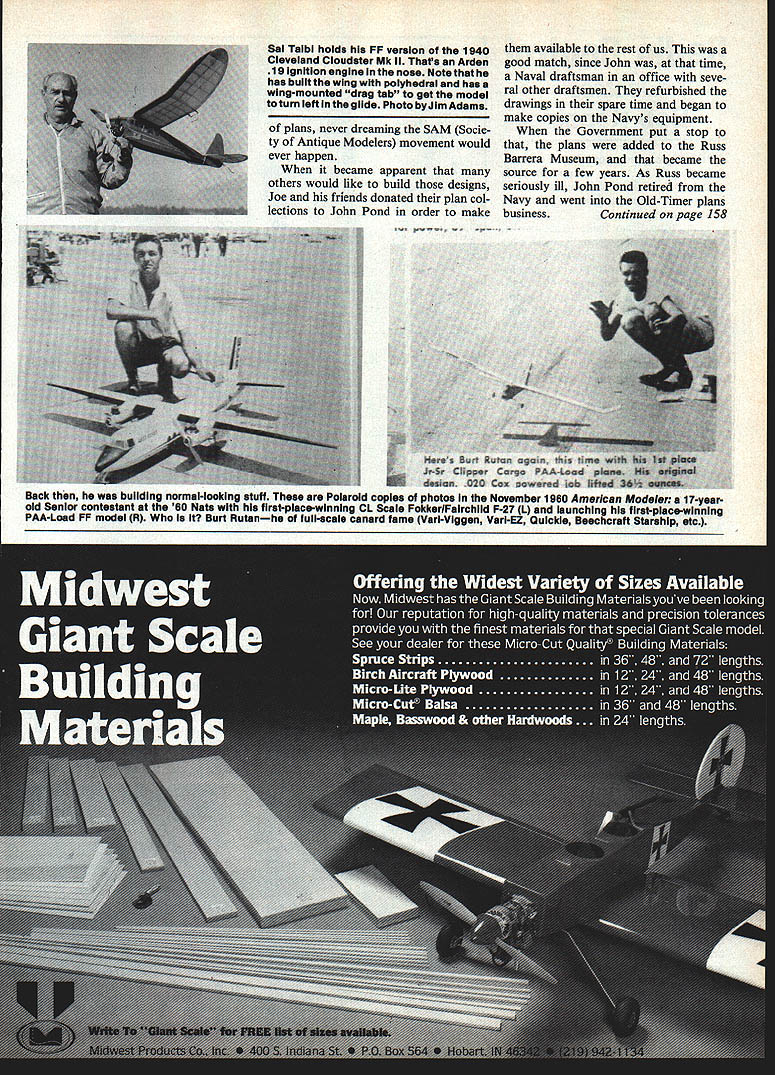
In past columns I’ve highlighted the modeling backgrounds of several people who became prominent in the commercial world: Dr. Paul MacCready, Roy Marquart, Roger Hammer, and others. Now let's add Burt Rutan.
If you don't know Burt Rutan, you may not have heard of VariViggen, VariEze, VQZ, LongEZ, or Defender — all out-of-the-rut canard-configuration designs from Rutan. He is recognized worldwide as a preeminent expert on canard aerodynamics and has repeatedly demonstrated improved speed and stability with the configuration. Several manufacturers are now releasing similar designs.
Burt was a former National Champion and an active modeler in Free Flight and Control Line in the late 1950s. Some of what he learned then shows in his later work. For example, he pioneered composite construction for homebuilts — a technique that echoes earlier hobby techniques like "Hobby Poxy EZ Does It" (foam molding covered with balsa and epoxy). The hottest trend in the aircraft industry today is composite structures: combinations of high-strength plastics (epoxies) with reinforcing cloth or fibers (fiberglass, carbon), producing lightweight, strong airframe components. While others have contributed, Rutan's work helped bring composites into wider use for light aircraft.
Transcribed from original scans by AI. Minor OCR errors may remain.

