
Radio Control: Old-Timers
Dr. D. B. Mathews
ONE MORE TIME! To join, rejoin, or renew your membership in the Society of Antique Modelers (SAM), send $10 to S.A.M., 4269 Sayoko Circle, San Jose, CA 95136.
An exception. When is a model SAM-legal, even though it was not "designed, kitted, or plans published prior to December 31, 1942?" When it's an Old Ruler. Though the event has never really caught on, some rather exciting possibilities exist for models to be developed to meet the requirements of this event.
The SAM rule book lists Old Ruler as a special event and says: "Any model that meets the requirements of the 1941 AMA rules is eligible for this event. Minimum cross section 1/2 sq. in.; 8 ounces per square foot wing loading; 80 ounces per cubic inch displacement power loading. Model may be an original design."
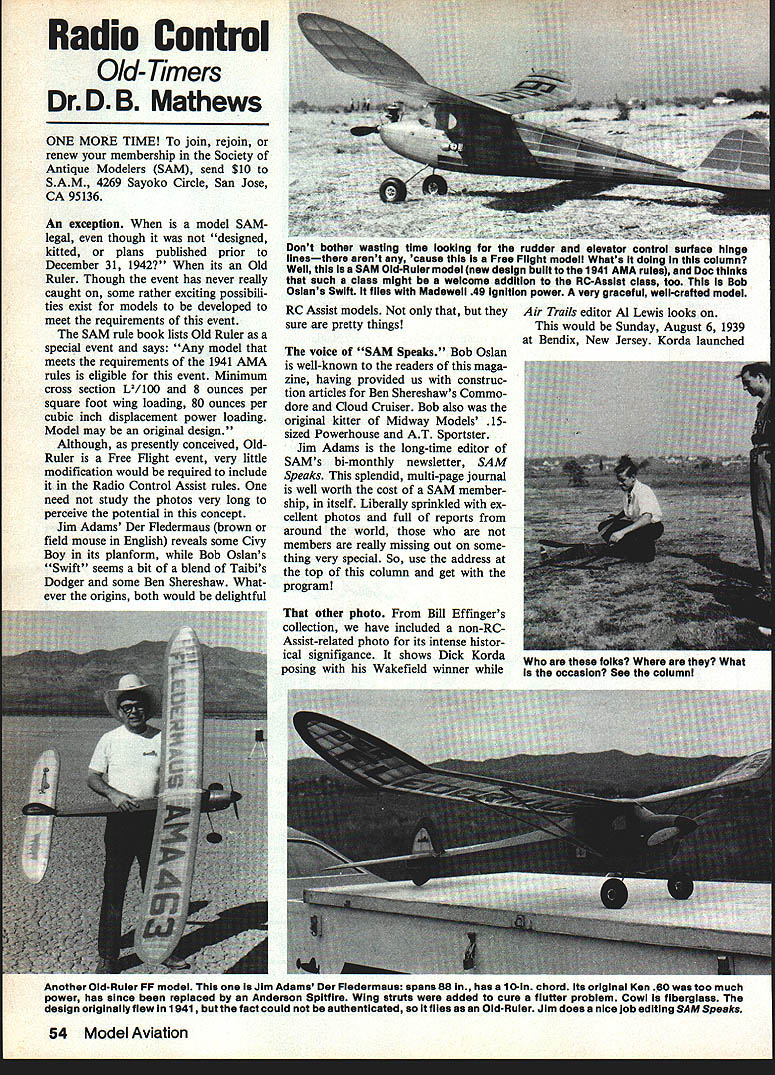
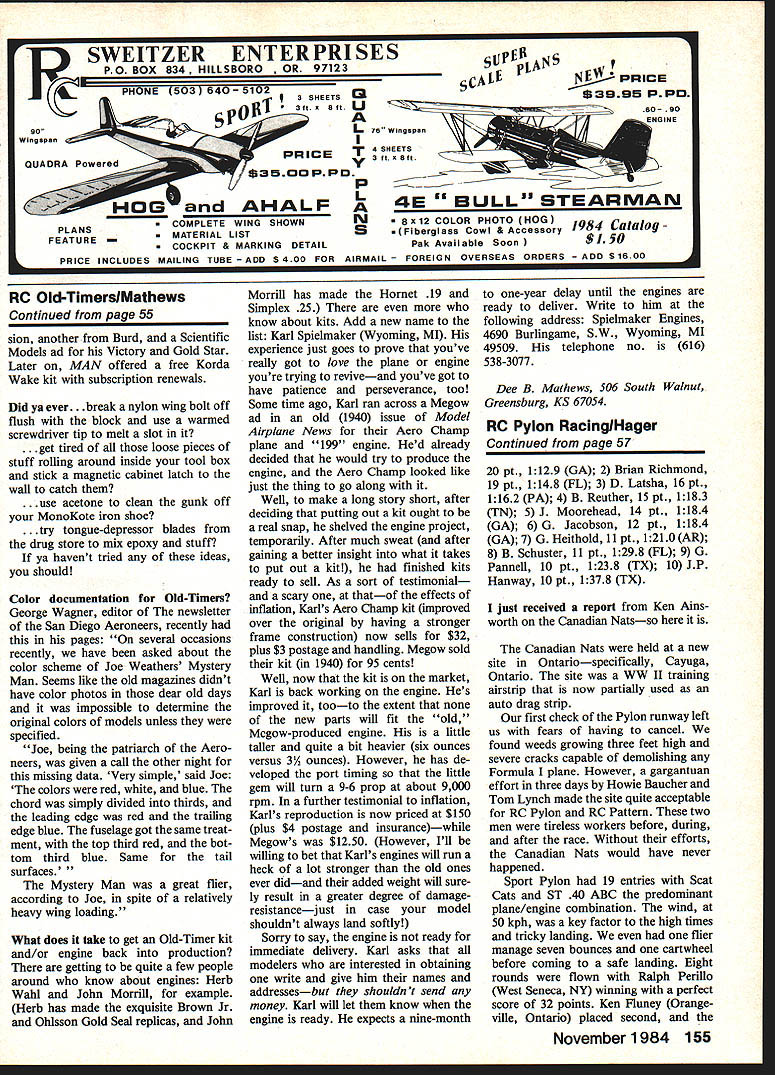
Although, as presently conceived, Old Ruler is a Free Flight event, very little modification would be required to include it in the Radio Control Assist rules. One need not study the photos very long to perceive the potential in this concept.
Jim Adams' Der Fledermaus (brown or field mouse in English) reveals some Civy Boy in its planform, while Bob Oslan's "Swift" seems a bit of a blend of Taibi's Dodger and some Ben Shereshaw. Whatever the origins, both would be delightful RC-Assist models.
Don't bother wasting time looking for the rudder and elevator control surface hinge lines—there aren't any, 'cause this is a Free Flight model! What's it doing in this column? Well, this is a SAM Old-Ruler model (new design) built to the 1941 AMA rules, and Doc thinks that such a class might be a welcome addition to the RC-Assist class, too. This is Bob Oslan's Swift. It flies with Madewell .49 ignition power. A very graceful, well-crafted model.
The voice of "SAM Speaks." Bob Oslan is well-known to the readers of this magazine, having provided us with construction articles for Ben Shereshaw's Commodore and Cloud Cruiser. Bob also was the original kitter of Midway Models' .15-sized Powerhouse and A.T. Sportster.
Jim Adams is the long-time editor of SAM's bi-monthly newsletter, SAM Speaks. This splendid, multi-page journal is well worth the cost of a SAM membership, in itself. Liberally sprinkled with excellent photos and full of reports from around the world, those who are not members are really missing out on something very special. So, use the address at the top of this column and get with the program!
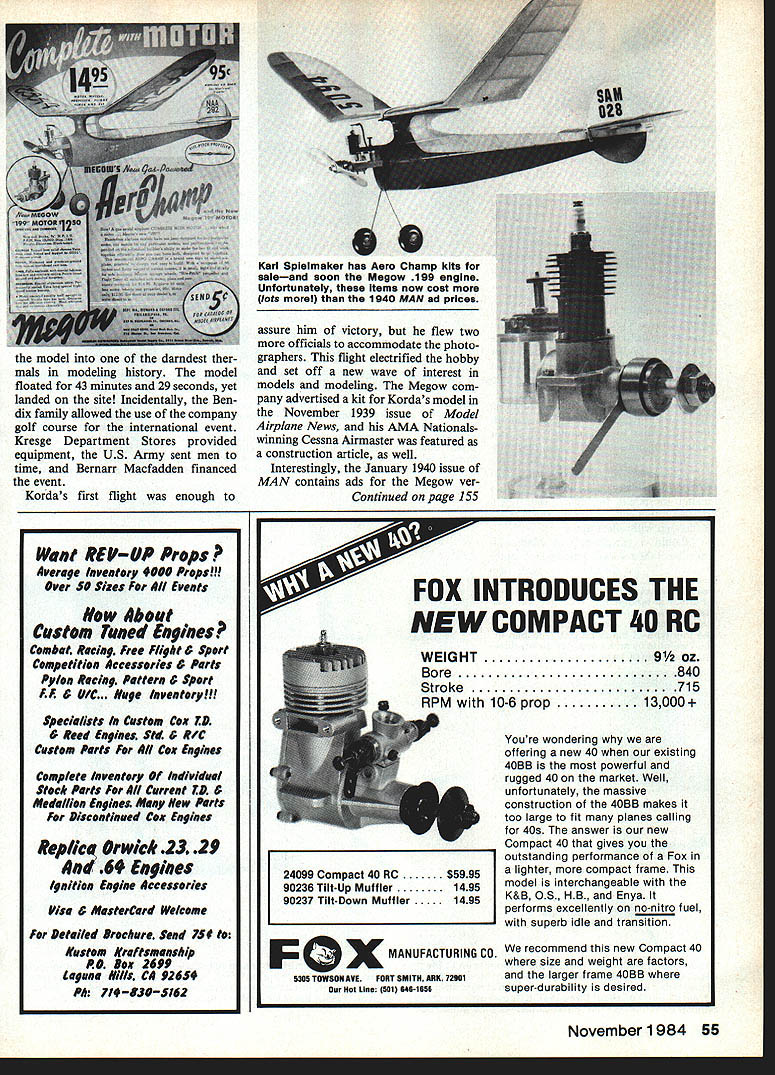
That other photo. From Bill Effinger's collection, we have included a non-RC-Assist-related photo for its intense historical significance. It shows Dick Korda posing with his Wakefield winner. Although he was assured of victory, he flew two more official flights to accommodate the photographers. This flight electrified the hobby and set off a new wave of interest in models and modeling.
The Megow company advertised a kit for Korda's model in the November 1939 issue of Model Airplane News, and his AMA Nationals-winning Cessna Airmaster was featured as a construction article as well. Interestingly, the January 1940 issue of MAN contains ads for the Megow version, another from Burd, and a Scientific Models ad for his Victory and a Gold Star. Later on, MAN offered the free Korda Wake kit with subscription renewals.
Did ya ever...
- break a nylon wing bolt off flush with the block and use a warmed screwdriver tip to melt a slot in it?
- get tired of all those loose pieces of stuff rolling around inside your toolbox and stick a magnetic cabinet latch to the wall to catch them?
- use acetone to clean the gunk off your MonoKote iron shoe?
- try tongue-depressor blades from the drug store to mix epoxy and stuff?
If ya haven't tried any of these ideas, you should!
Color documentation for Old-Timers?
George Wagner, editor of the newsletter of the San Diego Aeroneers, recently had this in his pages: "On several occasions recently, we have been asked about the color scheme of Joe Weathers' Mystery Man. Seems like the old magazines didn't have color photos in those dear old days and it was impossible to determine the original colors of models unless they were specified.
"Joe, being the patriarch of the Aeroneers, was given a call the other night for this missing data. 'Very simple,' said Joe: 'The colors were red, white, and blue. The chord was simply divided into thirds, and the leading edge was red and the trailing edge blue. The fuselage got the same treatment, with the top third red, and the bottom third blue. Same for the tail surfaces.'"
The Mystery Man was a great flier, according to Joe, in spite of a relatively heavy wing loading.
What does it take to get an Old-Timer kit and/or engine back into production? There are getting to be quite a few people around who know about engines: Herb Wahl and John Morrill, for example. (Herb has made the exquisite Brown Jr. and Ohlsson Gold Seal replicas, and John Morrill has made the Hornet .19 and Simplex .25.) There are even more who know about kits. Add a new name to the list: Karl Spielmaker (Wyoming, MI). His experience just goes to prove that you've really got to love the plane or engine you're trying to revive—and you've got to have patience and perseverance, too!
Some time ago, Karl ran across a Megow ad in an old (1940) issue of Model Airplane News for their Aero Champ plane and "199" engine. He'd already decided that he would try to produce the engine, and the Aero Champ looked like just the thing to go along with it.
Well, to make a long story short, after deciding that putting out a kit ought to be a real snap, he shelved the engine project temporarily. After much sweat (and after gaining a better insight into what it takes to put out a kit!), he had finished kits ready to sell. As a sort of testimonial—and a scary one, at that—one of the effects of inflation, Karl's Aero Champ kit (improved over the original by having a stronger frame construction) now sells for $32, plus $3 postage and handling. Megow sold their kit (in 1940) for 95 cents!
Well, now that the kit is on the market, Karl is back working on the engine. He's improved it, too—to the extent that none of the new parts will fit the "old," Megow-produced engine. His is a little taller and quite a bit heavier (six ounces versus 3-1/2 ounces). However, he has developed the port timing so that the little gem will turn a 9-6 prop at about 9,000 rpm. In a further testimonial to inflation, Karl's reproduction is now priced at $150 (plus $4 postage and insurance)—while Megow's was $12.50. (However, I'll be willing to bet that Karl's engines will run a heck of a lot stronger than the old ones ever did—and their added weight will surely result in a greater degree of damage resistance—just in case your model shouldn't always land softly!)
Sorry to say, the engine is not ready for immediate delivery. Karl asks that all modelers who are interested in obtaining one write and give him their names and addresses—but they shouldn't send any money. Karl will let them know when the engine is ready. He expects a nine-month to one-year delay until the engines are ready to deliver. Write to him at the following address:
Spielmaker Engines 46909 Burlingame S.W. Wyoming, MI 49509 Telephone: (616) 538-3077
Dee B. Mathews 506 South Walnut Greensburg, KS 67054.
Transcribed from original scans by AI. Minor OCR errors may remain.

