
Radio Control
Old-Timers
Dr. D. B. Mathews
WE'VE MOVED. Please note the new address at the end of this column. Our correspondence stack is in a bit of a mess. If we owe you a letter, either be patient or send us another!
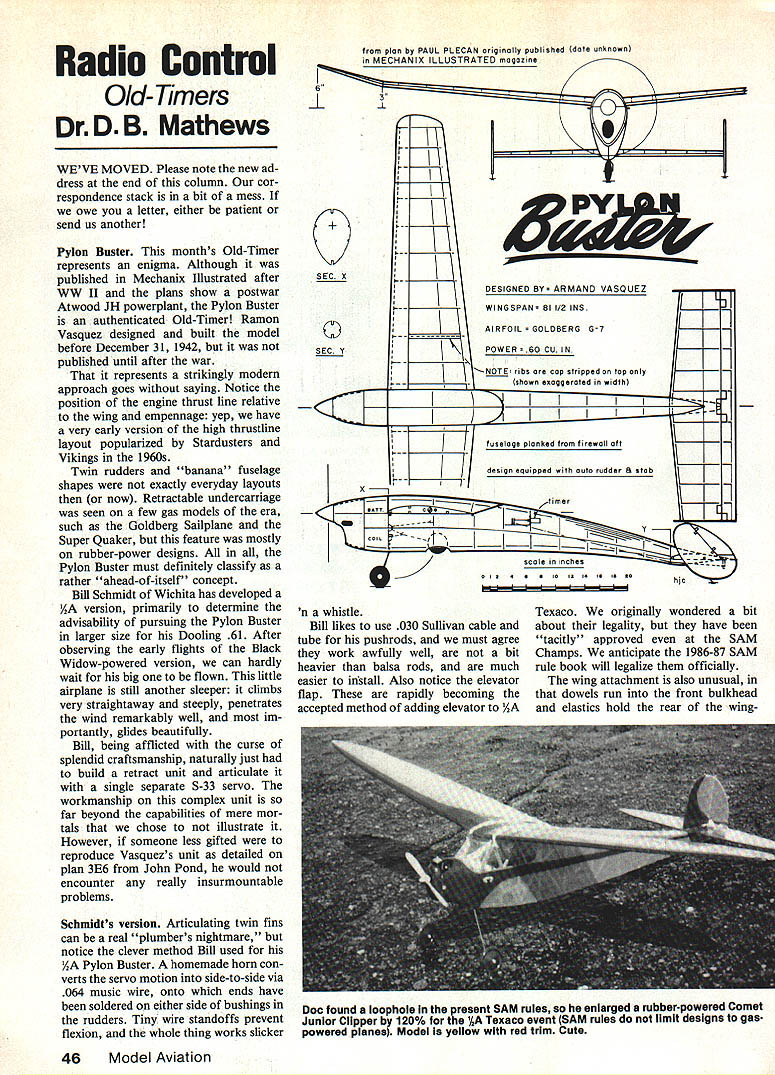
Pylon Buster. This month's Old-Timer represents an enigma. Although it was published in Mechanix Illustrated after WWII and the plans show a postwar Atwood JH powerplant, the Pylon Buster is an authenticated Old-Timer. Ramon Vasquez designed and built the model before December 31, 1942, but it was not published until after the war.
That it represents a strikingly modern approach goes without saying. Notice the position of the engine thrust line relative to the wing and empennage — we have a very early version of the high thrustline layout popularized by Stardusters and Vikings in the 1960s.
Twin rudders and a "banana" fuselage shape were not exactly everyday layouts then (or now). Retractable undercarriage was seen on a few gas models of the era, such as the Goldberg Sailplane and the Super Quaker, but this feature was mostly on rubber-power designs. All in all, the Pylon Buster must definitely classify as a rather "ahead-of-itself" concept.
Bill Schmidt of Wichita has developed a 1/2A version, primarily to determine the advisability of pursuing the Pylon Buster in larger size for his Dooling .61. After observing the early flights of the Black Widow-powered version, we can hardly wait for his big one to be flown. This little airplane is still another sleeper: it climbs very straightaway and steeply, penetrates the wind remarkably well, and most importantly, glides beautifully.
Bill, being afflicted with the curse of splendid craftsmanship, naturally just had to build a retract unit and articulate it with a single separate S-33 servo. The workmanship on this complex unit is so far beyond the capabilities of mere mortals that we chose not to illustrate it. However, if someone less gifted were to reproduce Vasquez's unit as detailed on plan 3E6 from John Pond, he would not encounter any really insurmountable problems.
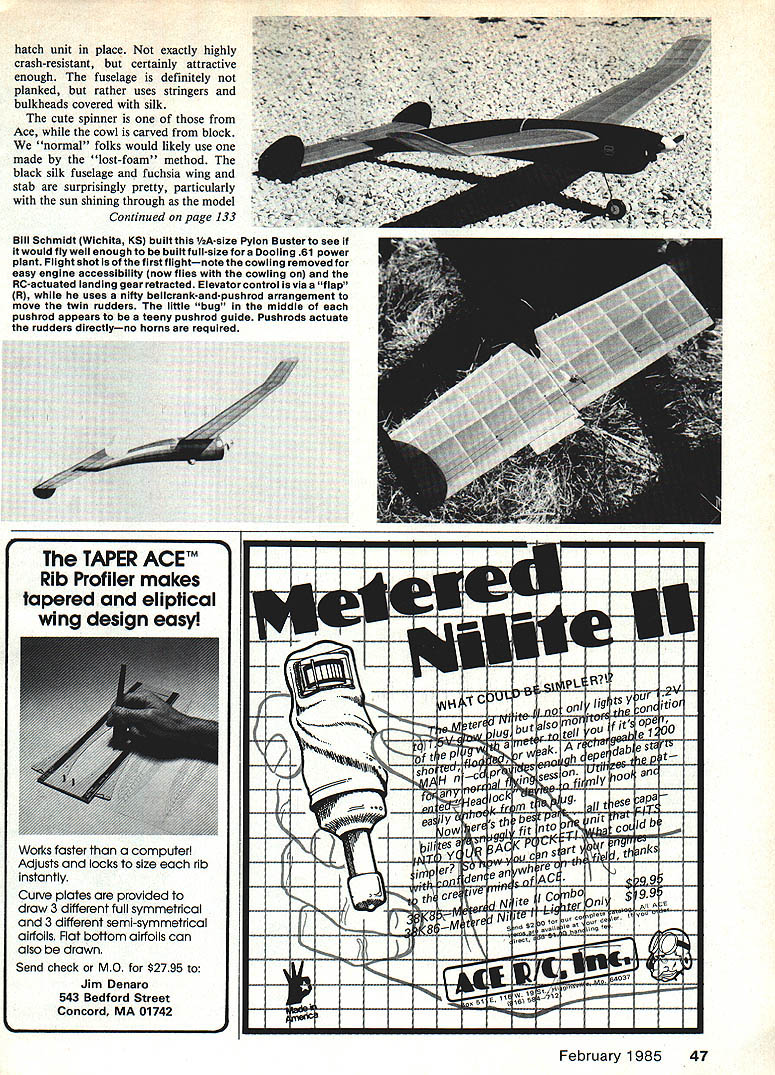
Schmidt's version. Articulating twin fins can be a real "plumber's nightmare," but notice the clever method Bill used for his 1/2A Pylon Buster. A homemade horn converts the servo motion into side-to-side movement via .064 music wire, onto which ends have been soldered on either side of bushings in the rudders. Tiny wire standoffs prevent flexion, and the whole thing works slicker 'n a whistle.
Bill likes to use .030 Sullivan cable and tube for his pushrods, and we must agree they work awfully well; they are not a bit heavier than balsa rods and are much easier to install. Also notice the elevator flap. These are rapidly becoming the accepted method of adding elevator to 1/2A Texaco. We originally wondered a bit about their legality, but they have been "tacitly" approved even at the SAM Champs. We anticipate the 1986–87 SAM rule book will legalize them officially.
The wing attachment is also unusual: dowels run into the front bulkhead and elastics hold the rear of the wing hatch unit in place. Not exactly highly crash-resistant, but certainly attractive enough. The fuselage is definitely not planked; it uses stringers and bulkheads covered with silk.
The cute spinner is one of those from Ace, while the cowl is carved from block. We "normal" folks would likely use one made by the lost-foam method. The black silk fuselage and fuchsia wing and stab are surprisingly pretty, particularly with the sun shining through the model.
Radio Control: Old-Timers
Continued from page 47
Reduced to 60% of the original size, the Pylon Buster shows enough potential to hold its own in any 1/2A Texaco competition; full-sized and fully powered, it may well be extraordinary. Anyone who has been flying one of these is invited to let us know how it goes.
Two approaches to power runs. The incredible explosion of activity in 1/4A Texaco around the world has introduced more modelers to the joys of RC Old-Timer than any of us thought possible. These relatively inexpensive, easy-to-build, and fun-to-fly little rascals are absolutely perfect first Old-Timer subjects. We would anticipate this event may finally make the point with the Free Flight fraternity that adding RC to a Free Flight model to reduce retrieving problems and add usable flying sites is not sacrilege!
Interestingly, since motor runs are not timid but are a function of how much fuel one can squeeze into the Black Widow tank, two completely divergent approaches have evolved:
- High-nitro, small-prop approach — Use high nitro and small props to gain lots of altitude in the two- or three-minute motor run. This high-fast approach depends on thermals for every flight.
- Low-nitro, long-run approach — Use low nitro, 8 x 3 (or larger) props and seven- to eight-minute motor runs. Slow-low seemingly assures at least ten minutes with no lift at all; with just a little "help," the 15-minute max is well within reach.
To obtain those long engine runs, modifications such as two — or even three — head gaskets, 10% nitro fuel, and 8 x 4 or 8 x 6 props are used. Needle settings become very critical with the regular heads, and it may be necessary to look through a large batch of Black Widows before a properly fitted one is found. Front bearing "slop" is an absolute no-no. Most are also modifying the fuel pickup from the original plastic to a J-shaped section of 3/32" I.D. brass or aluminum tubing.
East side, west side: Since the 1985 SAM Champs is to be held in California and the AMA Nationals in Massachusetts, RC Old-Timer nuts on either coast are being given a chance to attend major meets next summer. Those in the middle of the country can choose or attend both. For 1986, we should see the reverse setup, while the 1987 SAM Champs would be in the Midwest. I'll bet the Fort Worth Plainsmen could host a super SAM Champs at what could be the "premier site for Free Flight and RC-Assist" — Pyramid Acres. How about it, you Texans?
Dee B. Mathews 8420 Nantucket Wichita, KS 67212
Transcribed from original scans by AI. Minor OCR errors may remain.

