
Radio Control
Old-Timers
Dr. D.B. Mathews
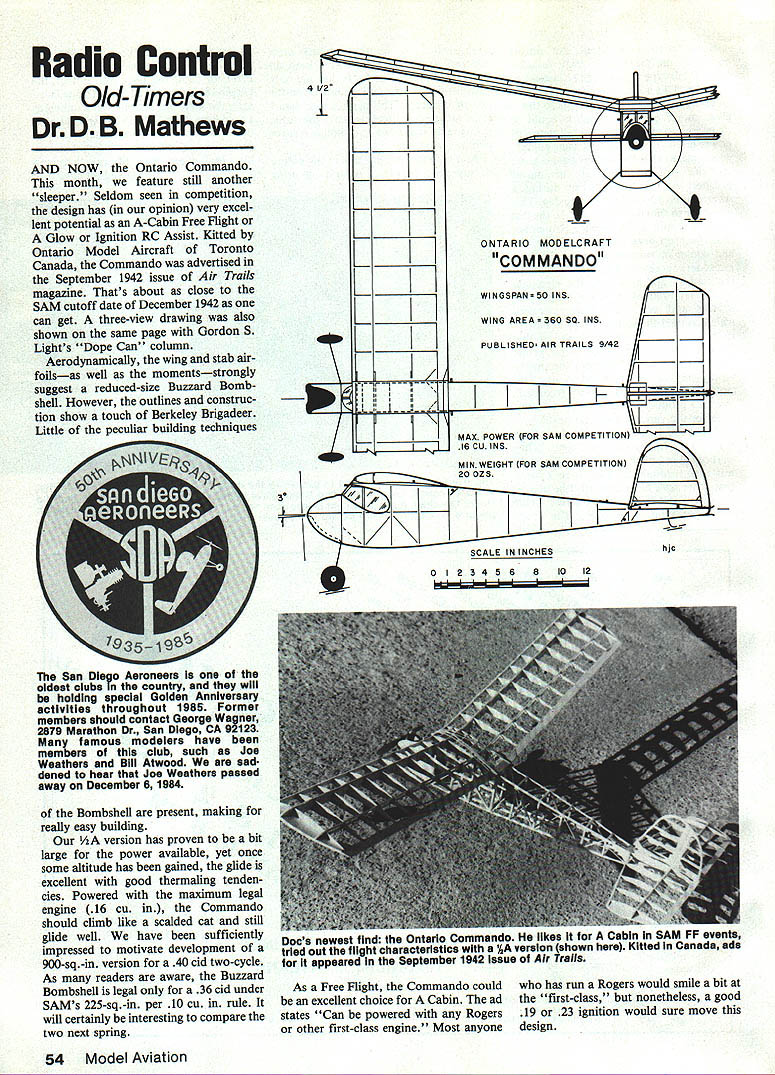
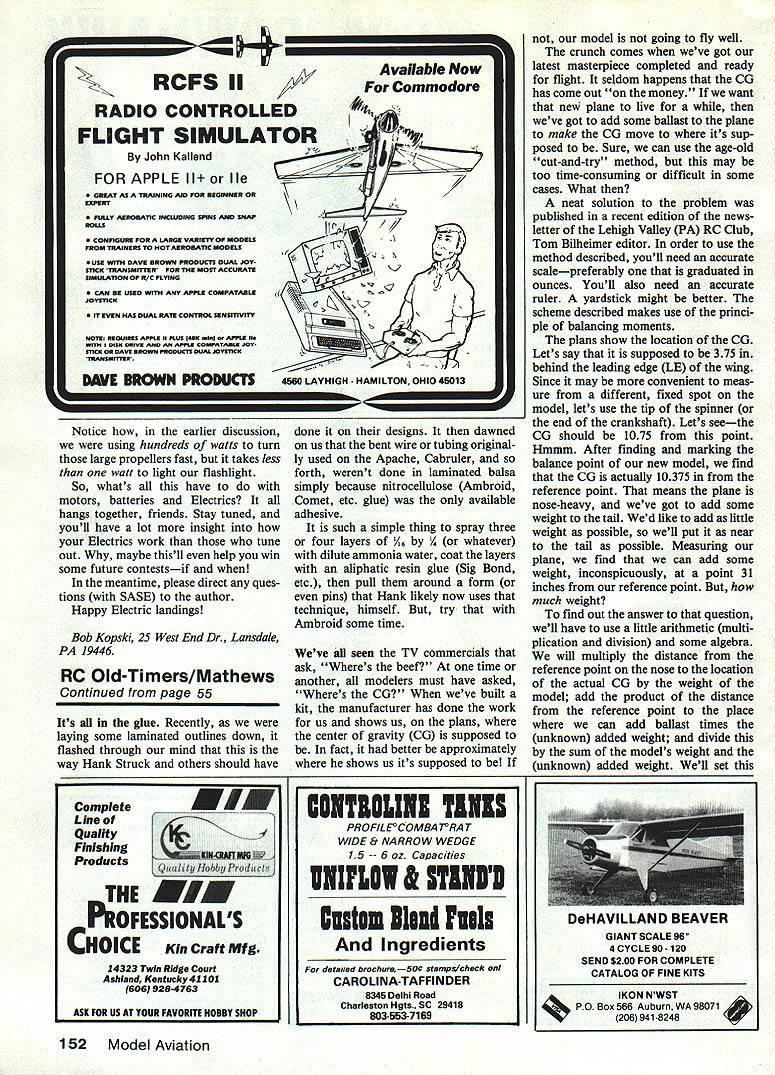
AND NOW, the Ontario Commando. This month, we feature still another "sleeper." Seldom seen in competition, the design has, in our opinion, very excellent potential as an A‑Cabin Free Flight or A‑Glow or ignition RC‑assist. Kitted by Ontario Model Aircraft of Toronto, Canada, the Commando was advertised in the September 1942 issue of Air Trails magazine. That's about as close to the SAM cutoff date of December 1942 as one can get. A three‑view drawing was also shown on the same page with Gordon S. Light's "Dope Can" column.
Aerodynamically, the wing and stab airfoils—as well as the moments—strongly suggest a reduced‑size Buzzard Bombshell. However, the outlines and construction show a touch of Berkeley Brigadier. Little of the peculiar building techniques of the Bombshell are present, making for really easy building.
Our 1/2A version has proven to be a bit large for the power available, yet once some altitude has been gained, the glide is excellent with good thermaling tendencies. Powered with the maximum legal engine (.16 cu. in.), the Commando should climb like a scalded cat and still glide well. We have been sufficiently impressed to motivate development of a 900‑sq.‑in. version for a .40 cu. in. two‑cycle. As many readers are aware, the Buzzard Bombshell is legal only for a .36 cu. in. under SAM's 225‑sq.‑in. per .10 cu. in. rule. It will certainly be interesting to compare the two next spring.
As a free flight, the Commando could be an excellent choice for A Cabin. The ad states, "Can be powered with any Rogers or other first‑class engine." Most anyone who has run a Rogers would smile a bit at the "first‑class," but nonetheless, a good .19 or .23 ignition would sure move this design.
The Commando is well suited to John Morrel's Simplex 19. His address is 143 Richmond St., El Segundo, CA 90245. The plans (350 sq. in.) are available from John Pond Plans, P.O. Box 3215, San Jose, CA 95156. Order plan No. 1D5.
"Berkeley Bill's" plans. The "W.E." in W.E. Technical Services (P.O. Box 76884, Atlanta, GA 30328) is none other than Bill Effinger of the old Berkeley Models. He has for sale a long list of updated RC Old‑Timers as well as scale subjects in plan‑pattern form. We have closely examined many of them and find the quality and completeness to be exceptional. All subjects are well‑engineered and profusely illustrated with comprehensive instructions.
Subjects range from the delightfully ugly Berkeley Buccaneer Standard (first gas design to sell for a dollar a foot span) to a quarter‑scale SE‑5A. We unhesitatingly recommend them to one and all.
RC Old‑Timers — Mathews
Continued from page 55
It's all in the glue. Recently, as we were laying some laminated outlines down, it flashed through our mind that this is the way Hank Struck and others should have done it on their designs. It then dawned on us that the bent wire or tubing originally used on the Apache, Cabruler, and so forth weren't done in laminated balsa simply because nitrocellulose (Ambroid, Z‑poxy, cement, etc.) was the only available adhesive.
Is it such a simple thing to spray three or four layers of 1/32 by 1/4 (or whatever) with dilute ammonia water, coat the layers with an aliphatic resin glue (Sig‑Bond, etc.), then pull them around a form (or even pins)? Hank likely now uses that technique himself. But try that with Ambroid sometime.
We've all seen the TV commercials that ask, "Where's the beef?" At one time or another, all modelers must have asked, "Where's the CG?" When we've built a kit, the manufacturer has done the work for us and shows us, on the plans, where the center of gravity (CG) is supposed to be. In fact, it had better be approximately where he shows us it's supposed to be! If not, our model is not going to fly well.
The crunch comes when we've got our latest masterpiece completed and ready for flight. It seldom happens that the CG has come out "on the money." If we want that new plane to live for a while, then we've got to add some ballast to the plane to make the CG move to where it's supposed to be. Sure, we can use the age‑old "cut‑and‑try" method, but this may be too time‑consuming or difficult in some cases. What then?
A neat solution to the problem was published in a recent edition of the newsletter of the Lehigh Valley (PA) RC Club, Tom Blimeier, editor. In order to use the method described, you'll need an accurate scale—preferably one that is graduated in ounces. You'll also need an accurate ruler. A yardstick might be better. The scheme described makes use of the principle of balancing moments.
The plans show the location of the CG. Let's say that it is supposed to be 3.75 in. behind the leading edge (LE) of the wing. Since it may be more convenient to measure from a different, fixed spot on the model, let's use the tip of the spinner (or the end of the crankshaft). Let's see—the CG should be 10.75 in. from this point. Hmmm. After finding and marking the balance point of our new model, we find that the CG is actually 10.375 in. from the reference point. That means the plane is nose‑heavy, and we've got to add some weight to the tail. We'd like to add as little weight as possible, so we'll put it as near to the tail as possible. Measuring our plane, we find that we can add some weight, inconspicuously, at a point 31 in. from our reference point. But how much weight?
To find out the answer to that question, we'll have to use a little arithmetic (multiplication and division) and some algebra. We will multiply the distance from the reference point on the nose to the location of the actual CG by the weight of the model; add the product of the distance from the reference point to the place where we can add ballast times the (unknown) added weight; and divide this by the sum of the model's weight and the (unknown) added weight. We'll set this up as an equation and solve for the unknown weight.
(W × dA + w × dB) / (W + w) = dD
where:
- W = weight of the model
- w = weight to be added
- dA = distance from reference to actual CG
- dD = distance from reference to desired CG
- dB = distance from reference to ballast point
Rearranging and solving for w gives:
w = W (dD − dA) / (dB − dD)
Using the example above:
- W = 56 oz.
- dA = 10.375 in.
- dD = 10.75 in.
- dB = 31 in.
w = 56 (10.75 − 10.375) / (31 − 10.75) = 56 (0.375) / (20.25) ≈ 1.03 oz.
Therefore, we'll have to add about one ounce at the 31‑in. point to correct the CG.
For that matter: how about holding a firewall and motor mount on without epoxy? Or, for that matter, before commercial glue came in a tube, they bought it in jars or melted nitrate photographic negatives in acetone. Those were the good old days.
Where have you been all these years? One of those "Why didn't someone think of this before" gadgets is the dihedral and CG stand thing from Ace RC. Our good friend, Red Costlow, sent us a preproduction version of his device, and we have finally found an accurate way to block up surfaces for dihedraling.
If you've not found one in your Christmas stocking, by all means get one. No more hunting around for boxes or books that are never just exactly the right height. We simply hold the surface tip onto the horizontal dowel with a clothespin and sand in the bevel. Infinitely adjustable with a positive lock, the stand enables one to duplicate the angle over and over again.
We have added inch marks onto the vertical dowels so that we can refer to them to find a ruler! This simplistic little tool is a real bargain and highly recommended to all of you.
Class A Texaco. The SAM 49ers are promoting another new concept in Texaco events. Briefly, the model must be an antique design (prior to December 31, 1938) powered with any Class A (.20 cid and under) engine. Fuel allotment is 10 cc per flight. Max is 5 minutes with three attempts. Scaling up or down is permitted, and the other rules follow SAM RC outlines.
The appeal, as we see it, is larger sizes than the 1/2A Texaco event with less‑temperamental engines. On the other hand, these models will certainly be easier to transport than the "big Texaco" nine‑footers. We intend to give this event a trial and would appreciate hearing from others who are trying it.
More plan searchers. Readers are looking for plans of the Cyclone Aircraft Heath Bull Pup and the Triangle Dictator in any of three sizes. Anyone who might have them is asked to advise. Both are designs worth reviving.
Immediately after submitting the 1/2A Texaco Clipper Junior photo for the February column, Sal Taibi (president of the Society of Antique Modelers) issued an emergency ruling prohibiting the enlargement of rubber‑power designs for the event. It seems that one of our "budding" designers wrote him to ask about the legality of it all, since the rules (for both Free Flight and RC assist) didn't say a thing about limiting power events to gas designs. That, then, brings us to Bill Schmidt's spark‑ignition Black Widow. Fortunately, the '42 Texaco rules are rather specific, allowing only fuel pickup, muffler, needle valve, and throttle mods. On that basis, the spark‑ignition '32 is legal. That's probably just as well, when one considers how long the darn thing would run on a tank of gas and oil! The extended motor‑run times allowed in SAM Free Flight and RC events when using ignition‑converted glow engines certainly make the sparker an attractive proposition, however. (Let's face it: the darn thing is so cute, we've got to have an excuse to own and use one!)
Dee B. Mathews 8420 Nantucket Wichita, KS 67212
Transcribed from original scans by AI. Minor OCR errors may remain.

