

Radio Control: Old-Timers
Dr. D. B. Mathews
The latest "sleeper" — The Lancer
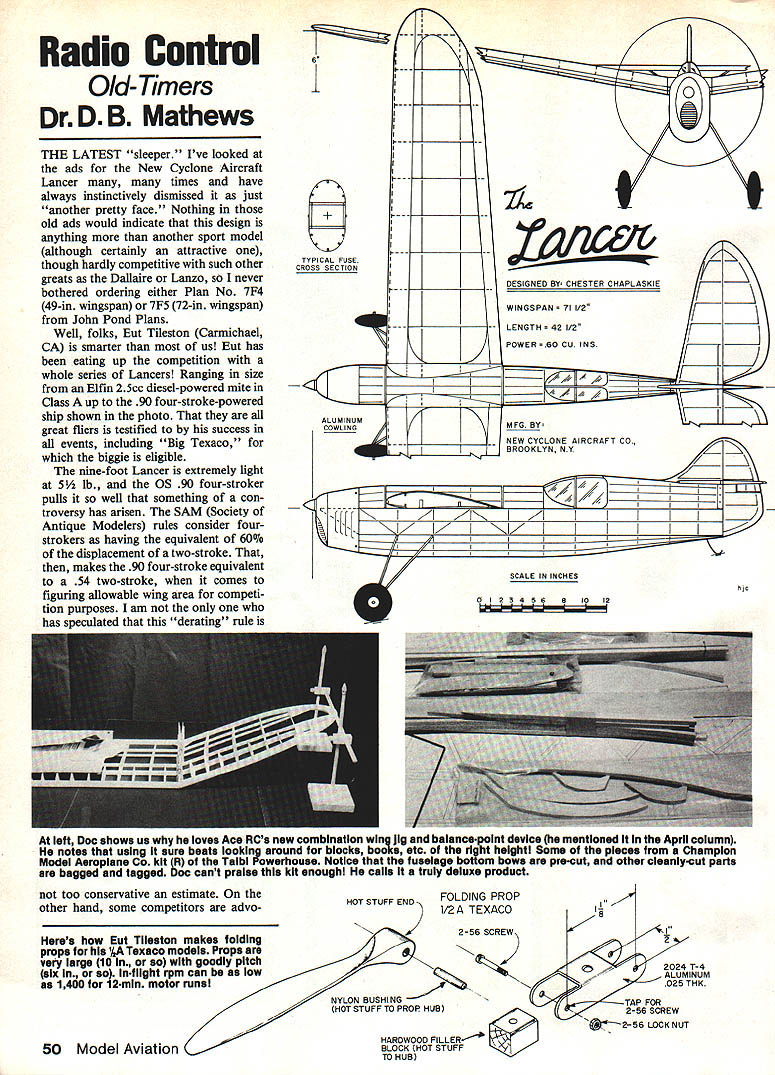
I've looked at the ads for the New Cyclone Aircraft Lancer many times and always instinctively dismissed it as "just another pretty face." Nothing in those ads suggested the design was more than an attractive sport model, hardly competitive with such greats as the Dallaire or Lanzo, so I never bothered ordering either Plan No. 7F4 (49 in. wingspan) or 7F5 (72 in. wingspan) from John Pond Plans.
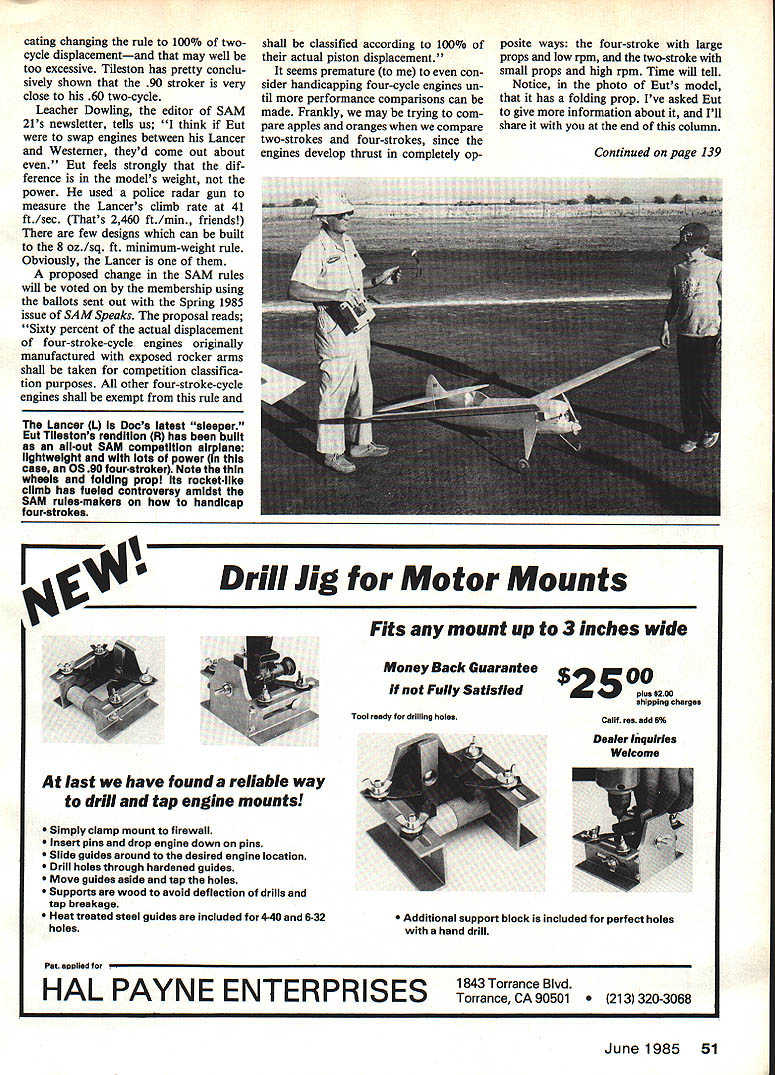
Well, Eut Tileston (Carmichael, CA) is smarter than most of us. Eut has been winning with a whole series of Lancers, ranging in size from an Elfin 2.5 cc diesel-powered mite in Class A up to the .90 four-stroke-powered ship shown in the photo. They are all excellent fliers, as testified by his success in events including Big Texaco.
The nine-foot Lancer is extremely light at 5 1/2 lb., and the OS .90 four-stroker pulls it so well that controversy has arisen. The model features thin wheels and a folding prop; its rocket-like climb (measured at about 41 ft/sec or 2,460 ft/min with a police radar gun) has fueled debate among SAM rule-makers. Few designs can be built to the 8 oz./sq. ft. minimum-weight rule and still deliver that performance.
SAM rule controversy
SAM (Society of Antique Modelers) rules currently consider four-stroke engines as having the equivalent of 60% of the displacement of a two-stroke for competition classification. That makes a .90 four-stroke equivalent to a .54 two-stroke when figuring allowable wing area. Some competitors advocate changing the rule to 100% two-cycle displacement; others feel 60% is not conservative enough.
Leacher Dowling, editor of SAM 21's newsletter, believes that if Eut swapped engines between the Lancer and a Westerner they would perform about the same. Eut feels the difference comes down to model weight and power used. I think handicapping four-strokes based on 100% actual piston displacement is premature until more performance comparisons are available. Frankly, we may be comparing apples and oranges — four-strokes tend to use large props at low rpm, two-strokes small props at high rpm. Time will tell.
The proposed SAM rule change to be voted on reads: "Sixty percent actual displacement of four-stroke-cycle engines originally manufactured with exposed rocker arms shall be taken for competition classification purposes; other four-stroke-cycle engines shall be exempt from the rule." Ballots will be sent out in the Spring 1985 issue of SAM Speaks.
Folding prop on Tileston's Lancer
Eut's Lancer uses a folding prop. Eut reports the folding hub is a modified commercial unit adapted for the thin wheels. Key details:
- Hub retained with a 2-56 screw and a small locknut.
- An aluminum spacer and a hardwood filler block fill the wheel center.
- The prop used on the OS .90 four-stroke was a 12 x 6 folding unit.
- In flight, the Lancer's climb was about 41 ft/sec (2,460 ft/min).
- Eut stresses careful alignment and secure mounting of the hub to avoid any chance of propeller loss.
Old-Timer of the Month and reader notes
Pylon Buster memories
The "Old-Timer of the Month" feature in the February issue created quite a stir. The Pylon Buster is an unusual design, and a letter from Col. Joe Dudziak (San Antonio, TX) added more novelty: the original versions were finished in light blue — an odd color for a free-flight model because it's hard to see in the air.
From Col. Dudziak's letter:
- He remembered timing the model at a Brooklyn Sky Scrapers or Prop Spinners contest at Hicksville, Long Island, in the Forties.
- The model builder was Eugene (Gene) Szabo of Huntington, L.I. The wing was about 80 in. span and the fuselage about 46 in. long.
- The story told at the contest: Gene built it to demonstrate the Pylon Buster or a similar airplane. On launch the engine quit, and the airplane glided into the trees — the last anyone saw of it.
I also recall timing a Pylon Buster flown by its designer. It was a larger airplane powered by a McCoy .60 — the first of those engines I had seen. On one flight it went straight up and finally out of sight after a 10-minute max; keeping it in sight was extremely difficult, especially in light-blue finish. Color choice clearly matters for visibility on long flights.
Corrections
The April column contained a picture of a biplane called Hobo by Daniel Phillips. I incorrectly listed his address as Reston, VA. He is actually from Whitesboro, NY.
Trimming and balancing R/C models
When trimming and balancing R/C models that have been altered or restored:
- Start with the CG shown on the plan.
- Move it a little at a time until the model balances and trims satisfactorily.
- Small amounts of nose weight or a slight aft movement of the wing usually correct glide or turning problems.
- Tip washout or differential incidence can help tighten a turning tendency.
Where to send letters and photos
Send letters and photos to:
- Ron Van Putte
- 111 Sleepy Oaks Rd.
- Ft. Walton Beach, FL 32548
In memoriam: Joe Weathers
Joe Weathers, a patriarch of the San Diego Aeroneers, has passed away. He was admired not only for competitive designs but for inspired beauty and form. Notable designs by Elbert Joe Weathers include:
- Tubby (featured as "Q-T of the Month", Oct. 1980)
- Winged Victory (Apr. 1982)
- Westerner (published, reduced, Apr. 1976 Model Builder)
- Kayoe, Mystery Man, Miss San Diego
His designs will continue to delight future modelers and stand as a living memorial.
Timers and missing spark-ignition parts
A common frustration when restoring antique sparker engines is the missing ignition timer assembly. After the glow plug became dominant, many timer assemblies were removed and discarded. As a result, many "old model airplane engine" finds are conversions with no timer assembly, leaving otherwise usable engines idle.
A solution: Micro Model Engineering
- Address: 1310 W. LaFayette St., Sturgis, MI 49091
- They stock timer assemblies and many commonly missing parts: built-on tankers, prop-spinner nuts, venturis, and parts for many engines (Ardens, Anderson Spitfires, Atwoods, Triumphs, Delongs, Dennymites, Doolings, Hurricanes, McCoys, Mohawks, OKs, Forsters, etc.).
- Woody Bartlett and Roy Johnson produce high-quality reproductions at reasonable prices — send a dollar for a complete list of products.
Get those old sparkers running as intended!
Drill stops — use wheel collars
Drill stops that clamp onto the drill bit to control hole depth are available, but many modelers already use wheel collars for the same purpose. Slip a wheel collar of appropriate size onto the drill bit and tighten the Allen-head set screw — simple and effective.
Champion Models: Taibi Powerhouse kit
Champion Models' Taibi Powerhouse kit is an excellent product:
- Pieces are precut and bagged; even the laminated stabilizer leading edge is done at the factory.
- Die-cut ribs were criticized by one reviewer, but I prefer punching and block-sanding ribs when it saves cutting time.
- The Powerhouse is a marvelous fun machine with a .60/.90 four-stroker or a .40/.45 two-stroke and remains Sal Taibi's most popular design.
Plans and plan sources
Allen Hunt
- Box 726, Dunbar, WV 25064
- Offers an incredible list of plans for a refundable $2.
- Includes many classic rubber-power scale designs (Winter, Stahl, Booten, Plecan, Struck) and sport rubber-kit designs in original sizes and enlargements.
- Drawings include all ribs and formers, left and right wing panels, and stabilizer — excellent quality.
- Also offers RC Assist gems (74-in. Bay Ridge Mike, Diamond Demon), plan-enlargement service, and access to a file of over 2,000 three-views.
Folding props for 1/2A Texaco
The 1/2A Texaco crowd is increasingly using folding props and very low rpm to extend engine run times. Eut Tileston provided detailed notes and a drawing; key points:
Construction and safety:
- Folding props are easy to make and safe for competitive 1/2A Texaco, since competitive engines should not turn more than 4,000–4,500 rpm static.
- For higher revs, reinforce the blade hub with a layer of fiberglass and CyA glue.
- Use stock prop blades, thinning and reshaping them as needed.
General rules:
- Use the largest prop the landing gear will accommodate to permit ROG, then trim the blade to produce the rpm required for the model's weight.
- Pitch: 6–8 inches.
- Engine speed targets by wing loading:
- 10 oz./sq. ft. wing loading: 1,500–1,800 rpm
- 12 oz./sq. ft.: 2,000–2,500 rpm
- 14 oz./sq. ft.: 3,000–3,600 rpm
Performance notes:
- Engine runs of eight to 15 minutes are common for engines turning 2,000 rpm or less.
- Powered flights of more than 18 minutes have been made with a 10 oz./sq. ft. model using a modified TOP Flite 13 x 6 prop; the model still ROGs. Engine speed in the air was about 1,400 rpm.
Closing
Dee B. Mathews 8420 Nantucket Wichita, KS 67212
Transcribed from original scans by AI. Minor OCR errors may remain.

