
Radio Control: Old-Timers
Dr. D. B. Mathews
A Bubble Bursts
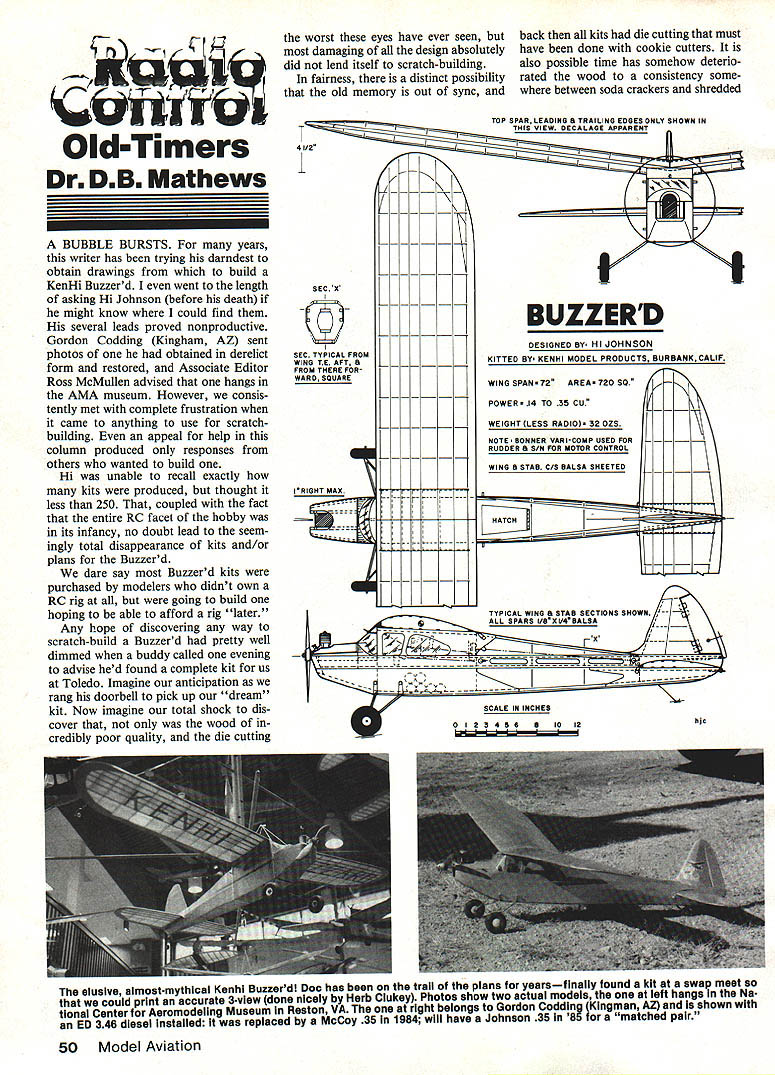
For many years I have been trying my darndest to obtain drawings from which to build a KenHi Buzzer'd. I even went so far as to ask Hi Johnson (before his death) if he might know where I could find them. His several leads proved nonproductive. Gordon Codding (Kingman, AZ) sent photos of one he had obtained in derelict form and restored, and Associate Editor Ross McMullen advised that one hangs in the AMA museum. However, we consistently met complete frustration when it came to anything to use for scratch-building. Even an appeal for help in this column produced only responses from others who wanted to build one.
Hi was unable to recall exactly how many kits were produced, but thought it was less than 250. That, coupled with the fact that the entire RC facet of the hobby was in its infancy, no doubt led to the seeming disappearance of kits and/or plans for the Buzzer'd.
We dare say most Buzzer'd kits were purchased by modelers who didn't own an RC rig at all but were going to build one hoping to be able to afford a rig "later." Any hope of discovering a way to scratch-build a Buzzer'd had pretty well dimmed when a buddy called one evening to advise he'd found a complete kit for us at Toledo. Imagine our anticipation as we rang his doorbell to pick up our "dream" kit. Now imagine our total shock to discover that not only was the wood of incredibly poor quality and the die-cutting the worst these eyes have ever seen, but most damaging of all, the design absolutely did not lend itself to scratch-building.
In fairness, there is a distinct possibility that old memory is out of sync, and back then all kits had die-cutting that must have been done with cookie cutters. It is also possible time has somehow deteriorated the wood to a consistency somewhere between soda crackers and shredded wheat.
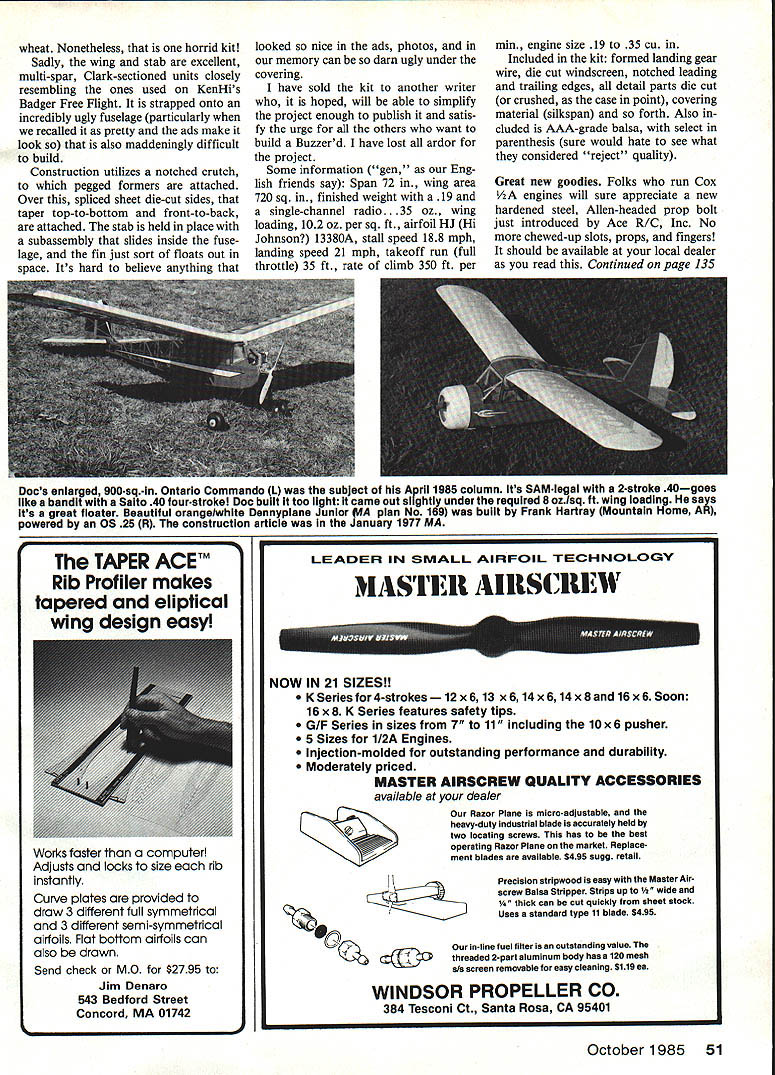
Nonetheless, a horrid kit. Sadly, the wing and stab were excellent multi-spar, Clark-sectioned units, closely resembling ones used on KenHi's Badger Free Flight, yet were strapped onto an incredibly ugly fuselage. Pictures recalled in the pretty ads made it look better, but the fuselage was maddeningly difficult to build. Construction utilizes a notched crutch, pegged formers attached over spliced sheet, die-cut sides tapering top-to-bottom and front-to-back; the attached stab is held in place as a subassembly that slides inside the fuselage. The fin just sort of floats out in space. It's hard to believe anything that looked nice in ads or photos could be so ugly under covering. We have sold the kit; another writer hoped we would be able to simplify the project enough to publish and satisfy others who want to build the Buzzer'd, but we have lost the ardor for the project.
Buzzer'd Specifications (from English friends)
- Span: 72"
- Area: 720 sq. in.
- Finished weight (less radio): 32 oz.
- Wing loading: 10.2 oz. per sq. ft.
- Airfoil: HJ (Hi Johnson) 13380A
- Stall speed: 18.8 mph
- Landing speed: 21 mph
- Takeoff run (full throttle): 35 ft
- Rate of climb: 350 ft per min
- Engine size: .19 to .35 cu. in.
Included in the kit were formed landing-gear wire, die-cut windscreen, notched leading and trailing edges, detail parts die-cut, crushed-case point, covering material (Silkspan), etc. Also included was AAA-grade balsa (select) — parenthetically, one would hate to see what was considered reject quality.
New Goodies
Great new goodies. Folks who run Cox 1/2A engines will appreciate a new hardened steel Allen-headed prop bolt just introduced by Ace R/C, Inc. No more chewed-up slots, props, and fingers! It should be available at your local dealer.
RC Old-Timers — Continued
Ever wished you could quickly get the landing gear on and off your Old-Timer to stow it in the car or clean out the area around the fuselage? Then you'll love Vortac Mfg. Co.'s "Gear Locks." These look like ordinary nylon straps but are much thicker to provide a locking slot on one side. One uses the included drilling jig, secures one end, then adjusts the other screw for a tight latching of the swinger over the section. To remove the gear, one just pushes on the slotted end and it releases. These things also are great for mounting cabins on bipes and on some of the Old-Timer designs with wire wing mounts.
I've already mentioned Ace's Tach-Master, which I have decided is now an absolute necessity in my field box; another of their products is equally important, particularly to the 1/2A Texaco flier. The Mini ESV is just great for checking the battery charge on those 100 mA packs between flights—just to be sure enough is left for that last flight. For that matter, it is darn good safety practice with any size flight pack. Did you ever look at the meter on the transmitter and think to yourself, "So the transmitter battery is still up, wonder what the state of the flight battery is?" This little pocket-sized gem is the answer to be sure.
Newsletters and Photos Needed!
For some reason, several of the SAM chapters are no longer sending me their newsletters. Without them, I lose my primary source of leads for interesting stuff to use in this column. Please reconsider dropping me from your mailing lists! I am sensitive to not printing page after page of contest results, mostly as the time frame is such that those results are "yesterday's news" by the time the magazine arrives at your home. I see my function in the Old-Timer scene as a chronicler of new and old technical information, and to continue in that framework I need your inputs.
MA can successfully reproduce quality color prints, so send them, please.
Needle Setting Four-Cycle Engines
Still more negative stuff. Just to get the reader's attention... I have concluded that it is nearly impossible to needle a four-cycle engine by ear! Using my own collection of strokers (currently six, and rising), I have repeatedly found that what sounds like the right needle-valve setting is always lean when checked with my Ace Tach-Master. That is: the RPM will increase when I richen the mix that was set by sound alone.
Just to check out this little discovery, I have now asked about a dozen fliers at the local strips to set their strokers to what they consider an optimum sound, tached them, then asked the modeler to richen the setting a click or two. So far, every engine has increased RPM in a richened setting!
This leads me to a certain degree of alarm when I consider that most of these modelers are also using "four-cycle fuel!" The difference between regular fuel and the "new" four-cycle blends is reduced lubrication. Consider the impact on engine life from someone running an engine lean on the ground with reduced oil in the fuel, particularly as it leans out even more in flight!
My conclusion: always use a quality tachometer when setting the needle on a four-stroke, or at least use regular two-cycle fuel.
These engines are absolute jewels when compared to old-time engines and deserve to be set up and flown in the manner intended — not over-leaned, under-lubed, and under-prepared!
Dr. D. B. Mathews 8420 Nantucket Wichita, KS 67212
Transcribed from original scans by AI. Minor OCR errors may remain.

