
Radio Control: Old-Timers
Dr. D. B. Mathews
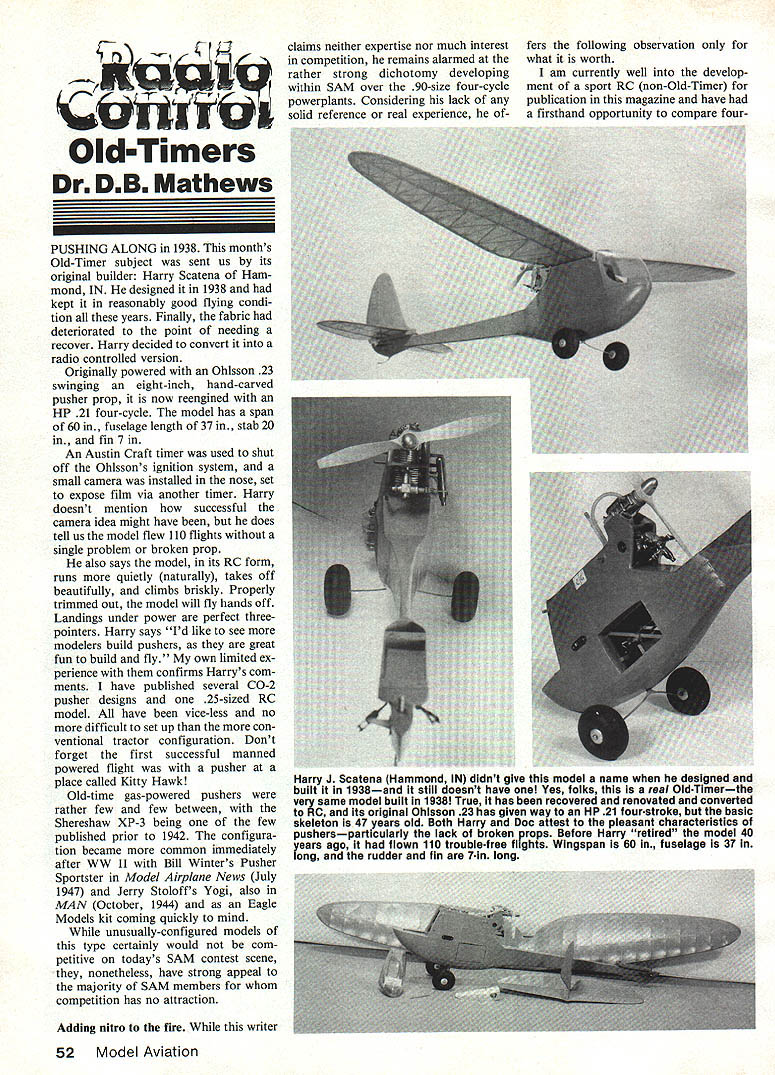
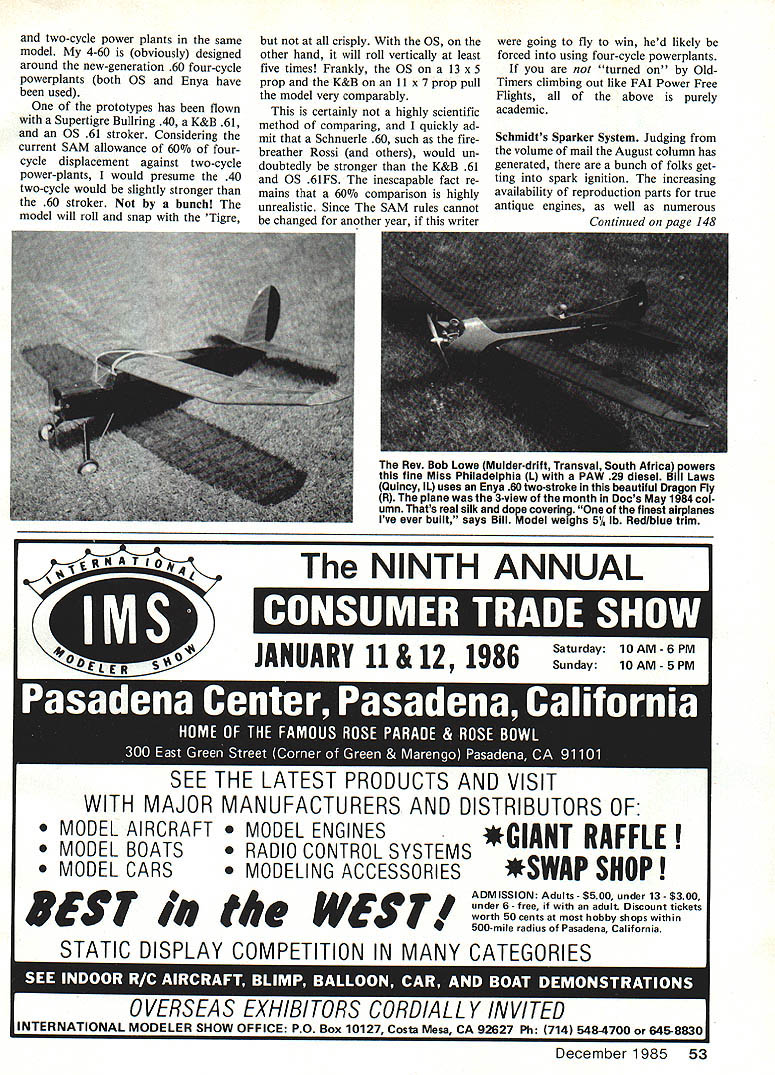
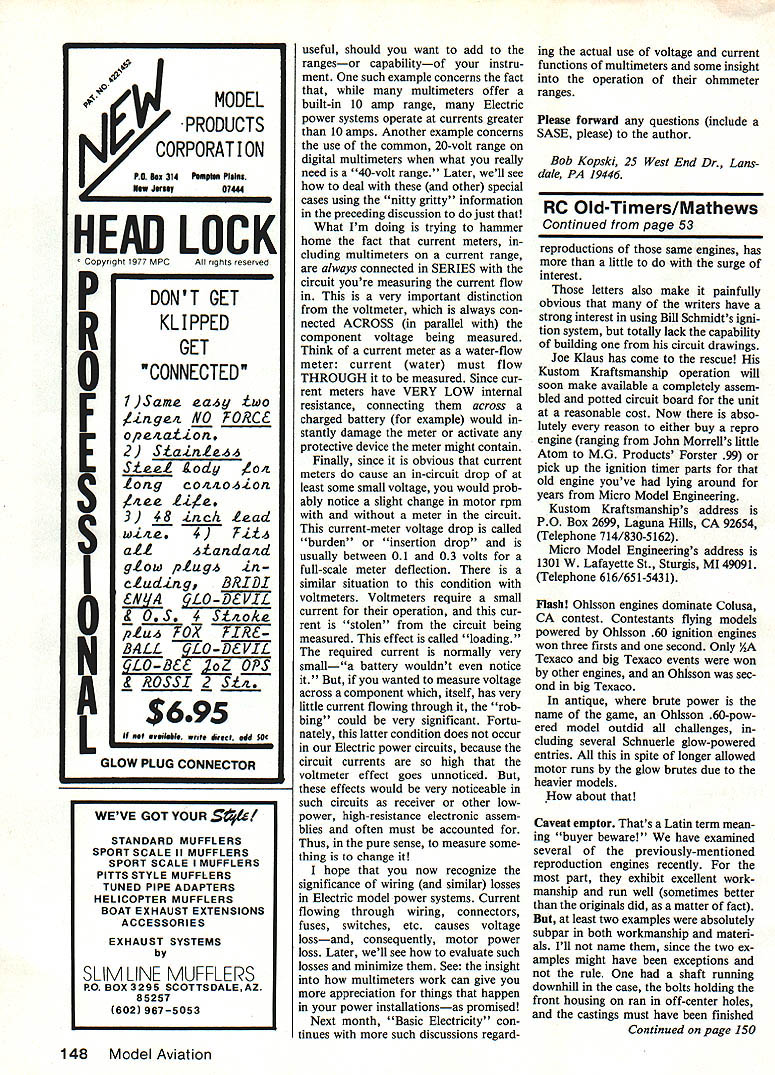
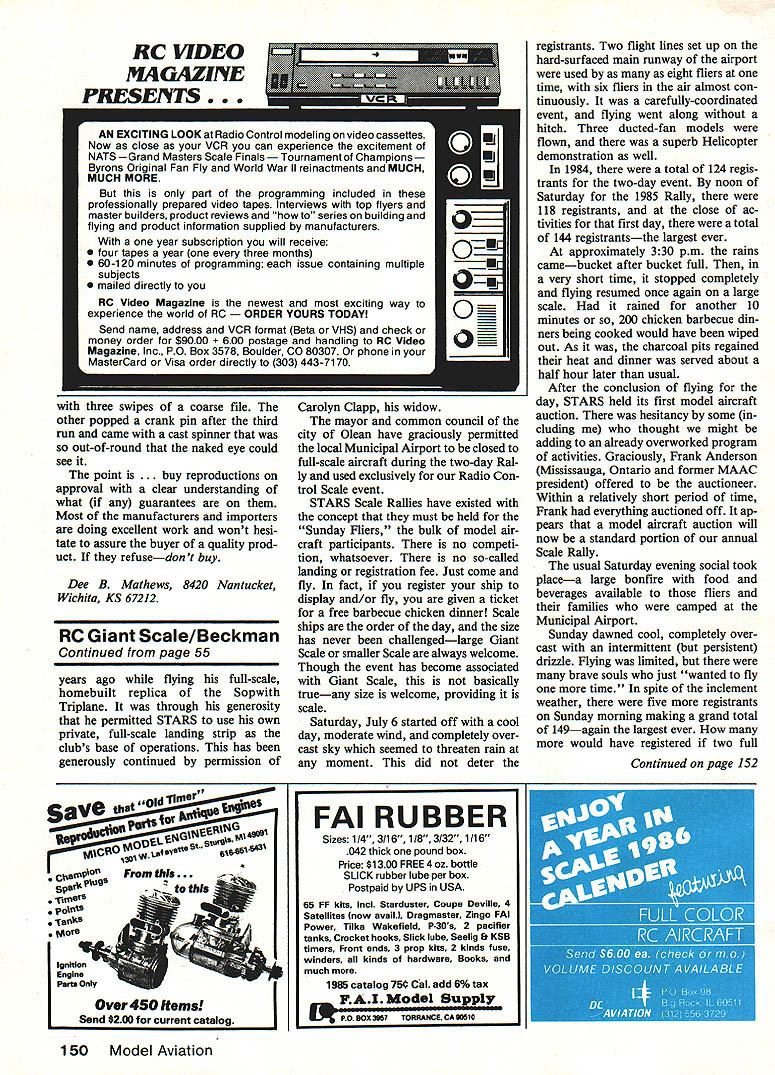
Harry J. Scatena's 1938 Pusher
Pushing along in 1938, this Old-Timer was designed and built by Harry J. Scatena of Hammond, IN. He kept it in reasonably good flying condition for decades, and when the fabric finally deteriorated he recovered, renovated and converted it to radio control.
Model details:
- Wingspan: 60 in.
- Fuselage length: 37 in.
- Stabilizer: 20 in.
- Fin: 7 in.
- Original engine: Ohlsson .23 with an 8-inch hand-carved pusher prop.
- Current engine (RC conversion): HP .21 four-cycle.
An Austin Craft timer was used to shut off the Ohlsson's ignition system in the earlier configuration, and Harry installed a small camera in the nose set to expose film via another timer. He doesn't say whether the camera idea was successful, but he does report the model flew some 110 flights with only a single broken prop over its early life.
In its RC form the model runs more quietly, takes off beautifully, climbs briskly, and—properly trimmed—will fly hands-off. Landings under power are described as perfect three-pointers. Harry recommends more modelers build pushers; they are great fun to build and fly. The author confirms these pleasant characteristics from limited experience.
Don't forget: the first successful manned powered flight was with a pusher (Kitty Hawk).
Old-time pushers and designs
Old-time gas-powered pushers were relatively rare; Shereshaw's XP-3 is one of the few published prior to 1942. The pusher configuration became more common immediately after WWII with designs such as Bill Winter's "Pusher Sportster" (Model Airplane News, July 1947) and Jerry Stoloff's "Yogi" (MAN, October 1944), and later as an Eagle Models kit. While unusually configured models of this type might not be competitive on today's SAM contest scene, they have strong appeal to many SAM members for whom competition is not the primary attraction.
We have published several CO2 pusher designs and a .25-sized RC model; these have been vice-less and no more difficult to set up than the more conventional tractor configuration.
Adding nitro to the fire
This writer claims neither expertise nor great interest in competition, but is concerned about a growing split within SAM over .90-size four-cycle powerplants and the SAM allowance that gives four-cycles 60% displacement against two-cycles.
Observations from practical comparisons:
- The author's 4-60 is designed around new-generation .60 four-cycle powerplants (examples flown include OS and Enya).
- One prototype has been flown with a Supertigre Bullring .40, a K&B .61, and an OS .61 stroker.
- Given the 60% rule, a .40 two-cycle might be slightly stronger than a .60 stroker, but not by much.
- With the Supertigre .40 the model will roll and snap but not crisply; with the OS .61 it will roll vertically at least five times. An OS on a 13x5 prop and a K&B on an 11x7 prop pull the model very comparably.
- Admittedly, Schnuerle .60 fire-breathers (Rossi and similar) would likely be stronger than the K&B .61 and OS .61FS.
Conclusion: the 60% displacement allowance is an unrealistic comparison. Since SAM rules cannot be changed for another year, a competitor intent on winning would likely be forced into using four-cycle powerplants. If you are not interested in Old-Timers competition (or in seeing them climb like FAI Power Free Flights), the whole issue is largely academic.
Schmidt's Sparker System
Judging from the volume of mail generated by the August column, many modelers are getting into spark ignition. The increasing availability of reproduction parts for antique engines, and numerous reproductions of those engines, has helped fuel this interest.
Many correspondents expressed strong interest in Bill Schmidt's ignition system but lacked the capability to build one from circuit drawings. Joe Klaus, of Kustom Kraftsmanship, will soon offer a completely assembled and potted circuit board for the unit at a reasonable cost. This makes it practical to either buy a reproduction engine or pick up ignition timer parts for an old engine from Micro Model Engineering.
Contact information (as provided):
- Kustom Kraftsmanship: P.O. Box 2699, Laguna Hills, CA 92654. Telephone: 714/830-5162.
- Micro Model Engineering: 1301 W. Lafayette St., Sturgis, MI 49091. Telephone: 616/651-5431.
Flash: Ohlsson engines dominated C gas contests—contestants flying models powered by Ohlsson .60 ignition engines claimed three firsts and one second. Only YA Texaco and big Texaco events were won by other engines; an Ohlsson was second in big Texaco. In antique events, where brute power is important, an Ohlsson .60-powered model competed well even against several Schnuerle glow-powered entries, despite longer allowed motor runs by the glow-powered brutes.
Caveat emptor: several reproduction engines recently examined generally exhibited excellent workmanship and ran well (sometimes better than the originals), but at least two examples were subpar in workmanship and material. Reported defects included a shaft set downhill in the crankcase, bolts running in off-center holes, and poorly finished castings—reminders to buy carefully.
Transcribed from original scans by AI. Minor OCR errors may remain.

