
Radio Control: Old-Timers
Dr. D. B. Mathews
PACIFICOASTER
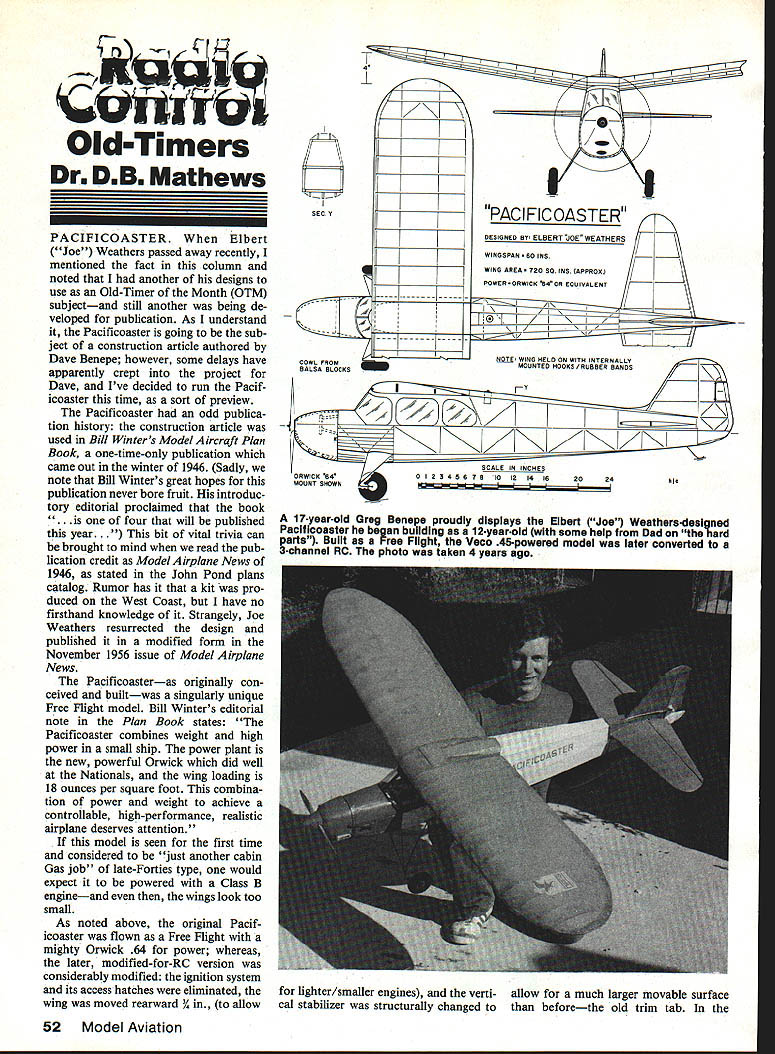
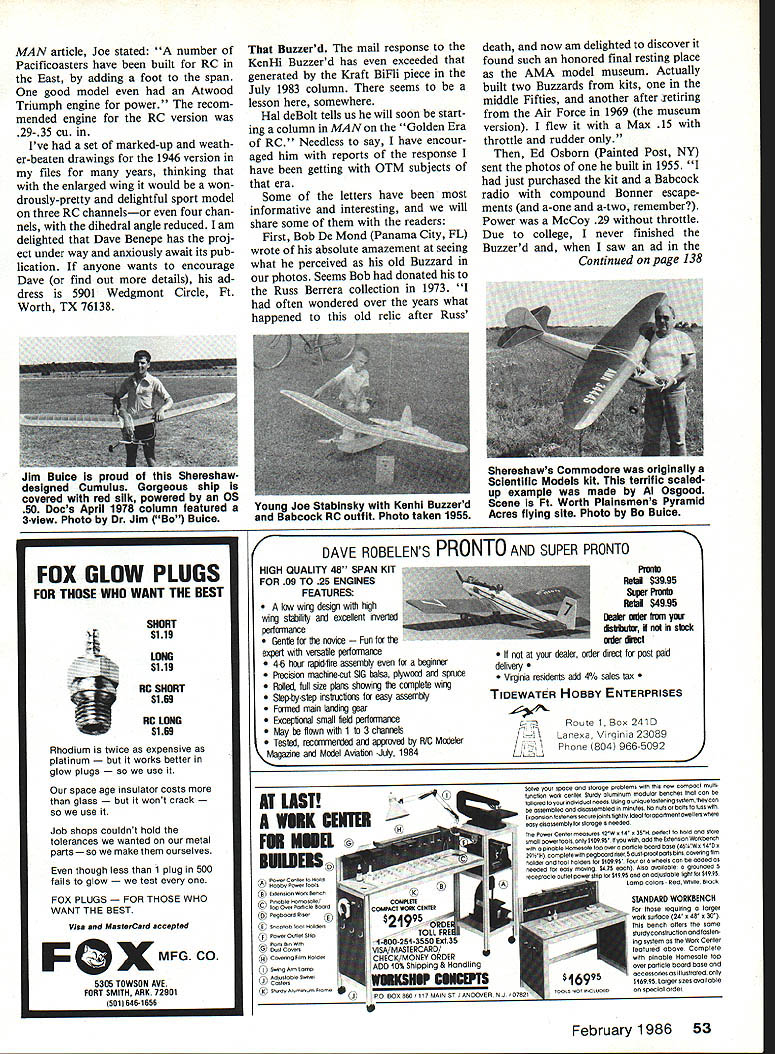
When Elbert ("Joe") Weathers passed away recently, I mentioned the fact in this column and noted that I had another of his designs to use as an Old-Timer of the Month (OTM) subject — and still another was being developed for publication. As I understand it, the Pacificoaster is going to be the subject of a construction article authored by Dave Benepe; however, some delays have apparently crept into the project for Dave, and I've decided to run the Pacificoaster this time as a sort of preview.
The Pacificoaster had an odd publication history. The construction article was used in Bill Winter's Model Aircraft Plan Book, a one-time-only publication which came out in the winter of 1946. Bill Winter's introductory editorial proclaimed that the book ". . . is one of four that will be published this year . . ." — sadly, those hopes never bore fruit. This bit of trivia explains why the publication credit is sometimes given as Model Airplane News of 1946 in the John Pond plans catalog. Rumor has it that a kit was produced on the West Coast, but I have no firsthand knowledge of that. Strangely, Joe Weathers resurrected the design and published it in a modified form in the November 1956 issue of Model Airplane News.
The Pacificoaster — as originally conceived and built — was a singularly unique Free Flight model. Bill Winter's editorial note in the Plan Book states: "The Pacificoaster combines weight and high power in a small ship. The power plant is new, powerful Orwick which did well at the Nationals, and the wing loading is 18 ounces per square foot. This combination of power and weight to achieve a controllable, high-performance, realistic airplane deserves attention."
If this model is seen for the first time and considered to be "just another cabin Gas job" of late-Forties type, one would expect it to be powered with a Class B engine — and even then, the wings look too small.
As noted above, the original Pacificoaster was flown as a Free Flight with a mighty Orwick .64 for power; whereas the later, modified-for-RC version was considerably changed: the ignition system and its access hatches were eliminated, the wing was moved rearward 3/4 in. (to allow for lighter/smaller engines), and the vertical stabilizer was structurally changed to allow for a much larger movable surface than before — the old trim tab. In the MAN article, Joe stated: "A number of Pacificoasters have been built for RC in the East, by adding a foot to the span. One good model even had an Atwood Triumph engine for power." The recommended engine for the RC version was .29–.35 cu. in.
I've had a set of marked-up and weather-beaten drawings for the 1946 version in my files for many years, thinking that with the enlarged wing it would be a wondrously pretty and delightful sport model on three RC channels — or even four channels, with the dihedral angle reduced. I am delighted that Dave Benepe has the project under way and anxiously await its publication. If anyone wants to encourage Dave (or find out more details), his address is:
- Dave Benepe, 5901 Wedgmont Circle, Ft. Worth, TX 76138
That Buzzer'd.
The mail response to the Ken-Hi Buzzer'd has even exceeded that generated by the Kraft BiFli piece in the July 1983 column. There seems to be a lesson here, somewhere.
Hal deBolt tells us he will soon be starting a column in MAN on the "Golden Era of RC." Needless to say, I have encouraged him with reports of the response I have been getting with OTM subjects of that era. Some of the letters have been most informative and interesting, and we will share some of them with the readers.
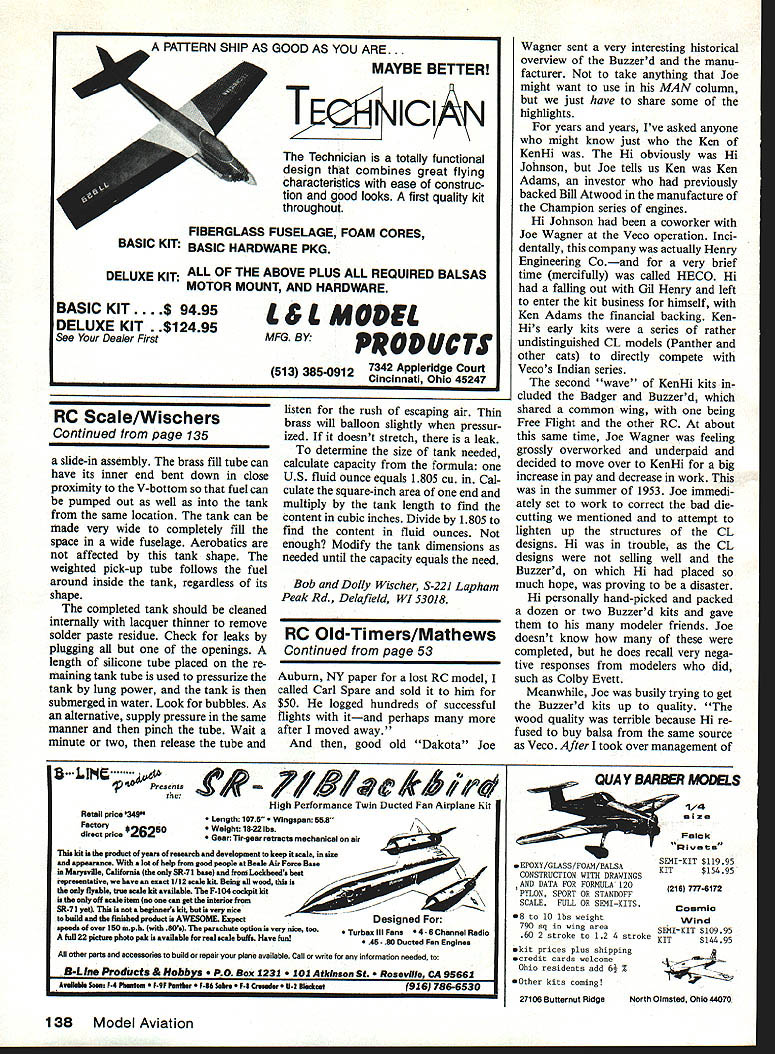
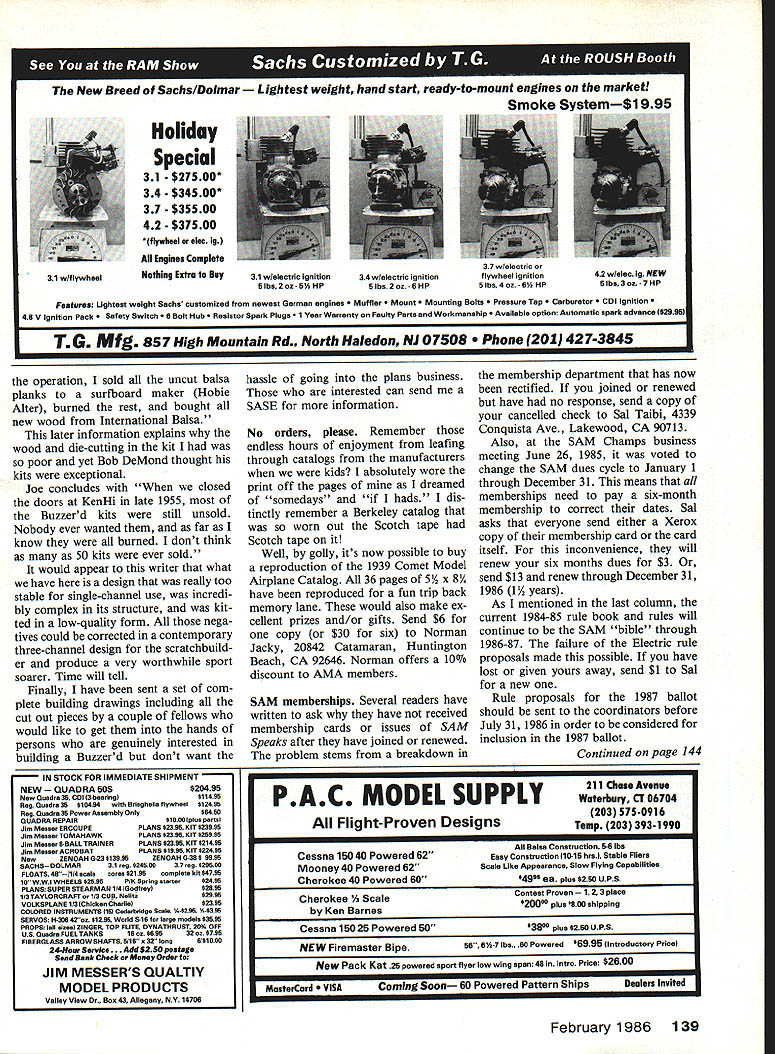
First, Bob DeMond (Panama City, FL) wrote of his absolute amazement at seeing what he perceived as his old Buzzard in our photos. Bob had donated his to the Russ Berrera collection in 1973. "I had often wondered over the years what happened to this old relic after Russ' death, and now am delighted to discover it found such an honored final resting place as the AMA model museum. Actually built two Buzzards from kits, one in the middle Fifties and another after retiring from the Air Force in 1969 (the museum version). I flew it with a McCoy .15 with throttle and rudder only."
Ed Osborn (Painted Post, NY) sent photos of one he built in 1955. "I had just purchased the kit and a Babcock radio compound with compound Bonner escapements, and a one-and-a-two, remember? Power was a McCoy .29 without throttle. Due to college, I never finished the Buzzard and, when I saw an ad in the magazine, . . ." (Ed's note trailed off in the copy I received.)
Joe Wagner sent a very interesting historical overview of the Buzzer'd and the Ken-Hi company. Not to take anything Joe might want to use in his MAN column, but we have to share some of the highlights.
For years I've asked anyone who might know just who the "Ken" of Ken-Hi was. The "Hi" obviously was Hi Johnson, but Joe tells us Ken was Ken Adams, an investor who had previously backed Bill Atwood in the manufacture of the Champion series of engines.
Hi Johnson had been a co-worker with Joe Wagner at the Veco operation. Incidentally, that company was actually Henry Engineering Co. — and for a very brief time was called HECO. Hi had a falling out with Gil Henry and left to enter the kit business for himself, with Ken Adams providing the financial backing. Ken-Hi's early kits were a series of rather undistinguished CL models (Panther and other cats) to directly compete with Veco's Indian series.
The second "wave" of Ken-Hi kits included the Badger and Buzzer'd, which shared a common wing, with one being Free Flight and the other RC. At about this same time, Joe Wagner was feeling grossly overworked and underpaid and decided to move over to Ken-Hi for a big increase in pay and decrease in work. This was in the summer of 1953. Joe immediately set to work to correct the bad die-cutting we mentioned and to attempt to lighten up the structures of the CL designs. Hi was in trouble, as the CL designs were not selling well and the Buzzer'd, on which Hi had placed so much hope, was proving to be a disaster. He personally hand-picked and packed a dozen or two Buzzer'd kits and gave them to his many modeler friends. Joe doesn't know how many of these were completed, but he does recall very negative responses from modelers who did, such as Colby Evett.
Meanwhile, Joe was busy trying to get the Buzzer'd kits up to quality. "The wood quality was terrible because Hi refused to buy balsas from the same source as Veco. After I took over management of the operation, I sold all the uncut balsa planks to a surfboard maker (Hobie Alter), burned the rest, and bought all new wood from International Balsa."
This later information explains why the wood and die-cutting in some kits were so poor and yet others (as Bob DeMond remembered) seemed exceptional.
Joe concludes: "When we closed the doors at Ken-Hi in late 1955, most of the Buzzer'd kits were still unsold. Nobody ever wanted them, and as far as I know they were all burned. I don't think as many as 50 kits were ever sold."
It would appear to this writer that what we have here is a design that was really too stable for single-channel use, was incredibly complex in its structure, and was kitted in a low-quality form. All those negatives could be corrected in a contemporary three-channel design for the scratchbuilder and produce a very worthwhile sport soarer. Time will tell.
Finally, I have been sent a set of complete building drawings including all the cut-out pieces by a couple of fellows who would like to get them into the hands of persons who are genuinely interested in building a Buzzer'd but don't want the hassle of going into the plans business. Those who are interested can send me a SASE for more information. No orders, please.
Miscellany: catalogs, SAM business, and rules
Remember those endless hours of enjoyment from leafing through catalogs from the manufacturers when we were kids? I absolutely wore the print off the pages of mine as I dreamed of "somedays" and "if I hads." I distinctly remember a Berkeley catalog that was so worn out the Scotch tape had Scotch tape on it!
Well, it's now possible to buy a reproduction of the 1939 Comet Model Airplane Catalog. All 36 pages of 5-1/2 x 8-1/2 have been reproduced for a fun trip down memory lane. These would also make excellent prizes and/or gifts. Send $6 for one copy (or $30 for six) to:
- Norman Jacky, 20842 Catamaran, Huntington Beach, CA 92646
Norman offers a 10% discount to AMA members.
Many members have written. Several readers have asked why they have not received membership cards or issues of SAM Speaks after they have joined or renewed. The problem stemmed from a breakdown in the membership department that has now been rectified. If you joined or renewed but have had no response, send a copy of your cancelled check to:
- Sal Taifi, 4339 Conquista Ave., Lakewood, CA 90713
Also, at the SAM Champs business meeting on June 26, 1985, it was voted to change the SAM dues cycle to January 1 through December 31. This means that all memberships need to pay a six-month membership fee to correct their dates. Sal asks that everyone send either a Xerox copy of their membership card or the card itself. For this inconvenience, they will renew your six months' dues for $3. Or, send $13 and renew through December 31, 1986 (1-1/2 years).
As I mentioned in the last column, the current 1984–85 rule book and rules will continue to be the SAM "bible" through 1986–87. The failure of the Electric rule proposals made this possible. If you have lost or given yours away, send $1 to Sal for a new one.
Rule proposals for the 1987 ballot should be sent to the coordinators before July 31, 1986 in order to be considered for inclusion in the 1987 ballot.
Woody Woodman has been appointed to succeed Tom Acciavati as Rules Coordinator. Correspondence concerning RC rules proposals should be sent to Woody at:
- Woody Woodman, 233 Longview Drive, Bayville, NJ 08721
Even more stroker stuff
It is likely that readers are growing a bit weary of Ol' Doc and his four-cycle notes, but at the expense of milking the subject to death, let me share some early observations of the new OS .20 four-cycle. This little gem is well up to expectations, and I'm personally delighted with mine.
First and foremost, it is much lighter than the only previously available small four-stroker, and it fits a Hayes AL20 mount rather than an AL40. Performance is slightly stronger than an OS .15 two-stroke, but less than a Fox .19BB. Starting it with a starter is just as easy as the larger strokers, with absolutely no need for the built-in choke. I haven't even installed mine. Idle is very low and reliable, even though the engine uses a simple air-bleed carb.
Preliminary flights seem to indicate prop selection runs along the lines found with the larger units: diameter doesn't seem to be too critical, but pitch is. With a three-pound, 400 sq. in. sport-type model, a 9 x 5 wide-bladed prop seems slightly superior to the 10 x 4. On an Old-Timer-type model, I suggest the 10 x 5 wide-blader as a starting point.
My feelings about tachometers and fuel were expressed rather succinctly in a previous column. While the tach gave 10,500 rpm on the 9 x 5 Super M and 10,400 on the 10 x 4, I broke my only 10 x 5 before the engine was broken in. However, I suspect it would read about 10,000 rpm now. The engine sounds rich when it is at peak rpm, but it sounds better when it is leaned a bit and run slightly over the top — so use a tach, already!
Dee B. Mathews 8420 Nantucket Wichita, KS 67212
Transcribed from original scans by AI. Minor OCR errors may remain.

