
Radio Control: Old-Timers
Dr. D.B. Mathews
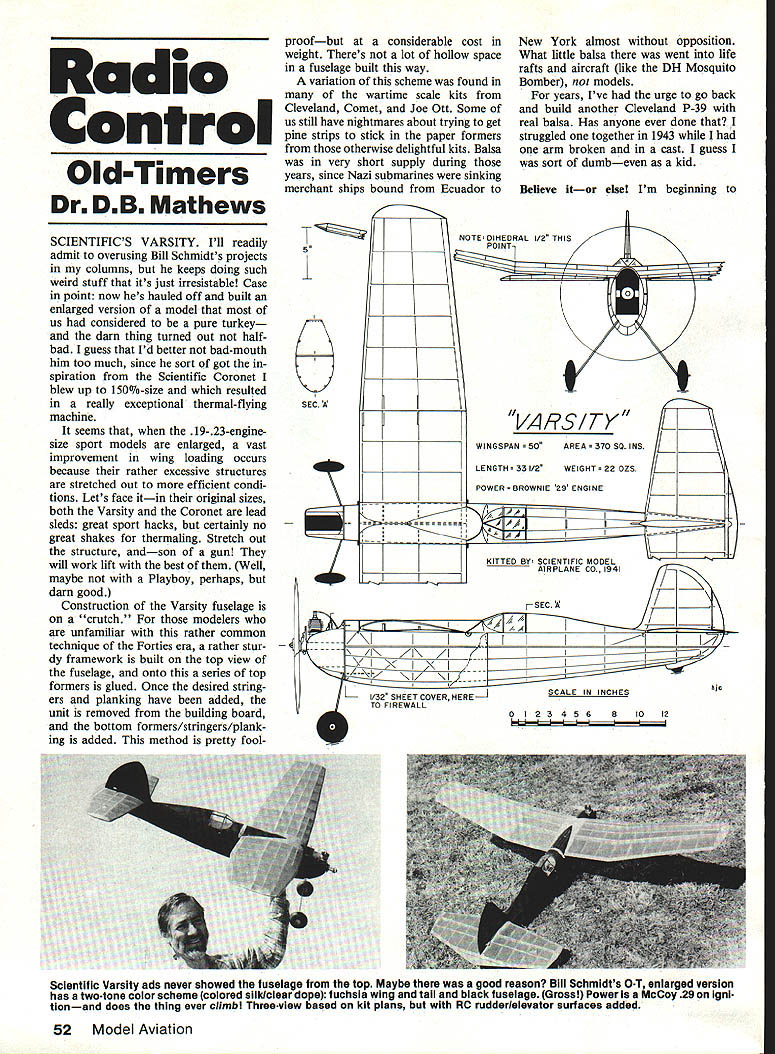
Scientific's Varsity
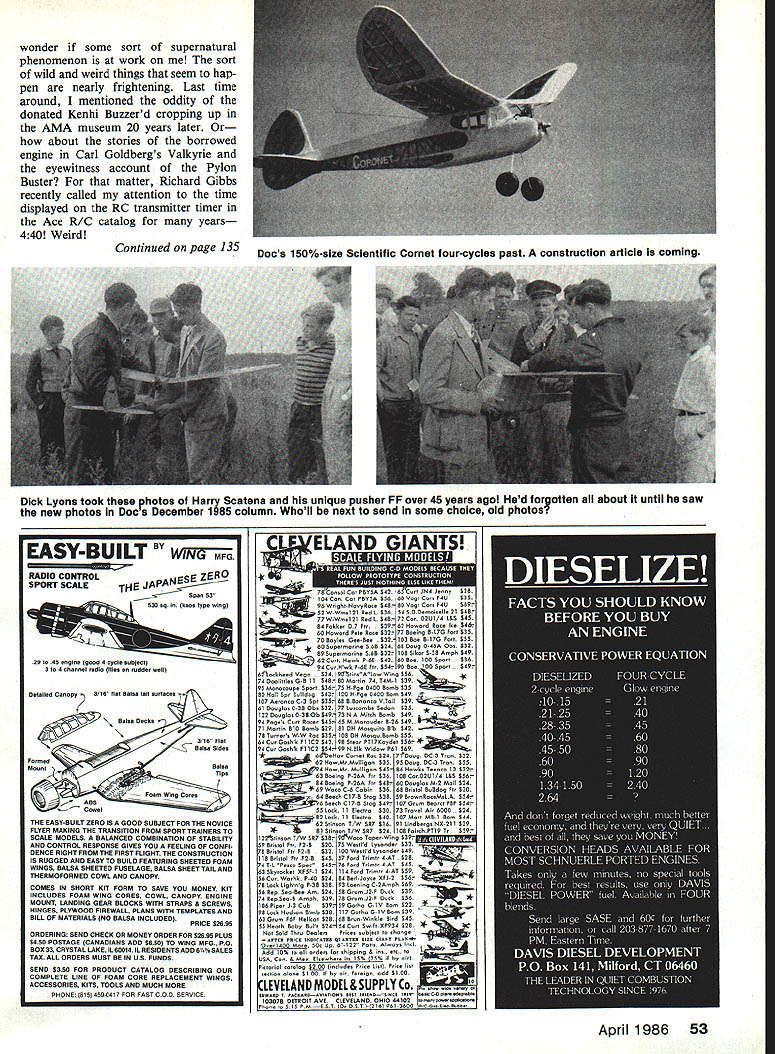
I'll readily admit to overusing Bill Schmidt's projects in my columns, but he keeps doing such weird stuff that it's just irresistible! Case in point: now he's hauled off and built an enlarged version of a model that most of us had considered to be a pure turkey—and the darn thing turned out half‑bad. I guess that I'd better not bad‑mouth him too much, since he sort of got the inspiration from the Scientific Coronet I blew up to 150% size, which resulted in a really exceptional thermal‑flying machine.
It seems that, when the .19–.23 engine‑size sport models are enlarged, a vast improvement in wing loading occurs because their rather excessive structures are stretched out to more efficient conditions. Let's face it—in their original sizes, both the Varsity and the Coronet are lead sleds: great sport hacks, but certainly no great shakes for thermaling. Stretch out the structure, and—son of a gun! They will lift with the best of them. (Well, maybe not with a Playboy, perhaps, but darn good.)
Construction of the Varsity fuselage is on a "crutch." For those modelers who are unfamiliar with this rather common technique of the Forties era, a rather sturdy framework is built on the top view of the fuselage, and onto this a series of top formers is glued. Once the desired stringers and planking have been added, the unit is removed from the building board, and the bottom formers, stringers, and planking are added. This method is pretty foolproof—but at a considerable cost in weight. There's not a lot of hollow space in a fuselage built this way.
A variation of this scheme was found in many of the wartime scale kits from Cleveland, Comet, and Joe Ott. Some of us still have nightmares about trying to get pine strips to stick in the paper formers from those otherwise delightful kits. Balsa was in very short supply during those years, since Nazi submarines were sinking merchant ships bound from Ecuador to New York almost without opposition. What little balsa there was went into life rafts and aircraft (like the de Havilland Mosquito bomber), not models.
For years, I've had the urge to go back and build another Cleveland P‑39 with real balsa. Has anyone ever done that? I struggled one together in 1943 while I had one arm broken and in a cast. I guess I was sort of dumb—even as a kid.
Believe it—or else!
I'm beginning to wonder if some sort of supernatural phenomenon is at work on me! The sort of wild and weird things that seem to happen are nearly frightening. Last time around, I mentioned the oddity of the donated Kenhi Buzzer cropping up in the AMA museum 20 years later. Or—how about the stories of the borrowed engine in Carl Goldberg's Valkyrie and the eyewitness account of the Pylon Buster? For that matter, Richard Gibbs recently called my attention to the time displayed on the RC transmitter timer in the Ace R/C catalog for many years—4:40! Weird!
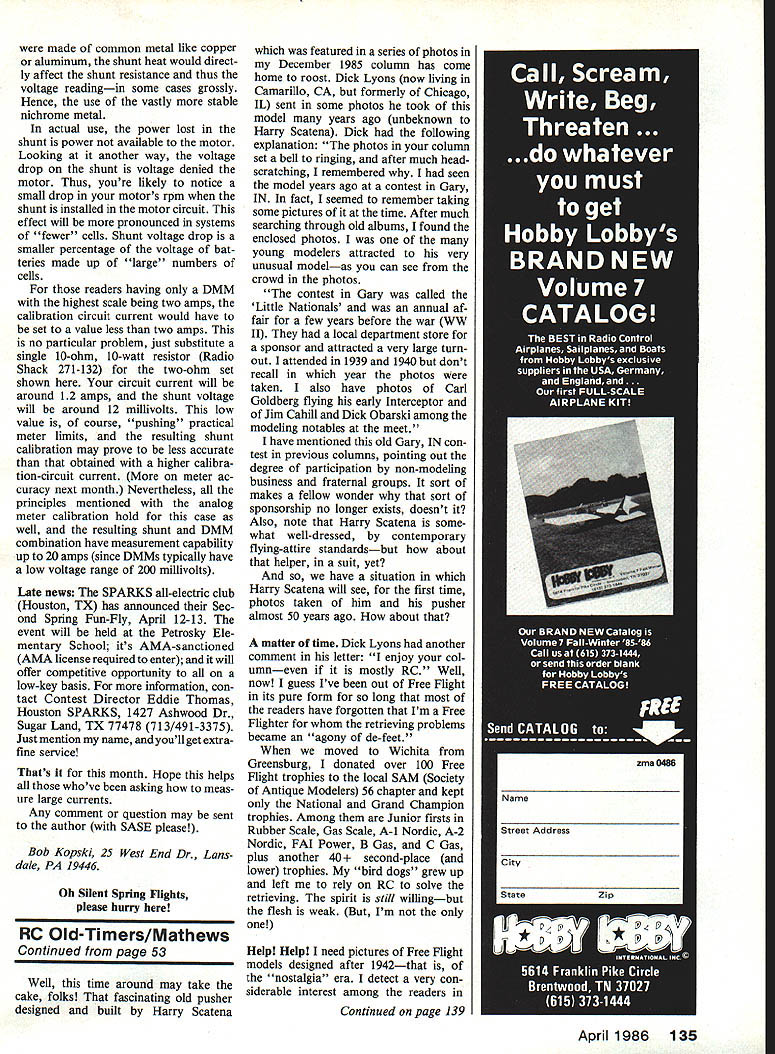
Well, this time around may take the cake, folks! That fascinating old pusher designed and built by Harry Scatena which was featured in a series of photos in my December 1985 column has come home to roost. Dick Lyons (now living in Camarillo, CA, but formerly of Chicago, IL) sent in some photos he took of this model many years ago (unbeknownst to Harry Scatena). Dick had the following explanation:
"The photos in your column set a bell to ringing, and, after much head‑scratching, I remembered why. I had seen the model years ago at a contest in Gary, IN. In fact, I seemed to remember taking some pictures of it at the time. After much searching through old albums, I found the enclosed photos. I was one of the many young modelers attracted to this very unusual model — as you can see from the crowd in the photos.
"The contest in Gary was called the 'Little Nationals' and was an annual affair for a few years, before the war (WW II). They had a local department store for a sponsor and attracted a very large turnout. I attended in 1939 and 1940 but don't recall in which year the photos were taken. I also have photos of Carl Goldberg flying his early Interceptor and of Jim Cahill and Dick Obarski among the modeling notables at the meet."
I have mentioned this old Gary, IN, contest in previous columns, pointing out the degree of participation by non‑modeling business and fraternal groups. It sort of makes a fellow wonder why that sort of sponsorship no longer exists, doesn't it? Also, note that Harry Scatena is somewhat well‑dressed, by contemporary flying‑attire standards — but how about that helper, in a suit, yet?
And so, we have a situation in which Harry Scatena will see, for the first time, photos taken of him and his pusher almost 50 years ago. How about that?
A matter of time
Dick Lyons had another comment in his letter: "I enjoy your column—even if it is mostly RC." Well, now I guess I've been out of Free Flight, in its pure form, for so long that most of the readers have forgotten that I'm a Free Flighter for whom the retrieving problems became an "agony of de‑feet."
When we moved to Wichita from Greensburg, I donated over 100 Free Flight trophies to the local SAM (Society of Antique Modelers) 56 chapter and kept only the National and Grand Champion trophies. Among them are junior firsts in Rubber Scale, Gas Scale, A‑1 Nordic, A‑2 Nordic, FAI Power, B Gas, and C Gas, plus another 40+ second‑place (and lower) trophies. My "bird dogs" grew up and left me to rely on RC to solve the retrieving. The spirit is still willing — but the flesh is weak. (But, I'm not the only one!)
Help! Help!
I need pictures of Free Flight models designed after 1942 — that is, of the "nostalgia" era. I detect a very considerable interest among the readers in non‑SAM‑era models. Hal deBolt tells me he will soon start a column on early RC designs in Model Airplane News, and I'd like to do some material on Free Flight from the same approximate time frame.
I am particularly turned on by the PAA‑Load (both large and small) designs, the wartime goodies such as The Kid, and by some of the really attractive sport types, such as the Pacificcoaster in my last column. Any photos would be greatly appreciated. Naturally, your inputs would be helpful, as well.
Two examples of the sort of thing I was thinking of are my Veco Sioux and Bill Winter's Midwest Sniffer enlargements published in Flying Models a few years back. If you could get excited about this sort of concept—or, even more important, if you've tried it—would you please drop me a line?
Dee B. Mathews 8420 Nantucket Wichita, KS 67212
Continued on page 139
Transcribed from original scans by AI. Minor OCR errors may remain.

