
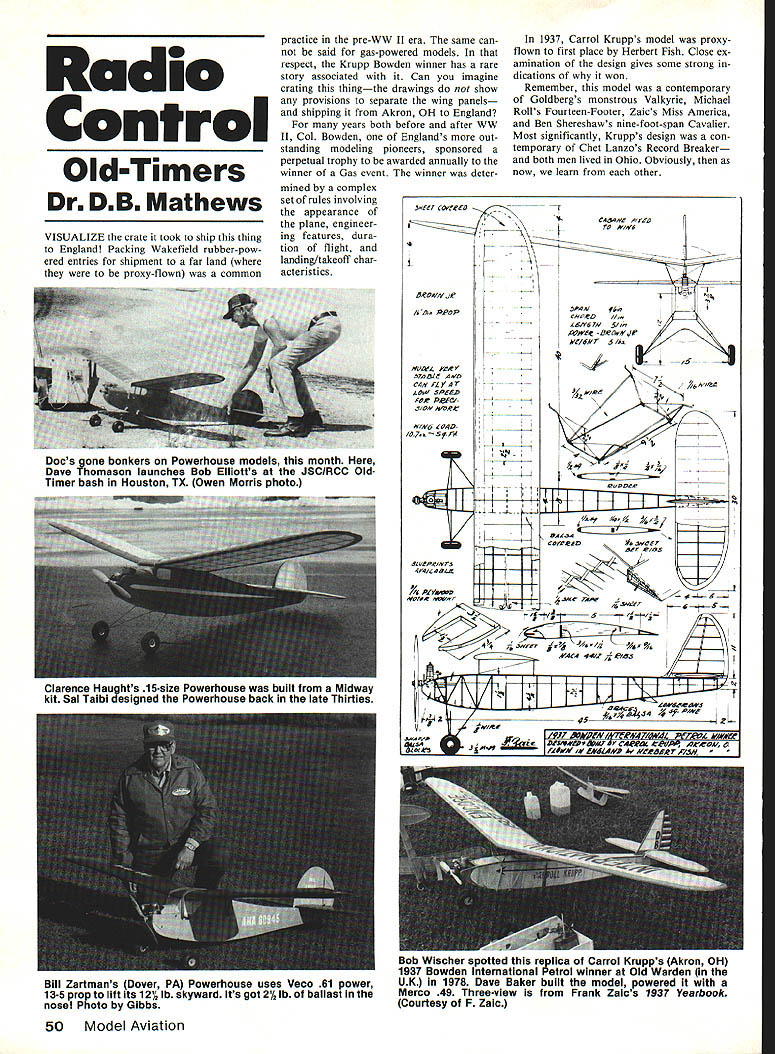
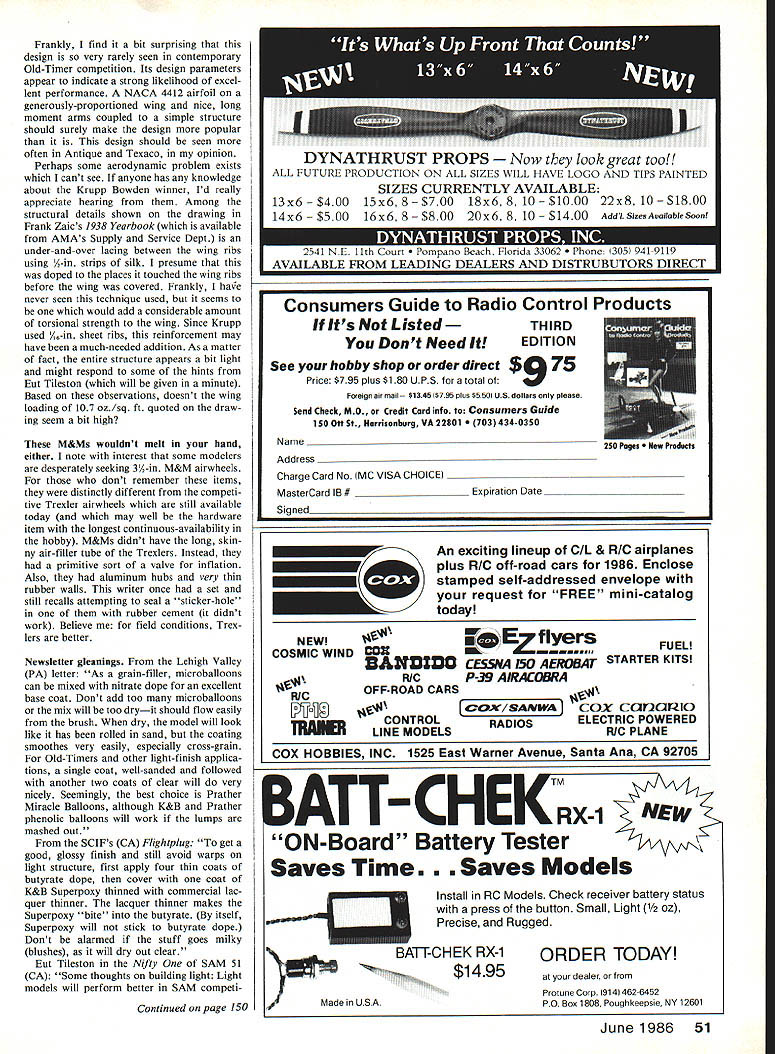
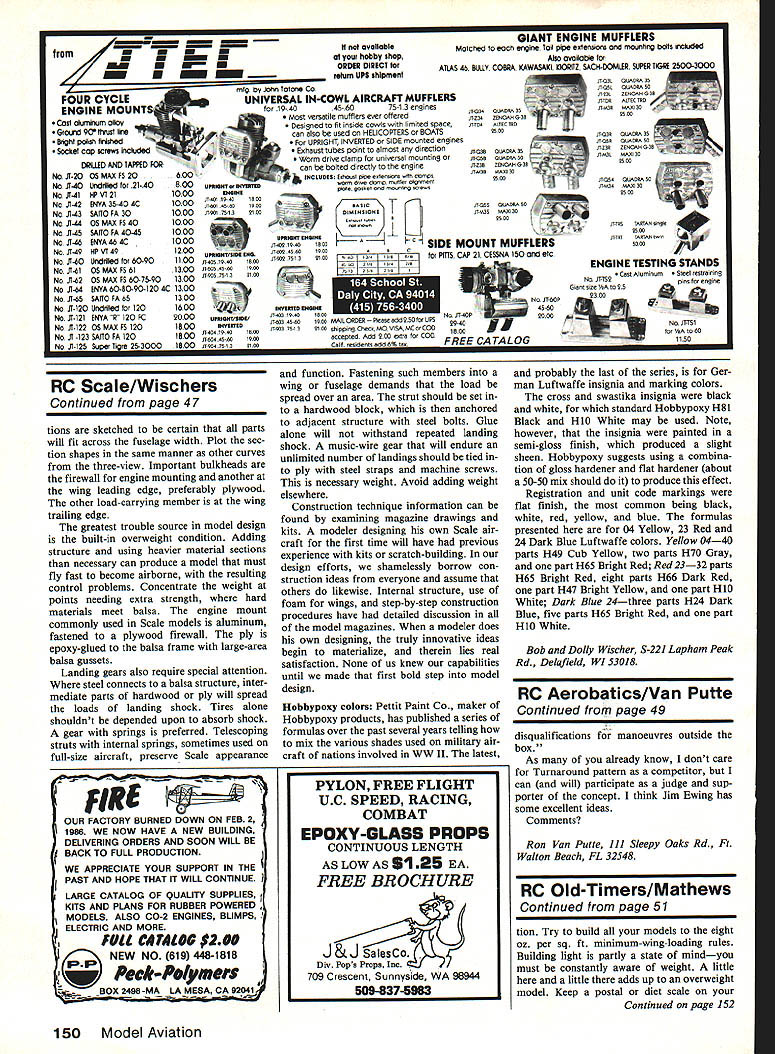
Radio Control: Old‑Timers
Dr. D. B. Mathews
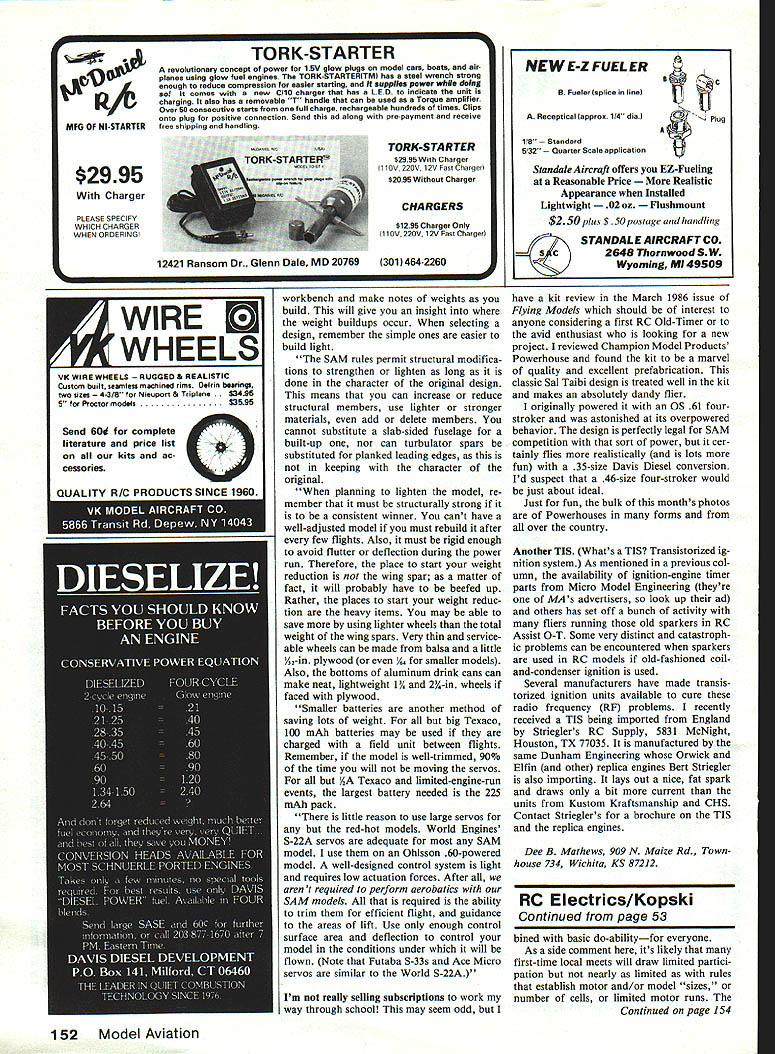
Visualize the crate it took to ship this thing to England. Packing Wakefield rubber‑powered entries for shipment to far lands (where they were to be proxy‑flown) was a common practice in the pre‑World War II era. The same cannot be said for gas‑powered models. In that respect, the Krupp–Bowden winner has a rare story associated with it. Can you imagine crating this airplane—the drawings do not show any provisions to separate the wing panels—and shipping it from Akron, Ohio to England?
For many years, both before and after World War II, Col. Bowden, one of England's more outstanding modeling pioneers, sponsored a perpetual trophy to be awarded annually to the winner of a gas event. The winner was determined by a complex set of rules involving the appearance of the plane, engineering features, duration of flight, and landing/takeoff characteristics.
In 1937, Carrol Krupp's model was proxy‑flown to first place by Herbert Fish. Close examination of the design gives some strong indications of why it won.
Contemporary context
Remember: this model was a contemporary of several notable designs, including:
- Goldberg's monstrous Valkyrie
- Michael Rolls' Fourteen‑Footer
- Frank Zaic's Miss America
- Ben Shereshaw's nine‑foot‑span Cavalier
Most significantly, Krupp's design was a contemporary of Chet Lanzo's Record Breaker—and both men lived in Ohio. Obviously, then as now, modelers learn from each other.
Frankly, I find it a bit surprising the design was very rarely seen in contemporary Old‑Timer competition. Its design parameters indicate a strong likelihood of excellent performance: a NACA 4412 airfoil, a generously proportioned wing, long moment arms and a simple structure should surely make the design popular. One should see it more often in Antique Texaco, in my opinion. Perhaps some aerodynamic problem exists; I can't see why. If anyone has knowledge about the Krupp–Bowden winner, I'd really appreciate hearing.
Structural details
The drawing (reproduced in Frank Zaic's 1938 Yearbook, available from AMA's Supply Service Dept.) shows an under‑and‑over lacing between wing ribs using 1/8‑in strips of silk (presumed doped in place and tacked to the wing ribs before covering). I have never seen this technique used; it seems it would add a considerable amount of torsional strength to the wing. Since Krupp used 1/8‑in sheet ribs, the reinforcement may have been a much‑needed addition. In fact, the entire structure appears a bit light and might respond to some of the hints Eut Tileston will give in a minute.
From the observations, doesn't the wing loading of 10.7 oz/sq ft quoted on the drawing seem a bit high? The wheels won't melt in your hand either, but note: some modelers are desperately seeking 3‑1/2‑in M&M airwheels. I don't remember this item distinctly; competitive Trexler airwheels still available today may well be the hobby‑hardware item of longest continuous availability. M&M wheels didn't have the long skinny air‑filler tube that Trexlers had—Trexler's primitive sort of valve inflation. Also, aluminum hubs with very thin rubber walls were a problem—this writer once recalls attempting to seal a stick‑on puncture; rubber cement didn't work. In field conditions, I believe Trexlers are better.
Newsletter gleanings and finishing tips
Lehigh Valley, PA letter: as a grain‑filler, microballoons can be mixed with nitrate dope as an excellent base coat. Don't add too many microballoons—the mix will be too dry; it should flow easily by brush. A dry model will look like it has a rolled‑sand coating. It smoothes very easily, especially cross‑grain. For Old‑Timers' light‑finish applications: a single coat, well sanded, followed by another one or two coats of clear will look very nice. Seemingly the best choice: Prather Miracle Balloons, although K & B and Prather phenolic balloons will work if the lumps are mashed out.
From the SCIF (CA) Flightplug: "To get a good, glossy finish and still avoid warps on light structure, it's better to apply four coats of butyrate dope, then cover with one coat of sealer and one or two thin coats of clear. The lacquer thinner makes the dope thin enough to flow easily. Superoxylin will not stick to butyrate dope. Don't be alarmed if the finish goes milky (blushes), as it will dry out clear."
Eut Tileston in The Nifty One of SAM 51 (CA): "Some thoughts on building light: light models will perform better in SAM competition."
Transcribed from original scans by AI. Minor OCR errors may remain.

