
Radio Control: Old-Timers
Dr. D. B. Mathews
Zaic Experimental No. 2
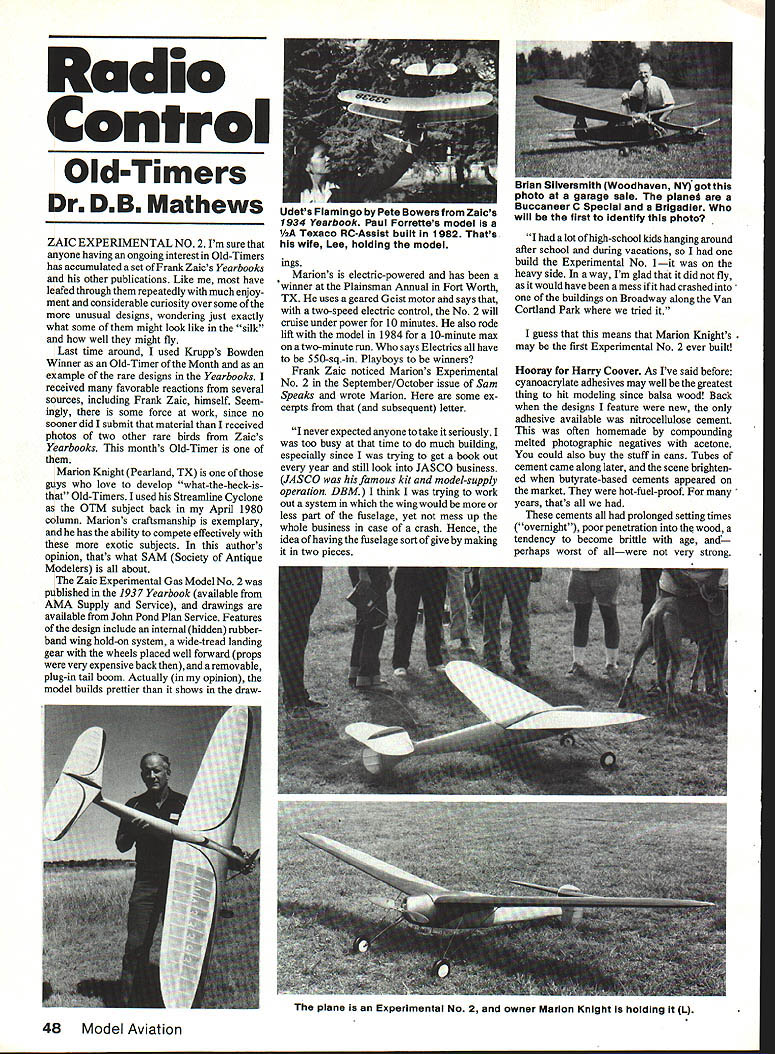
I'm sure that anyone having an ongoing interest in Old-Timers has accumulated a set of Frank Zaic's Yearbooks and his other publications. Like me, most have leafed through them repeatedly with much enjoyment and considerable curiosity over some of the more unusual designs, wondering just exactly what some of them might look like in the "silk" and how well they might fly.
Last time around, I used Krupp's Bowden Winner as an Old-Timer example of the rare designs in the Yearbooks. I received many favorable reactions from several sources, including Frank Zaic himself. Seemingly, there is some force at work, since no sooner did I submit that material than I received photos of two other rare birds from Zaic's Yearbooks. This month's Old-Timer is one of them.
Marion Knight (Pearland, TX) is one of those guys who love to develop "what-the-heck-is-that" Old-Timers. I used his Streamline Cyclone as the OTM subject back in my April 1980 column. Marion's craftsmanship is exemplary, and he has the ability to compete effectively with these more exotic subjects. In this author's opinion, that's what SAM (Society of Antique Modelers) is all about.
The Zaic Experimental Gas Model No. 2 was published in the 1937 Yearbook (available from AMA Supply and Service), and drawings are available from John Pond Plan Service. Features of the design include:
- An internal (hidden) rubber-band wing hold-on system.
- A wide-tread landing gear with the wheels placed well forward (props were very expensive back then).
- A removable, plug-in tail boom.
Actually, in my opinion the model builds prettier than it shows in the drawings.
Marion's is electric-powered and has been a winner at the Plainsman Annual in Fort Worth, TX. He uses a geared Geist motor and says that, with a two-speed electric control, the No. 2 will cruise under power for 10 minutes. He also recorded a 10-minute max in 1984 on a two-minute run. Who says electrics have to be 550-sq.-in. Playboys to be winners?
Frank Zaic noticed Marion's Experimental No. 2 in the September/October issue of SAM Speaks and wrote Marion. Here are some excerpts from that (and subsequent) letter.
"I never expected anyone to take it seriously. I was too busy at that time to do much building, especially since I was trying to get a book out every year and still look into JASCO business. (JASCO was his famous kit and model-supply operation.) I think I was trying to work out a system in which the wing would be more or less part of the fuselage, yet not mess up the whole business case if a crash. Hence the idea of having the fuselage sort of give, making two pieces. A lot of high-school kids hanging around after school during vacations could build Experimental No. 1 — it was heavy. I'm glad I did. It would have been a mess had it crashed into the buildings along Broadway near Van Cortlandt Park. I'd guess Marion Knight's may be the first Experimental No. 2 ever built."
Hooray for Harry Coover
As I've said before, cyanoacrylate adhesives may well be the greatest thing to hit modeling since balsa wood. Back when the designs I feature were new, the only adhesives available were nitrocellulose cement — often homemade by compounding melted photographic negatives with acetone. You could also buy the stuff in cans. Tubes of cement came along later, and the scene brightened when butyrate-based cements appeared on the market. For many years those cements were hot-fuel-proof, but they had prolonged setting times (often overnight), poor penetration into the wood, a tendency to become brittle with age, and — perhaps worst of all — were not very strong.
Most modelers became aware of cyanoacrylates (CyA) when Bob Hunter's company Satellite City began marketing Hot Stuff by mail in 1972. I first saw Hot Stuff at the 1973 Oshkosh Nats, where Bill and Bob Hunter were demonstrating. At the time I thought Hot Stuff would be great for field repairs but never considered using it as the primary adhesive during construction. Now, just 12 years later, I rarely use anything else.
A brief history of CyA:
- The material was developed in the 1940s by Harry Coover at Eastman Kodak while searching for ways to mass-produce gunsights. He found that cyanoacrylates could be poured into molds and would harden into usable castings, but they stuck to everything they touched.
- Coover later encountered the same sticking problem while trying to fabricate heat-resistant fighter canopies and shelved the material.
- In 1959 Coover appeared on the Garry Moore TV show "I've Got a Secret" to demonstrate the adhesive publicly. His secret was that he could lift Garry off the floor with a single drop of glue.
- Loctite acquired the manufacturing rights from Eastman and made the product available for industrial applications. In the early 1970s the product became available to consumers.
- According to the Chicago Tribune, over 100 million tubes of CyA are sold annually, making it the leading consumer glue in the world.
We modelers should find no surprises in the fact that we owe a big "Thanks" to Harry Coover.
RC-Assist Scale event
Several years ago, I attempted to encourage SAM clubs to try a Scale duration event. My thinking at that time was that many of the most attractive aspects of 1/2A Texaco would transfer neatly into a Scale event. Unfortunately, nothing much came of the idea. Now, a new proposal has surfaced, and while this concept is certainly a valid one, I wonder about a Scale event that requires no documentation, is open to all sizes of power-plants, and has three- to five-minute maxes.
New events invariably are tried out in several formats over several years before anything in the way of concrete rules are developed. Therefore, it will be interesting to see what the final form of this event will be.
My input would be to run the event just like 1/2A Texaco. That is:
- Full-tank Cox Black Widow engines for power.
- Two 10-minute maxes.
- Any pre-1942 prototype.
- Judging using the AMA three-judge system found in the AMA rule book.
Let the builders and fliers find the best model sizes and prop combinations! I think this would be a delightful event. What do you think?
Contact
Dee B. Mathews 909 Maize Rd., Townhouse 734 Wichita, KS 67212
Transcribed from original scans by AI. Minor OCR errors may remain.

