

Radio Control: Old-Timers
Dr. D. B. Mathews
Missing Old-Timer Plans
There are several Old-Timer designs advertised back then for which drawings seem no longer to exist. I wonder if, somewhere, someone might have one of those old kits gathering dust—or at least know someone who does. Wouldn't it be great if some reader of this column were to have such a treasure and be willing to share it with the general Old-Timer movement?
Two of the more interesting designs for which no drawings seem to exist are the Dictator, by Triangle Models, and the Cloud Drifter, by Modern Aircraft Supply. Both are poorly illustrated in the old magazine ads but appear to be cleanly designed and certainly worthy of resurrection.
If anyone should happen to have anything on these, I would be overjoyed to be able to borrow the drawings long enough to have them duplicated at the local blueprint shop; or, I'd pay for the duplication if the owner were unwilling to risk shipping the originals to me.
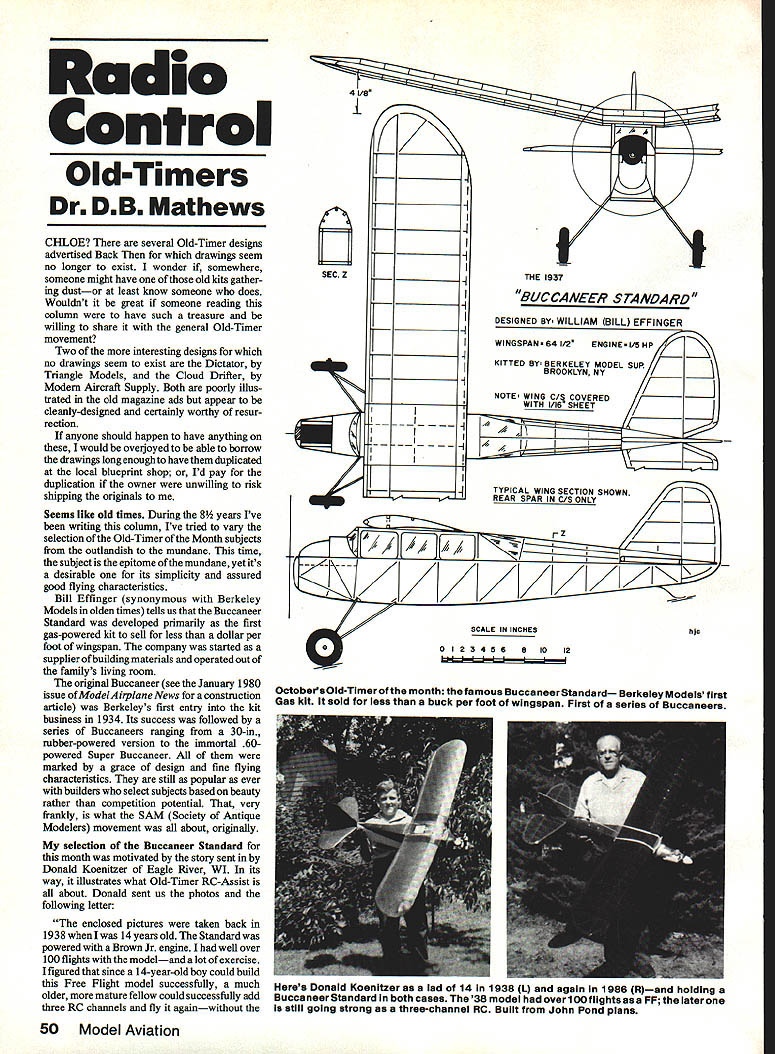
The Buccaneer Standard
Seems like old times. During the 8½ years I've been writing this column, I've tried to vary the selection of the Old-Timer of the Month subjects from the outlandish to the mundane. This time, the subject is the epitome of the mundane, yet it's a desirable one for its simplicity and assured good flying characteristics.
Bill Effinger (synonymous with Berkeley Models in olden times) tells us the Buccaneer Standard was developed primarily as the first gas-powered kit to sell for less than a dollar per foot of wingspan. The company was started as a supplier of building materials and operated out of the family's living room.
The original Buccaneer (see the January 1980 issue of Model Airplane News for a construction article) was Berkeley's first entry into the kit business in 1934. Its success was followed by a series of Buccaneers ranging from a 30‑in. rubber-powered version to the immortal .60‑powered Super Buccaneer. All of them were marked by a grace of design and fine flying characteristics. They are still as popular as ever with builders who select subjects based on beauty rather than competition potential. That, very frankly, is what the SAM (Society of Antique Modelers) movement was all about, originally.
A Reader's Restoration: Donald Koenitzer
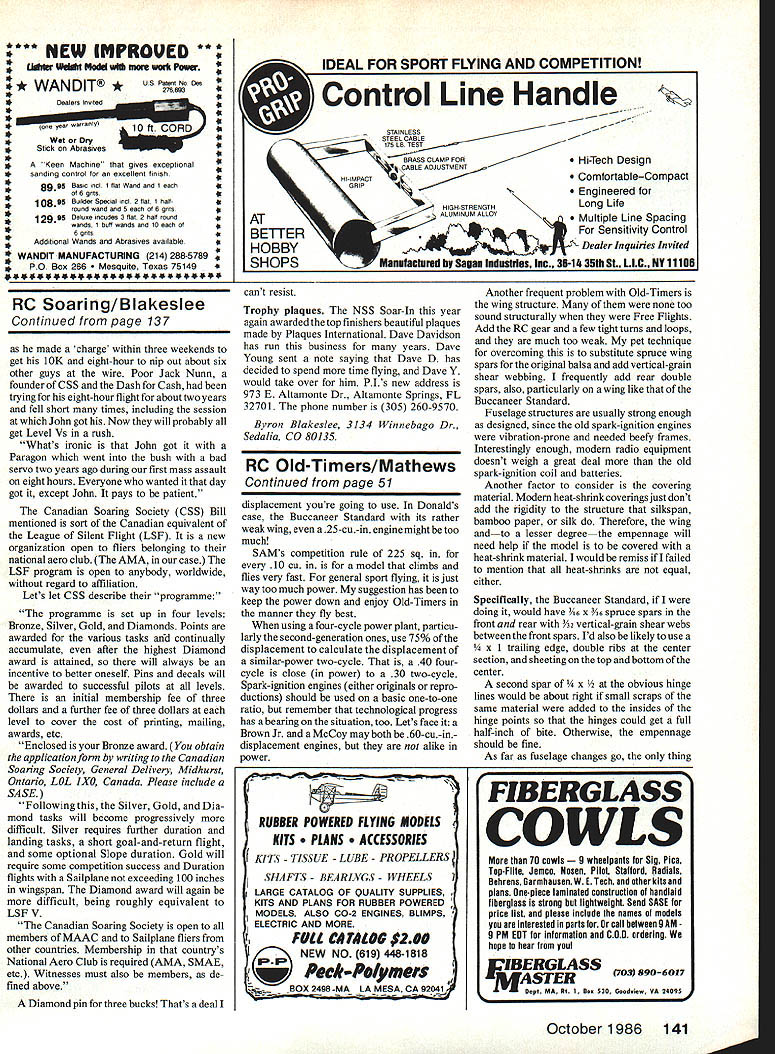
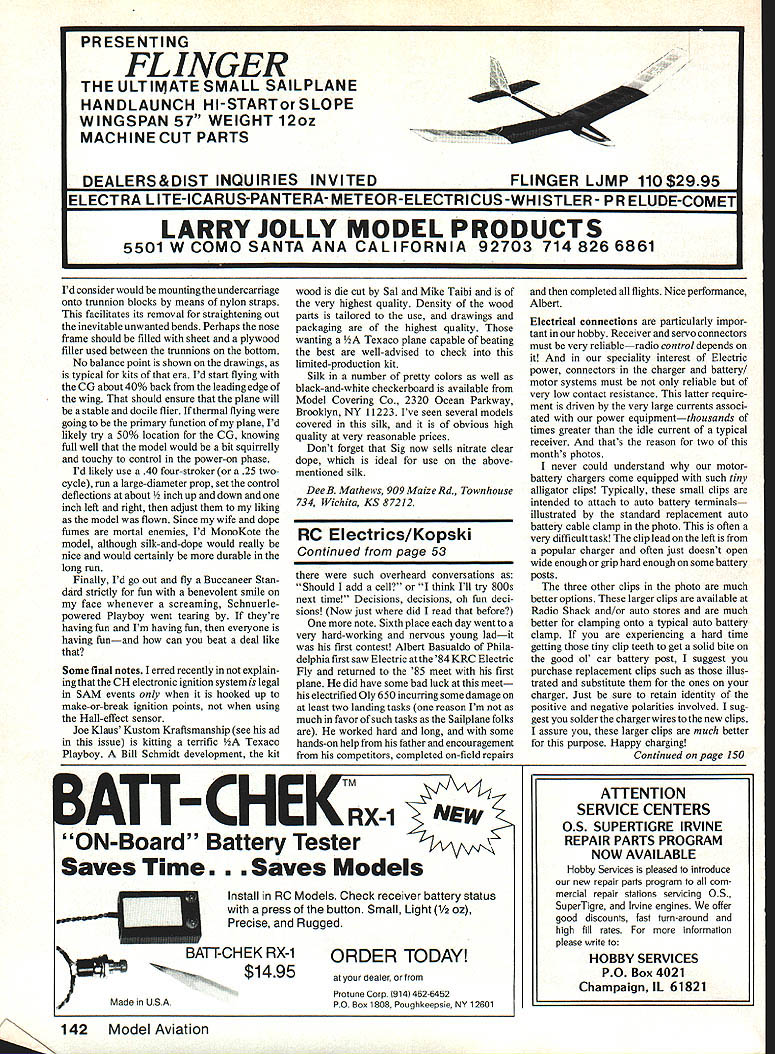
My selection of the Buccaneer Standard for this month was motivated by the story sent in by Donald Koenitzer of Eagle River, WI. In its way, it illustrates what Old-Timer RC-Assist is all about. Donald sent us the photos and the following letter:
"The enclosed pictures were taken back in 1938 when I was 14 years old. The Standard was powered with a Brown Jr. engine. I had well over 100 flights with the model—and a lot of exercise. I figured that since a 14‑year‑old boy could build this Free Flight model successfully, a much older, more mature fellow could successfully add three RC channels and fly it again—without the exercise.
"After a dozen letters and some six months of investigation (Obviously, Donald wasn't reading my column at that time, Doc.), I located a set of plans from John Pond Plans Service (P.O. Box 90310, San Jose, CA 95109, Doc.). I built the Standard this last winter following the plans exactly—except for adding rudder, elevator, and throttle.
"I used an OS .40RC, which proved to be more than adequate. (You'd better believe it! Doc.) With this much power, it practically climbs straight up, so I usually throttle back to about 1/4-throttle and putt around most realistically. I am very pleased with the Buccaneer Standard and find it a beautifully-flying airplane."
I find this letter most interesting not only from the nostalgia standpoint, but also because it points out several of the stumbling blocks I repeatedly find in letters I receive from builders who are into RC Old-Timers for the first time.
Power Recommendations
It's been said that a model-magazine columnist should repeat his material every few years, since a new batch of readers haven't had the opportunity to read what he wrote before. That seems to be true, and perhaps at the expense of boring some of our longtime readers, I'm going to start repeating myself.
First and foremost, the use of a .40-size two-stroke glow engine on a design with only 700 sq. in. of wing area is bad news! My recommendation has always been to use 275 sq. in. of wing area (or even more) for every .10 cu. in. of engine displacement you're going to use. In Donald's case with the Buccaneer Standard and its rather weak wing, even a .25-cu.-in. engine might be too much.
SAM's competition rule of 225 sq. in. for every .10 cu. in. is for a model that climbs and flies very fast. For general sport flying, it is just way too much power. My suggestion has been to keep the power down and enjoy Old-Timers in the manner they fly best.
When using a four-cycle power plant, particularly the second-generation ones, use 75% of the displacement to calculate the displacement of a similar-power two-cycle. That is, a .40 four-cycle is close (in power) to a .30 two-cycle. Spark-ignition engines (either originals or reproductions) should be used on a basic one-to-one ratio, but remember that technological progress has a bearing on the situation, too. Let's face it: a Brown Jr. and a McCoy may both be .60-cu.-in. displacement engines, but they are not alike in power.
Structural Considerations
Another frequent problem with Old-Timers is the wing structure. Many of them were none too sound structurally when they were Free Flighters. Add the RC gear and a few tight turns and loops, and they are much too weak.
My pet technique for overcoming this is to substitute spruce-grain spars for the original bass and add vertical-grain shear webbing. I frequently add rear double spars, also, particularly on a wing like that of the Buccaneer Standard.
Fuselage structures are usually strong enough as designed, since the old spark-ignition engines were vibration-prone and needed beefy frames. Interestingly enough, modern radio equipment doesn't weigh a great deal more than the old spark-ignition coil and batteries.
Another factor to consider is the covering material. Modern heat-shrink coverings just don't add the rigidity to the structure that silkspan and dope or tissue and dope did. Therefore, the old silkspan and dope (or tissue and dope) is to be preferred for structure where possible. I would be remiss if I failed to mention that all heat-shrinks are not equal, however.
Specifically, the Buccaneer Standard, if I were doing it, would have:
- 3/4 x 1-1/2 spruce spars in the front and rear with 3/32" vertical-grain shear webs between the front spars.
- A 1 x 1 trailing edge, double ribs at the center section, and sheeting on the top and bottom of the center section.
- A second spar of 1/4 x 1/4 at the obvious hinge line with small scraps of the same material added to the insides of the hinge points so the hinges could get a full 1/2" of bite.
Otherwise, the empennage should be fine.
Fuselage, Undercarriage, and Controls
As far as fuselage changes go, the only thing I'd do is to add a little more nose structure to protect the engine bearers. The control system should be as light and simple as possible—two or three functions only.
I'd consider mounting the undercarriage onto trunnion blocks by means of nylon straps. This facilitates its removal for straightening out the inevitable unwanted bends. Perhaps the nose frame should be filled with sheet and a plywood filler used between the trunnions on the bottom.
No balance point is shown on the drawings, as is typical for kits of that era. I'd start flying with the C.G. about 40% back from the leading edge of the wing. That should ensure that the plane will be a stable and docile flier. If thermal flying were going to be the primary function of my plane, I'd likely try a 50% location for the C.G., knowing full well that the model would be a bit squirrelly and touchy to control in the power-on phase.
I'd likely use a .40 four-stroke (or a .25 two-cycle), run a large-diameter prop, set the control deflections at about 1/2" up and down and 1" left and right, then adjust them to my liking as the model was flown. Since my wife and dope fumes are not mortal enemies, I'd MonoKote the model, although silk-and-dope would really be nice and would certainly be more durable in the long run.
Enjoyment and Perspective
Finally, I'd go out and fly a Buccaneer Standard strictly for fun with a benevolent smile on my face whenever a screaming, Schnuerle-powered Playboy went tearing by. If they're having fun and I'm having fun, then everyone is having fun—and how can you beat a deal like that?
Some final notes. I referred recently to the C1 electronic ignition system: it is legal in SAM events only when it is hooked up to make-or-break ignition points, not when using the Hall-effect sensor.
Equipment and Supplies
Joe Klaus' Kustom Kraftsmanship (see his ad in this issue) is building a terrific 1/2A Texaco Playboy. A Bill Schmidt development, the kit wood is die cut by Sal and Mike Taibi and is of the very highest quality. Density of the wood parts is tailored to the use, and drawings and packaging are of the highest quality. Those wanting a 1/2A Texaco plane capable of beating the best are well-advised to check into this limited-production kit.
Silk in a number of pretty colors as well as black-and-white checkerboard is available from Model Covering Co., 230 Ocean Parkway, Brooklyn, NY 11223. I've seen several models covered in this silk, and it is of obvious high quality at very reasonable prices.
Don't forget that Sig now sells nitrile clear dope, which is ideal for use on the above-mentioned silk.
D. B. Mathews 909 Maize Rd., Townhouse 734 Wichita, KS 67212
Transcribed from original scans by AI. Minor OCR errors may remain.

