
Radio Control: Old-Timers
Dr. D. B. Mathews
Hollinger's Nomad
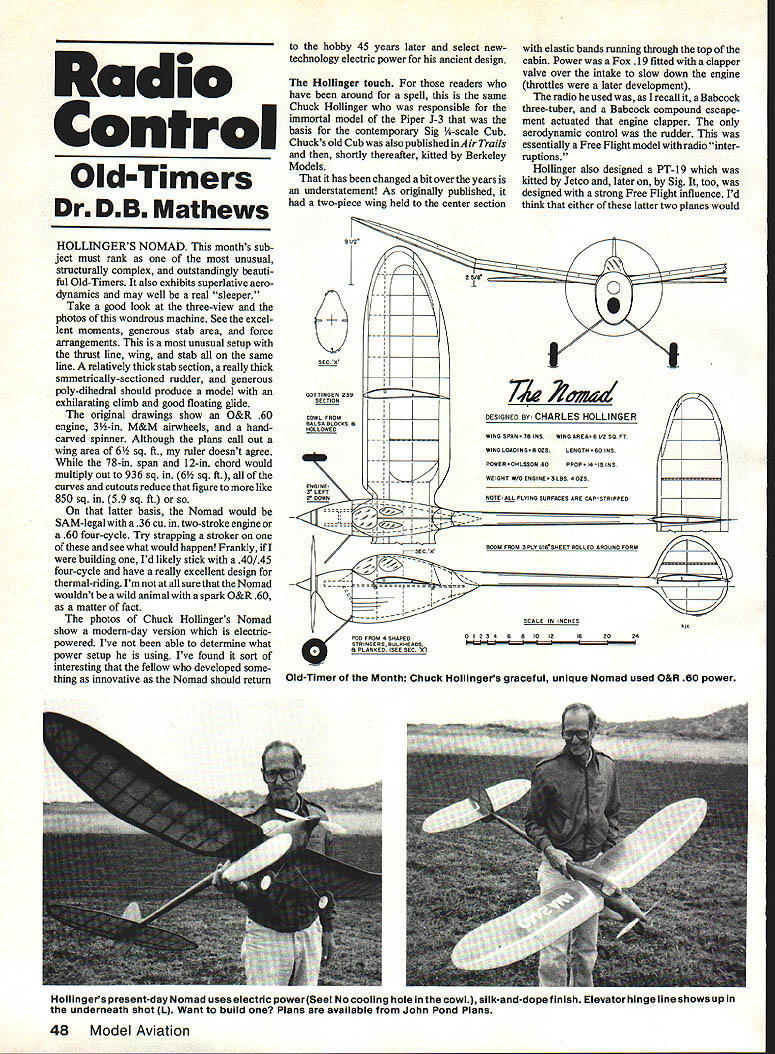
Hollinger's Nomad must rank as one of the most unusual, structurally complex, and outstandingly beautiful Old-Timers. It also exhibits superlative aerodynamics and may well be a real "sleeper." Take a good look at the three-view and the photos of this wondrous machine. Note the excellent moments, generous stab area, and force arrangements. This is a most unusual setup with the thrust line, wing and stab all on the same line. A relatively thick stab section, a really thick symmetrically-sectioned rudder, and generous poly-dihedral should produce a model with an exhilarating climb and a good, floating glide.
The original drawings show an O&R .60 engine, 3-1/2-in. M&M airwheels, and a hand-carved spinner. Although the plans call out a wing area of 6 sq. ft., my ruler doesn't agree. While the 78-in. span and 12-in. chord would multiply out to 936 sq. in. (6-1/2 sq. ft.), all of the curves and cutouts reduce that figure to more like 850 sq. in. (5.9 sq. ft.). On that latter basis, the Nomad would be SAM-legal with a 36 cu. in. two-stroke engine or a .60 four-cycle. Try strapping a stroker on one of these and see what would happen! Frankly, if I were building one, I'd likely stick with a .40/.45 four-cycle and have a really excellent design for thermal-riding. I'm not at all sure that the Nomad wouldn't be a wild animal with a spark O&R .60, as a matter of fact.
The photos of Chuck Hollinger's Nomad show a modern-day version which is electric-powered. I've not been able to determine what power setup he is using. I find it interesting that the fellow who developed something as innovative as the Nomad would return to the hobby 45 years later and select new-technology electric power for his ancient design.
The Hollinger touch
For those readers who have been around for a spell, this is the same Chuck Hollinger who was responsible for the immortal model of the Piper J-3 that was the basis for the contemporary Sig 1/2-scale Cub. Chuck's old Cub was also published in Air Trails and then, shortly thereafter, kitted by Berkeley Models.
That it has been changed a bit over the years is an understatement. As originally published, it had a two-piece wing held to the center section with elastic bands running through the top of the cabin. Power was a Fox .19 fitted with a clapper valve over the intake to slow down the engine (throttles were a later development).
The radio he used was, as I recall it, a Babcock three-tube, and a Babcock compound escapement actuated that engine clapper. The only aerodynamic control was the rudder. This was essentially a Free Flight model with radio "interruptions."
Hollinger also designed a PT-19 which was kitted by Jetco and, later on, by Sig. It, too, was designed with a strong Free Flight influence. I'd think that either of these latter two planes would make excellent RC conversions.
Nomad construction
The fuselage is essentially a pod-and-boom. The boom is composed of three layers of 1/8-in. A-grain balsa wrapped over a male mold carved from 1 1/4 x 1 1/4-in. balsa. The pod is developed using formers attached to a crutch, then planked with strips of balsa. The cowl is carved from blocks.
The wing is of rather thin section utilizing a Göttingen 239 airfoil. The framework is a sturdy D-tube with generous trailing edge spars.
All in all, this is a pretty model, well-stressed, and capable of rewarding its builder with something out of the rut. A splendid flying project.
Input to the 1/2A Scale Duration concept
Apparently I have hit some readers' imagination with the concept of a Duration RC Scale event. Judging from the response, the idea has merit and deserves more exploration. Below are two of the more interesting replies I've received.
Response from Glenn Cresens (Baton Rouge, LA)
"For many years, a few would-be Free Flighters with no place to fly have been working on a concept whereby the advantages of modern RC technology could be used for a Duration type of modeling. The basic objective has been to utilize sites unsuitable for traditional Free Flight. Meanwhile, powered Free Flight, once the backbone of aeromodeling, languishes in a sort of purgatory.
"Whatever it's called, RC-Assist, as developed by the Society of Antique Modelers (SAM), is an important modeling concept and deserves to be promoted by organized groups such as the National Free Flight Society (NFFS) and the AMA.
"My research on RC Duration has, I believe, demonstrated three facts:
- Powered Duration flying, antique or modern, is impossible without RC assist in most areas of the country because the necessary space for decent flying sites is not available.
- With RC assist, powered Duration models can be flown safely, and contests can be held on normal RC fields, or in drier areas any other setting.
- RC sport flyers would be interested and would participate in significant numbers if the idea were publicized in the modeling press and suitable kits were readily available."
My only additional comment to Glenn's is to point out that 1/2A Texaco has proven extremely popular.
Response from Bob Langelius (White Plains, NY)
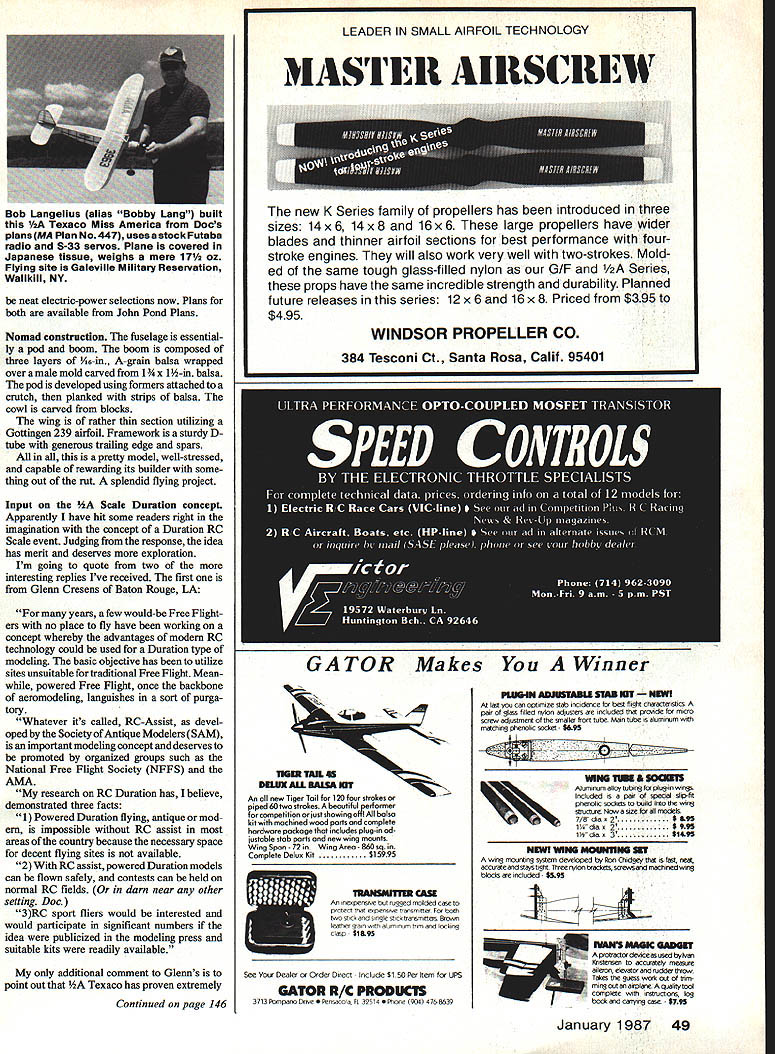
"The event would be terrific, I think, and possibly a real shot in the arm for those of us turned off by the high-powered, 'scary,' SAM-type machines.
"The Miss America in the photo took first place at the Eastern States Free Flight Championships. They run 1/2A Texaco as a fine bridge between the two disciplines."
When I first read Bob's letter and looked at the pictures, the importance of what he is saying sort of escaped me. Then it dawned on me: we have a Free Flight contest that has now included an RC/Assist Duration event. On reflection, that opens up a whole new area for the concept of 1/2A Scale Duration!
Bob has a sideline; he sells Texaco decals and special props. You can correspond with him at: 32 Clinton St., White Plains, NY 10603.
Most of my competition-oriented SAM friends are rather cool to this idea, since there are already so many SAM RC-Assist events that they have overcrowded the frequencies and aren't too wild about adding another event. So, who says that 1/2A Scale Duration needs to be a SAM event?
I'm beginning to lean toward the idea of adding 1/2A Scale Duration as an AMA event to be flown at Free Flight contests. As Bob says, it certainly would bridge the gap between the two disciplines and would almost certainly generate some new interest in Scale.
My sons and I converted rather successfully in Power and Rubber Scale for many years with immeasurable pleasure. However, the idea of putting that much work into a model that has the potential to crash or even worse — be lost in a fly-away — always limited the idea to casual tests, rarely for fun.
Consider, if you will, the potential which exists in enlarging an Earl Stahl or Sidney Stuart design — or reducing one of the large Megow or Comet rubber-powered models. Maybe we could even enlarge a Walt Mooney Peanut or a Don Spruill design! One could build the model with the assurance that it wouldn't be destroyed by a blown rubber motor or fly away on its first flight.
If any readers find this interesting and/or have built anything of this nature, I'd deeply appreciate hearing from them — plus any photos, too, of course.
For those considering developing designs for the 1/2A Scale Duration concept, I'd suggest using the basic 1/2A Texaco parameters:
- About 300 sq. in. wing area.
- A wing loading of about eight ounces per square foot.
- Similar power and weight margins as used in 1/2A Texaco practice.
I doubt if the result would be far off the mark.
I currently have a design built and ready to cover, and I'll report on it in the next column. In the meantime, let's brainstorm together!
Dr. D. B. Mathews 909 Maize Rd., Townhouse 734 Wichita, KS 67212
Transcribed from original scans by AI. Minor OCR errors may remain.

