
Radio Control: Old-Timers
By Dr. D. B. Mathews
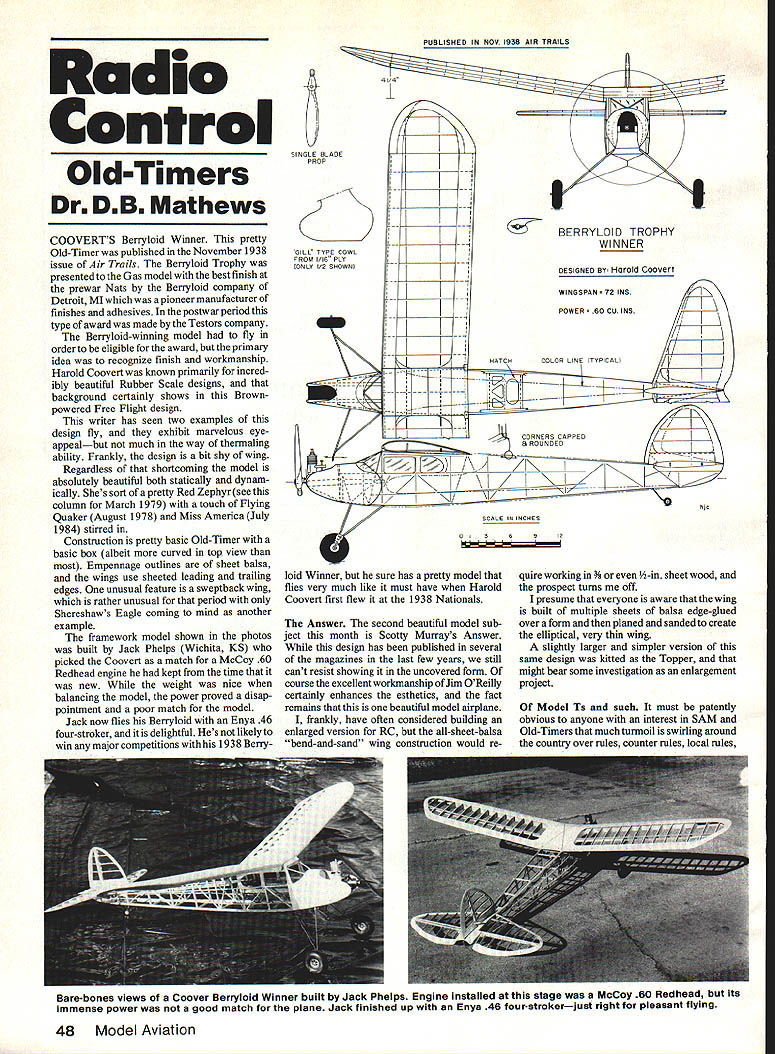
Published in November 1938, Air Trails
Coovert's Berryloid Winner
The Berryloid Trophy was presented to the gas model with the best finish at the prewar Nationals. The Berryloid Company of Detroit, MI, a pioneer manufacturer of finishes and adhesives, sponsored the award; in the postwar period a similar award was made by the Testors Company. The Berryloid-winning model had to fly to be eligible, but the primary idea was to recognize finish and workmanship.
Harold Coovert, known primarily for incredibly beautiful rubber-scale designs, shows that background in this brown-powered free-flight design. I have seen two examples. Both exhibit marvelous eye appeal but are somewhat lacking in thermaling ability — frankly, the design is a bit shy of wing. Regardless of that shortcoming, the model is absolutely beautiful both statically and dynamically. It is reminiscent of a pretty Red Zephyr with touches of Flying Quaker and Miss America.
Construction is basic Old-Timer: a box fuselage with a more curved top view than most, sheet-balsa empennage outlines, and wings with sheeted leading and trailing edges. One unusual feature for the period is the swept-back wing; Schreeshaw's Eagle is another rare example of that layout from the era.
The framework model shown in the photos was built by Jack Phelps of Wichita, KS. He originally paired the Coovert design with a McCoy .60 Redhead engine he had kept from when it was new. While the weight was useful for balancing, the McCoy proved a disappointment and a poor match for the model. Jack now flies his Berryloid with an Enya .46 four-stroker, and it is delightful. He may not win major competitions with his 1938 Berryloid Winner, but he has a very pretty model that flies much as it must have when Harold Coovert first flew it at the 1938 Nationals.
Construction notes:
- Gill-type cowl from 1/16 in. ply only. (1/2 shown.)
- Designer: Harold Coovert
- Wingspan: 72 in.
- Construction notes and plan details as shown.
The Answer
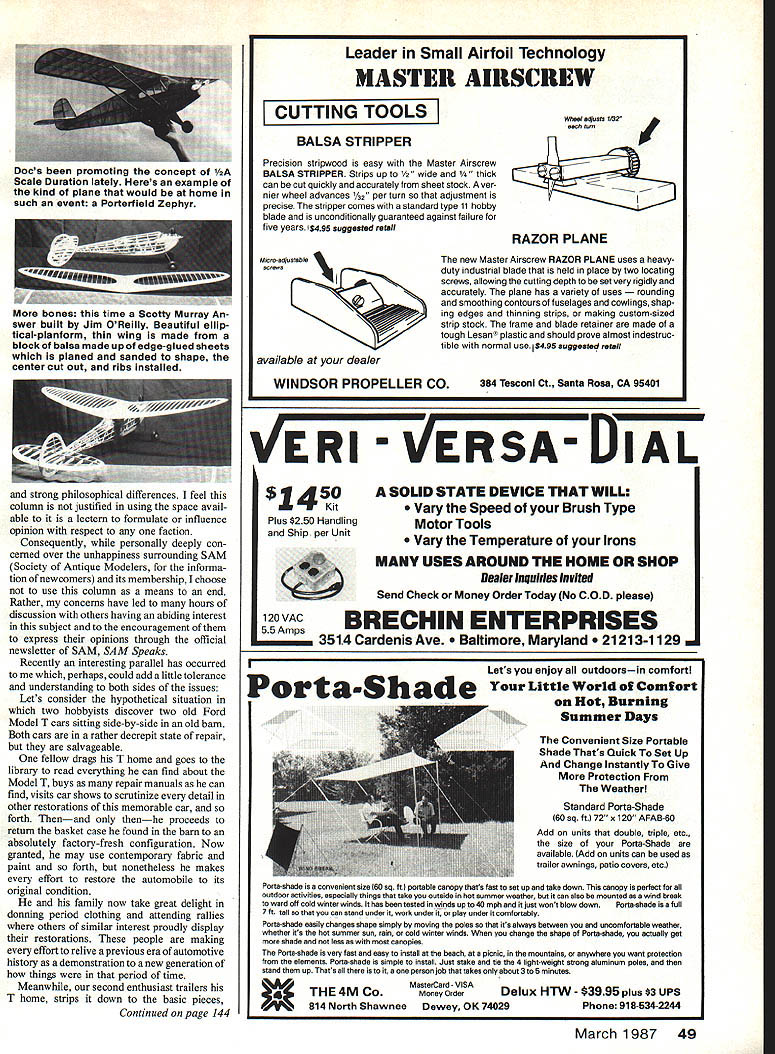
The second beautiful subject this month is Scotty Murray's Answer. Although this design has been published several times in recent years, it remains irresistible in uncovered form. The excellent workmanship of Jim O'Reilly certainly enhances the aesthetics; the fact remains that this is one beautiful model airplane.
I have often considered building an enlarged version for RC, but the all-sheet-balsa "bend-and-sand" wing construction would require working with fairly thick sheet balsa — a prospect that puts me off. The wing is built of multiple sheets of balsa edge-glued over a form and then planed and sanded to create the elliptical, very thin airfoil. A slightly larger and simpler version of this design was kitted as the Topper, which might be worth investigating as an enlargement project.
Of Model T's and Such
It must be obvious to anyone interested in SAM (Society of Antique Modelers) and Old-Timers that there is much turmoil around the country over rules, counter-rules, and local regulations. I am personally deeply concerned about the unhappiness surrounding SAM; newcomers and long-time members alike are affected. These concerns have led to long discussions with others who share an abiding interest in the subject and encouragement to express opinions through the official newsletter, SAM — SAM Speaks.
A recent parallel may add a little tolerance and understanding to both sides. Consider a hypothetical situation: two hobbyists discover two old Ford Model T cars sitting side-by-side in a barn. Both cars are decrepit but repairable. One fellow drags a T home, researches everything he can find about the Model T, buys repair manuals, visits car shows, scrutinizes other restorations, and returns his barn find to an absolutely factory-fresh configuration. He and his family take great delight donning period clothing, attending rallies, and proudly displaying the car.
The other fellow carefully reworks usable parts, installs a large-bore modern V-8, paints the car metallic red, chromes everything that will hold up, and has just as much fun. He and his family enjoy driving their "street rod" to rallies, comparing performance notes, and swapping tales. Both derive satisfaction from their hobby and apply different skills and interests to it.
Is one Model T more fun than the other? Is one inherently superior? Obviously not. It is strictly a personal preference, and nothing should be made of it. If everyone is having fun with their hobby and not harming anyone else, who is to judge?
Unfortunately, we all tend to judge the importance of someone else's activities, and that is where the rub occurs. I don't know if restoration-types and performance-types can always coexist inside the same organization, but I certainly hope they can.
That's all, folks. This column is finally ended; it took longer to write than any other in recent memory.
Dee B. Mathews 909 Maize Rd., Townhouse 734, Wichita, KS 67212
Transcribed from original scans by AI. Minor OCR errors may remain.

