
Radio Control: Old-Timers
D. B. Mathews
Shereshaw's Nimbus
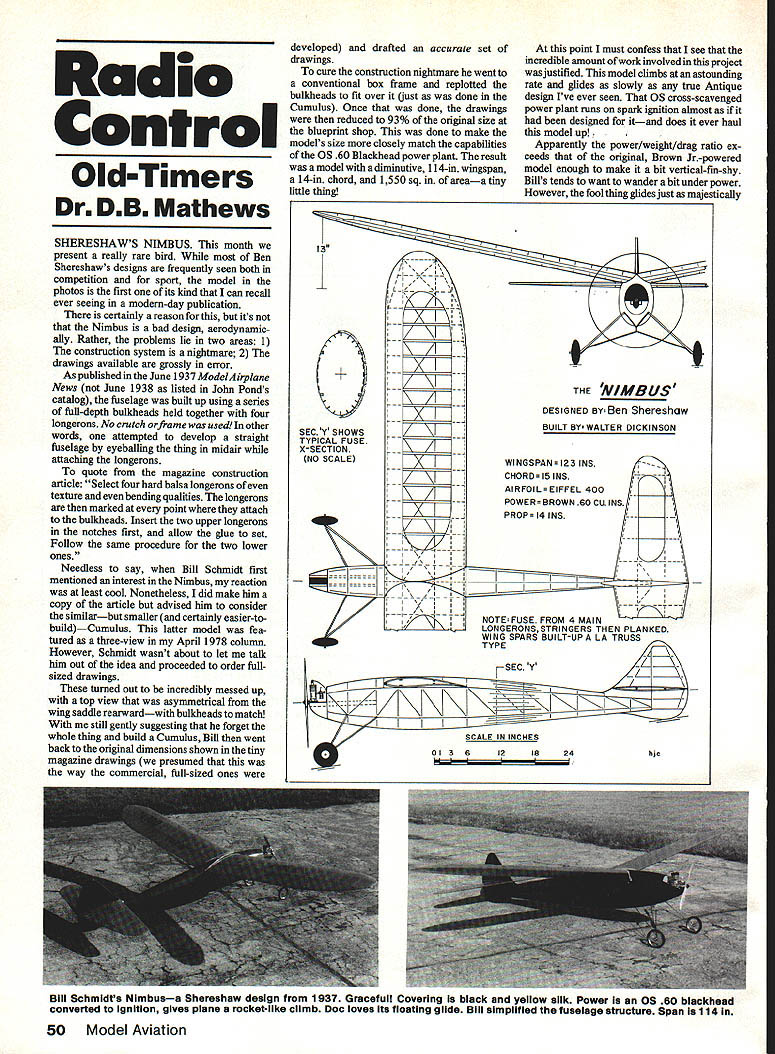
Shereshaw's Nimbus — this month we present a really rare bird. While most of Ben Shereshaw's designs are frequently seen both in competition and for sport, the Nimbus is the first one of its kind that I can recall ever seeing in a modern-day publication. There is certainly a reason for this, but it's not that the Nimbus is a bad design aerodynamically. Rather, the problems lie in two areas:
- The construction system is a nightmare.
- The drawings available are grossly in error.
As published in the June 1937 Model Airplane News (not June 1938 as listed in John Pond's catalog), the fuselage was built up using a series of full-depth bulkheads held together with four longerons. No crutch or frame was used. In other words, one attempted to develop a straight fuselage by eyeballing the thing in midair while attaching the longerons.
The magazine construction article advised: "Select four hard balsa longerons of even texture and even bending qualities. The longerons are then marked at every point where they attach to the bulkheads. Insert the two upper longerons in the notches first and allow the glue to set. Follow the same procedure for the two lower ones."
Needless to say, when Bill Schmidt first mentioned an interest in the Nimbus, my reaction was, to say the least, cool. I did make him a copy of the article but advised him to consider the similar — but smaller (and certainly easier-to-build) — Cumulus, which I had featured as a three-view in my April 1978 column. Schmidt wasn't about to be talked out of the idea and proceeded to order full-sized drawings.
Those drawings turned out to be incredibly messed up, with a top view that was asymmetrical from the wing saddle rearward — and bulkheads to match. Bill then went back to the original dimensions shown in the tiny magazine drawings (presuming that was how the commercial, full-sized ones had been developed) and drafted an accurate set of drawings.
To cure the construction nightmare he adopted a conventional box frame and replotted the bulkheads to fit over it (just as was done in the Cumulus). Once that was done, the drawings were reduced to 93% of the original size at the blueprint shop to better match the capabilities of an OS .60 Blackhead power plant. The result was a model with a 114 in. wingspan, a 14 in. chord, and about 1,550 sq. in. of area — a tiny little thing.
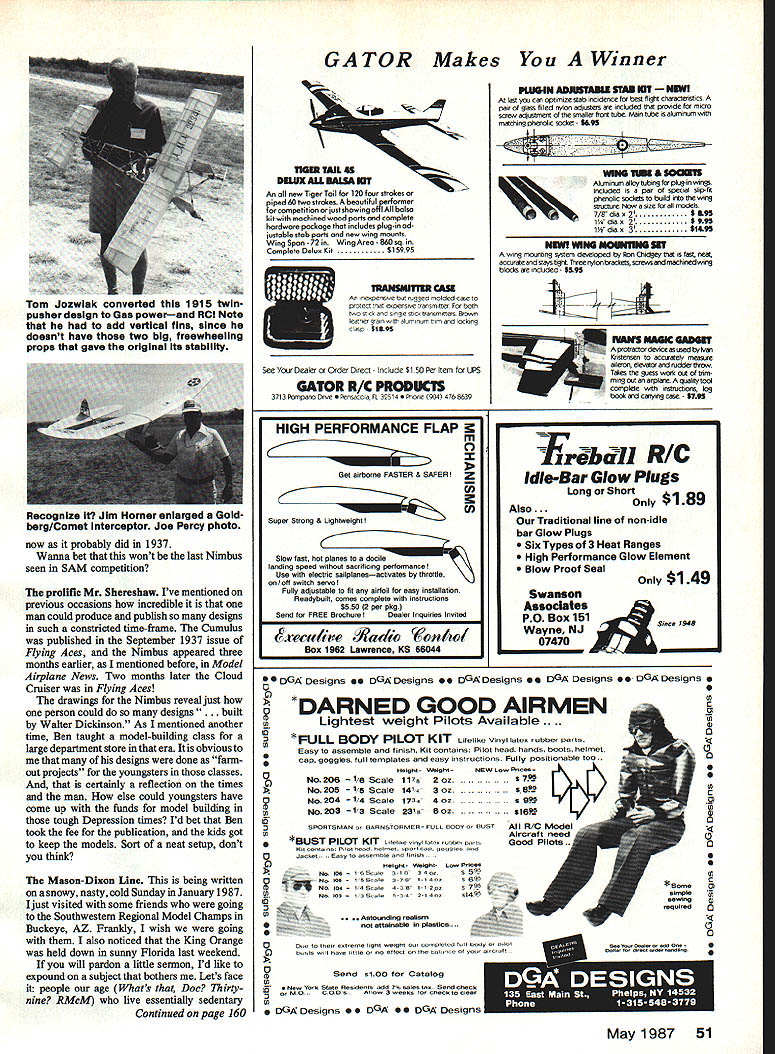
The amount of work was justified. The model climbs at an astounding rate and glides as slowly as any true antique design I've ever seen. The OS cross-scavenged power plant runs on spark ignition almost as if it had been designed for it — and it really hauls the model up. Apparently the power/weight/drag ratio exceeds that of the original Brown Jr.–powered model enough to make it a bit vertical-fin-shy: Bill's tends to want to wander a bit under power. However, the thing glides just as majestically. Wanna bet this won't be the last Nimbus seen in SAM competition?
Motor Pod and Structural Notes
I finally reached the point where I attached the pod to the fuselage with a tongue-and-groove arrangement as a friction slip-joint with screw-adjusted tightness. This allowed the entire pod assembly to pull free from the fuselage if needed, which put the motor/pod in a "flailing-about" mode constrained only by the motor wires; it did put a stop to continuing structural destruction.
The only reasons the motors were on the pod in the first place were so that I could install a spotlight in the nose where the motor would normally be, and to minimize motor "interfering" with the ground because landing attitude is all but impossible to judge in total darkness. So, unless you have no choice (i.e., some extreme reason) for not installing a motor conventionally, I suggest you don't use electric motors on pods — structurally, they're a pain.
The prolific Mr. Shereshaw
I've mentioned on previous occasions how incredible it is that one man could produce and publish so many designs in such a constricted time frame. The Nimbus appeared in Model Airplane News in June 1937; the Cumulus was published in the September 1937 issue of Flying Aces; and two months after the Nimbus the Cloud Cruiser was in Flying Aces. The drawings for the Nimbus were built by Walter Dickinson, showing just how one person could do so many designs.
Ben taught a model-building class for a large department store in that era. It is obvious that many of his designs were done as "farm-out" projects for the youngsters in those classes. That is certainly a reflection on the times and the man. How else could youngsters have come up with the funds for model building in those tough Depression times? I'd bet Ben took the fee for the publication and the kids got to keep the models. Sort of a neat setup, don't you think?
The Mason-Dixon Line
This is being written on a snowy, nasty, cold Sunday in January 1987. I just visited with some friends who were going to the Southwestern Regional Model Champs in Buckeye, AZ. Frankly, I wish we were going with them. I also noticed that the King Orange was held down in sunny Florida last weekend.
If you will pardon a little sermon: people age. Most of us who live essentially sedentary lives have absolutely no business out flying model airplanes for three or four days in high heat and humidity. A tragic death, such as occurred at last year's SAM Champs, points out only too clearly that such activities are ill-advised. If we were the types who played tennis or jogged regularly, perhaps a lesser hazard would be present. But by the nature of our model-building activities, most of us get little — if any — really strenuous exercise. For such as us to go running around in the sun and heat in the middle of summer chasing model airplanes is truly foolish.
It seems to me that any sort of contest aimed at old folks like us should be placed south of the Mason-Dixon Line in the winter, or north of it in the summer (and the farther north the better). I distinctly recall getting rather alarmed at seeing flushed faces, gross perspiration, shortness of breath, and general fatigue observed at the SAM Champs held in La Junta, CO. We are flirting with disaster if West Texas turns out hot and calm this next July!
Tim Banazak mentioned this concern at the SAM banquet and was put down because, "Having a SAM Champs in the winter months would interfere with school for the young people." What young people? I've never seen a school-age youngster compete in a SAM event. For that matter, most of us don't even have school-age children any more. I just don't think that objection is a valid point.
I'd personally much rather use some vacation time to observe or fly in a SAM Champs held in January in the Sun Belt than to half-kill myself in the heat of summer. How about you?
D. B. Mathews 909 Maize Rd., Townhouse 734, Wichita, KS 67212.
Transcribed from original scans by AI. Minor OCR errors may remain.

