
Radio Control: Old-Timers
Dr. D. B. Mathews
Li'l Misery
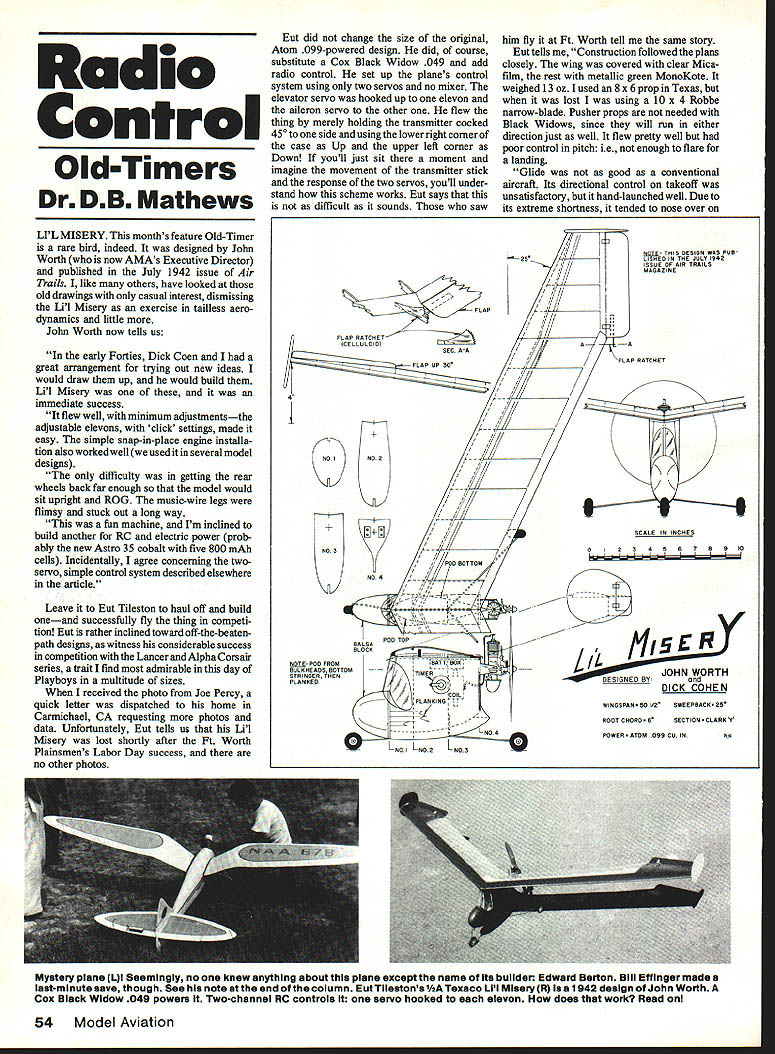
Li'l Misery, this month's featured Old-Timer, is a rare bird. It was designed by John Worth (now AMA's Executive Director) and published in the July 1942 issue of Air Trails. Many of us once dismissed the Li'l Misery as an exercise in tailless aerodynamics, but John Worth reports it was an immediate success when tested in the early Forties.
John Worth: "In the early Forties, Dick Cohen and I had a great arrangement for trying out new ideas. I would draw them up, and he would build them. Li'l Misery was one of these, and it was an immediate success.
"It flew well, with minimum adjustments—the adjustable elevons, with 'click' settings, made it easy. The simple snap-in-place engine installation also worked well (we used it in several model designs).
"The only difficulty was in getting the rear wheels back far enough so that the model would sit upright and ROG. The music-wire legs were flimsy and stuck out a long way.
"This was a fun machine, and I'm inclined to build another for RC and electric power (probably the new Astro 35 cobalt with five 800 mAh cells). Incidentally, I agree with the two-servo, simple control system described elsewhere in the article."
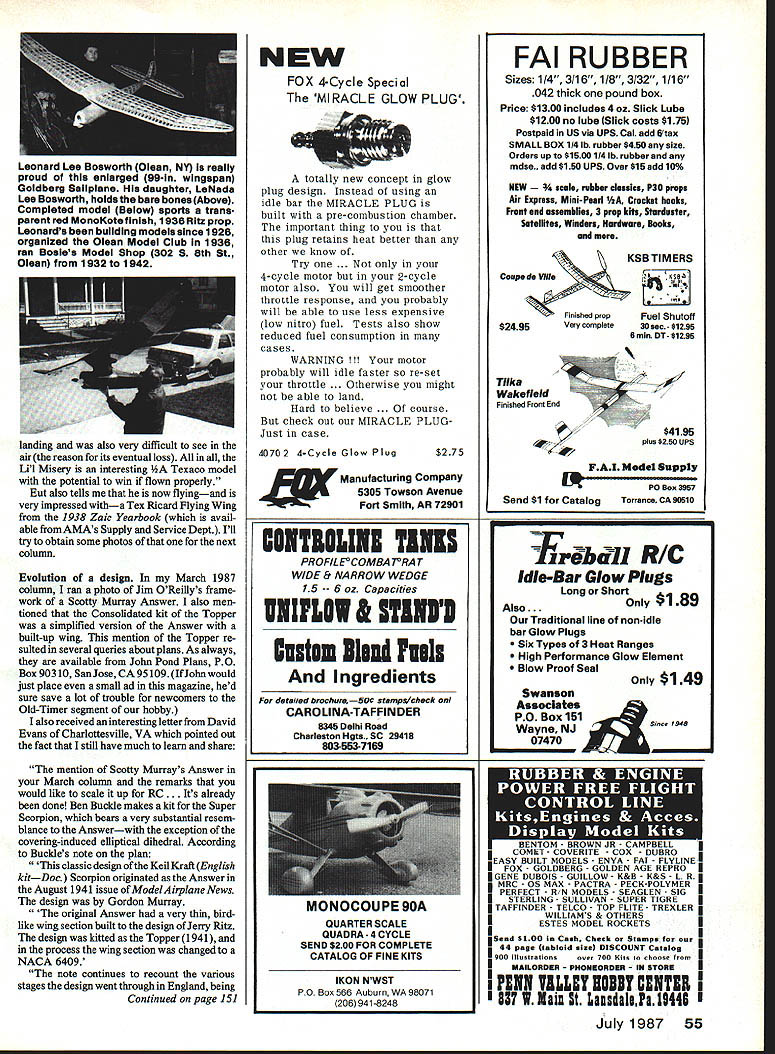
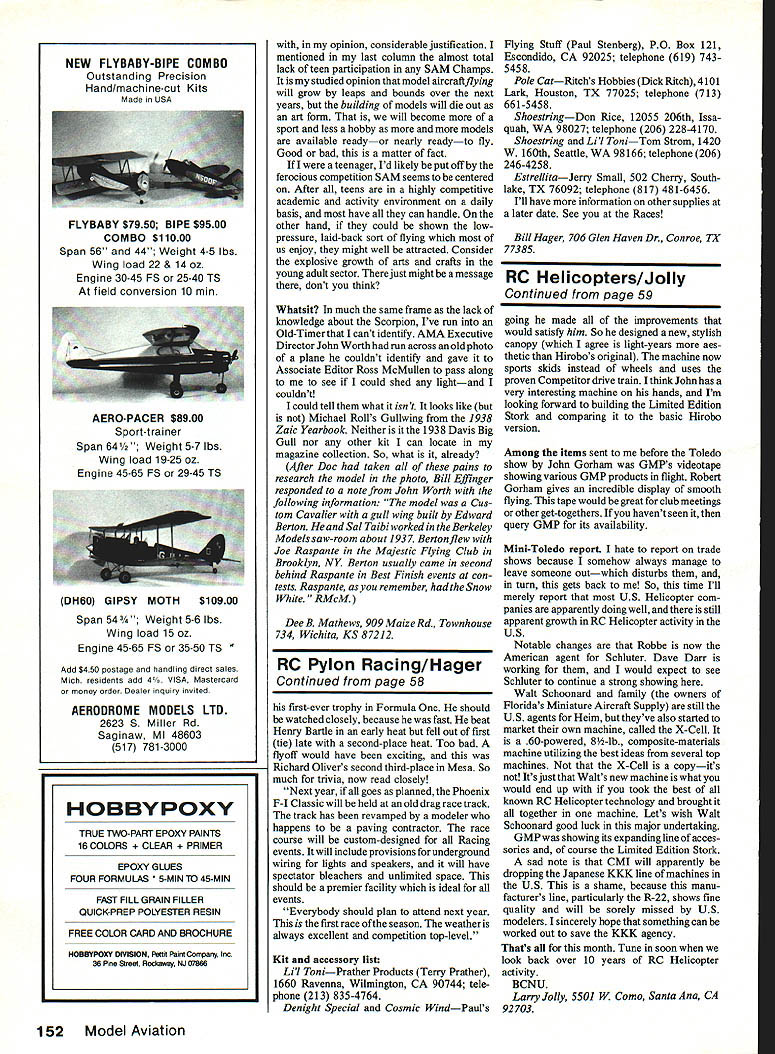
Eut Tileston built a Li'l Misery and successfully flew it in competition. Eut tends toward off-the-beaten-path designs (Lancer and Alpha Corsair series) and had good contest success.
Eut's Li'l Misery details:
- Size: same as original Atom .099 design (Eut substituted engines but kept size).
- Engine: Cox Black Widow .049 (can run either direction).
- Weight: 13 oz.
- Covering: wing—clear Micafilm; rest—metallic green MonoKote.
- Props used: 8×6 in Texas; later a 10×4 Robbe narrow-blade when lost.
- Control: two-servos, no mixer. One servo operated one elevon, the other operated the other elevon. Eut flew by holding the transmitter cocked 45° to one side, using the lower-right corner of the case as Up and the upper-left corner as Down—once visualized, the stick-to-servo response is straightforward.
- Performance notes:
- Flew pretty well but had poor pitch control—insufficient flare for landing.
- Glide not as good as a conventional aircraft.
- Directional control on takeoff was unsatisfactory; it hand-launched well but tended to nose over on takeoff due to extreme shortness.
- Landing was hard to see in the air (contributed to its eventual loss).
Unfortunately, Eut's Li'l Misery was lost shortly after the Ft. Worth Plainsmen's Labor Day event, and no additional photos are available.
Eut also reports he is now flying—and impressed with—a Tex Ricard Flying Wing from the 1938 Zaic Yearbook (available from AMA's Supply and Service Dept.). Photos may appear in a future column.
Evolution of a design
In my March 1987 column I ran a photo of Jim O'Reilly's framework of a Scotty Murray Answer and mentioned that the Consolidated kit of the Topper was a simplified version of the Answer with a built-up wing. That mention prompted queries about plans; plans are available from John Pond Plans, P.O. Box 90310, San Jose, CA 95109. If John would place a small ad in this magazine, it would help newcomers to the Old-Timer segment.
A letter from David Evans (Charlottesville, VA) pointed out that scaling Scotty Murray's Answer up for R/C has already been done: Ben Buckle makes a kit for the Super Scorpion, which closely resembles the Answer (except for the covering-induced elliptical dihedral). From Buckle's kit note: "This classic design of the Keil Kraft (English) kit—Doc. Scorpion originated as the Answer in the August 1941 issue of Model Airplane News. The design was by Gordon Murray."
Design history and notes:
- The original Answer had a very thin, birdlike wing section by Jerry Ritz.
- The design was later altered by Topper (1941), changing the wing to a NACA 4409.
- Postwar kit versions in England evolved into the Scorpion.
- Ben Buckle's Super Scorpion is available in a version that simplifies the difficult wing construction and sizes for .25–.32 two-stroke engines or .30–.40 four-strokes. Span ≈ 66 in.
I'd welcome comments from builders who have used Ben Buckle kits.
A lament to lost skills
David Evans' letter also reflects a broader concern: the decline of model-building skills among younger hobbyists. Many of us came to model aviation through Comet and Guillows rubber kits, which ease the transition to stick-built Old-Timers. That pathway may be fading as the hobby becomes more of a ready-to-fly sport.
Some thoughts and practical advice for scratch-builders:
- Scale airfoil vs. flat-bottom:
- Maintaining a true airfoil on fabric-covered wings can be compromised by fabric sag between ribs.
- Scale airfoils are often used for appearance and may have more flight impact on larger models.
- Engine and prop selection:
- If in doubt about engine size, choose the larger displacement to allow larger-diameter props.
- Larger, slower-turning props tend to be more efficient, quieter, and may reduce fuel consumption.
- We've had no overheating problems from large, slow-turning props; overheating is more often due to a lean needle setting or poor ventilation.
- Weight and balance:
- Building a fuselage to meet low weight targets becomes easier as model size increases; small models suffer most from high wing loading.
- Avoid overbuilding the fuselage for strength—after a bad landing, heavy fuselages have larger pieces to repair.
- Use light balsa aft and thin fuselage sides to help place the center of gravity around 25% of the wing chord for initial flights.
- Early estimates of total weight and nose/tail moments assist in material selection.
Correspondence: Bob and Dolly Wischer, S-221 Lapham Pearl Rd., Delafield, WI 53018.
Whatsit?
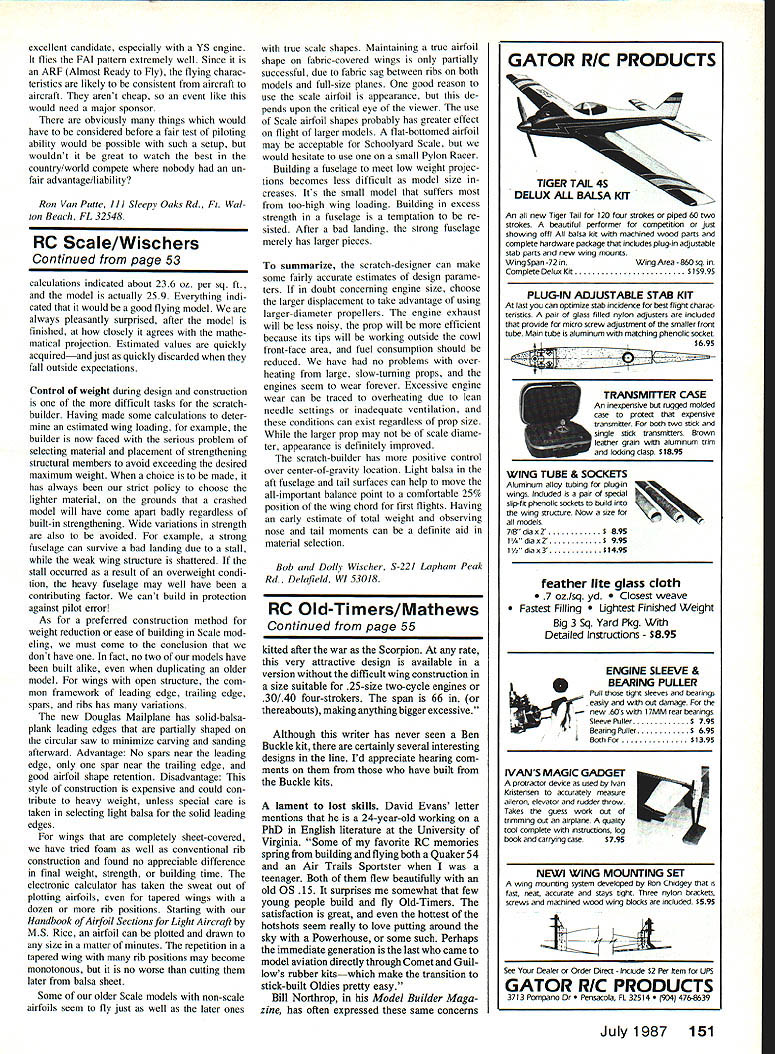
I was sent a photo of an Old-Timer that I couldn't identify. It looked like, but was not, Michael Roll's gullwing from the 1938 Zaic Yearbook; nor was it the 1938 Davis Big Gull or any kit I could find.
After further research, Bill Effinger responded to John Worth with the identification: the model was a Custom Cavalier with a gull wing built by Edward Berton. Berton and Sal Taibi worked in the Berkeley Models' war-room about 1937. Berton flew with Joe Raspante in the Majestic Flying Club in Brooklyn, NY, and often placed second behind Raspante in Best Finish events. (RMcM)
D.B. Mathews, 909 Maize Rd., Townhouse 734, Wichita, KS 67212.
Transcribed from original scans by AI. Minor OCR errors may remain.

