
Radio Control: Old-Timers
Dr. D.B. Mathews
SPOOK
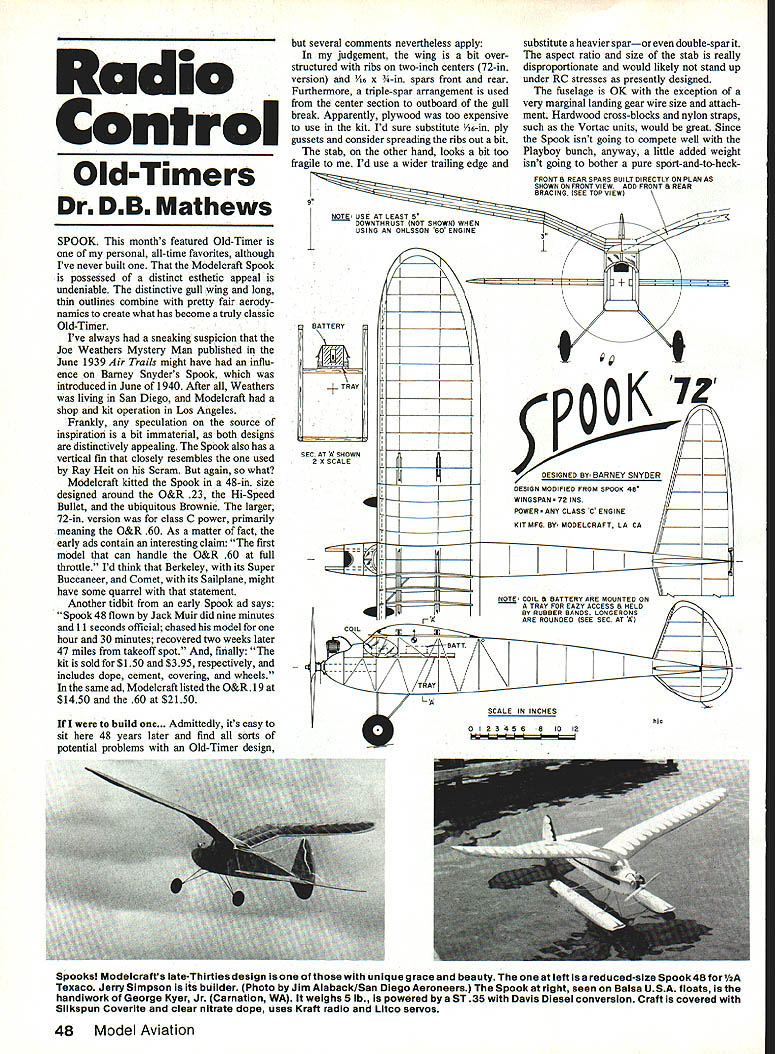
This month's featured Old‑Timer is one of my personal all‑time favorites, although I've never built one. The Modelcraft Spook has an undeniable aesthetic appeal. Its distinctive gull wing and long, thin outlines combine with pretty fair aerodynamics to create what has become a truly classic Old‑Timer.
I've always suspected that the Joe Weathers "Mystery Man" published in the June 1939 Air Trails might have influenced Barney Snyder's Spook, introduced in June 1940. After all, Weathers was in San Diego and Modelcraft had a shop and kit operation in Los Angeles. Any speculation on the source of inspiration is immaterial, though—both designs are distinctively appealing. The Spook also has a vertical fin that closely resembles the one Ray Heit used on his Scram.
Modelcraft kitted the Spook in two sizes:
- 48 in., designed around the O&R .23 Hi‑Speed Bullet and the ubiquitous Brownie.
- 72 in., for Class C power, primarily the O&R .60.
Early advertising contained some interesting claims and tidbits:
- "The first model that can handle the O&R .60 at full throttle." (A provocative claim—Berkeley and Comet might quarrel.)
- "Spook 48 flown by Jack Muir did nine minutes and 11 seconds official; chased his model for one hour and 30 minutes; recovered two weeks later 47 miles from takeoff spot."
- The kit was sold for $1.50 and $3.95, respectively, and "includes dope, cement, covering, and wheels."
- The same ad listed the O&R .19 at $1.50 and the .60 at $21.50.
If I were to build one, a few changes would be in order. Admittedly, it's easy 48 years later to find potential problems with an Old‑Timer design, but several comments apply:
- Wing: The wing seems over‑structured. In the 72‑in. version ribs were on 2‑in. centers with 3/16 x 3/8‑in. spars front and rear, plus a triple‑spar arrangement from the center section outboard of the gull break. Apparently plywood was too expensive to include in the kit. I would substitute 1/16‑in. ply gussets and consider spreading the ribs out a bit.
- Stabilizer: The stab looks too fragile. Use a wider trailing edge and a heavier spar—or even double‑spar it. The aspect ratio and size of the stab seem disproportionate and might not stand up under RC stresses as presently designed.
- Fuselage and gear: The fuselage is acceptable except for a very marginal landing gear wire size and attachment. Hardwood cross‑blocks and nylon straps (such as Vortac units) would be an improvement. Since the Spook isn't going to compete well with the Playboy bunch anyway, a little added weight won't hurt—it's pure sport. Additional cross bracing in the rear fuselage might also be a good idea.
George Kyer's Spook (shown in one of the photos) is powered by a Supertigre .35 Davis Diesel conversion driving a largish prop—an excellent choice. I'd hate to see one powered by a Schnuerle .40 screamer. Another power plant I'd consider is the inexpensive K&B .20 Sportster; obviously, a .40 four‑stroker would be something else entirely.
Spook plans are available from John Pond. For some reason my kit didn't include patterns for the stab and fin ribs—so build up blanks and block‑sand the airfoil and taper after assembly. All in all, the Modelcraft Spook is a great choice for a fun Old‑Timer with lots of unusual appeal.
I need your material
As always, I need photos of unusual Old‑Timer subjects (please: no Playboys or Bombers). Any input on electric Old‑Timers would be helpful, as would historical goodies. The magazine can successfully reproduce most good color prints as black‑and‑white pictures, so get out your Box Brownies and take some pics of your weird old model.
New products and such
- K&B Sportster .20 and .40: I'm pleased with these engines and the remarkably efficient mufflers that come with them. With the muffler, these engines make little more noise than a four‑stroker—so it can be done.
- Thick cyanoacrylate glues: They speed assembly and fill gaps well—something of a crutch for bad craftsmanship. Two ounces of a thick CA doesn't go as far as the same quantity of a thin one, but for poorly fitting pieces or when a very strong joint is needed, they have a place.
- Fuzzy‑covered Mylar hinge materials (from Lake, Rocket City, and now Sig): These are easy to install, especially in strip stock like we use in Old‑Timers. Cut a slit in the wood, slide in the hinge dry, then flow thin CyA into the seam. They are a bit stiffer than I prefer, but on Old‑Timers control surface loads and inputs are usually low, so any additional battery drain from stiffer hinges is likely insignificant.
Competition and SAM rules
I note with some amusement that another Old‑Timer columnist (in a different publication) challenges us to report on—and take a stand about—the dispute over SAM (Society of Antique Modelers) RC competition rules.
I do not and will not compete any more on a national level, primarily because competition tends to create hostility among otherwise nice people (myself included). To express my personal opinions here would betray the trust of those who confide in me. The intent of this column is not to influence policy but to create interest in a fascinating aspect of our hobby and to chronicle its history.
I hope the warring parties recognize the damage such attitudes are doing and return to the basic function of a recreational activity: to enjoy.
Development work and observations
For the last eight months I've been developing an EL/T (entry‑level trainer), trying to combine Old‑Timer aerodynamic parameters with easier construction techniques of a contemporary design. The skiff revision is currently flying with both an OS .20 four‑stroker and a K&B .20 Sportster two‑stroke. The results of the development flying may be significant for what comes next.
A friend at the flying site recently pointed out some four‑stroker work at the first of the Surpass series, even though it is not advertised as such. He is correct—look at the bubbles on the head covers. High‑lift cams (and similar modifications) have obviously been used. Furthermore, switching between engines produced virtually no difference in linear velocity of the model's flight. Conclusion: at least in this instance, the .20 four‑stroker is right in there with the .20 two‑stroker.
Dee B. Mathews 909 Maize Rd., Townhouse 734 Wichita, KS 67212
Transcribed from original scans by AI. Minor OCR errors may remain.

