
Radio Control: Old-Timers
Dr. D. B. Mathews
The replica
For the first time ever, this month's Old-Timer is one that has never before been published. It isn't yet SAM‑legal (SAM is the Society of Antique Modelers, an organized national group that promotes building, flying, and competing with Free Flight models designed prior to 1941; some of their present‑day events utilize Radio Control).
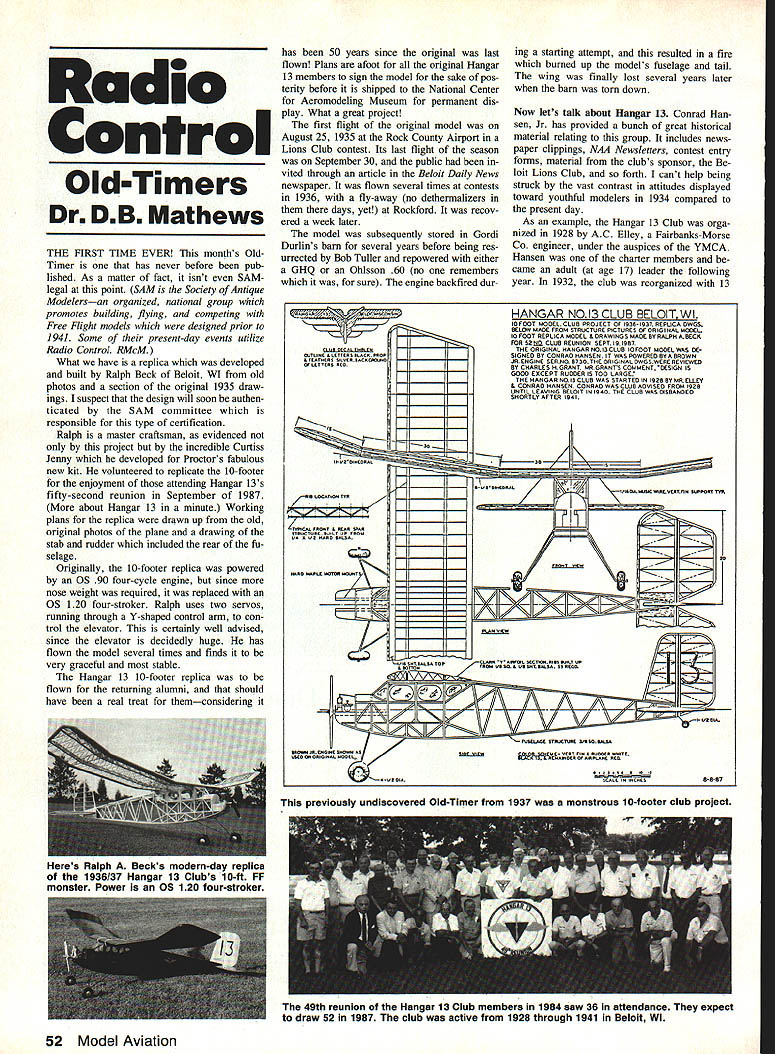
The replica was developed and built by Ralph Beck of Beloit, WI from old photos and a section of the original 1935 drawings. Ralph is a master craftsman, as evidenced not only by this project but by the Curtiss Jenny he developed from Proctor's kit. He volunteered to replicate the 10‑footer for the Hangar 13 fifty‑second reunion in September 1987. Working plans were drawn up from the original photos and a drawing of the stabilizer and rudder, which included the rear fuselage.
Originally the replica was powered by an OS .90 four‑cycle engine, but because more nose weight was required it was replaced with an OS 1.20 four‑stroker. Ralph uses two servos running through a Y‑shaped control arm to operate the elevator—certainly well advised, since the elevator is quite large. He has flown the model several times and finds it very graceful and stable.
The Hangar 13 10‑footer replica was to be flown for returning alumni, a special treat considering it had been 50 years since the original was last flown. Plans were made to have the original Hangar 13 members sign the model for posterity before it is shipped to the National Center for Aeromodelling Museum for permanent display. The design is expected to be authenticated by the SAM committee responsible for certification.
History of the original 10‑footer
- First flight: August 25, 1935, at Rock County Airport during a Lions Club contest.
- Last flight of that season: September 30, 1935; the public had been invited via an article in the Beloit Daily News.
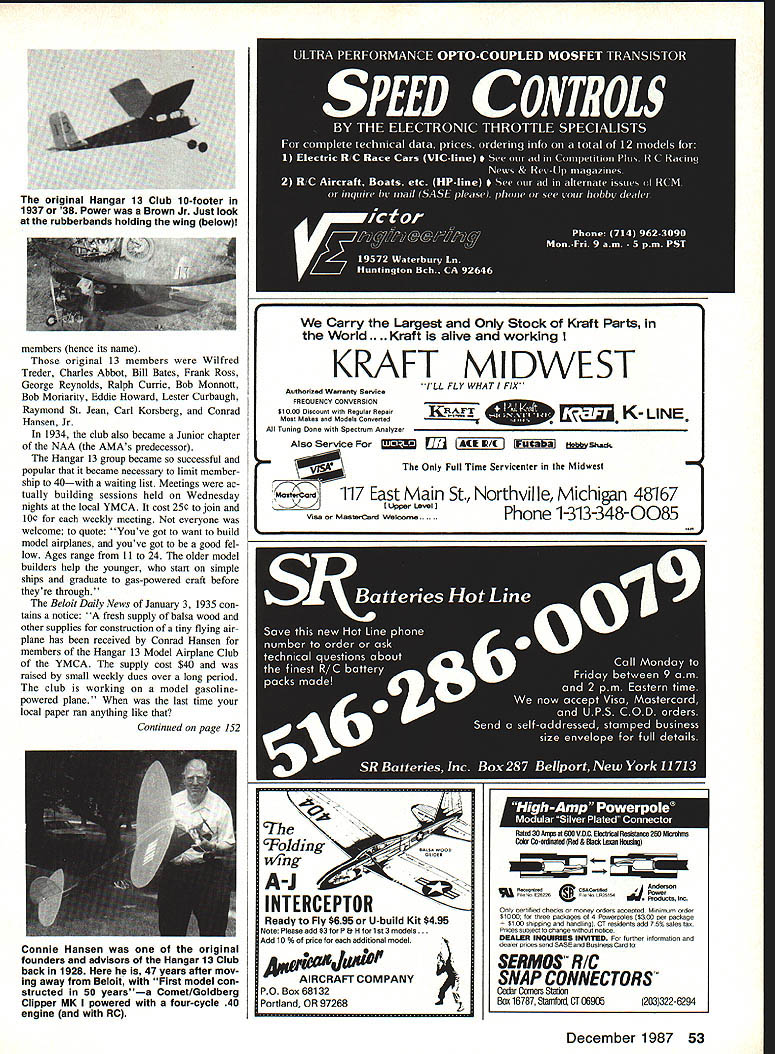
- The model was flown several times in 1936. It experienced a fly‑away at Rockford (no dethermalizers in those days) and was recovered a week later.
- Subsequently stored in Gordi Durlin's barn for several years, the model was resurrected by Bob Tuller and repowered with either a G.H.Q. or an Ohlsson .60 engine (no one recalls which for sure). An engine backfire during a starting attempt caused a fire that burned the fuselage and tail. The wing was finally lost several years later when the barn was torn down.
Hangar 13
Conrad Hansen, Jr. provided extensive historical material relating to Hangar 13, including newspaper clippings, NAA newsletters, contest entry forms, and material from the club's sponsor, the Beloit Lions Club. The documents highlight the contrast between attitudes toward youthful modelers in the 1930s and today.
- Origins and organization:
- The Hangar 13 Club was organized in 1928 by A. C. Elley, a Fairbanks‑Morse engineer, under the auspices of the YMCA.
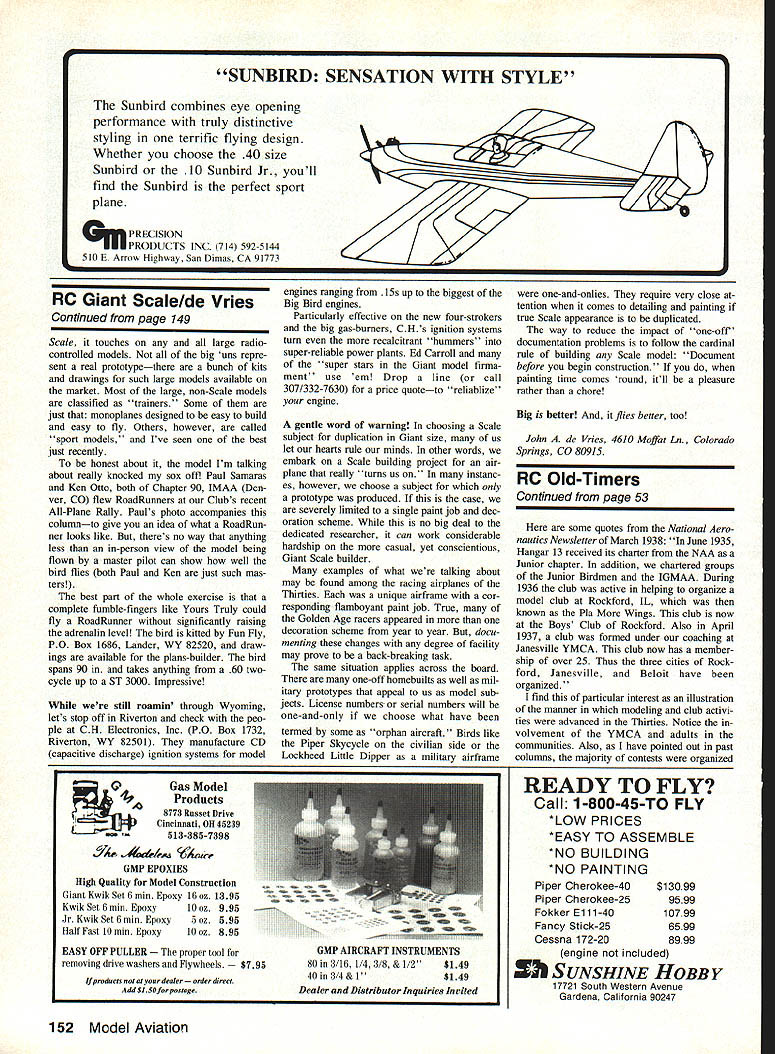
- Conrad Hansen was one of the charter members and became an adult leader at age 17 the following year.
- In 1932 the club was reorganized with 13 members, hence the name Hangar 13.
- The original 13 members were:
- Wilfred Treder
- Charles Abbot
- Bill Bates
- Frank Ross
- George Reynolds
- Ralph Currie
- Bob Monnott
- Bob Moriarity
- Eddie Howard
- Lester Curbaugh
- Raymond St. Jean
- Carl Korsberg
- Conrad Hansen, Jr.
- Activities and growth:
- In 1934 the club became a junior chapter of the NAA (the predecessor of the AMA).
- Hangar 13 became so successful and popular that membership was eventually limited to 40, with a waiting list.
- Meetings were building sessions held on Wednesday nights at the local YMCA. It cost 25¢ to join and 10¢ for each weekly meeting.
- Membership ages ranged from 11 to 24. The older model builders helped the younger ones, who began with simple models and graduated to gas‑powered craft.
- Contemporary notices:
- From the Beloit Daily News, January 3, 1935: "A fresh supply of balsa wood and other supplies for construction of a tiny flying airplane has been received by Conrad Hansen for members of the Hangar 13 Model Airplane Club of the YMCA. The supply cost $40 and was raised by small weekly dues over a long period. The club is working on a model gasoline‑powered plane."
- From the National Aeronautics Newsletter, March 1938:
"In June 1935, Hangar 13 received its charter from the NAAA as a Junior chapter. In addition, we chartered groups of the Junior Birdmen and the I.G.M.A.A. During 1936 the club was active in helping to organize a model club at Rockford, Ill., which was then known as the Pla‑Mor Wings. This club is now at the Boys' Club of Rockford. Also in April 1937, a club was formed under our coaching at Janesville YMCA. This club has a membership of over 25. Thus the three cities of Beloit, Janesville and Rockford have been organized."
Closing observations
The Hangar 13 material illustrates how modeling and club activities were advanced in the 1930s, with strong involvement from the YMCA, civic groups, and adults in the community. Many contests were organized by the Lions Club, the YMCA, and other civic groups rather than by the model clubs themselves. Contests were local affairs that often drew family audiences even when only a few contestants participated.
Transcribed from original scans by AI. Minor OCR errors may remain.

