
Radio Control: Old-Timers
Dr. D.B. Mathews 909 N. Maize Rd., Townhouse 734 Wichita, KS 67212
WHAT SEASON is it, anyway? This column is being written on a 100° afternoon in August 1987, but it is for the February 1988 issue! And the February issue will reach readers just about Christmas 1987. To say it is a bit weird to be wishing readers a joyous holiday season under these circumstances is a definite understatement. But such is the magazine writer's fate.
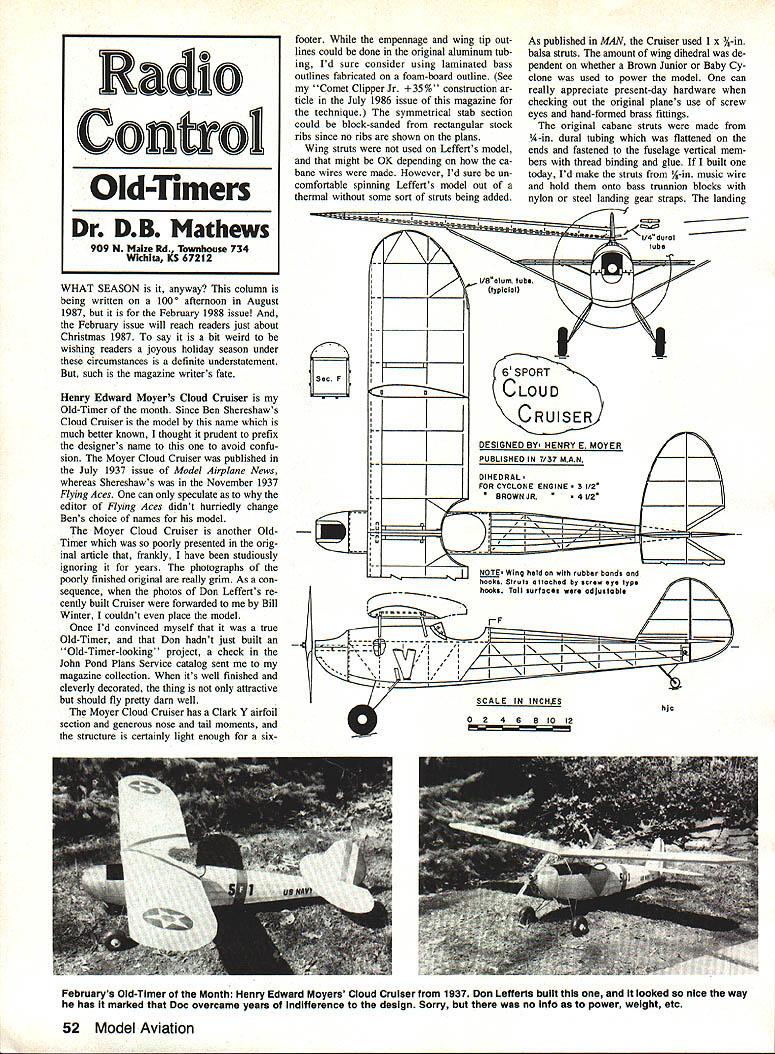
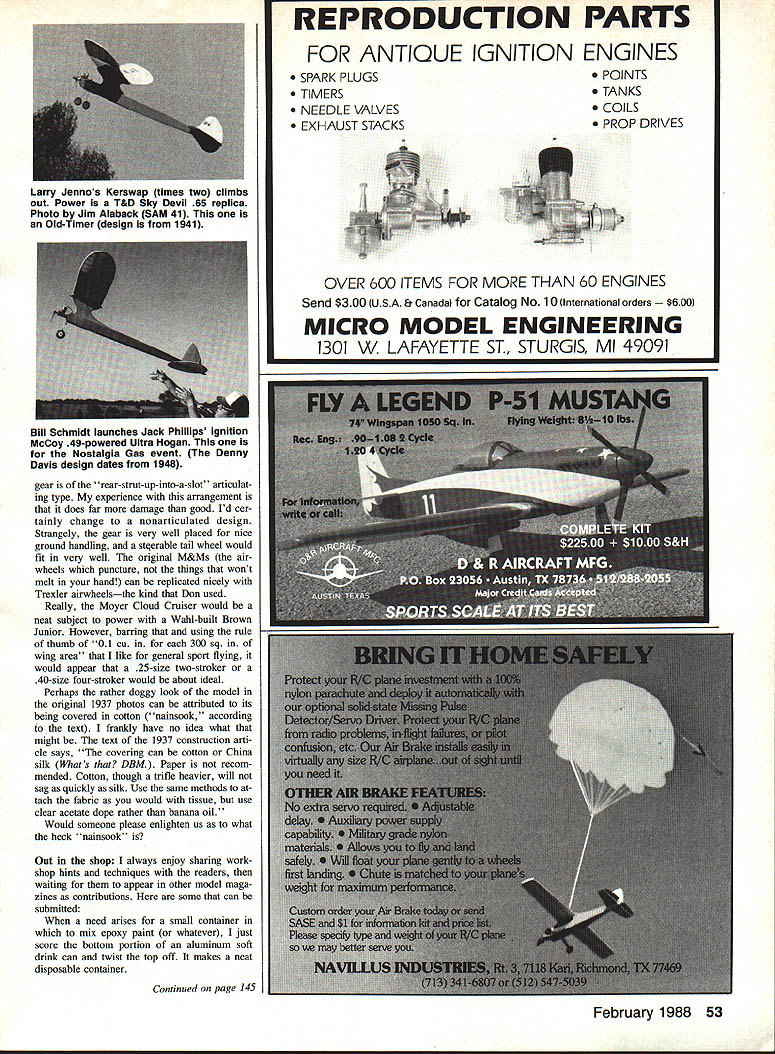
Henry Edward Moyer's Cloud Cruiser is my Old-Timer of the month. Since Ben Shereshaw's Cloud Cruiser is the model by this name that is much better known, I thought it prudent to prefix the designer's name to this one to avoid confusion. The Moyer Cloud Cruiser was published in the July 1937 issue of Model Airplane News, whereas Shereshaw's appeared in the November 1937 Flying Aces. One can only speculate why the editor of Flying Aces didn't hurriedly change Ben's choice of names for his model.
The Moyer Cloud Cruiser is another Old-Timer that was so poorly presented in the original article that, frankly, I have been studiously ignoring it for years. The photographs of the poorly finished original are really grim. As a consequence, when photos of Don Leffert's recently built Cruiser were forwarded to me by Bill Winter, I couldn't even place the model. Once I'd convinced myself that it was a true Old-Timer and that Don hadn't just built an "Old-Timer-looking" project, a check in the John Pond Plans Service catalog sent me to my magazine collection. When it's well finished and cleverly decorated, the thing is not only attractive but should fly pretty darn well.
The Moyer Cloud Cruiser has a Clark Y airfoil section and generous nose and tail moments, and the structure is certainly light enough for a six-footer. While the empennage and wing-tip outlines could be done in the original aluminum tubing, I'd consider using laminated basswood outlines fabricated on a foam-board outline (see my "Comet Clipper Jr. +35%" construction article in the July 1986 issue for the technique). The symmetrical stab section could be block-sanded from rectangular stock since no ribs are shown on the plans. Wing struts were not used on Leffert's model, and that might be OK depending on how the cabane wires were made. However, I'd be uncomfortable spinning Leffert's model out of a thermal without some sort of struts being added.
As published in MAN, the Cruiser used 1 x 3/16-in. balsa struts. The amount of wing dihedral was dependent on whether a Brown Junior or Baby Cyclone engine was used to power the model. One can really appreciate present-day hardware when checking out the original plane's use of screw eyes and hand-formed brass fittings.
The original cabane struts were made from 1/4-in. dural tubing which was flattened on the ends and fastened to the fuselage vertical members with thread binding and glue. If I built one today, I'd make the struts from 5/32-in. music wire and hold them onto bass trunnion blocks with nylon or steel landing-gear straps. The landing gear was a rear-strut-up-into-a-slot articulating type. Experience shows this arrangement does far less damage; I'd certainly change the non-articulated design.
Strangely, the gear was very well placed for nice ground handling. A steerable tail wheel would fit very well. The original M&M airwheels puncture; they won't melt and can be replicated nicely with Trexler airwheels—the kind Don used.
Really, the Moyer Cloud Cruiser would be a neat subject for power. A Wahl-built Brown Junior would be suitable. However, using the rule of thumb of .01 cu. in. per sq. in. of wing area for general sport flying, a 25-size two-stroker or a 40-size four-stroker would be about ideal.
Perhaps the rather doggy look of the model in the original 1937 photos can be attributed to its being covered with cotton nainsook, according to the text. Frankly, I have no idea what that might be. The 1937 construction article says covering can be cotton or China silk. DBM paper recommended cotton; though a trifle heavier, it will sag quickly. For silk, use the same methods that fabric would—treat it like tissue; use clear acetate dope rather than banana oil. Would someone please enlighten us what the heck nainsook is? Our shop always enjoys sharing workshop hints and techniques.
Out in the shop
I always enjoy sharing workshop hints and techniques with readers, then waiting for them to appear in other model magazines as contributions. Here are some that can be submitted:
- When a need arises for a small container in which to mix epoxy, paint (or whatever), score the bottom portion of an aluminum soft-drink can and twist the top off. It makes a neat disposable container.
- To avoid painted fingernails and glue-daubed fingers, use disposable latex examination gloves. They have a good fit with adequate feel and are only about 10¢ a pair. They come in small, medium, and large sizes (to match your dress-glove size) in boxes of 50 or 100, and they are ambidextrous. I don't like vinyl gloves—they're baggy, fit poorly, and dissolve in some commonly used materials.
- Where to get them? Look in your Yellow Pages for "Dental Supplies." They will be glad to sell you the gloves and some of the other things mentioned here. Your money is just as green as a dentist's!
- For many years I've mixed epoxy adhesives on paper mixing pads normally used in a dental office. These come in several paper densities and sizes. My favorites are CDE 6 x 6 in. and Premier 3 x 4 in. Both come in multi-sheet pads with adhesive on the edges. To mix epoxy, do it on top of the pad, use the mix, then tear off the top sheet and dispose of it. You'll pay less than a penny a sheet.
- The neatest mixing spatulas available are tongue depressors. These come in junior (about 1/2-in. wide) and regular (about 3/4-in. wide) sizes. They are sold in boxes of 100 and 500 and are very reasonable in cost. You don't need sterile tongue depressors for this use!
- A small anecdote: when my son Mark was a little kid, he asked me to bring home some "ahhh sticks" for a project. After some head-scratching, I finally asked what an "ahhh stick" might be. He answered, "You know, the stick a doctor puts in your mouth and you say 'AHHH!'"
Spook revisited
I've had a surprising amount of mail seeking a source of plans for the Spook as featured in my September 1987 column. As always, no one knows John Pond's address since he doesn't advertise in this magazine. Once again: John Pond Plans, P.O. Box 19010, San Jose, CA 95190.
Additionally, Gordon Codding, 3724 John L. Ave., Kingman, AZ 86401, has Spook drawings showing RC conversion. He also has a very long list of plans for other gas and rubber Old-Timers, as well as scale drawings of many designs. He also has one of the best assortments of plans for the wartime and immediate postwar kits I've seen. Send him $3 for a very complete listing. You're bound to find something you've always wanted—and at very reasonable prices, too.
Transcribed from original scans by AI. Minor OCR errors may remain.

