
Radio Control: Old‑Timers
Dr. D. B. Mathews 909 N. Maize Rd., Townhouse 734 Wichita, KS 67212
Anniversary Time
Somehow it's hard to comprehend I've been writing this column since the December 1977 issue — that's over ten years. Reflecting on that span, many readers would appreciate a consolidated listing of the three‑views and the comments about the kits that have appeared over the decade. Looking back also shows how much the scene has changed. Ten years ago only three Old‑Timer kits were available and most models were powered by true antique engines or sport‑type glow engines.
Fortunately, the essential SAM Old‑Timer concept has remained constant: fun. I continue to be delighted with the response to designs that have virtually no contest potential. Readers who get teary‑eyed over Spooks, Buccaneer Standards, and other restorations keep writing and sending photos. The competition groups generally surface only when they want publicity. It appears I’ve developed a following of historians, restorers, and recreators. Keep sending material on odd‑bucket Old‑Timers — another decade of columns will be a breeze!
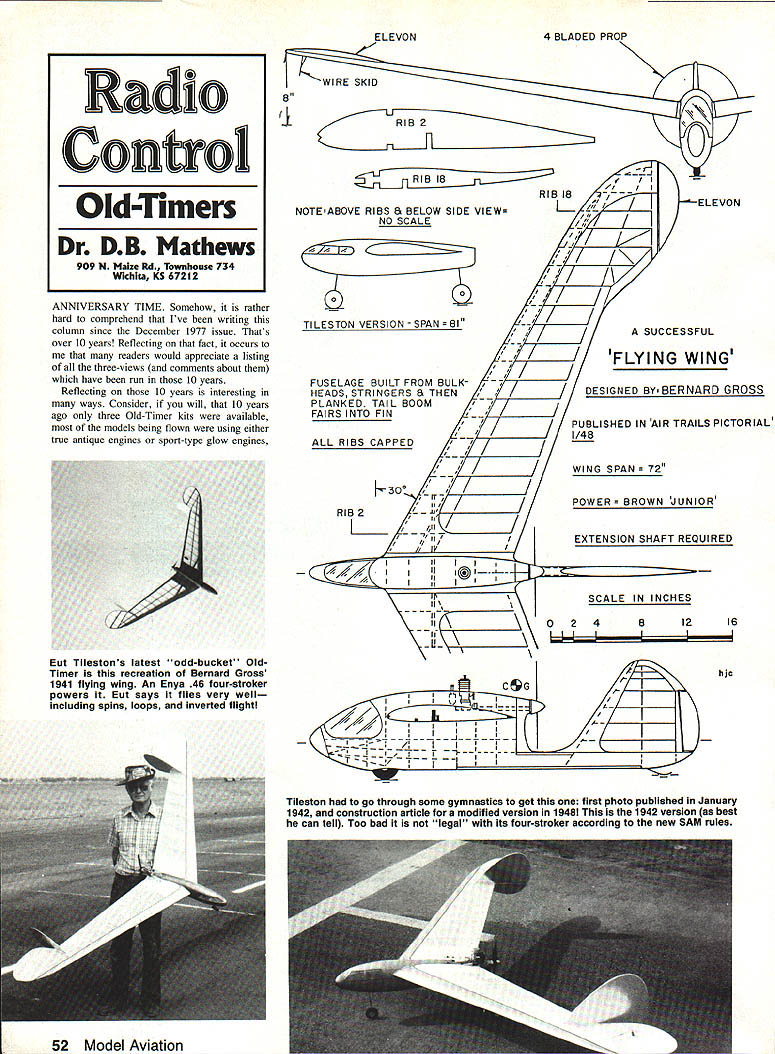
Eut Tileston’s Gross Wing
Background and construction sources
Eut Tileston (Carmichael, CA) previously developed the Lil' Misery (see July 1987). He has now recreated Bernard Gross' 1941 flying wing — simply called the Gross Wing. A photo of the original appears in the January 1942 Air Trails, but the construction article didn't appear until January 1948. The 1948 article altered the design to include a fuselage‑mounted rudder, yet Bernard Gross stated the original 1941 wing was used. Tileston has used the 1942 photo for the fuselage and rudder planform and combined those with the airfoils and outline from the 1948 version. Whether this fully authenticates the configuration is unclear at the time of writing.
Power, dimensions, and materials
- Powerplant: Enya .46 four‑stroke.
- Span: 84 in.
- Wing area: 675 sq. in. (scaled to meet SAM's 225 sq. in. per lb limit).
- Weight as built: about 2½ lb (remarkably light).
Tileston has also pioneered the use of foam and composite construction techniques in Old‑Timers. I cannot be certain whether the Gross Wing's ribs are balsa or foam cuts.
Flight characteristics
- Climb: outstanding.
- Stability: unstable without use of the rudder.
- Spins: this is the first wing Tileston has been able to spin; recovery is normal.
- Inverted flight: very good, perhaps more stable than upright.
- Loops (inside and outside): solid.
- Rolls: very sluggish.
An acrobatic Old‑Timer, indeed.
SAM Rule Changes and Effects
Longtime friend Bill Baker asked me to explain the new SAM rules for RC. My take: the rule changes are still being sorted and there are contradictions — expect lawyers and committees to tinker for at least a year. Below are the major practical effects illustrated by Tileston’s Gross Wing.
- Area/performance scaling: Tileston scaled the wing to 675 sq. in. to meet SAM’s 225 sq. in. per lb limit. If the finished model’s wing loading falls below newly required minimums, it will have to be ballasted.
- Engine classification: under the old rules some four‑stroke engines were classified by a reduced displacement factor (example given: 60% of .46 = .276 cu. in.), which could make an Enya .46 legal under a .30 equivalence. Under the new rules four‑cycle engines are classified according to their full displacement, making many previously acceptable four‑strokes illegal in certain classes (e.g., a .46 would not qualify as a .30).
- Minimum wing loading: new rules require at least 10 oz. per sq. ft. in some contexts; models lighter than that may require ballast.
- Construction materials: the new SAM rules generally outlaw construction materials other than the wood specified on the original plans. This raises paradoxes about modern conveniences: do metal wing‑joiners or molded nylon engine mounts (not shown on original drawings) become illegal? The contradictions are evident.
One must salute Tileston for another gutsy, innovative effort. I maintain he’d be a standout regardless of what he flies or how many rules are passed that seem aimed at him.
Events and Contests
Upcoming events
- 1988 SAM Champs: scheduled for Lawrenceville, IL on July 19–22. For more information contact Don Stachler, RR 5, Box 56B, Bloomfield, IN 47424.
- 1988 AMA Nats: official information will be available in the magazine. Whether unofficial events will include SAM Free Flight and RC is unknown to me. Joe Beshar has notified me he will sponsor his Vintage event at the Nats.
The Vintage event
Vintage attempts to combine Free Flight (FF) and RC in an Old‑Timer format. Key points:
- No size scaling is allowed.
- Design eligibility parameters are the same as those for SAM events.
- Vintage uses different engine/run times for various types of ignition engines.
- The official time is stopped when the flier uses radio after the power run.
It seems this area is often dominated by non‑scale Playboys running Super Tiger P.D.P. ignition engines, with the added “fun” of playing chicken to see who is most willing to risk not getting his model back on the field.
Free Flight vs. Radio — My View
There is a presumption circulating that a special Vintage center or similar programs are needed to introduce Free Flighters to the “advantages” of radio retrieval and to encourage them to add RC to their models and events. That notion is, to me, an insult.
Free Flighters are among the most intelligent and dedicated people in the hobby. They do not need instruction on how to fly their models or live their preferences. Those of us who have aged or for whom retrieval hassles have become excessive have naturally migrated to Old‑Timer RC or RC soaring. Those who continue with pure Free Flight have every right to do so. In this democratic hobby, everyone is free to pursue their own route to happiness so long as they harm no one. Free Flighters are certainly not harming anyone — and they do not need to be “educated.”
Transcribed from original scans by AI. Minor OCR errors may remain.

